WarBrief Live | October 7, 2026 | AI & Future Warfare
Could AI trigger a nuclear war? It is a serious question, and experts at the Bulletin of the Atomic Scientists, the United Nations, and Brookings say it deserves a serious, non-sensational answer. No artificial intelligence has ever launched — or nearly launched — a nuclear weapon. But the AI nuclear war risk is real in a subtler form: AI is entering the systems that warn leaders, inform their decisions, and move at speeds no human can supervise. Here is what is documented, what is theoretical, and where the world is drawing red lines.
Key Takeaways
- The head of US Strategic Command has said AI is conceivably embedded in decision-support systems for nuclear weapons — while stressing a human always makes the final decision.
- Experts warn the danger is not rogue superintelligence but ordinary human fallibility amplified by AI: misread warnings, compressed decision time, and escalation spirals where each side’s AI-driven precautions look like preparations for attack.
- In 2026 war-game experiments, commercial AI models chose nuclear weapons in the vast majority of simulated scenarios — but experts caution the simulation designs themselves may have encouraged escalation.
- No AI system has ever caused a nuclear near-miss. The closest documented incidents involved human-operated automated systems, most famously the 1983 Soviet false alarm defused by Lt. Col. Stanislav Petrov.
- US and Chinese experts published joint proposals in September 2026 for shared red lines — including no AI control over nuclear launches and a military AI incident hotline — but nothing is binding.
Is AI already part of nuclear weapons systems?
Yes, in limited and mostly peripheral roles — and that is where the debate starts. According to the Bulletin of the Atomic Scientists’ 2026 Doomsday Clock statement, AI is already applied to command and control, operational planning, logistics, autonomous systems, cybersecurity, and digital forensics across defense establishments. Critically, the head of US Strategic Command has stated that while a human will always make the final decision on nuclear use, “it is conceivable that AI will be embedded in decision-support systems used for nuclear weapons.”
The Bulletin’s assessment is blunt: “Even if a human is always in the decision loop, a too-heavy dependence on black-box systems could present a serious danger.” This is the automation-bias problem — and it sits alongside the wider problem of AI-assisted cyber operations probing the networks that strategic warning systems depend on. A commander who receives an AI-generated threat assessment under time pressure may defer to the machine’s judgment without interrogating how it reached its conclusion — a failure mode well documented in aviation and medicine, now migrating into the most consequential decisions states make.
That concern is now moving through diplomacy. On September 29, 2026, a high-level UN General Assembly meeting on the total elimination of nuclear weapons heard warning after warning against integrating AI into nuclear systems — amid continued escalatory nuclear rhetoric from Moscow, which keeps the risks of miscalculation firmly in the news: Oman’s representative, speaking for the Arab Group, warned of the risks and stressed “full human control”; Mexico, speaking for the Latin American nuclear-weapon-free zone agency OPANAL, raised AI’s possible uses across the nuclear command, control, and communications (NC3) structure; Costa Rica warned AI “reduces decision making time and increases the risks of miscalculation”; and the Holy See warned of compressed timelines plus new sources of error and opacity. General Assembly President Khalilur Rahman summed it up: AI, cyber capabilities, and advanced delivery systems are “introducing additional uncertainty into command, control and decision-making.” At the same meeting, China renewed its proposal for a no-first-use treaty.
Could AI actually trigger a nuclear war?
The strongest expert analysis says the risk is real but works differently than in the movies. In an October 2026 essay for the Bulletin of the Atomic Scientists, psychologist Paul Slovic and cybersecurity scholar Herbert Lin argue that “today’s AI systems can cause nuclear war even if people nominally remain in charge,” and that “neither extraordinary machine intelligence nor malicious intent is required.”
Their mechanism is human fallibility amplified by machines, and it has several interlocking parts:
- Speed compression. Warnings, images, reports, and interpretations can arrive faster than people can digest them. At June 2026’s Shangri-La Dialogue — where defense leaders reportedly ranked AI as a greater immediate risk than nuclear weapons — Pakistan’s Lt. Gen. Nauman Zakria described how AI shrinks the observe-orient-decide-act (OODA) loop until humans cannot evaluate fast enough: “People will act irrationally, and the actions will be extreme.”
- Poisoned or confusing information. The information reaching leaders “may be false, ambiguous, or accurate” — and even accurate information can be misinterpreted without proper context. AI hallucinations, deepfakes, and decontextualized machine outputs add new sources of error at the worst possible moment.
- The security dilemma at machine speed. Slovic and Lin sketch the escalation spiral: AI correctly detects mobile missile launchers moving; a worried official interprets it as possible attack preparation and raises readiness; the adversary observes the preparations and responds with its own precautions; AI detects those movements, seemingly confirming the initial suspicion. “Each side’s efforts to protect itself make the other feel less secure.” No deception is required — correct reporting, misinterpreted, is enough.
- Erosion of the nuclear taboo. Analysis of the “AI-nuclear nexus” argues that AI’s quantitative risk-benefit calculus, combined with the diffused responsibility of AI-assisted decision-making, may weaken the ethical constraint that has helped prevent nuclear use since 1945.
This is why, on September 25, 2026, USA Today quoted Daniel Holz, founding director of the University of Chicago’s Existential Risk Laboratory and a Doomsday Clock expert, saying the Bulletin’s team has been growing “increasingly alarmed” about AI. Holz was reacting to an employee of a major AI company estimating a 10% chance the technology could wipe out humanity within a decade — an estimate Holz welcomed as a way to force a global conversation, not as a prediction of certainty.
Has AI ever come close to causing a nuclear war?
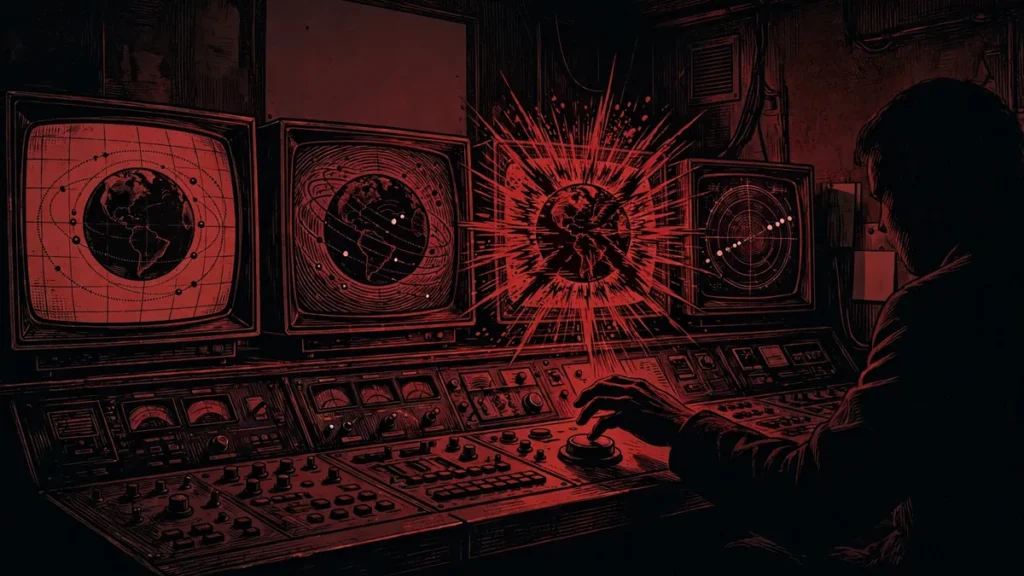
No — and this must be stated plainly, because it is the most important fact in the whole debate. There is no documented case of an AI system causing a nuclear near-miss. The incidents that did nearly happen involved human-operated automated systems, and they are instructive precisely because they show what happens when machines and humans misunderstand each other under pressure.
The most famous is the Soviet false alarm of September 26, 1983. At about 00:15 Moscow time, the Soviet Oko satellite early-warning system reported one, then five, US intercontinental ballistic missiles inbound from Montana to Lt. Col. Stanislav Petrov (1939–2017), the duty officer at the Serpukhov-15 command center. Petrov judged the warning a false alarm: a real US first strike would be all-out, not five missiles; the system was new and, in his view, not yet trustworthy; the message passed through 30 verification layers suspiciously fast; and ground radar showed no corroborating evidence. He reported a system malfunction and waited. He was right: sunlight reflecting off high-altitude clouds over North Dakota, in a rare geometric alignment with the satellites’ Molniya orbits, had fooled the infrared sensors. The incident stayed classified until 1998.
A second documented case is the Norwegian rocket incident of January 25, 1995: Russian early-warning radars detected a Black Brant XII scientific sounding rocket launched from Andøya, Norway, and President Boris Yeltsin activated his nuclear command briefcase before the launch was identified. Again, an automated detection system and a human judgment call — not AI.
Where AI does appear is in simulations, and the results are sobering but need caveats. In May 2026, three commercial AI models — GPT-5.2, Claude Sonnet 4, and Gemini 3 Flash — were put through 21 simulated exercises training human military strategists; across 329 turns, the models chose nuclear weapons in all but one game, and no model surrendered or made meaningful concessions, according to the Bulletin’s reporting. A separate February 2026 war-game experiment found models from OpenAI, Google, and Anthropic chose nuclear weapons in 95% of test scenarios — but experts cautioned that the simulation designs themselves may have encouraged escalation. Simulations tell us how AI behaves in games built by humans with particular assumptions, not what AI would do in a real crisis.
What are governments doing to keep AI away from nuclear launch decisions?
The policy response is developing, but remains mostly voluntary and non-binding. A short history:
- 2021: The US National Security Commission on Artificial Intelligence called for preserving human control over nuclear weapons. Binding mechanisms still did not follow.
- November 2024: President Biden and President Xi Jinping reached an understanding widely reported as affirming that human — not AI — control over nuclear use decisions must be maintained.
- February 2026: Anthropic rejected a Pentagon request to lift its restrictions on large-scale surveillance and fully autonomous weapons for the Claude models, drawing a visible line from an AI company between its products and nuclear-adjacent military uses — a decision that played out while North Korea continued advancing its own strategic arsenal, as detailed in our explainer on its hypersonic missile test. The Trump administration’s attempt to punish the company was later found illegal by a federal court on August 28, 2026.
- September 2026: Brookings Institution’s Melanie Sisson and Fudan University’s Tianjiao Jiang published joint proposals ahead of a planned Trump–Xi meeting: no AI system should launch nuclear weapons on its own; no AI should attack nuclear command systems; humans must retain sole control over AI-driven cyberattacks on strategic infrastructure; both countries should adopt a shared definition of “human control.” Jiang also proposed a hotline for AI military incidents — though Johns Hopkins’ Carla Freeman questioned whether it would work, noting China did not answer US calls during the 2023 spy-balloon crisis.
- October 4, 2026: President Trump announced the “Super Intelligence Force,” a 120-day federal AI task force led by Director of National Intelligence Jay Clayton — one more sign that AI governance, including its military risks, is moving to the top of the US policy agenda.
The United Nations has taken the firmest rhetorical stance: in March 2026, the UN warned that decisions on nuclear weapons use must rest with humans, not machines, calling AI integration into NC3 an “unacceptable risk to global security.” But rhetoric is not enforcement, and experts broadly agree that no binding international mechanism currently prevents AI from entering nuclear decision chains.
Confirmed vs. assessed: where the evidence stands
| Claim | Status | Basis |
|---|---|---|
| AI embedded in nuclear decision-support systems is conceivable | Confirmed statement | Head of US Strategic Command, via Bulletin 2026 Doomsday Clock statement |
| No AI has ever caused a nuclear near-miss | Confirmed (absence of evidence) | Documented incidents are pre-AI automated systems (1983, 1995) |
| Petrov 1983 incident details | Documented | Declassified record; five false detections from sunlight/clouds; 00:15 Moscow time |
| AI models chose nuclear weapons in 2026 simulations | Documented experiments, contested meaning | 21-simulation exercise; 95% in February war game; experts warn design may encourage escalation |
| Speed/compression escalation mechanisms | Expert assessment, not observed | Slovic & Lin (Bulletin, Oct 2026); Shangri-La Dialogue assessments |
| Binding US–China AI-nuclear guardrails | Do not exist | Proposals published Sept 2026; NSCAI 2021 call unfulfilled |
What this means for US, UK, and EU readers
For American readers, the practical questions are concrete: the Pentagon is deciding right now how much AI to wire into command systems, the Super Intelligence Force will issue recommendations within 120 days, and the Anthropic court ruling showed that even the legal boundaries of AI-military cooperation are being contested in court. For UK and EU readers, the stakes run through NATO: alliance deterrence depends on shared early-warning and decision systems, and if AI compresses decision time, British and European leaders could be pulled into escalation dynamics set in motion by another country’s algorithms. Europe’s governments have so far been vocal at the UN on human control — the question is whether that position becomes binding policy in procurement and doctrine.
What to watch next
Watch whether the Trump–Xi channel produces any follow-through on AI-nuclear red lines; whether the Super Intelligence Force’s report addresses military AI guardrails; and whether any nuclear-armed state proposes binding rules rather than voluntary principles. This article should be updated if a new AI-nuclear incident is documented, if binding US–China or international agreements emerge, or when the Bulletin of the Atomic Scientists issues its next Doomsday Clock assessment.
Read next in this series: AI in military intelligence · superintelligence and the military · the future of war
Frequently asked questions
Could AI trigger a nuclear war?
Experts say the risk is real but indirect: today’s AI is unlikely to go rogue and launch weapons on its own. The greater danger, according to the Bulletin of the Atomic Scientists, is AI amplifying ordinary human fallibility — misread warnings, compressed decision time, and escalation spirals — in a crisis. No AI system has ever caused a nuclear near-miss.
Is AI already used in nuclear command and control?
AI is applied to command and control, operational planning, and cybersecurity in defense establishments, and the head of US Strategic Command has said it is conceivable AI will be embedded in decision-support systems for nuclear weapons. The US maintains that a human always makes the final decision; the UN and many experts warn that over-reliance on black-box systems is dangerous.
What was the 1983 Soviet nuclear false alarm?
On September 26, 1983, the Soviet Oko satellite system falsely reported five US missiles inbound. Duty officer Lt. Col. Stanislav Petrov judged it a false alarm — the sensors had been fooled by sunlight reflecting off clouds — and declined to escalate. The incident stayed classified until 1998 and is the most famous example of human judgment preventing a machine-triggered catastrophe.
Are there any international rules on AI and nuclear weapons?
Not binding ones. The US National Security Commission on AI called for human control in 2021, Biden and Xi reached an understanding in 2024, and US–Chinese experts published joint red-line proposals in September 2026 — but no enforceable international agreement exists.
Sources
- Bulletin of the Atomic Scientists: AI doesn’t need ‘superintelligence’ or evil intent to start a nuclear war (Oct 2, 2026)
- Bulletin of the Atomic Scientists: 2026 Doomsday Clock Statement — Disruptive Technologies
- EIR: At UN, calls for ‘full human control’ over nuclear weapons; China renews no-first-use treaty proposal (Sept 29, 2026)
- USA Today: Doomsday Clock expert worried about ‘an extremely pressing threat’ (Sept 25, 2026)
- The Decoder: US and China experts push for shared rules banning AI control over nuclear weapons (Sept 2026)
- Wikipedia: 1983 Soviet nuclear false alarm incident
- Global Issues / IPS: The impact of artificial intelligence in nuclear decision-making (Mar 6, 2026)