
WarBrief Live | October 9, 2026 | International Security
On October 6, 2026, France test-fired its new M51.3 nuclear missile from the ballistic missile submarine Le Vigilant in the North Atlantic, with President Emmanuel Macron watching from a nearby frigate. This explainer breaks down what the M51.3 missile is, how it fits into France’s nuclear deterrent, and why Paris chose this moment to launch it.
Key Takeaways
- France fired an unarmed M51.3 missile from the submarine Le Vigilant off Brittany on October 6, 2026 — the first sea launch of the M51.3 and the second firing of the variant overall.
- The M51.3 is France’s newest submarine-launched ballistic missile: three stages, solid fuel, more than 50 tonnes, new TNO-2 warheads, and improved range, accuracy and missile-defence penetration.
- The test was an acceptance firing after the submarine’s major overhaul — but Macron used it to send a strategic signal amid renewed tensions with Russia over Ukraine and Kaliningrad.
- France holds roughly 290 nuclear warheads — the world’s fourth-largest arsenal and the EU’s only nuclear stockpile — at an annual cost of about €5.6 billion.
What happened in the M51.3 test-fire?
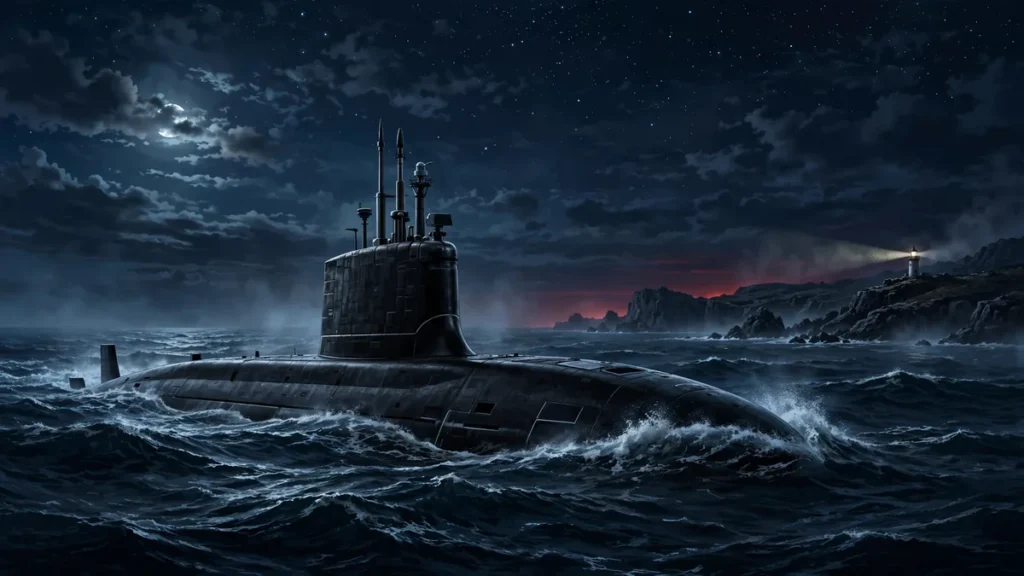
France’s Ministry of Defence announced on October 6, 2026 that a nuclear-powered ballistic missile submarine had successfully fired an M51 missile in its M51.3 version — the first firing of the upgraded variant from a submarine. The launch, codenamed Operation SMERTRIOS, took place off the coast of Finistère from the SSBN Le Vigilant, according to the French MoD press release translated by Naval News.
The missile carried no nuclear warhead. It was tracked throughout its flight by the Directorate General of Armaments’ missile-testing resources, including the test vessel Monge, and splashed down in the North Atlantic several hundred kilometres from any coastline — in strict compliance with France’s international commitments.
President Emmanuel Macron watched from the multi-mission frigate Auvergne, an unusual step for a certification test the ministry described as routine. He posted footage on X, writing: “To be free, one must be feared. And to be feared, one must be powerful.” In a video message he added: “Today we are stronger. The message has been sent loud and clear for wherever it must be received.” The firing was the second of the M51.3 overall and the first from a submarine, Armed Forces Minister Catherine Vautrin said; the first test took place from a land site at Biscarrosse, southwest France, in November 2023.
What is the M51.3 missile?
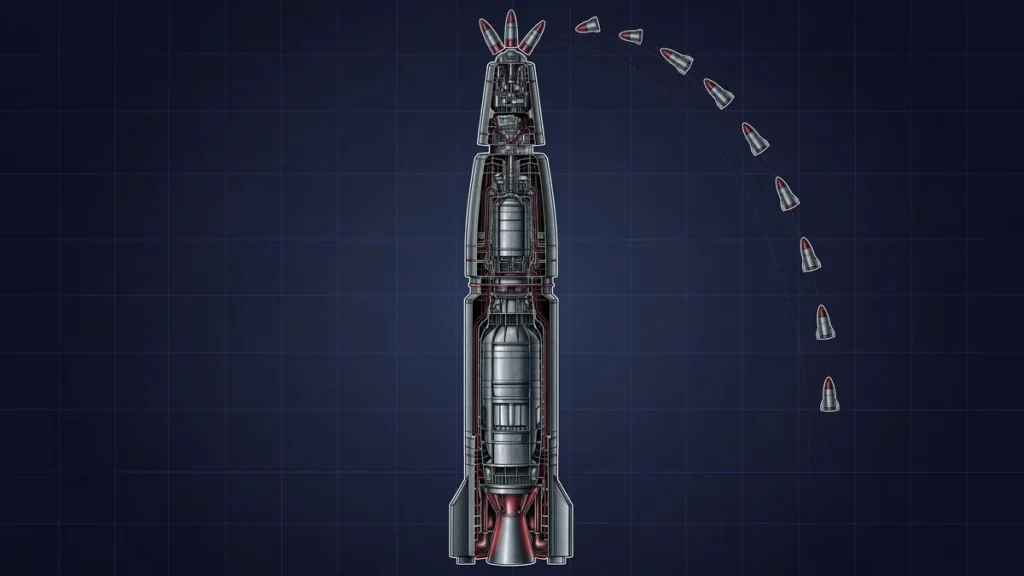
The M51.3 is the third version of the M51, France’s submarine-launched strategic ballistic missile, built by ArianeGroup for the Directorate General of Armament. It is a three-stage, solid-fuel missile weighing more than 50 tonnes and measuring about 12 metres long, carrying new oceanic nuclear warheads (TNO-2) developed by the French Atomic Energy Commission (CEA). It entered operational service on October 24, 2025 — a major step in the modernisation of France’s sea-based nuclear deterrent.
The variant offers improved range, accuracy and penetration capability against evolving adversary missile defences compared with the M51.2. France does not disclose the missile’s range, but public estimates for the M51 family generally place it at around 9,000 km or more, and French officials have said the new version flies farther. Development began in 2014; a follow-on M51.4, under development since September 2025, is already under contract, with experiments for it riding aboard the October 6 shot.
Background and timeline
- May 2013: Le Vigilant‘s last acceptance firing fails when the missile self-destructs early in flight — the only submarine-launched test shot not to complete its flight.
- 2014: Development of the M51.3 variant begins.
- November 2023: First M51.3 flight test, from the land-based site at Biscarrosse.
- 2023–2026: Le Vigilant undergoes its second major overhaul at Brest — roughly four million work hours, including 18 months in dry dock.
- March 2026: At Île Longue, Macron announces France will expand its nuclear arsenal for the first time since at least 1992, plus joint European nuclear exercises, possible short-term deployment of nuclear-capable assets on allied territory and deeper consultation with partners.
- October 2025: The M51.3 officially enters operational service.
- October 6, 2026: Le Vigilant fires an unarmed M51.3 off Finistère in Operation SMERTRIOS — the first submarine launch of the variant. Macron observes from the frigate Auvergne.
By the numbers: the M51.3 and France’s arsenal
| Metric | Figure | Source |
|---|---|---|
| French nuclear warheads (CONFIRMED) | ~290 | Reuters |
| Annual cost of the arsenal (CONFIRMED) | ~€5.6 billion | Reuters |
| Ballistic missile submarines (CONFIRMED) | 4 (Le Triomphant class), 16 tubes each, at least one at sea at all times | French MoD / Naval News |
| M51.3 weight / length (CONFIRMED) | >50 tonnes / ~12 m | Defence Blog |
| M51.3 service entry (CONFIRMED) | October 24, 2025 | French MoD / Naval News |
| M51 family range (REPORTED) | 9,000–10,000 km | Independent estimates; Paris keeps the official figure classified |
| Re-entry speed (REPORTED) | ~Mach 20 | Specialist defence press |
Caveat: figures marked CONFIRMED are supported by at least two sources, including the French MoD or Reuters. Figures marked REPORTED come from single or secondary sources and reflect public estimates, not official French data.
Why did France launch it now?
Technically, the timing is routine. France conducts an acceptance firing after every major overhaul of a ballistic missile submarine to verify that the boat and its missiles operate as one system — Le Terrible did the same in April 2023. Le Vigilant had just completed its overhaul, and the M51.3 needed its first submarine firing after the November 2023 land test.
Strategically, the timing is anything but routine. The announcement made no mention of Russia, but the test came days after Russian President Vladimir Putin warned the West not to escalate the standoff over Ukraine by threatening Kaliningrad — the Russian exclave wedged between EU members Poland and Lithuania — making clear Moscow would defend it with nuclear weapons if necessary, as Reuters reported. Moscow had also handed NATO a diplomatic note warning of “Russian strikes against decision-making centres” in Europe at the very start of any conflict.
Macron made the signalling explicit by attending in person — a head of state does not turn up to a routine certification test by accident. Since March, he has branded the new approach “advanced deterrence”: an arsenal expansion, stopped public disclosure of warhead numbers, and an offer of joint exercises, deeper consultation and possible temporary basing of nuclear-capable assets to European partners. France is also building next-generation ballistic missile submarines — expected to replace the Le Triomphant class after 2035 — and a hypersonic strategic missile programme for the airborne leg, launched this year.
France’s nuclear arsenal and Europe’s deterrence debate
France’s deterrent is strictly national and independent — a stance Paris has guarded since the 1960s — but it is increasingly framed in European terms. France is the EU’s only nuclear-armed state, holding the world’s fourth-largest arsenal. The sea-based leg (four submarines at Île Longue, Brittany, carrying the M51 family) provides continuous at-sea deterrence; the air leg (Rafale jets armed with nuclear cruise missiles) provides flexibility and visibility.
The debate in European capitals is whether France’s independent deterrent can or should become Europe’s. Germany, Poland and the Baltic states — watching US commitments fluctuate and Russian rhetoric harden — are the most interested audiences for Macron’s offer of nuclear consultation and cooperation. Sceptics counter that French doctrine keeps the final decision in Paris alone, and that consultation is not a shared trigger. The M51.3 launch does not settle that debate — but it demonstrates the hardware underpinning it: a modernised, survivable sea-based force whose improved range gives France more patrol options while keeping European and Russian targets within reach.
Readers tracking the broader confrontation can follow developments via our Intelligence and Country Profiles hubs, and see how economic pressure complements military signalling in our analysis of the EU’s Russia sanctions push.
What this means for US/UK/EU readers
Prices: The launch itself moves no markets, but the Kaliningrad standoff behind it adds to the geopolitical risk premium already priced into European energy and defence stocks — the same premium that has kept oil prices elevated through the Iran war.
Travel: These launches take place in designated zones far from commercial routes; no disruption to European or transatlantic flights has been reported.
Security: For EU readers, the takeaway is rearmament as the continent’s default — France doubling its military budget over a decade, expanding its arsenal and offering partners a nuclear consultation framework. For US readers, the test is a reminder that European nuclear capability reduces, but does not replace, the deterrent weight Washington carries in NATO. For UK readers, France’s expansion narrows the gap with Britain’s 225-warhead arsenal reported by Reuters.
What to watch: whether any ally publicly accepts Macron’s consultation offer; whether the M51.4 test programme stays on schedule; and whether Moscow answers with its own demonstrative launch, as it has done with submarine-launched tests in past standoffs.
What to watch next
The immediate question is diplomatic: does the launch cool or sharpen the Kaliningrad standoff? Putin has said Russia has no plans to attack any European country and wants peaceful coexistence, while NATO insists none of its exercises threaten Russian territory. The October 6 firing sits between those claims — a demonstration, not a provocation, but one with an unmistakable addressee. On the technical side, watch the M51.4 programme and the next-generation submarines under construction in Cherbourg.
Frequently asked questions
What is the M51.3 missile?
The M51.3 is the third version of France’s M51 submarine-launched ballistic missile, built by ArianeGroup. It is a three-stage, solid-fuel missile weighing more than 50 tonnes and about 12 metres long, carrying new TNO-2 nuclear warheads with improved range, accuracy and the ability to penetrate enemy missile defences. It entered operational service on October 24, 2025.
How many nuclear weapons does France have?
Roughly 290 warheads, the world’s fourth-largest arsenal, costing about €5.6 billion a year to maintain according to Reuters. France is the only EU member with nuclear weapons, and its arsenal is split between submarine-launched missiles and air-launched cruise missiles.
Why did France test-fire the M51.3 on October 6, 2026?
Officially, it was an acceptance firing after Le Vigilant‘s major overhaul — France certifies every ballistic missile submarine this way. Strategically, Macron used the launch, attending in person, to signal deterrent credibility days after Vladimir Putin warned the West over Kaliningrad and Ukraine.
Can the M51.3 reach Russia?
Paris does not publish the missile’s range, so the answer relies on public estimates: independent specialists place the M51 family at 9,000–10,000 km. From patrol areas in the North Atlantic, that would put most of Russia — plus the Middle East and parts of North America — within reach. More range means more ocean to hide in while targets stay covered.
Is this the first time France has fired a missile like this?
No — it was the second M51.3 firing overall and the first from a submarine. The first test flew from a land site at Biscarrosse in November 2023. France regularly fires M51 missiles after submarine overhauls, though Le Vigilant‘s previous acceptance shot in 2013 failed when the missile self-destructed early in flight.
Sources
- Reuters: France tests upgraded nuclear missile against backdrop of Russia tensions
- Naval News: French Navy conducts acceptance firing of M51.3 missile from Le Vigilant SSBN
- Defence Blog: France fires its newest nuclear missile from a submarine
- SOFREP: France’s new nuclear missile spent nearly a year in service before its first submarine launch
- SOFX: France test-fires M51.3 nuclear missile from Le Vigilant submarine in first sea launch


Discussion 0
Share analysis, corrections, or context. Be civil — comments are moderated.