
WarBrief Live | October 8, 2026 | Breaking Analysis
On October 7, 2026, European Union ambassadors approved 1,646 new designations under the bloc’s Russia sanctions regime — the largest single tranche since Russia’s full-scale invasion of Ukraine in February 2022. More than half of the new listings target the supply chain behind Russia’s ballistic missiles, including the 9M723 Iskander-M, at a moment when Ukraine has nearly run out of the US-made Patriot interceptors needed to stop them. The package still needs a formal vote: EU foreign ministers are expected to adopt it on Monday, October 12.
Key Takeaways
- EU ambassadors approved 1,646 new Russia sanctions designations on October 7 — 743 individuals, 826 entities, and 77 politicians elected in Russian-occupied Ukrainian territories.
- More than half of the listings target Russia’s ballistic-missile production chain: solid fuels, rocket engines, missile testing and research firms, and makers of specialised textiles and carbon fibre.
- The measures are not yet law. They take effect only after EU foreign ministers formally adopt them on October 12 and the list is published.
- The move lands as Russia intensifies ballistic-missile strikes on Ukraine and global diesel markets stay tight — with possible fuel-price effects for European households heading into winter.
What happened on October 7, 2026?
EU ambassadors — the Committee of Permanent Representatives, known as COREPER — gave unanimous political approval to a sanctions package drawn up by the European External Action Service (EEAS), the bloc’s foreign-policy arm. Three EU diplomats confirmed the decision to Reuters, and Radio Free Europe/Radio Liberty’s Europe editor Rikard Jozwiak reported the ambassadors had given the list the “green light.”
This is a listings package, not a sectoral one. Unlike the EU’s numbered sanctions “packages” — which can ban whole categories of trade — this tranche adds individual names and companies to the sanctions list: asset freezes, travel bans, and a prohibition on EU persons making funds or economic resources available to them. The listings-only design was deliberate. EU foreign-policy chief Kaja Kallas signalled in August that separating designations from sector-wide measures would make negotiations faster, and the October 7 approval — roughly seven weeks after she promised the “most far-reaching sanctions listings since the start of the war” — suggests the strategy worked. EU sanctions require unanimity among all 27 member states, and the formal, legally binding vote happens at the Foreign Affairs Council on October 12. Until the list is published in the EU’s Official Journal, none of the 1,646 designations are enforceable.
What does the 1,646 list target?
The headline number breaks down into three groups, according to a list obtained by The Kyiv Independent: 743 individuals, 826 entities, and 77 people who stood as candidates in Russian-organised elections in occupied Ukrainian territories. The overwhelming focus is Russia’s military-industrial complex — and within that, the ballistic-missile supply chain above all.
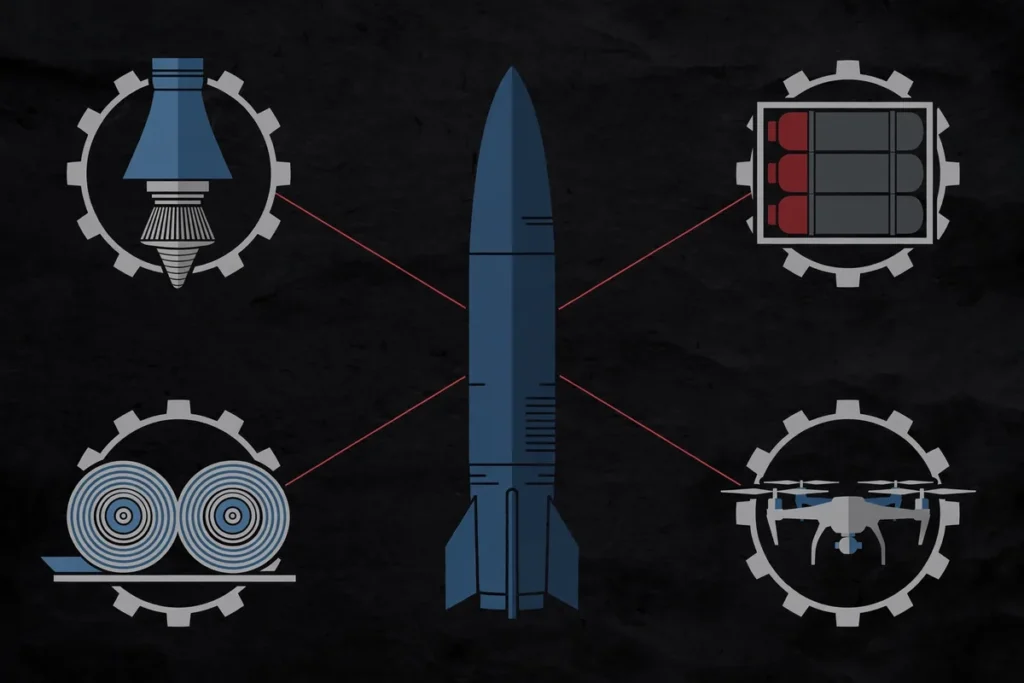
More than half of the new designations are tied to the production chain of missiles such as the 9M723 Iskander-M, diplomats told Reuters. The net is wide and technically specific: entities involved in missile testing and research, producers of solid fuels and rocket engines for the Iskander system, and manufacturers of specialised textiles and synthetic and carbon fibres used across multiple missile systems. Drone manufacturers and shipyards that service submarines are also on the list.
Two additions stand out beyond the missile chain. First, the 77 politicians sanctioned over elections staged in occupied territories — part of a pattern of smaller rolling lists the EU has used against election rigging, child abductions and propaganda. Second, seven North Korean entities and individuals linked to Moscow’s war effort, a reflection of EU concern about deepening Russia–North Korea military links. In July, Ukrainian President Volodymyr Zelensky said Russia had struck Ukraine with North Korean missiles for the first time in nearly a year, after an apparent stock replenishment.
By the numbers
| Metric | Figure | Source | Status |
|---|---|---|---|
| New designations approved October 7 | 1,646 | Reuters (3 EU diplomats) | CONFIRMED |
| Individuals listed | 743 | The Kyiv Independent via rks.news; RFE/RL via europesays.com | CONFIRMED |
| Entities listed | 826 | The Kyiv Independent via rks.news; RFE/RL via europesays.com | CONFIRMED |
| Occupied-territory politicians listed | 77 | The Kyiv Independent via rks.news | CONFIRMED |
| Share tied to missile production | “More than half” | Reuters (diplomat briefing) | REPORTED — precise split not published |
| Existing EU Russia listings | 3,000+ | EU / Kaja Kallas | CONFIRMED |
| Claimed cost to Russia’s war machine | “Over €1 trillion” | Kaja Kallas, August 2026 | CLAIMED — EU estimate, not independently verified |
| Formal adoption vote | October 12 | Reuters; Sky News via rks.news | SCHEDULED |
Caveat: the identities of the 1,646 targets have not been officially published. Figures above come from diplomat briefings and a list obtained by The Kyiv Independent, and remain subject to change before the October 12 vote.
Why is the EU targeting missile production now?
Because it is the weapon Ukraine is currently least able to stop. The 9M723 Iskander-M is a quasi-ballistic missile: fast, manoeuvrable in flight, and — crucially — interceptable in practice only by US-made Patriot air-defence systems. Reuters reports that Ukraine has virtually run out of Patriot interceptors as the United States diverts military resources to the Gulf, and Russia has seized on the gap to ramp up ballistic-missile strikes.
The timing is not abstract. On October 7, the same day the ambassadors voted, Russia’s defence ministry said it had carried out a “massive strike” on targets in Kyiv and other Ukrainian regions, hitting port facilities in the Odesa region and vessels it said were serving Ukraine’s armed forces. Zelensky has spent weeks pleading for both interceptors and pressure, calling for new sanctions packages targeting missile supply chains that “take effect as early as October.”
Sanctions on a missile supply chain do not stop missiles already built — they are a long-game weapon. Carbon fibre, solid propellants and specialised electronics are chokepoints where Russian domestic substitution is hardest, and the EU’s bet is that degrading production capacity now shortens the war’s destructive tail.
Background and timeline
- August 17, 2026: Kaja Kallas tells the German newspaper Die Welt she is preparing the “most far-reaching sanctions listings since the start of the war,” with the EEAS expected to propose about 1,600 names. She says existing sanctions have deprived Russia’s war machine of over €1 trillion.
- September 2026: The EU extends its individual Russia sanctions — imposed over violations of Ukraine’s territorial integrity — for another three years, until September 2029.
- Early October 2026: Vladimir Putin says Moscow will not resume diesel exports, currently banned until the end of October, until sanctions are lifted — explicitly linking fuel flows to sanctions relief.
- October 7, 2026: EU ambassadors unanimously approve the 1,646 designations. The same day, Russia announces “massive strikes” on Kyiv, the Odesa region and Black Sea shipping.
- October 12, 2026: EU foreign ministers expected to formally adopt the package at the Foreign Affairs Council.
- October 18, 2026: A parallel US pressure track reaches its deadline — the Graham Act sanctions deadline Washington set for action against Russia’s war economy.
Why it matters
Scale first: adding 1,646 names to a regime that already covers more than 3,000 individuals and entities is an expansion of roughly one-half in a single day — the biggest enforcement step since 2022. Second, precision: this is the most technically granular strike the EU has aimed at Russia’s weapons pipeline, reaching down to fibre producers and fuel chemists rather than just headline oligarchs. Sanctions on weapons procurement networks are a recurring Western tool — Washington recently used them against an Iran-linked network — but the missile-chain focus here is unusually systematic.
Third, leverage: Putin’s decision to tie diesel exports to sanctions relief shows Moscow treats the sanctions regime as a bargaining chip — which cuts both ways, giving the EU something to trade if diplomacy ever restarts. For the full picture of how Brussels tracks all of this, see our Sanctions Tracker.
What this means for US/UK/EU readers
Fuel prices: This is the channel most likely to touch household budgets. The global diesel market is already tight — the Iran war has disrupted supply, Ukrainian strikes have knocked out Russian refining capacity, and Moscow’s diesel export ban runs until the end of October. If sanctions pressure hardens and Russia keeps fuel off the market, European drivers and anyone heating a home with oil could see higher prices this winter. It is a risk, not a certainty — watch pump prices and heating-oil quotes through October.
Markets: Energy and defence equities tend to be sensitive to escalation in this theatre, and sanctions expansions can move compliance costs for firms with legacy Russia exposure. This is educational context, not financial advice — sanctions headlines are a poor basis for investment decisions.
Travel and security: No direct impact on travel: no new airspace closures or advisories flow from a listings package. The relevant risk is the battlefield trend behind it — Russia’s intensifying strikes on Kyiv and Black Sea shipping — which travellers to the region should track through official advisories.
For US readers specifically: the Patriot interceptor shortage at the heart of this story is partly a story about American resources being diverted to the Gulf. The October 18 Graham Act deadline adds a US legislative track to watch alongside the EU’s October 12 vote.
Different perspectives
Brussels frames the package as steady, cumulative pressure: Kallas’s position is that sanctions keep working until Moscow ends the war, pointing to the claimed €1 trillion cost to Russia’s war machine. Kyiv wants speed over scale — Zelensky’s ask was for missile-supply-chain packages “as early as October,” plus the interceptors he calls “a vital necessity.”
Moscow treats sanctions as both grievance and leverage, tying diesel exports to their removal, while routinely dismissing listings as ineffective. Sceptics note the evasion problem: entities reconstitute under new names and third-country intermediaries keep components flowing. A listing degrades a supply chain; it does not switch it off overnight.
What to watch next
- October 12: the Foreign Affairs Council vote. Sanctions need unanimity — watch for any last-minute objections from member states that have slowed past packages.
- The Official Journal publication: the full list of names will reveal exactly which firms, officials and intermediaries are hit — and which countries’ supply chains the EU believes feed Russia’s missile plants.
- Russia’s response: whether Moscow extends its diesel export ban past October 31, and whether the current wave of strikes on Kyiv and Black Sea shipping escalates further.
- The North Korea thread: seven new North Korean listings suggest fresh intelligence on arms transfers — watch for what, if anything, the EU says publicly about it.
- Washington’s parallel track: the October 18 Graham Act deadline could layer US measures on top of the EU’s within a week of adoption.
Frequently asked questions
What are the new EU sanctions on Russia in October 2026?
On October 7, 2026, EU ambassadors approved 1,646 new sanctions designations — 743 individuals, 826 entities, and 77 politicians linked to elections in occupied Ukrainian territories. Most target Russia’s military-industrial complex, especially the ballistic-missile supply chain: solid fuels, rocket engines, missile research firms, carbon-fibre producers, drone makers and submarine-servicing shipyards.
When will the new EU sanctions take effect?
The October 7 vote was political agreement, not law. The package must be formally adopted by EU foreign ministers — expected on October 12, 2026 — and then published in the EU’s Official Journal before the asset freezes and travel bans become enforceable.
How many people and companies has the EU sanctioned over Russia?
Before this tranche, the EU’s Russia sanctions regime already covered more than 3,000 individuals and entities. Once the 1,646 new designations are adopted, the total will rise to roughly 4,600 — the largest expansion since Russia’s full-scale invasion began in February 2022.
Do EU sanctions actually hurt Russia’s war effort?
It is debated. The EU’s foreign-policy chief claims sanctions have cost Russia’s war machine over €1 trillion, and researchers document real component shortages in Russian weapons production. But evasion through third countries and reconstituted front companies is extensive, so sanctions degrade supply chains over years rather than stopping production overnight.
Why is the Iskander missile so hard to stop?
The 9M723 Iskander-M is a quasi-ballistic missile that manoeuvres during flight and arrives at very high speed, giving air defences minimal engagement time. In practice it can only be reliably intercepted by US-made Patriot systems — and Ukraine has nearly run out of Patriot interceptors, which is why Russia has ramped up ballistic-missile strikes.
Sources
- Reuters: EU envoys approve new Russia sanctions listings, diplomats say
- Rks News: Russia Faces More Than 1,600 New EU Sanctions (via The Kyiv Independent)
- EuropeSays: EU Backs Record Sanctions List of 1,646 Russian Targets
- Particle News: EU Ambassadors Approve Largest Single Russia Sanctions List Since 2022
Discussion 0
Share analysis, corrections, or context. Be civil — comments are moderated.