WarBrief Live | October 1, 2026 | Sanctions & Diplomacy
Ukraine’s finance minister has urged the European Union to be “brave enough” to unlock the immobilized Russian central bank reserves sitting in Brussels, warning that the frozen Russian assets Ukraine debate could determine whether Kyiv can fund its war effort through 2027. With a $78 billion funding gap looming and allies’ pledges covering barely a quarter of the aid needed, the push puts the stalled “reparations loan” idea back at the center of European politics weeks before EU leaders meet on October 15-16.
Key Takeaways
- Ukraine’s Finance Minister Serhii Marchenko told donors in Brussels on September 29-30 that 2027 financing could face a $78 billion hole unless allies act, and urged “bold action” on the immobilized Russian assets.
- Kyiv needs $52.6 billion in external financial aid for 2027, but only $20 billion is covered so far; roughly $45 billion in defense spending also lacks firm guarantees.
- About €210 billion of Russian central bank assets are immobilized in the EU, most of it in Brussels-based Euroclear — more than enough on paper, but legally and politically contested.
- Marchenko floated transferring the assets from Euroclear into an EU-owned custodian to share the legal risk that sank the December 2025 plan; Ukraine financing returns to the European Council agenda on October 15-16.
What happened in Brussels
Read next: our full preview of the October 15–16, 2026 European Council summit, where leaders will debate Ukraine funding, the frozen Russian assets and EU defence readiness.
Marchenko met representatives from international donors and financial institutions in Brussels this week as EU finance officials began sizing up next year’s budgets. His message was blunt: the war is longer and harder than anyone budgeted for, and without a resolution on the frozen Russian assets, Ukraine cannot cover its costs.
“We need our friends, our European politicians, to be brave enough and to make some bold actions,” Marchenko told the gathering, according to reporting on the private discussions. “Unfortunately, the war is longer, the war is harder, and we need to provide some resolution of frozen Russian assets or provide other means for us to survive.”
The minister argued that using the asset pool was both practical and fair: a way to meet extraordinary wartime costs, protect Ukraine’s debt sustainability, and hold Moscow financially accountable for the damage it has inflicted. He acknowledged the issue was politically difficult and urged the bloc to build a centralized, legally sound framework rather than leaving Belgium and Euroclear to carry the risk alone.
A day earlier, Marchenko had made a similar case at a European Policy Centre panel, backing the idea of moving the assets from Euroclear into an EU-owned custodian. The structure is designed to spread the legal exposure across all 27 member states instead of concentrating it in Brussels.
Background: the $78 billion funding gap and frozen Russian assets
The numbers Marchenko laid out show why Kyiv is escalating the pressure. Ukraine needs $52.6 billion in external financial aid in 2027; donors have covered about $20 billion, leaving a $32.6 billion hole. On top of that, roughly $45 billion in planned defense expenditure has no guaranteed allied backing. Combined, the unfunded portion reaches $78 billion (€68.77 billion) — a figure that would force Kyiv into deep cuts to protected spending, including military salaries and pensions, if left unfilled.
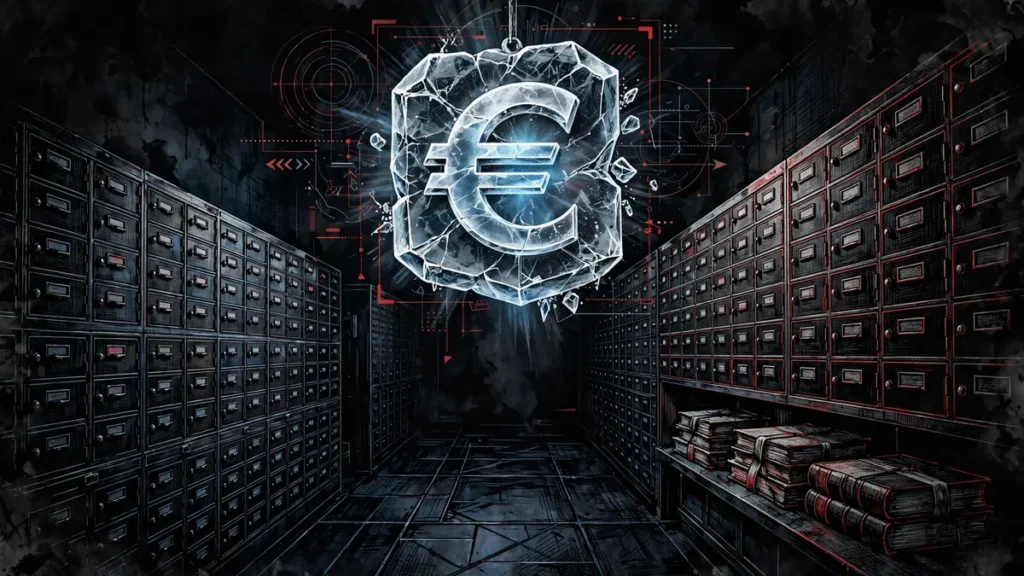
The assets in question have been immobilized since 2022, when the EU, the US and their partners froze Russian central bank reserves after the full-scale invasion. The EU now holds about €210 billion of them, the bulk parked in Euroclear’s vaults in Brussels. The money legally still belongs to Russia; sanctions regulations immobilize it rather than confiscate it, and the distinction is what makes every proposal to use it so fraught.
- 2022: The EU and G7 immobilize Russian central bank reserves after the full-scale invasion.
- 2024-2025: The G7 structures a $50 billion loan to Ukraine backed by the windfall profits earned on the frozen assets, while the principal remains untouched.
- December 2025: European Commission President Ursula von der Leyen proposes a “reparations loan” that would lend the frozen balances themselves onward to Ukraine. Belgium, which would bear the primary legal risk, blocks it; EU leaders instead agree a €90 billion loan to Ukraine for 2026-2027 financed by EU borrowing on capital markets.
- September 2026: Reporting flags a €23 billion financing gap for Ukraine in 2026 alone as military spending outruns the December framework, and EU officials confirm Ukraine financing will return to the October 15-16 European Council.
- September 29-30, 2026: Marchenko meets donors in Brussels and presses for “bold action” on the immobilized assets.
Why it matters
The fight over the frozen Russian assets Ukraine question is no longer just about one year’s budget. It is the test case for whether Europe can convert its sanctions leverage into durable war financing — and a precedent that will shape how central banks worldwide think about holding reserves in Western financial centers.
For Ukraine, the math is unforgiving. European Commission President Ursula von der Leyen has said €37 billion in EU budget support remains available this calendar year, and the €90 billion December 2025 loan was meant to cover 2026-2027. But the IMF estimated Ukraine needs €135 billion over those two years, military spending is running above the framework’s assumptions, and donor fatigue is compounding the gap. Analysts quoted in recent reporting warn that failing to secure external financing could lead to cuts in protected spending — a fiscal crisis running in parallel with the war.
For the EU, the October 15-16 European Council is the deadline the market is watching. The mechanism back on the table is a revised version of the December structure: Euroclear and other custodians would lend the frozen cash balances to the European Commission, which would lend them onward to Ukraine as a zero-coupon, interest-free obligation. If Russia ever pays reparations, Ukraine would use them to repay the loan, which would then unwind back through the Commission to the custodians. The assets are never confiscated outright — a reversibility that supporters argue keeps the scheme defensible under international law.
For the wider sanctions architecture, see our Sanctions Tracker hub and our reporting on how Washington pursues sanctions enforcement against weapons-procurement networks through Operation Economic Outcast.
Different perspectives
Ukraine’s case is that the perpetrator should pay, the money is sitting idle while Ukraine bleeds, and every alternative forces European taxpayers to foot the bill. Marchenko’s “bold actions” framing is aimed directly at leaders who privately agree the assets should be used but publicly hesitate to be the first to say so.
Belgium’s objection is financial, not ideological. Euroclear is based in Brussels, so Belgium would absorb the heaviest blow if Russia won legal challenges to any seizure-like move. The December 2025 compromise explicitly reserved the EU’s right to use the assets to repay the €90 billion loan “in full accordance with EU and international law” — language that kept the door open while shelving the fight. Marchenko’s EU-owned custodian proposal is a direct attempt to answer this objection by distributing the risk across the bloc.
The Commission’s position has been that a reparations loan is a legally viable route. Von der Leyen has stressed the assets would be lent, not confiscated: “Ukraine must repay this loan if Russia pays reparations, because the perpetrator must be held accountable.” EU foreign policy chief Kaja Kallas has said the mechanism does not contradict international law. The Commission’s earlier version needed only a qualified majority — at least 16 of 27 member states representing 65% of the population — rather than unanimity.
Skeptics’ warning, including some member states and financial lawyers, is that seizing or seizing-adjacent use of central bank reserves in peacetime sets a precedent that could fracture the reserve-currency system for decades, raising borrowing costs for everyone and pushing rivals to park reserves elsewhere. Russia has repeatedly threatened litigation and retaliatory asset seizures of its own.
The markets angle cuts both ways: the protracted war in Iran has already shown how fast geopolitical risk reprices commodities, as our coverage of the Iran war’s energy fallout has detailed. A Ukrainian funding collapse would be the European equivalent of a supply shock — to bond markets and the euro itself.

What to watch next
All eyes are on the European Council on October 15-16, where Ukraine financing is confirmed back on the formal agenda. Watch for three things: whether the Commission tables a concrete reparations-loan legal text, whether Belgium’s resistance softens under the EU-owned-custodian proposal, and whether any agreement needs unanimity or can pass by qualified majority.
Also on the watchlist: the final tranche timing of the €90 billion December 2025 loan, any signals from Washington about its own frozen-assets stance, and the next round of donor consultations in Brussels. For ongoing developments, follow our Conflict Zones and Sanctions Tracker coverage.
Frequently asked questions
How much money do Ukraine’s allies need to provide in 2027?
Ukraine’s finance minister told donors in Brussels that Kyiv needs $52.6 billion in external financial aid in 2027, of which only about $20 billion is covered so far. Combined with roughly $45 billion in defense spending without firm allied guarantees, the total unfunded gap could reach $78 billion.
What is the reparations loan proposal for Ukraine?
The reparations loan is a European Commission-backed scheme under which Euroclear and other custodians would lend the frozen Russian central bank balances to the Commission, which would lend them onward to Ukraine as a zero-coupon, interest-free loan. If Russia ever pays war reparations, Ukraine would use them to repay the loan, which would then unwind back to the custodians. The assets are lent, not confiscated outright.
Can the EU legally use frozen Russian assets?
The EU argues a structured lending arrangement preserves reversibility and is defensible under international law, with EU foreign policy chief Kaja Kallas saying the concept does not contradict international law. But the law is genuinely contested: opponents cite sovereign immunity and warn of massive litigation from Russia, which is why Belgium has resisted bearing the risk alone.
Why is Belgium the key obstacle?
Most of the €210 billion in immobilized Russian assets sits in Euroclear, a depository headquartered in Brussels. Belgium would therefore face the heaviest legal and financial exposure if Russia challenged the move in court. Kyiv’s proposed EU-owned custodian aims to spread that risk across all 27 member states.
When will the EU decide on the frozen assets?
Ukraine financing is confirmed on the agenda of the European Council meeting on October 15-16, 2026. Watch whether the Commission tables a legal text for the reparations loan and whether leaders opt for a qualified-majority vote to bypass holdouts.
Sources
- GetUp News: Ukraine pushes for Russian assets to plug $78 billion gap in 2027
- Eurotoday: Ukraine’s war chest is running low at the worst possible moment
- The Wake / The Leadsman: The Money That Cannot Move — Europe’s reparations loan and the precedent it sets
- EUalive: Why the EU could not agree to use the frozen Russian assets for Ukraine