
WarBrief Live | October 14, 2026 | Security
On October 13, 2026, NATO began its annual nuclear deterrence drill, Steadfast Noon, in Italy — an exercise involving 17 allied nations that tests the alliance’s nuclear procedures without using a single live weapon. But what is NATO’s Steadfast Noon exercise, and why does an alliance that insists the drill is “routine” announce it to the entire world? This explainer breaks down how NATO’s nuclear-sharing system works, what the 2026 edition involves, and why this year’s exercise has drawn a sharp warning from Moscow.
Key Takeaways
- Steadfast Noon 2026 runs from October 13 to 23 in Italy with 17 allied nations taking part; NATO stresses that no live nuclear weapons are used.
- The drill exercises NATO’s nuclear-sharing system: US-owned B61-12 bombs stored in Europe, deliverable by specially certified allied aircraft.
- NATO calls the exercise routine and unrelated to current events; Russia has accused the alliance of provocation around Kaliningrad and warned it could use its “entire arsenal.”
- Independent analysts estimate 100–120 US nonstrategic nuclear bombs are stored at six bases in five European countries; exact figures remain classified.
What is NATO’s Steadfast Noon exercise?
Steadfast Noon is NATO’s principal annual exercise for testing its nuclear deterrence capabilities. Each year, a rotating host nation leads allied air forces through rehearsals of the procedures that would be used if the alliance ever had to employ nuclear weapons — from generating dual-capable aircraft and moving them to dispersal bases to coordinating the conventional support missions (surveillance, refuelling, command and control) that a nuclear operation requires.
The 2026 edition began on October 13 in Italy, with 17 nations participating and the overall scale “in line with previous iterations of the exercise,” according to NATO’s October 8 announcement. Italy has previously hosted the drill six times, making this the seventh Italian edition, the country’s defence ministry said. The exercise is scheduled to run through October 23.
Three facts define every Steadfast Noon: it is long-planned and routine, no live weapons are used, and NATO states it is not linked to current world events or directed against any country. NATO Secretary General Mark Rutte framed it as both a readiness tool and a signal: “NATO is a defensive Alliance. This exercise helps us ensure a safe, secure, effective, and credible capability to preserve peace, prevent coercion and deter aggression. It also sends a clear message of unity and resolve.”
| Metric | Figure | Status / Source |
|---|---|---|
| Participating nations | 17 | Confirmed — NATO |
| Exercise dates | October 13–23, 2026 | Confirmed — NATO |
| Host nation | Italy (7th time hosting) | Confirmed — Italy’s defence ministry via Reuters |
| Live nuclear weapons used | None | Confirmed — NATO |
| 2025 edition: aircraft | ~70 | Confirmed — NATO |
| 2025 edition: personnel | ~2,000 | Confirmed — NATO |
| US B61 bombs in Europe (estimate) | ~100–120 | Estimate — FAS/Kristensen via Bulletin of the Atomic Scientists |
| Storage bases | 6 bases in 5 countries | Estimate — FAS via Bulletin of the Atomic Scientists |
Estimates of warhead numbers and storage locations are independent analyst assessments; NATO does not publish nuclear stockpile figures.
How does NATO nuclear sharing work?
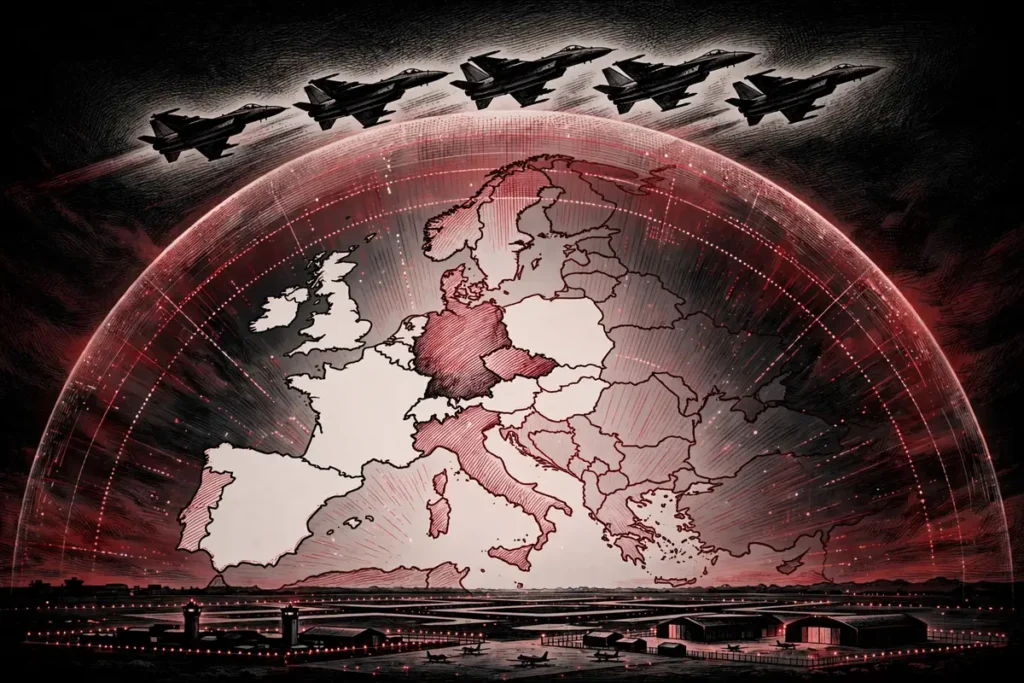
NATO describes itself as a nuclear alliance: “as long as nuclear weapons exist, NATO will remain a nuclear alliance,” as SHAPE’s spokesperson put it during the 2025 exercise. The mechanism is called nuclear sharing. The United States forward-deploys a stockpile of nonstrategic B61 gravity bombs in Europe — analysts at the Federation of American Scientists estimate 100 to 120 B61-12 bombs at six bases in five countries: Aviano and Ghedi in Italy, Incirlik in Türkiye, Kleine Brogel in Belgium, Volkel in the Netherlands, and Büchel in Germany. That estimate comes from the Bulletin of the Atomic Scientists’ Nuclear Notebook; the exact numbers are classified, and there are indications — not yet confirmed — that bombs may also have returned to RAF Lakenheath in the UK.
Crucially, the United States retains absolute control and custody of those weapons. They can only be released with US authorization, and only then could they be delivered by allied “dual-capable aircraft” (DCA) — jets certified to carry both conventional and nuclear ordnance. Belgium, Italy, the Netherlands and Türkiye currently operate DCA units; the United Kingdom is rejoining the mission, with at least 12 nuclear-certified F-35A jets planned, according to the UK defence minister. Germany is transitioning its DCA fleet from the ageing Tornado to the F-35A, and Dutch F-35s have now taken a central, nuclear-certified role.
Sharing goes beyond the bomb-carriers. Under a concept known as SNOWCAT — Support of Nuclear Operations with Conventional Air Tactics — non-nuclear allies contribute fighter escorts, surveillance, refuelling and other conventional missions around a nuclear operation. A DGAP policy brief documents how countries including Greece, Poland, the Czech Republic and Türkiye have provided such escort support. As NATO’s nuclear policy chief Jim Stokes noted, this shows “how we share the nuclear burden in different ways” — even allies without dual-capable aircraft contribute through planning, exercises and consultations. Steadfast Noon is where all of those pieces are rehearsed together.
Why does NATO publicly announce its nuclear drill?
A nuclear-weapons exercise in wartime Europe sounds like the kind of thing an alliance might keep quiet — yet NATO announces Steadfast Noon every year, with dates, host nation and explicit no-live-weapons assurances. The reason is transparency as an escalation-management tool. As Stokes said during the 2025 edition, the goal is “promoting transparency when and where appropriate, so that our Allied populations and the wider world have a good understanding of what we are doing.” A nuclear drill conducted in secrecy could be misread by an adversary’s early-warning systems; a publicly announced one, with clearly communicated boundaries, is far less likely to trigger a catastrophic miscalculation.
Last year’s edition illustrates the scale: around 70 aircraft from 14 allied nations, roughly 2,000 personnel, operations centered on Volkel Air Base in the Netherlands with supporting elements at Kleine-Brogel in Belgium, RAF Lakenheath in the UK and Skrydstrup in Denmark. Thirteen aircraft types took part, including dual-capable fifth-generation F-35s, alongside E-3A Sentry surveillance aircraft and KC-135 Stratotanker refuelling aircraft in conventional support roles.
The 2026 edition is already visibly underway. Open-source flight tracking on October 14 showed Italian and allied tankers — a KC-767A, NATO A330 MRTTs, an E-3A Sentry and an Italian E.550 early-warning aircraft — sustaining intense activity over the Tyrrhenian Sea, with Pratica di Mare air base as a hub. Separately, Germany has deployed three Tornado fighter-bombers from Tactical Air Wing 33 to Aviano Air Base in northern Italy, according to the German press agency DPA — a reported, single-source detail consistent with the exercise’s DCA rehearsals.
Steadfast Noon 2026 and Russia’s “entire arsenal” warning
Moscow views the drill very differently. Russia has accused NATO of carrying out what it considers provocative activity around its Kaliningrad exclave and warned that it would be prepared to use its “entire arsenal” if the alliance attempted to cut off the Baltic territory, Reuters reported on October 8. In a document sent to NATO and seen by Reuters, Moscow accused the alliance of a “dangerous and reckless course” carrying “high risks of the outbreak of a direct armed conflict.”
NATO has condemned those remarks, while alliance officials say they have not observed major changes in Russia’s nuclear posture, AFP reported. The exchange fits a pattern of sharpening deterrence rhetoric: just two days before Steadfast Noon began, NATO’s supreme allied commander Gen. Alexus Grynkewich warned of a decisive allied response to any attack on alliance territory, outlining a “theory of victory” built on blocking, blunting and breaking an aggressor. France, notably, sits outside this architecture — Paris keeps an independent nuclear deterrent, takes no part in NATO’s Nuclear Planning Group, and does not join Steadfast Noon; its M51.3 submarine-launched missile program runs on a separate track.
What Steadfast Noon means for US, UK and EU readers
First, the reassurance: this is a routine annual drill, not a crisis signal. No live nuclear weapons are involved, no civilian airspace closures have been announced, and commercial flights over Italy and the Mediterranean are operating normally. If you live near Aviano or Ghedi in northern Italy, the most visible effect will be increased military air activity through October 23.
For US readers, the exercise is a reminder that American aircraft, tankers and personnel form the backbone of the deterrent being rehearsed — the US weapons, US custody and US release authority are the system’s core. For UK readers, the drill touches RAF Lakenheath’s historic role in past editions and Britain’s planned return to the dual-capable mission with F-35As. For EU readers, the drill underwrites the security guarantees that let European capitals — from Vilnius, which is pushing for a permanent US base, to Warsaw — plan their defence spending with confidence.
Markets rarely price deterrence drills directly, but the rhetoric around them can add a risk premium to energy and shipping: watch oil and gas benchmarks for volatility if Moscow escalates its nuclear messaging during the exercise window.
What to watch after Steadfast Noon ends on October 23
Three things matter once the jets stand down. First, whether Russia responds with its own nuclear signalling or strategic-forces exercise — a regular feature of these cycles. Second, whether NATO publishes its standard post-exercise assessment and what it says about readiness. Third, how the drill’s lessons feed the alliance’s broader posture on the eastern flank, where initiatives like Eastern Sentry and Baltic Sentry continue and Lithuania’s campaign for a permanent American base keeps gaining momentum. Our Intel hub tracks these developments as they happen.
Frequently asked questions
Is NATO’s Steadfast Noon exercise a response to Russia?
NATO describes Steadfast Noon as a long-planned, routine annual exercise held with a rotating host nation — the 2026 dates and Italy host were set well in advance. That said, Moscow has framed this year’s edition as provocation, and the exercise is unfolding against the sharpest Russia–NATO tensions in years, which is why the drill is drawing more attention than usual.
Are live nuclear weapons used in Steadfast Noon?
No. NATO and Italy’s defence ministry both state that no live nuclear weapons are used. The exercise rehearses procedures — generating aircraft, coordinating support missions and verifying safety standards — using training shapes and simulated attacks rather than real warheads.
Where are NATO’s nuclear weapons stored in Europe?
The exact locations and numbers are classified. Independent analysts at the Federation of American Scientists estimate roughly 100–120 US B61-12 bombs at six bases in five countries: Aviano and Ghedi (Italy), Incirlik (Türkiye), Kleine Brogel (Belgium), Volkel (Netherlands) and Büchel (Germany). There are unconfirmed indications that weapons may also have returned to RAF Lakenheath in the UK.
What is the B61-12 bomb?
The B61-12 is the modernized US gravity bomb at the core of NATO’s shared deterrent in Europe. It adds a guided tail kit for improved accuracy to the long-serving B61 design, and analysts describe it as a precision-guided weapon with selectable explosive force. It is certified for delivery by aircraft including the F-35A, F-15E, F-16, Tornado and B-2.
Does France take part in Steadfast Noon?
No. France maintains a fully independent nuclear deterrent under national command and does not participate in NATO’s Nuclear Planning Group or its nuclear-sharing arrangements, so it does not join Steadfast Noon. Paris modernizes its own arsenal separately, including the M51.3 submarine-launched missile.
Sources
- NATO: NATO holds annual nuclear exercise Steadfast Noon (October 8, 2026)
- NATO: NATO’s annual nuclear exercise Steadfast Noon begins (October 13, 2025)
- Reuters: Italy to host NATO nuclear exercise Steadfast Noon next week (October 8, 2026)
- AFP via Daily Sabah: NATO to launch annual nuclear deterrence drills in Italy amid tensions (October 8, 2026)
- Bulletin of the Atomic Scientists: Nuclear Notebook — The changing nuclear landscape in Europe
- Defence Industry Europe: NATO says Steadfast Noon 2026 exercise will test nuclear deterrence readiness
- DGAP: NATO’s Nuclear Sharing — Policy Brief 2020/04
- ITamilRadar: Steadfast Noon — NATO tankers sustain intense air activity over the Tyrrhenian Sea (October 14, 2026)


Discussion 0
Share analysis, corrections, or context. Be civil — comments are moderated.