
WarBrief Live | October 14, 2026 | Markets & Economy
The Black Sea grain corridor — the shipping lane that once carried a quarter of the world’s wheat exports — has shut down again, and the shock is landing on supermarket shelves. Global food prices hit their highest level in nearly four years in September 2026, and the UN food agency says the renewed battle over Black Sea shipping is a central cause. Here’s what happened to the corridor, why wheat prices are climbing, and what it means for your weekly shop.
Key Takeaways
- The UN Food and Agriculture Organization’s Food Price Index averaged 136.0 points in September 2026 — up 5.8% from a year earlier and the highest since November 2022.
- Ukrainian and Russian grain exports have both collapsed after strikes on ports, terminals, and vessels shut down the Black Sea export route in summer 2026.
- Baltic EU states pushed for a ban on Russian grain transiting the EU at a Brussels leaders’ summit on October 14, 2026 — a sign the grain war is now a diplomatic war too.
- Analysts say the corridor could reopen under a new deal in 2027, but shipping attacks show no sign of stopping — so food-price pressure is likely to persist into winter.
How the Black Sea grain corridor collapsed in 2026
The Black Sea has been a battlefield for grain since Russia’s full-scale invasion of Ukraine began in 2022. Moscow’s blockade of Ukrainian ports that year helped push world food prices to record highs, until the UN and Turkey brokered the Black Sea Grain Initiative, which reopened a protected shipping lane and moved nearly 33 million tons of grain before it lapsed in 2023. Ukraine then ran its own unilateral shipping corridor through 2025.
That arrangement broke down in July 2026, when the war re-erupted along its maritime axis. Russia intensified drone and missile strikes on Ukrainian port infrastructure around Odesa and on civilian vessels themselves, while Ukraine hit Russian energy and port targets in response. Shipowners stopped calling, insurers withdrew cover, and the corridor effectively froze.
The Russian side is nearly as bleak. All three grain terminals at Novorossiysk — Russia’s main deep-water export outlet — halted operations after Ukrainian strikes in August, and shipping through the Sea of Azov has been restricted since July 10. Russia has been forced to redirect shipments to Baltic terminals that previously handled coal and fertilizer. Azov-Black Sea basin shipments “came to almost a standstill from mid-August,” according to agricultural consultancy IKAR, as reported by Reuters. For the first time in this war, both shores of the Black Sea have lost major grain-export capacity at the same time.
Why are wheat prices rising again?
Because the two biggest Black Sea exporters — Russia and Ukraine typically account for more than a quarter of global wheat exports — are suddenly shipping far less. Futures markets reacted first; the costs then cascade down to mills, bakers, and grocery bills.
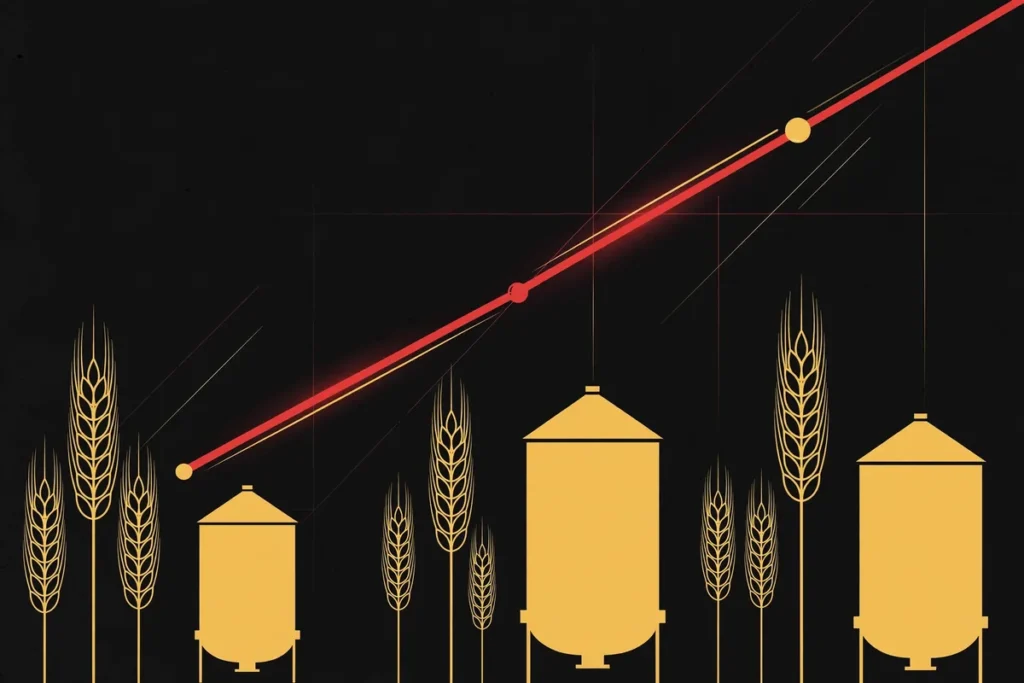
The numbers tell the story. The FAO’s benchmark food price index rose for a third straight month in September, averaging 136.0 points — up 1.5% on the month and 5.8% on the year. World wheat prices climbed 6.3% in a single month, which the FAO attributed mainly to logistical constraints in the Black Sea region and dry weather in parts of North America. Chicago wheat futures traded near $6.89 a bushel in early October, after touching nearly $8 a bushel in September — a three-and-a-half-year high.
Export volumes have cratered. Ukraine exported just 2.4 million tons of agricultural products in September — only 46% of the required volume, according to Agriculture Minister Taras Vysotskyi, quoted by Ukrainska Pravda. The minister warned Ukraine could lose about 30 million tons of agricultural exports — worth roughly $30 billion — in the current marketing year if the ports stay shut. On the Russian side, consultancy Sovecon forecasts October wheat exports at just 2.5 million tons, about half of last year’s 5.1 million, and has cut its 2026/27 grain export forecast to 44.7 million tons from 49.4 million. An IFPRI–AMIS seminar estimate put the combined Ukrainian-Russian wheat export shortfall at 6.5 million tons for July–September 2026, potentially widening to 10.2 million tons by the end of October.
The Black Sea grain crisis by the numbers
Educational context only — this is not financial advice.
| Metric | Figure | Source |
|---|---|---|
| FAO Food Price Index, September 2026 | 136.0 points, +5.8% year-on-year — CONFIRMED | FAO |
| World wheat prices, September vs August | +6.3% month-on-month — CONFIRMED | FAO |
| Ukraine agricultural exports, September 2026 | 2.4 million tons — 46% of required volume — CONFIRMED | Ukrainian Agriculture Ministry |
| Russian wheat export price (FOB, 12.5% protein) | $268/ton, up $2 on the week — CONFIRMED | IKAR via Reuters |
| Combined Ukraine+Russia wheat export shortfall, Jul–Sep | 6.5 million tons below last year — REPORTED | IFPRI–AMIS seminar |
| Sovecon forecast for Russian 2026/27 grain exports | 44.7 million tons (cut from 49.4) — REPORTED | Sovecon via Reuters |
| Estimated GDP hit to Ukraine from port blockade | −2.2% of real GDP — REPORTED | Dragon Capital |
Figures marked CONFIRMED come from official data or multi-sourced reporting; REPORTED figures are analyst or government estimates that may be revised.
Who depends most on Black Sea grain?
The pain is not evenly shared. North Africa and the Middle East — Egypt, Turkey, and several import-dependent states — buy the largest share of Russian and Ukrainian grain, and they are being forced toward more expensive suppliers in the United States, Australia, and Argentina. FAO Chief Economist Maximo Torero warned that the pressures “will soon pass through to consumer food prices, especially in food and energy import dependent countries.”
Ukraine itself is bleeding. Agriculture is the country’s key source of export income, and without accessible deep-water ports Kyiv can move only about half its exportable harvest, using rail, the Danube, and roads. The Agriculture Ministry says farmers lack the cash to plant next year’s crop: if the blockade persists into spring, Ukraine’s planted area could shrink by 35–40%. Dragon Capital estimates the blockade could reduce Ukraine’s real GDP by 2.2% and has forecast a record $71 billion foreign trade deficit for 2026.
Could a new Black Sea grain deal reopen the ports?
Diplomats have not given up. At the UN General Assembly, Turkey and the EU both called for a resumption of exports, and US Secretary of State Marco Rubio told reporters that both Russia and Ukraine had expressed interest in a “limited ceasefire” covering attacks on grain and energy facilities — though he cautioned “that won’t be easy.” Meanwhile the grain war has gone political in Brussels: on October 8, Lithuania’s prime minister called for the EU to sanction Russian grain and ban its transit through EU territory; two days later the Baltic prime ministers sent a joint letter putting the issue on the EU agenda, warning the bloc must not become a channel “through which Russia compensates for the economic consequences of its own aggression.” The three Baltic leaders attended a summit of EU leaders in Brussels on October 14 — with President Volodymyr Zelensky expected — where the grain transit question was on the table.

Investment firm Dragon Capital forecasts that Ukraine could resume seaborne grain exports in 2027 under a diplomatic agreement modeled on the 2022–2023 Black Sea Grain Initiative — without needing a full ceasefire. Markets are already pricing the possibility: in September, when signals of a possible maritime ceasefire emerged, Chicago wheat futures fell for four consecutive weeks — from $7.95 to $6.92 a bushel, a drop of nearly 13% — as traders bet on the return of Black Sea exports. When talks stalled, prices bounced back. That 13% swing is a measure of how much global food prices now depend on what happens on the Black Sea.
For more on how the fighting reached the sea lanes, see our explainers on the Odesa port strikes, the Russian strike on a cargo ship off Odesa, and the drone attack on a vessel in NATO waters near Bulgaria.
What the grain crisis means for US/UK/EU readers
For American, British, and European shoppers, the grain corridor collapse does not mean empty shelves — but it does mean a more expensive grocery run through winter. Bread, pasta, noodles, and cooking oil prices track global grain markets with a lag of several months, so September’s price spike is only now filtering into wholesale contracts. Households already squeezed by the $106 oil shock pushing up winter fuel bills face a second front in the cost-of-living squeeze.
For policymakers it complicates inflation control: the FAO index’s third straight monthly rise hits the part of inflation voters feel most. For US wheat farmers the disruption is mixed — higher global prices improve margins, though drought has hit parts of the North American crop. And the parallel disruption in the Strait of Hormuz keeps freight and fertilizer costs elevated across the board.
What to watch next in the Black Sea grain standoff
- The Brussels summit fallout: will EU leaders act on the Baltic call to sanction and block Russian grain transit?
- Autumn storms: Black Sea weather and North American conditions will shape export capacity and winter-wheat planting.
- The Rubio channel: whether a “limited ceasefire” for grain and energy facilities survives Moscow’s resistance.
- Ukraine’s spring planting: a persistent blockade could cut planted area by 35–40%, deepening the 2027 supply shock.
- The surplus trap: if the corridor suddenly reopens, the accumulated surplus could crash prices, UkrAgroConsult warns.
For the broader picture, read our analysis of why oil surged past $103 as energy and food shocks collide.
Frequently asked questions
What is the Black Sea grain corridor?
The shipping route that carries grain exports from Ukraine and Russia through the Black Sea and the Turkish straits to world markets. A UN- and Turkey-brokered version ran from 2022 to 2023, moving nearly 33 million tons of grain; Ukraine later operated its own corridor until fighting shut it down in summer 2026.
Why are food prices rising in 2026?
Because Black Sea grain exports have collapsed after strikes on ports and vessels, tightening world wheat and maize supply. The FAO also points to drought in parts of North America, uncertainty over shipping through the Strait of Hormuz, and higher freight and fertilizer costs.
Which countries depend most on Black Sea grain?
Egypt, Turkey, and countries across North Africa and the Middle East are the biggest buyers of Russian and Ukrainian grain, and face the sharpest price rises when Black Sea shipments stop, according to the FAO.
Could the grain corridor reopen in 2027?
Possibly. Dragon Capital forecasts a new diplomatic deal — modeled on the 2022–2023 Black Sea Grain Initiative — could restore seaborne grain exports in 2027 without a full ceasefire, but no agreement exists yet.
Will food prices keep rising through winter?
Analysts expect pressure to persist while Black Sea exports stay disrupted. In September, hopes of a maritime ceasefire alone pushed Chicago wheat futures down nearly 13% in four weeks — a sign of how fast prices could reverse.
Sources
- FAO: Food Price Index rises in September amid weather concerns and transport disruptions
- Fastmarkets: FAO Food Price Index rises in September to highest since November 2022
- Reuters via Maritime Professional: Russian wheat export costs rise, shipments buffer domestic price drop
- Ukrainska Pravda: Ukraine to lose 30 million tonnes of agricultural exports unless ports unblocked
- Kyiv Independent: Ukraine welcomes Baltic push to ban Russian grain transit through EU
- UkrAgroConsult: Black Sea grain surplus could trigger a collapse in global prices once ports reopen
- UkrAgroConsult: Dragon Capital forecasts reopening of Black Sea grain corridor in 2027
- Council on Foreign Relations: Hunger on the Horizon — the new Black Sea grain crisis
- Global Agriculture: Black Sea wheat exports collapse as shipping attacks escalate


Discussion 0
Share analysis, corrections, or context. Be civil — comments are moderated.