WarBrief Live | October 7, 2026 | Black Sea Security
Two merchant ships were struck by combined air and sea drones in the early hours of October 6, 2026, inside Bulgaria’s exclusive economic zone — the first attack on commercial shipping in the waters of NATO-member Bulgaria. The Togo-flagged Alfa Watan suffered critical structural damage and sank, with her crew missing; the Palau-flagged Able, carrying wheat, caught fire and all 18 of her crew were rescued. The Bulgaria ship drone attack of October 2026 marks a sharp westward expansion of the threat to Black Sea shipping: Bulgaria’s prime minister called it a “gross violation of international law” and warned that the war is spreading geographically.
Key Takeaways
- Air and sea drones struck two merchant ships around 3 a.m. local time on October 6, 2026, roughly 70 nautical miles off Bulgaria’s coast — the first such attack in Bulgaria’s exclusive economic zone.
- The Togo-flagged Alfa Watan sank; her crew remains missing despite a Bulgarian navy, air force and border police search. The Palau-flagged Able caught fire; all 18 crew were rescued by the ferry Dioscuria, two with severe injuries.
- Who launched the drones is officially unknown. Ukraine’s President Zelensky says a joint check with Bulgaria’s navy established a Russian combined attack; Bulgaria’s prime minister says the origin is unclear.
- The strike comes a day after the Royad Mammadov sinking in Romania’s waters, and hours before a tanker was hit off Russia’s Sochi coast — a 48-hour chain of attacks across the Black Sea.
What happened in the Bulgaria ship drone attack?
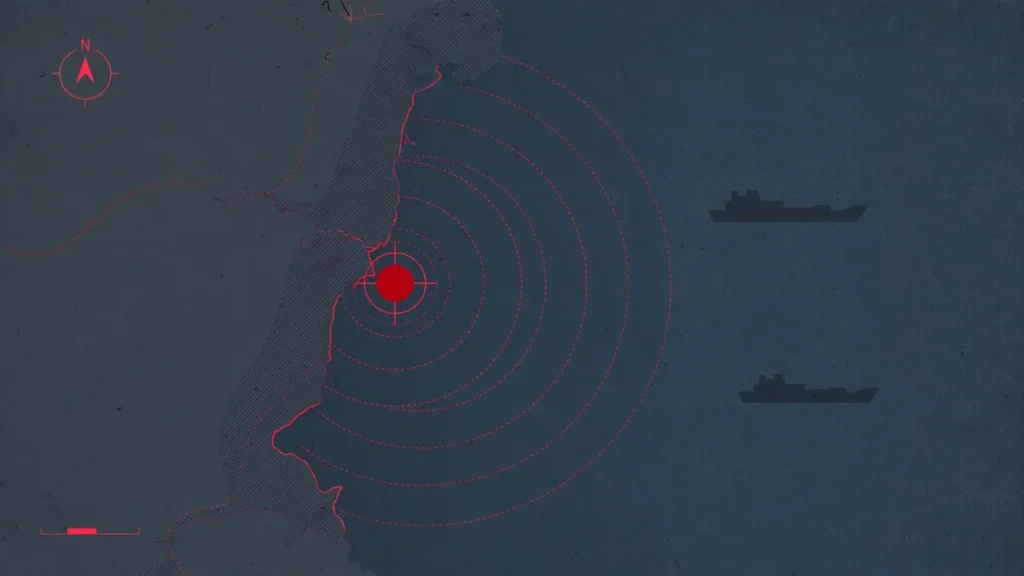
At around 3 a.m. local time on October 6, 2026, sea and aerial drones struck two commercial vessels operating in the Black Sea off eastern Bulgaria, about 70 nautical miles (130 km) from the coastal town of Byala and east of Cape St Atanas — well inside Bulgaria’s exclusive economic zone and roughly 140 nautical miles from the Ukrainian coast, Reuters reported.
The Alfa Watan, sailing under the flag of Togo and heading north, took critical structural damage and sank at the scene. Rescuers later found overturned life rafts, life jackets and debris — but no crew. Her cargo was not disclosed by authorities, and the number of people aboard remains unknown.
The Able, flying the flag of Palau, was carrying wheat and sailing south when she was hit. Fire broke out aboard and the crew abandoned ship; the Bulgarian ferry Dioscuria altered course to assist and evacuated all 18 crew members — 11 Turkish and 7 Indian nationals. Two sailors suffered severe injuries, one burns and one a head injury, and were flown by helicopter to a hospital in Varna, according to the Associated Press.
Bulgarian Prime Minister Rumen Radev convened an emergency government meeting and declared the attack “an unacceptable attack in Bulgaria’s exclusive economic zone” and a “blatant violation of international law and maritime law,” the AP reported. Radev added that the incident was “seriously disrupting shipping in the Black Sea, driving up insurance costs even further and making shipping extremely difficult.”
Shipping sources described it as the first drone attack on shipping inside Bulgaria’s economic zone — a significant escalation, since Bulgaria is a NATO member and its waters had until now sat outside the corridor of ship strikes concentrated near Ukraine’s coast.
By the numbers
| Metric | Figure | Source |
|---|---|---|
| Distance of attack from Bulgarian coast | ~70 nautical miles (130 km), off Byala | Reuters (CONFIRMED) |
| Distance from Ukrainian coast | ~140 nautical miles | Reuters (CONFIRMED) |
| Able crew rescued | 18 (11 Turkish, 7 Indian) | AP, AFP (CONFIRMED) |
| Crew severely injured, flown to Varna | 2 | AP, AFP (CONFIRMED) |
| Alfa Watan crew recovered | 0 — crew still missing | Reuters, AFP (CONFIRMED) |
| Royad Mammadov dead (Romania’s EEZ, Oct 5) | 2 dead, 11 rescued | Reuters, AP (CONFIRMED) |
| Alfa Watan owner | Turkish-owned (Equasis database) | AFP (REPORTED) |
| Strikes on commercial ships, July–September 2026 | 210+ | Ambrey, via Fox News (REPORTED) |
Figures marked CONFIRMED are backed by at least two independent sources; REPORTED figures come from a single or secondary source and should be treated with caution.
Who attacked the ships off Bulgaria?
The short answer: officially, nobody knows. Bulgarian authorities have not attributed the strike. Prime Minister Radev said it was unclear whether the drones came from Russia or from Ukraine, according to the BTA news agency, and told Bulgarian media the drones were “either Russian or Ukrainian.”
Kyiv, however, has pointed the finger at Moscow. President Volodymyr Zelensky said in his nightly address on October 6 that a joint Ukrainian-Bulgarian navy investigation established the incident “was a combined Russian attack using maritime and aerial drones,” adding that “the Ukrainian Defence Forces were conducting no operations in this part of the sea.” He called it “a continuation of Russia’s attempt to make the western part of the Black Sea completely unsafe for navigation,” Reuters reported.
A maritime security source told Reuters that initial assessments suggested the strike had probably been a Russian attack, and British maritime security firm Vanguard Tech reached a similar assessment, according to Splash247. But Moscow has made no comment on the incident at all, and NATO declined to comment, referring inquiries to Bulgarian authorities, the AP reported.
The fog is thickened by a single unconfirmed Turkish-source claim, noted by Vanguard, that the two vessels had collided near the entrance to Romania’s Sulina Canal — an account no official source has repeated. WarBrief treats that as unverified.
Background and timeline
The Bulgaria strike did not happen in isolation. It was the second of three ship attacks across the Black Sea in barely 48 hours:
- October 5, 2026: The Turkish-owned, St Kitts and Nevis-flagged Royad Mammadov, carrying corn from Izmail in Ukraine to Italy, caught fire and sank in Romania’s exclusive economic zone, about 30 nautical miles south of Sfantu Gheorghe. Two seafarers were killed and 11 rescued, according to Romania’s interior ministry. Zelensky said the ship was struck by two Russian drones. Read our earlier coverage: Royad Mammadov: Black Sea Ship Strike Explained (2026).
- October 6, early morning: The Alfa Watan and Able are hit off Bulgaria — the incident covered in this article.
- October 6, evening: The Liberian-flagged Aframax tanker Rio was set ablaze off Russia’s Black Sea coast near Sochi after an unmanned-vessel attack, according to Russia’s Transport Ministry; all 23 crew, Indian nationals, were rescued with no injuries, Reuters reported. Beaches in Sirius were closed.
- October 7: President Iliana Yotova convened a Security Council session for Wednesday afternoon on maritime security and critical infrastructure, the AP reported — the outcome is not yet known.
The pattern follows months of Russian strikes on Ukrainian port infrastructure around Odesa, which we analyzed in Odesa Strikes Explained: Russia’s Black Sea Blockade (2026) — a campaign that has steadily pushed shipping danger westward.
Why it matters
First, geography. The attack happened inside the waters of a NATO member state — something the alliance cannot ignore even without invoking its treaty articles. Radev himself warned that “if this war is not brought to an end in time, it will continue to expand its geographical scope and increase the risk of even a global conflict.” Asked about NATO Articles 4 or 5, he said he saw no need, citing “more serious” attacks elsewhere — a line Bulgarian media carried and which NATO, in declining to comment, effectively let stand.
Second, economics. The Black Sea carries a large share of the world’s grain and a growing share of its energy. Every attack forces shipowners to re-price voyages: war-risk insurance surcharges rise, freight rates follow, and the cost lands on importers. Radev made the point explicitly — shipping is being disrupted and insurance costs driven “even further” up. British maritime-risk firm Ambrey counted more than 210 strikes on commercial ships between July and September 2026, according to Fox News, meaning the Bulgaria attack is an escalation inside a pattern that was already accelerating.
What this means for US/UK/EU readers
Food prices: The Able was carrying wheat south through waters that feed the grain corridor into the Mediterranean and beyond. Repeated attacks on grain carriers raise freight and insurance costs, which feed into bread and pasta prices across Europe — and tighten global wheat markets the US also trades in.
Fuel and energy: The same day’s attack on the Rio tanker off Sochi is a reminder that energy shipping in the Black Sea is also in the line of fire. Disruption there can move diesel and gasoil prices in Eastern Europe and ripple into global markets.
Travel and security: Bulgaria’s Black Sea coast is a major summer destination for European tourists; the incident sits far offshore and poses no direct threat to beachgoers, but it does harden the security backdrop for NATO’s eastern flank, from Romanian ports to the Turkish straits.
Markets: Shipping and insurance stocks and grain futures are the instruments that react first to Black Sea incidents — historically, each escalation has produced short-lived price spikes before markets price in the new risk baseline.
Different perspectives
Sofia is treating the attack as a law-enforcement and rescue emergency first, and a geopolitical question second. Radev’s government has launched a full search for the missing crew and is monitoring for environmental damage — an oil spill inside a tourist coastline would be a second crisis.
Kyiv sees deliberate Russian terror against civilian navigation. Zelensky framed the strike as Moscow’s strategy to make the western Black Sea “completely unsafe for navigation,” and Ukraine’s foreign minister Andrii Sybiha said Russia “drives up risks, insurance and transport costs.”
Moscow has said nothing — neither denying nor acknowledging. Silence is itself a signal, consistent with Russia’s stance on previous unattributed strikes.
Brussels and Budapest: European Commission President Ursula von der Leyen condemned the attack, saying “commercial ships – and innocent crews – are being targeted, with lives already lost at sea,” while Hungary’s prime minister said Budapest “stands in full solidarity with Bulgaria,” Reuters and AFP reported.
What to watch next
The missing crew of the Alfa Watan is the immediate human story — as of October 7, no crew members had been recovered and the search continues. Watch for the outcome of President Yotova’s Security Council meeting on Wednesday afternoon, any environmental assessment from Bulgarian authorities, and whether vessel traffic off Bulgaria’s coast is rerouted or paused.
The bigger strategic question is whether NATO’s eastern members begin coordinating naval escorts or new insurance guarantees for Black Sea shipping — and whether shipowners simply start avoiding the western Black Sea altogether, as many did the Red Sea during the Houthi campaign. For ongoing coverage, follow our Conflict Zones hub.
Frequently asked questions
Who attacked the two ships off Bulgaria?
No one has been officially identified as responsible. Ukraine’s president says a joint Ukrainian-Bulgarian navy check showed a Russian combined air-and-sea drone attack; Bulgaria’s prime minister says it is unclear whether the drones came from Russia or Ukraine; a maritime security source told Reuters an initial assessment pointed to Russia. Russia has not commented.
Why hasn’t Bulgaria invoked NATO Article 4 or 5?
Prime Minister Radev said he saw no need to invoke the alliance’s consultation or collective-defence articles, citing what he described as more serious attacks elsewhere. He said he had informed the EU Council and NATO leadership. NATO declined to comment and referred questions to Sofia.
Is the Black Sea safe for commercial shipping now?
Clearly not in its western reaches. With two ships sunk in two days — one in Romania’s waters, one in Bulgaria’s — plus a tanker hit off Sochi, shipowners face higher war-risk premiums and may reroute or pause voyages. Bulgaria’s prime minister said the attacks are already disrupting Black Sea shipping and driving insurance costs higher.
Are the Alfa Watan crew still alive?
Unknown. Rescuers found an overturned lifeboat, life jackets and debris but no crew members. Bulgarian navy, air force and border police units were still searching as of October 7, and no crew had been recovered.
What happens if more ships are hit in NATO waters?
Bulgaria’s president has convened a Security Council session on maritime security, and the EU is watching closely. Further attacks could push NATO’s Black Sea members toward coordinated naval escorts or insurance backstops — and could prompt shipowners to avoid the western Black Sea entirely.
Sources
- Reuters via LA Post: Drone sinks ship off Bulgaria, as fears grow about hybrid attacks by Russia
- Associated Press via LA Post: Bulgarian PM says drone attack on 2 commercial vessels is ‘blatant violation of international law’
- Reuters: Russia says tanker crew rescued in Black Sea after attack set ship ablaze
- Splash247: Grain carrier sinks off Romania after suspected Russian drone strike
- Fox News: Drone strike sinks ship in NATO waters, Zelenskyy warns of looming massive strike