
WarBrief Live | October 13, 2026 | Global Conflicts
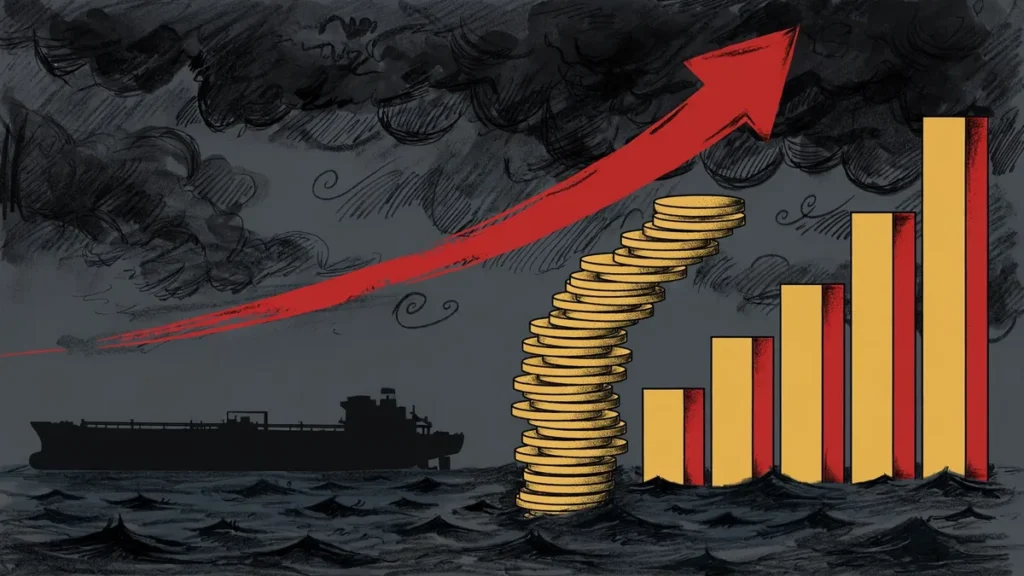
The Hormuz blockade shipping costs are no longer just an oil-market story — they are the story. Eight months into the US-Iran war, moving a single tanker of crude out of the Gulf costs roughly twenty-five times what it did before the shooting started, and every dollar of that bill is working its way into fuel prices, freight bills and inflation readings worldwide. This is what the shutdown of the world’s most important energy chokepoint actually costs, in freight, insurance and fuel — and why the bill keeps growing.
Key Takeaways
- Hiring a supertanker out of the Gulf now costs $1.2–1.6 million a day, up from $30,000–$65,000 before the war — and shippers struggle to find any vessel willing to make the run at all.
- War-risk insurance has jumped to 7.5–10% of a ship’s hull value per transit, up from 0.25% before the conflict — a 30-to-40-times increase, per Morningstar DBRS.
- Freight now represents 25–30% of Gulf crude’s delivered cost, against 1–3% before the war, according to maritime intelligence firm Windward.
- Traffic through the strait has collapsed: 31 ships transited daily in the final week of September, against 138 before the war — and the IMO says 93+ ships have been hit since February 28.
- A US- and UAE-backed oil shuttle via Oman is keeping some exports moving with ship-to-ship transfers, but Iran has now named it an explicit target.
What is the Hormuz blockade costing shippers?
The Strait of Hormuz is the narrow gap through which roughly a fifth of the world’s oil and gas flowed before the war began on February 28, 2026, when US and Israeli strikes hit Iran. Today the waterway is effectively a war zone: commercial traffic has collapsed, and the cost of every remaining sailing has exploded.
The headline number is freight. The daily cost of hiring an oil supertanker (a Very Large Crude Carrier, or VLCC) to sail from the Persian Gulf to China was about $65,000 a day last year, according to Clarksons data reported by CNN. By the time the Iran war was about to begin, it had climbed to $230,000 a day. Now it costs roughly $1.6 million a day. Other trackers put it at $1.2–1.3 million a day — either way, an increase of roughly twenty-fold and more, with oil producers now paying $30–40 million for a single roundtrip voyage in and out of the strait, according to the Wall Street Journal.
The reason is not mysterious. Maritime security company Vanguard counts at least 14 attacks on commercial vessels since September 20 alone, and the International Maritime Organization says at least 93 ships have been hit since the war began on February 28, with 24 sailors killed, according to industry reporting. Few crews want to sail into a corridor where, in the third quarter alone, 45 ships were targeted — 87% of them tankers, 47% belonging to Gulf Arab energy companies’ own national fleets, per Windward data cited by Al Jazeera.
The logistical workaround is itself expensive. Between 15 and 20 percent of the world’s VLCC fleet is now tied up in an inefficient shuttle system — smaller vessels loading crude at Arab ports, ship-to-ship transfers in the Gulf of Oman, then VLCCs carrying it onward — rather than sailing directly. “This is having cascading impacts for all vessel classes on freight and values across the world,” Windward analyst Michelle Wiese Bockmann told Al Jazeera.
Why are tanker rates so high right now?
Rates spike when sailors start saying no — and in the Gulf, they increasingly do. Some shippers are offering crews up to $25,000 per Hormuz trip, per the Wall Street Journal. Tanker captains can command $100,000 a month plus a $50,000 bonus per crossing, against normal pay of about $15,000, while ordinary sailors — normally paid around $1,500 a month — are receiving double pay near the strait and four to six times normal wages during actual transits, per industry reports.
The violence is getting closer, not further away. On October 11, the Nicaragua-flagged tanker MT Petro Dolphin was struck by a drone at the Sohar anchorage off Oman, leaving two Indian sailors missing; the same day, the tanker MT Valthera was hit by an unknown projectile and caught fire — attacks we broke down in our explainer. On October 12, the UK Maritime Trade Operations agency reported a container ship hit by a projectile while transiting the strait. Iran’s Revolutionary Guard, for its part, claims three tankers were badly damaged over the weekend after hitting naval mines — a claim no outside source has independently confirmed, and which Tehran has paired with footage that does not clearly show a mine detonating.
Iran has also put the alternative system squarely in its sights. The IRGC says any tanker using routes Tehran deems unauthorized will be “pursued” and “punished” anywhere in the region — and Windward notes that most of the recent attacks have targeted vessels transiting the southern corridor with their transponders switched off.
By the numbers: the blockade’s shipping bill
| Metric | Figure | Source |
|---|---|---|
| VLCC day rate, Persian Gulf to China | $1.2–1.6M/day now, vs $20k–65k/day last year | Clarksons via CNN; tradersunion.com (CONFIRMED) |
| Freight share of delivered Gulf crude cost | 25–30% now, vs 1–3% pre-war | Windward via Al Jazeera (CONFIRMED) |
| War-risk insurance per transit | 7.5–10% of hull value, vs ~0.25% pre-war (30–40x) | Morningstar DBRS via Canadian Underwriter (CONFIRMED) |
| Ships transiting Hormuz daily | 31 (final week of September), vs 138 pre-war | Windward via Al Jazeera (CONFIRMED) |
| VLCC capacity tied up in shuttle logistics | 15–20% of the global fleet | Windward via Al Jazeera (CONFIRMED) |
| Ships hit since Feb 28 | 93+, 24 sailors killed | IMO via tradersunion.com (CONFIRMED) |
| Captain pay | $100k/month + $50k per transit, vs ~$15k normal | tbsnews.net; The Week (CONFIRMED) |
| Fujairah bunker fuel | $686/tonne, up 67% year on year | Argus via tradersunion.com (CONFIRMED) |
| US blockade enforcement tally | 4 vessels disabled, 135 ships turned around, 10 IRGC-linked tankers destroyed since July 14 | US CentCom via Gulf News (REPORTED — US claim; limited independent verification) |
| Gulf oil-company discounts | Up to $35/barrel below official selling prices | Windward via The Week (REPORTED) |
| IRGC mine claims, Oct 10–12 | Three tankers badly damaged by naval mines | IRGC via Reuters/PressTV (REPORTED — Iranian claim, unconfirmed) |
Caveat: figures marked CONFIRMED appear in two or more independent sources; REPORTED items are claims by one side or single-source data, and are attributed as stated.
Background and timeline
- February 28, 2026: US and Israeli strikes on Iran open the war; Iran begins attacking ships transiting Hormuz without its authorization.
- July 14, 2026: The US naval blockade of Iran’s southern ports resumes, with sanctions tightening — the start of the tally CentCom now cites.
- Early September 2026: The IRGC threatens tankers at ports and anchorages in Kuwait and Bahrain, accusing both of hosting US forces.
- October 6, 2026: Only seven commodity vessels cross Hormuz — the lowest since July 23 — and crude flows through the strait fall 27% to 10.1 million barrels per day, per Kpler data.
- October 10, 2026: A US fighter jet strikes the stern of the Panama-flagged M/V Ocean Molica (also known as Arika Sun) in the Gulf of Oman, disabling its propulsion after it ignored repeated blockade warnings; no crew harmed.
- October 11, 2026: MT Petro Dolphin hit by a drone at Sohar anchorage (two Indian sailors missing); MT Valthera hit by a projectile; Iran’s security chief Mohsen Rezaei declares the US-UAE oil shuttle an explicit target and claims Iran has been striking “five or six” participating vessels nightly for weeks (Iranian claim).
- October 12, 2026: IRGC says a third tanker struck a naval mine (claim); UKMTO reports a projectile strike on a container ship transiting Hormuz; US Secretary of State Marco Rubio and UK Foreign Secretary Ed Miliband recommit to safeguarding Hormuz transit and holding Iran accountable.
- October 13, 2026: The IMF sharply cuts its 2026 growth forecasts for the Middle East and Central Asia, citing the longer-than-expected closure of the Strait of Hormuz.
What is the US-UAE oil shuttle around Hormuz?
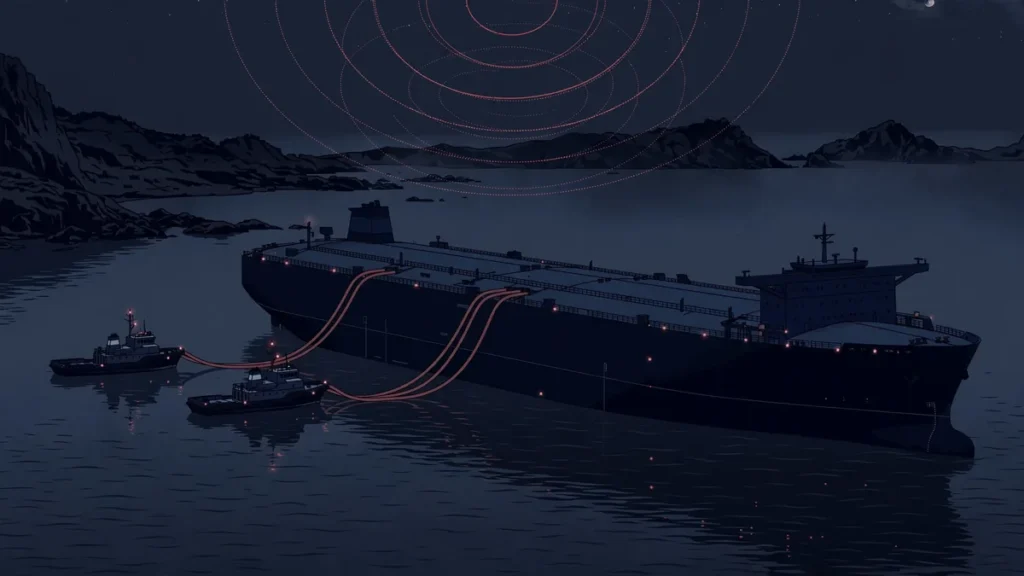
With the main strait nearly impassable, the US Navy opened a workaround: smaller vessels load crude at Arab ports and ferry it to larger tankers via ship-to-ship transfers in the Gulf of Oman, then VLCCs sail onward through a southern corridor near Oman’s coast — often with transponders switched off and sailing at night to avoid Iranian targeting. Oman permits the passage under international maritime law’s right of transit, with US military assistance, and the operation is run by the Gulf states — especially the UAE — in close coordination with the US Navy, according to The Week’s reporting.
The system works — Kpler data shows overall Gulf oil flows have returned close to pre-conflict levels, even though flows through Hormuz itself remain about a third below pre-war levels. But it works expensively, which is why Iran now sees it as the pressure point. Rezaei has called it a “smuggling operation run by US Central Command and the UAE military” (his characterization), claimed Iranian forces are striking participating vessels nightly (unverified claim), and warned that US-linked digital infrastructure in the UAE — data centres, AI facilities and undersea cables — could face retaliation. Attacks have already extended beyond the strait to target the shuttle system itself.
What this means for US/UK/EU readers
The blockade’s bill does not stay in the Gulf — it travels in the tanker and arrives at the pump. In the United States, regular gasoline averaged about $4.36 a gallon on October 11, per AAA data, and the reason is freight rather than supply: CNN reported that the “insane” $1.6-million-a-day tanker cost is baked into every barrel that reaches a refinery. European drivers face the same arithmetic, with transport costs adding more than $35 to a single barrel shipped from Saudi Arabia to Rotterdam, against about $2 in 2025.
The knock-on effects reach far beyond fuel. The IMF’s October 13 cut — projecting a 0.3% contraction for the Middle East and Central Asia in 2026, instead of the 1.9% growth it forecast six months ago, with Saudi Arabia down 3.3% and the UAE down 3.9% — is explicitly tied to the prolonged Hormuz closure, and regional demand shocks feed global inflation through supply chains. Marcos Alvarez of Morningstar DBRS warns shippers may need special coverage for vessels trapped for months carrying perishable food or factory-bound components, costs that flow straight through to consumers: “You are not even transiting the Strait, but one of your key suppliers might be.”
WarBrief Live covers markets for their geopolitical context only. This article is educational content and is not financial advice.
Different perspectives
Tehran treats the strait as leverage. Iran’s security chief argues the pressure is working because Hormuz has a global impact — a view echoed by Crisis Group analyst Hamidreza Azizi, who notes Iran appears “under no immediate pressure to reach an agreement,” while questioning whether Tehran is overestimating its ability to sustain the pressure given the mounting economic costs to Iran itself.
Washington and London treat it as a security obligation. Rubio and Miliband this week reiterated a shared commitment to safeguarding Hormuz transit and holding Iran accountable, while Qatar’s emir called for intensified efforts to protect navigation and energy infrastructure across the Gulf.
The shipping industry treats it as a math problem. With only a limited number of ships willing to make the run, those that do command record rates — and everyone along the chain, from crew to insurers to refiners to motorists, is paying. What is disputed is not the direction of the numbers but some of the claims behind them: CentCom’s enforcement tally and the IRGC’s mine claims both rest on one side’s word, with limited or no independent verification.
What to watch next
Three things will determine whether the shipping bill gets worse. First, the shuttle system’s survival: if Iranian attacks succeed in deterring the US-UAE workaround, even the current trickle of exports chokes off, and freight goes higher still. Second, the insurance cycle: Lloyd’s of London’s Joint War Committee keeps the area in its war-risk zone, and Alvarez says he does not expect it to be removed for months — meaning the 30-to-40-times insurance multiplier is locked in for the foreseeable future. Third, the diplomatic track: Tehran claims Washington has accepted some of its seven conditions for reopening the strait — a claim the US has not confirmed — while the IMF now assumes the waterway reopens in 2027. Until one of these moves, the world’s oil will keep paying war prices to move. For context on how this has already fed through to crude benchmarks, see our analysis of why oil prices surged past $103, and track the broader conflict on our conflict-zones hub.
Frequently asked questions
Why is shipping through the Strait of Hormuz so expensive right now?
A pile-up of costs: tanker day rates of $1.2–1.6 million (up roughly 20x since before the war), war-risk insurance at 7.5–10% of hull value (up 30–40x), crew danger pay, 67% higher bunker fuel at Fujairah, and an inefficient ship-to-ship shuttle system that ties up 15–20% of the world’s VLCC fleet. The underlying driver is the war itself — 93+ ships hit since February 28, per the IMO — which has collapsed the supply of ships willing to make the run.
Why are gasoline prices still high even though oil is moving through the Strait of Hormuz again?
Because the oil is moving expensively, not freely. Shipowners pay record charter rates, record insurance and record crew pay to move every barrel through or around the war zone, and Gulf national oil companies are discounting up to $35 a barrel just to get cargo moving. Those logistics costs are embedded in the refined price of every gallon, which is why US gasoline sat near $4.36 a gallon even as crude flows partially recovered.
What is the US-UAE oil shuttle around the Strait of Hormuz?
It is the workaround keeping some Gulf oil flowing: smaller vessels load crude at Arab ports and transfer it ship-to-ship onto VLCCs in the Gulf of Oman, which then sail onward through a southern corridor near Oman’s coast with US military assistance — often at night with transponders off. The system is run by the Gulf states, especially the UAE, in close coordination with the US Navy. Iran has declared it an explicit target and claims to strike participating vessels (an unverified Iranian claim).
Are there any alternative routes to bypass the Strait of Hormuz?
Only partial ones. Saudi Arabia can pump some crude to the Red Sea via the East-West pipeline; the UAE has a small Fujairah pipeline; but countries like Iraq, Kuwait and Bahrain have no alternative export route. The US-UAE shuttle via Oman is the main workaround, and it depends on ship-to-ship transfers that Iran is now attacking. There is no full-capacity substitute for the strait, which is why the IMF says its closure is weighing on the entire region’s economy.
How much does war-risk insurance cost for a tanker in the Gulf?
Before the war, plain hull-and-machinery cover for a Hormuz transit cost about 0.25% of the vessel’s insured value. The latest broker numbers are 7.5–10% — a 30-to-40-times increase, per Morningstar DBRS — meaning a supertanker can face up to $20 million in war insurance alone for one Gulf voyage. Cargo insurance typically does not cover war risk, so shippers buy it separately, and may also need non-damage business interruption cover if their ship gets trapped for months.
Sources
- Al Jazeera: Iran sets crosshairs on ‘US-UAE’ oil shuttle out of Strait of Hormuz (October 12, 2026)
- CNN: If the Strait of Hormuz is open, why are gas and diesel so expensive? (October 9, 2026)
- Canadian Underwriter: No end in sight to blockade in Hormuz — what happens to marine coverage now? (October 2026)
- The Week: Iran’s new strategy — targeting oil shuttles to control the Strait of Hormuz (October 13, 2026)
- The Economic Times: Crude oil crisis in Hormuz — much more than just price and quantity (October 13, 2026)
- Traders Union: Strait of Hormuz shipping costs surge as tanker crews command danger pay (October 2026)
- Gulf News: 135 ships turned around — US intensifies enforcement of Iran naval blockade (October 2026)
- Yeni Safak: US and UK vow to safeguard Hormuz transit, hold Iran to account (October 13, 2026)
- Gulf News: US-Iran war — IRGC warns foreign powers off Strait of Hormuz (October 13, 2026)


Discussion 0
Share analysis, corrections, or context. Be civil — comments are moderated.