WarBrief Live | October 7, 2026 | AI & Future Warfare
On October 4, 2026, President Donald Trump announced a federal “Super Intelligence Force” task force to coordinate American artificial intelligence policy. Two days later, the phrase “super intelligence” was trending — and meaning two different things at once. In Washington, it is the administration’s new brand name for AI. In research labs, “superintelligence” is a technical term for a machine that could outthink humanity in every domain. This explainer separates what super intelligence means in a military context — from the AI tools armed forces use today to the hypothetical systems experts warn about — and shows what is proven, what is policy, and what is still speculation.
Key Takeaways
- “Super intelligence” now has two meanings: the Trump administration’s 2026 rebrand of federal AI policy, and the technical term for a hypothetical AI smarter than all humans in every domain. They are not the same thing.
- No superintelligent system exists today. The most capable current systems — frontier models from labs such as OpenAI, Anthropic and Google DeepMind — remain human-guided and narrow in autonomy.
- Militaries already use AI as an assistant: intelligence analysis, targeting support, drone operations, cyber defense, logistics and wargaming. None of this is superintelligence.
- The decisive debate is human control. US policy (DoD Directive 3000.09) and proposed law (the FY2027 defense bill framework) still require human judgment over lethal force.
- Experts disagree on timelines but agree on the stakes: escalation, miscalculation and nuclear stability demand rules before the most dangerous capabilities arrive.
What does “super intelligence” actually mean?
The confusion starts with the vocabulary. Researchers use a ladder of terms, and each rung means something different:
- AI (narrow): systems that perform specific tasks — image recognition, translation, radar signal processing. Machines have beaten humans at narrow tasks for decades.
- Generative AI: models that produce text, images, code and video, built on large-scale machine learning.
- Frontier AI: the most capable current models, from labs such as OpenAI, Anthropic and Google DeepMind. They are broadly capable but still guided constantly by human input.
- AGI (artificial general intelligence): a system with human-level intelligence across a wide range of tasks. Nothing deployed today qualifies.
- Superintelligence (ASI): philosopher Nick Bostrom’s 2014 definition — an intellect that “greatly exceeds the cognitive performance of humans in virtually all domains.” The concept has roots in mathematician I.J. Good’s 1960s idea of an “ultraintelligent machine” and Vernor Vinge’s 1993 essay on the technological singularity.
Now comes the twist. Since late September 2026, the US executive branch has used “Super Intelligence” as its official name for all artificial intelligence — keeping the existing legal definition of AI but changing the label. When the White House says “Super Intelligence Force,” it means an AI task force, not a program to build superintelligent machines. The technical research community uses the word very differently. Any claim that a government “has” superintelligence should be treated with skepticism — and measured against the research definition, not the branding.
What would super intelligence mean for the military?
Imagine a system that could out-plan any general, out-code any hacker and redesign its own weapons faster than any engineering team. That is the scenario military thinkers mean when they ask whether super intelligence could become the military’s ultimate weapon. A truly superintelligent system applied to warfare could, in theory, fuse every sensor on the planet into one picture, plan campaigns in seconds, discover cyber vulnerabilities no human could find, and design novel weapons overnight.
But every one of those verbs is conditional. No such system exists, and researchers disagree sharply on whether and when it could. AI safety researcher Evan Hubinger of Anthropic has said publicly there is more than a 10% chance AI could threaten humanity within a decade — a personal estimate, not a scientific consensus. Anthropic CEO Dario Amodei wrote in a September 2026 essay that slowing the pace of AI capability gains by even a year or two could greatly reduce the risk of something going badly wrong; OpenAI’s Sam Altman and Elon Musk publicly backed his concern. Meanwhile, a Quinnipiac University poll released in early October 2026 found 73% of Americans were concerned AI could threaten human survival.
The honest answer to “could it be the ultimate weapon?” is: in theory, a superintelligence could dwarf every military advantage in history — but it does not exist, and the race to build more capable systems is happening with safety rules that even the labs themselves say are incomplete.

How is AI already used in military operations?
Today’s military AI is a far cry from superintelligence — but it is already changing how wars are fought. The Pentagon’s Project Maven, launched in 2017, used machine learning to analyze drone footage; its descendant systems now help process vast streams of intelligence data. In Ukraine, small AI models trained on battlefield data run on cheap chips aboard drones, helping them recognize targets and resist jamming. Reporting on the 2026 Iran conflict described US forces using advanced AI to help strike roughly 1,000 targets in the opening day of operations — one of the largest documented uses of military AI in combat. (Attribution: reported by US and international media in March 2026; the Pentagon has not released a full accounting.)
The main real-world uses fall into a few buckets: intelligence fusion (combining satellite imagery, signals and open-source data), targeting support (suggesting, not selecting, targets), cyber defense and offense, logistics (predicting maintenance, routing supplies), and wargaming (simulating adversary decisions). In every case, current systems act as advisers to human commanders — fast, powerful advisers, but advisers. For a deeper look at the intelligence side, see our explainer on how military drones moved from surveillance to strike. (for the intelligence side in depth, see our explainer on AI in military intelligence)
Who decides when AI can use lethal force?
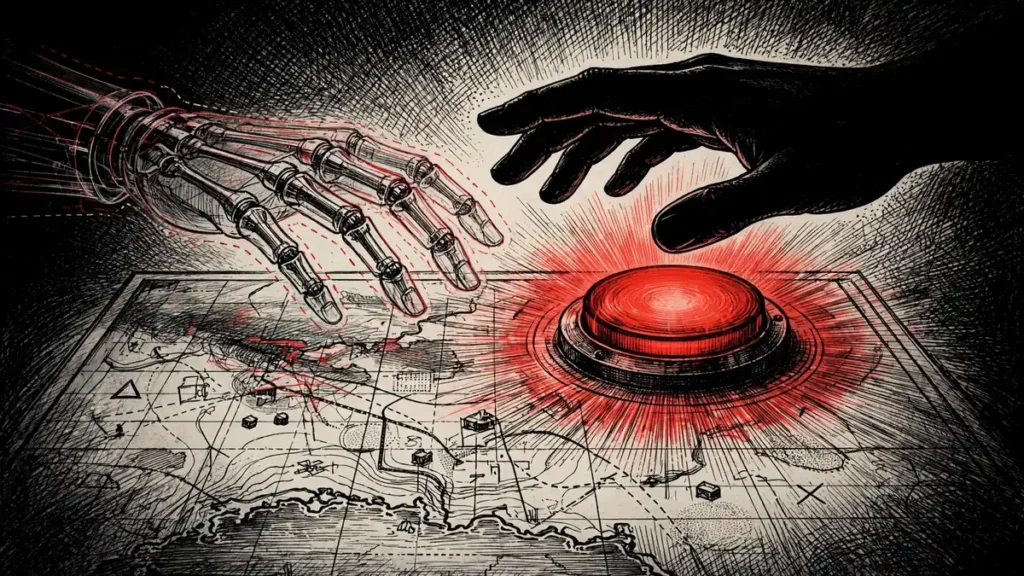
This is the central moral and legal question. Under DoD Directive 3000.09, the Pentagon’s governing policy on autonomy in weapon systems (issued January 2023), autonomous weapons may — after activation by a human — select and engage targets without a human approving each strike. But the directive requires commanders and operators to retain “appropriate levels of human judgment,” plus legal review, testing and safeguards. In plain terms: a commander can authorize a system to defend a defined area, but the human sets the mission, the rules and the limits.
The debate is heating up. On September 30, 2026, Defense Secretary Pete Hegseth announced a new four-star Autonomous Warfare Command at Quantico, Virginia — intended to accelerate drones, robotics and AI across the armed forces — without, in the Pentagon’s account as reported, addressing human control over lethal force. In Congress, the Senate Armed Services Committee’s draft of the FY2027 defense bill (marked up June 10, 2026) would codify “appropriate levels of human judgment” into law and require fail-safes, intervention methods and records of target-selection logic. Internationally, the 2024 REAIM summit in Seoul saw about 60 countries endorse a “Blueprint for Action” for responsible military AI — including the principle that humans must keep control over any use of nuclear weapons. China declined to support it.
Paul Scharre, executive vice president of the Center for a New American Security and author of Army of None, has warned that “we could look back 15 or 20 years from now and realize we crossed a very significant threshold” — and that autonomous weapons could shift power toward non-state actors who face none of the treaty constraints states do. For the ethics debate in full, read our explainer on autonomous weapons systems.
What do experts warn could go wrong?
Three risks dominate serious analysis. Escalation: AI systems that compress decisions from days to seconds could trigger crises faster than diplomats can respond — a concern explored in depth by Scharre and Michael Depp in a 2024 War on the Rocks essay on AI and nuclear stability. Loss of control: complex systems may behave in ways their operators cannot predict or stop, especially in electronic-warfare environments where communications break down. Nuclear stability: integrating AI into nuclear command-and-control is the red line researchers fear most — the REAIM declaration’s insistence on human control of nuclear weapons exists precisely because of it. (A full analysis of the AI–nuclear question is covered in a companion explainer.)
There is also the governance gap. The Pentagon announced a new Autonomous Warfare Command and a classified fast-track AI memorandum in 2026, Congress is writing human-control rules into law, and labs are calling for a slowdown — all at once. The rules are being written while the capabilities are already deploying.
What this means for US/UK/EU readers
For taxpayers, the Super Intelligence Force is a signal that AI dominance is now treated as a national mission on par with the space race — expect defense AI budgets, university research funding and data-center construction to remain political flashpoints. For service members and their families, the shift toward autonomous systems means the character of military service itself is changing; the Pentagon’s own framing of a “high-low mix” of exquisite crewed platforms and mass cheap drones will reshape which skills the armed forces value. And for everyone else: the standards written now — in Washington’s task forces, in Congress’s defense bill, and in international summits — will decide whether the AI in tomorrow’s wars answers to humans. Public concern is already high: 81% of Americans told Quinnipiac in October 2026 that safety matters more than innovation. Our reporting on the Pentagon’s Project Meridian shows how deeply the tech industry is now embedded in these decisions.
Read next: The future of war: will AI, drones and robots replace armies?
Frequently asked questions
Does superintelligence exist?
No. Superintelligence — AI that greatly exceeds human intelligence in virtually every domain — remains a hypothetical concept discussed by researchers and philosophers. The most capable AI systems in 2026 are frontier models that are powerful but still human-guided and narrow in autonomy.
What is the US “Super Intelligence Force”?
Announced by President Trump on October 4, 2026, it is a federal task force chaired by Director of National Intelligence Jay Clayton, with the FTC chair, the Pentagon’s research chief and the OPM director as vice chairs. Its mandate is to coordinate federal AI policy and engagement with AI companies, infrastructure providers and public groups — an AI governance body, not a military superintelligence program.
Does the Pentagon allow AI to choose targets?
Under DoD Directive 3000.09, an autonomous weapon can select and engage targets after a human activates it within defined rules — but commanders must retain “appropriate levels of human judgment,” and systems require legal review and testing. Congress is moving to write that requirement into law via the FY2027 defense bill.
Could AI start a nuclear war?
No documented incident of AI causing a nuclear launch exists. The serious concern among experts is that AI could speed up decision-making, produce false warnings or be misused in ways that escalate a crisis. About 60 countries endorsed the principle of keeping human control over nuclear weapons at the 2024 REAIM summit in Seoul.
Sources
- CNN: Trump announces leadership of AI task force (Oct 4, 2026)
- TechCrunch: Trump unveils his new Super Intelligence Force (Oct 4, 2026)
- Arms Control Association: U.S. Senate panel approves AI, autonomous weapons rules (July/Aug 2026)
- Reuters: Sixty countries endorse ‘blueprint’ for AI use in military; China opts out (Sept 10, 2024)
- Computer Weekly: Will autonomous weapons make humans passive participants in war? (Paul Scharre interview)
- USA Today: Trump names top aides to ‘super intelligence’ AI force (Oct 4, 2026)