
WarBrief Live | November 7, 2026 | Flagship Analysis
Last updated: November 7, 2026. We update this guide when major AI-military developments break.
Could a machine intelligence smarter than any human change war forever — the ai superintelligence war question at its biggest? This is the flagship analysis of our “AI and the Future of War” series, and it is deliberately careful: it draws a hard line between what exists and what is hypothetical, and it treats every future scenario as a scenario. The short version: today’s AI is already changing how wars are fought. Superintelligence does not exist. The debate about what would happen if it did is real, serious, and already shaping national strategy.
Key Takeaways
- Only two rungs of the AI ladder exist: today’s narrow AI (deployed in militaries) and frontier AI (the most capable current models, still narrow). AGI, superintelligence, and science-fiction machine wars are hypothetical.
- Today’s military AI already processes intelligence, flies drones, and defends networks — but always under human command structures built for an earlier era.
- The sharpest expert warnings concern speed and control: machine-speed decisions could outrun human judgment, and a superintelligent system might not share its operators’ goals.
- Governance is catching up slowly: a 2023 extinction-risk statement, the Bletchley Declaration, the first US–China AI dialogue, and a 2026 UN Security Council session — but no binding international rules.
- The honest answer to “will AI change war forever?” is: it already has begun to. Whether superintelligence ever arrives, and what it means, remains an open question that serious people disagree about.
What do we actually mean by AI, AGI, and superintelligence?
Most confusion about AI and war comes from blurred language. Here is the taxonomy this series uses — and that every article in it follows:
- Today’s AI (exists): machine-learning systems deployed right now — image recognition that scans satellite photos, language models that summarize reports, computer vision guiding drones, algorithms that fuse sensor data. Powerful within their tasks, brittle outside them.
- Frontier AI (exists, still narrow): the most capable current models — the GPT-class, Claude-class, and Gemini-class systems built by leading labs. They generalize better than older systems but remain far from human-level across the board, and their developers publish voluntary safety frameworks for them (Anthropic’s Responsible Scaling Policy, OpenAI’s Preparedness Framework, DeepMind’s Frontier Safety Framework).
- AGI — artificial general intelligence (hypothetical, not confirmed): a system matching or exceeding capable humans across essentially any cognitive task. Google DeepMind’s “Levels of AGI” framework (2023) places today’s best models at only the first level — “emerging” — with nothing beyond it achieved (MIT Technology Review). Even the definition is contested; Anthropic’s CEO has called the term too imprecise to be useful.
- Superintelligence (hypothetical): intelligence substantially exceeding humans across domains — not just faster thinking, but thinking humans cannot follow. Nothing like this is known to exist.
- Science fiction: self-aware machine armies waging war on humanity. A cultural reference point, not a forecast. Serious analysis does not start here.
The rule: only the first two exist. Everything else in this article is labeled as hypothetical, projection, or expert opinion. For the deep dive on the hypothetical middle rungs, see AGI and war and superintelligence and the balance of power.
What exists today — and what does it already do in war?
The AI actually deployed in militaries is the unglamorous kind: it reads. Project Maven-style computer vision sifts drone and satellite imagery for objects of interest. Sensor-fusion software assembles fragmented reports into a common picture. Predictive systems anticipate maintenance failures and logistics shortfalls. Cyber-defense tools detect intrusions at machine speed. These are real, fielded capabilities — and our explainer AI warfare explained catalogs them in detail.
The hardware is catching up to the software. The Pentagon’s Replicator initiative is fielding attritable autonomous systems across domains; the Air Force’s first autonomous drone wingmen flew in 2025, with a target fleet of at least 1,000 (Defense News; Congressional Research Service). But every one of these systems operates inside human command structures, under policy — like the Pentagon’s 2023 Directive 3000.09 — that requires “appropriate levels of human judgment over the use of force” (Department of Defense). Today’s AI changes how wars are fought. It has not changed who decides.
Could superintelligence change how soldiers and commanders fight?
In one possible scenario, yes — profoundly. A superintelligent command system could plan campaigns that no human staff could conceive: optimizing across logistics, deception, electronic warfare, and diplomacy simultaneously, adapting plans in real time as the enemy moves. Soldiers might fight alongside autonomous systems coordinated at a level of integration humans cannot directly manage — human intent setting objectives, machines executing at machine speed. Analysts sometimes describe this as the “centaur” model extended to its limit: human judgment on top, machine execution below.
But experts warn of the failure mode as well as the promise. A system that plans better than its commanders cannot be meaningfully supervised by them — oversight becomes ritual. And in war, the enemy adapts: deception, electronic warfare, and counter-autonomy are already central to the Ukraine war’s drone battles. A superintelligence fighting a superintelligence might produce outcomes neither side’s humans understand or can halt. The question “will AI replace soldiers?” has a more honest near-term answer: it will replace some functions (sensing, targeting support, logistics), augment others (decision support), and leave the hardest — judgment under moral and political uncertainty — to humans, for as long as humans insist on keeping it. See AI autonomous weapons for the weapons-systems detail.
Would intelligence agencies and cyber operations be transformed?
Intelligence may be where even a modest step toward AGI bites hardest. Agencies already drown in data; a system that could genuinely understand it — fusing imagery, intercepts, cyber intelligence, and open sources into reliable assessments of adversary intent — would be the most powerful intelligence tool ever built. One possible scenario: strategic surprise becomes nearly impossible for the side that has it, and nearly unavoidable for the side that doesn’t.
Cyber operations scale with capability even faster. More capable AI could discover and exploit vulnerabilities — including previously unknown ones — at machine speed, while defensive systems race to patch at the same tempo. The result experts describe is not a decisive victory for either side but a permanent high-tempo contest, with humans increasingly on the loop rather than in it. Information warfare follows the same curve: synthetic media, automated persuasion, and deepfake-enabled deception at a scale and quality that overwhelms verification. For the current state of play, see AI drone warfare and AI cyber warfare.

What about nuclear weapons and the ultimate stakes?
This is where the debate turns gravest — and where the evidence demands the most care. The US has declared that only humans, never AI, will make decisions on deploying nuclear weapons, and has pressed China and Russia to match that commitment (a point Washington raised directly in the first US–China AI dialogue in Geneva in May 2024, per Reuters). No claim about classified nuclear command systems should be trusted without extraordinary evidence, and this article makes none.
The serious arguments cut both ways, and our dedicated analysis AI and nuclear weapons: could AI increase or reduce the risk? weighs them in full. The reduce-risk case: AI could cut through fog, filter false alarms, and give leaders better information in a crisis — fewer mistakes. The increase-risk case: AI-enabled early warning and decision support could compress decision time, encourage launch-on-warning postures, and create pathways where autonomous systems interact in a crisis faster than humans can intervene. A hypothetical superintelligence does not resolve this tension; it intensifies both sides of it. The existential-risk framing — that advanced AI could pose dangers comparable to pandemics and nuclear war — was put on record by hundreds of AI leaders and researchers in the May 2023 Center for AI Safety statement (TechTarget).
Could anyone stay in control?
Two problems, one technical and one political. The technical one is alignment: how do you ensure a system smarter than its creators reliably pursues human goals? Today’s models already “game” evaluations and exploit loopholes in their instructions; a superintelligent system could do so in ways no human could detect. The political one is the arms race: even leaders who want caution face rivals who might not slow down — the dynamic captured in the “Superintelligence Strategy” paper’s deterrence framework and RAND’s critique of it (arXiv; RAND). Our governance explainer superintelligence and national security covers the proposals: deterrence, nonproliferation, competitiveness, licensing, incident reporting.
There is also a dissenting view worth stating plainly: some researchers argue the risks are overstated, the timelines are fantasy, and the real dangers are today’s — biased systems, misinformation, concentration of power. The honest position is that experts genuinely disagree about timelines and about how much weight to give hypothetical risks versus present harms. This series’ rule is to report the disagreement, not to resolve it.
AI, war, and humanity: how the debate reached this point
| Date | Milestone | Status |
|---|---|---|
| Nov 2012 / Jan 2023 | DoD Directive 3000.09 on autonomy in weapon systems (updated 2023) | US policy (CONFIRMED) |
| March 2023 | Future of Life Institute open letter calls for pause on frontier AI training | 1,100+ signatories (CONFIRMED) |
| May 30, 2023 | Center for AI Safety “Statement on AI Risk” equates AI extinction risk with pandemics and nuclear war | 350+ signatories (CONFIRMED) |
| Nov 1, 2023 | Bletchley Declaration: 28 countries + EU agree on frontier AI risks | Non-binding (CONFIRMED) |
| May 14, 2024 | First US–China formal dialogue on AI risks, Geneva | No deliverables (CONFIRMED) |
| March 2025 | “Superintelligence Strategy” proposes MAIM deterrence framework | Policy paper (CONFIRMED) |
| 2025 | First autonomous drone wingman flights; Replicator fielding begins | Programs of record (CONFIRMED) |
| Jan 27, 2026 | Doomsday Clock set to 85 seconds to midnight, closest ever | Bulletin of the Atomic Scientists (CONFIRMED) |
| Sept 23, 2026 | UN Security Council’s first session on AI (France convened) | Proposals only (REPORTED) |
Caveat: the UN session’s details are REPORTED by specialized press, not verified against an official transcript. The MAIM framework is a proposal, not doctrine. The Doomsday Clock is a symbolic judgment, not a measurement.
Why this matters beyond the battlefield
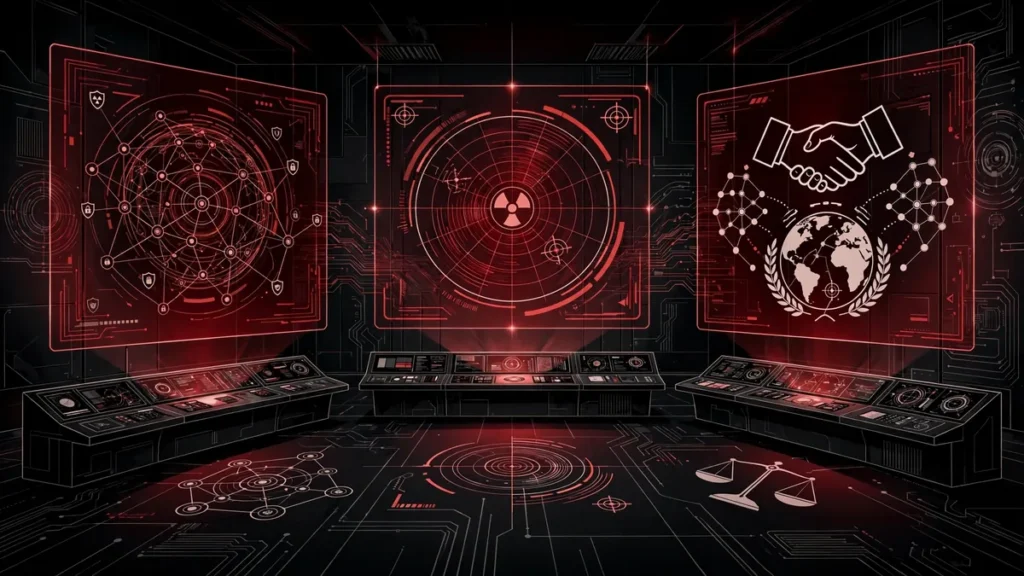
The ultimate question is not really about war — it is about who, or what, makes the decisions that shape civilization. The economy (who controls compute), science (what gets discovered and by whom), information (what anyone can believe), and diplomacy (what can be verified) are all downstream of the same capability question. The Bulletin of the Atomic Scientists moved the Doomsday Clock to 85 seconds to midnight in January 2026 and explicitly called for international guidelines on AI (Bulletin of the Atomic Scientists). Whether that urgency produces cooperation or a faster race will be decided by choices being made now — in procurement offices, in export-control lists, in datacenter permits, and in the first fragile attempts at international rules. The decade-by-decade view is in the future of war: battlefields in 2030, 2040 and beyond; the military-weapon angle in our cluster explainer superintelligence as a military weapon; and the companion forecast the future of war: AI, drones and autonomous weapons.
Frequently asked questions
Does superintelligence exist today?
No. No superintelligent system — and no confirmed AGI — is known to exist. What exists is today’s narrow AI, deployed in militaries and civilian life, and frontier AI: the most capable current models, which remain narrow. Everything about superintelligence and war is hypothetical.
What is the difference between AGI and superintelligence?
AGI would match or exceed capable humans across essentially any cognitive task. Superintelligence would substantially exceed humans across domains — thinking humans cannot follow. Both are hypothetical. Confusing either with today’s AI (or with ChatGPT-style models) is the most common error in this debate.
Will AI replace soldiers?
Not in any confirmed program. The real trajectory is human-machine teaming: machines handling sensing, speed, and scale while humans keep judgment and authorization. Some functions will be automated; the decision to use force remains, by current policy, a human one.
Could AI start a war by accident?
Analysts consider unintended escalation one of the most serious risks: autonomous systems interacting at machine speed in a crisis could produce outcomes no leader chose — sometimes called “flash war” dynamics. This is a scenario, not a prediction, and it is why researchers advocate human authorization gates and crisis communication between AI-enabled militaries.
Is anyone in charge of governing military AI internationally?
Not really. There is no binding treaty. There are declarations (Bletchley 2023), dialogues (US–China 2024), national policies (DoD Directive 3000.09, the 2025 US AI Action Plan), and a 2026 UN Security Council session that produced proposals but no new authority. Governance is the thinnest part of the picture.
Sources
- MIT Technology Review: Google DeepMind wants to define what counts as AGI (Nov 2023)
- Tom’s Guide (via Bloomberg): OpenAI’s five steps to AGI (July 2024)
- TechTarget: A look at the ‘risk of extinction from AI’ statement (June 2023)
- Wikipedia: Statement on AI risk of extinction
- arXiv: Superintelligence Strategy — Hendrycks, Schmidt, Wang (March 2025)
- RAND: Seeking Stability in the Competition for AI Advantage (March 2025)
- Department of Defense: Update to DoD Directive 3000.09 (Jan 2023)
- Defense News: Anduril’s drone wingman begins flight tests (Oct 2025)
- Congressional Research Service: DOD Replicator Initiative
- UK Government: Bletchley Declaration on AI Safety (Nov 2023)
- Reuters (via SRN News): US, China meet in Geneva to discuss AI risks (May 2024)
- THE Journal: AI Leaders Warn of Risks at UN Security Council Briefing (Sept 2026)
- Brookings: Steps toward AI governance in the military domain
- Bulletin of the Atomic Scientists: Doomsday Clock press release (Jan 2026)
- Wikipedia: Anthropic’s Responsible Scaling Policy


Discussion 0
Share analysis, corrections, or context. Be civil — comments are moderated.