WarBrief Live | October 7, 2026 | AI & Future Warfare
The AI Iran war — the US-Israeli air and missile campaign against Iran that began on February 28, 2026 — has become the first large-scale conflict in which artificial intelligence sits at the center of the targeting process. American planners used an AI-assisted targeting platform to generate strike packages at unprecedented speed, Iran answered with its own AI-assisted drone swarms, and the campaign exposed both the power and the danger of letting algorithms into the kill chain.
Key Takeaways
- The Pentagon’s Maven Smart System — an AI-assisted targeting platform built by Palantir — fused satellite, drone, radar and signals intelligence into strike recommendations throughout Operation Epic Fury.
- Sworn testimony from the Pentagon’s AI chief says Maven, powered by xAI’s Grok, enabled 2,000 munitions on 2,000 targets in 96 hours.
- The February 28 Minab school strike, which killed 150+ people including 123 children, is linked by a Bloomberg investigation to stale intelligence and over-reliance on the AI-assisted targeting chain.
- US officials told CNN that Chinese intelligence, including satellite imagery, helped Iran improve its targeting of US forces in the Strait of Hormuz.
How is AI being used in the Iran war?
When US and Israeli forces opened Operation Epic Fury on February 28, 2026, they struck more than 1,000 targets inside Iran in the first 24 hours — a tempo analysts say would have been impossible without AI-assisted intelligence. At the center was the Maven Smart System, the Pentagon’s AI-enabled platform built by Palantir Technologies under a $1.3 billion contract. Maven pulls together more than 150 data sources — satellite imagery, drone feeds, radar tracks and intercepted electronic communications — into one shared battlefield picture, then ranks targets and helps planners choose weapons.
What Maven does not do is pull the trigger. Pentagon officials state that humans select every target, and in a March 11, 2026 CENTCOM briefing, Adm. Brad Cooper said US warfighters use AI tools to sift data — but humans make the final decisions about what and when to shoot. The central debate is not whether AI aims weapons, but how much humans genuinely review what AI recommends.
What is the Pentagon’s Maven AI system?
Maven began in 2017 as a Pentagon program applying computer vision to drone footage. By 2026 it had become the department’s central AI targeting backbone — the Pentagon’s chief digital and AI officer, Cameron Stanley, describes it as one screen replacing eight or nine separate intelligence systems, condensing target-list work that once took staff hours into minutes.
The AI models inside Maven have changed over time. Anthropic’s Claude was integrated in late 2024 to help sort intelligence, according to NBC News reporting — but in February 2026 the government terminated its Anthropic contracts after the company declined to permit fully automated strikes or mass surveillance of Americans. Then came the unexpected disclosure: in sworn testimony attached to a June 15, 2026 Justice Department filing reviewed by Agence France-Presse, Stanley testified that xAI’s Grok had been integrated into Project Maven as a “Grok Gov Model,” and that Maven Smart Systems enabled US forces to deploy over 2,000 munitions against 2,000 targets within 96 hours during Operation Epic Fury. The filing surfaced in an environmental lawsuit over gas turbines powering an xAI data center — and it tied Elon Musk’s growing Pentagon AI role directly to live targeting support in the Iran campaign.
(see our explainer on autonomous warfare)
What went wrong at the Minab school?
The darkest episode of AI’s role in the Iran war is the February 28 strike on the Shajarah Tayyebeh Elementary School in Minab, southern Iran. Two US Tomahawk missiles hit the school in the opening hours of the war, killing more than 150 people, including at least 123 children. On September 18, 2026, Bloomberg published an investigation based on an unreleased internal Pentagon review, describing a “cascade of preventable failures”: the site had once been part of an IRGC compound but had been converted to a school years before the war — yet the location remained catalogued as an IRGC facility in the military intelligence database, and the stale classification flowed into Maven, which flagged it as a day-one target.
Some CENTCOM personnel reportedly expected Maven to automatically flag stale intelligence — though investigators could not establish why. Palantir has denied its software was at fault. The same reporting exposed a staffing collapse: civilian-harm-mitigation staffing across the Pentagon fell roughly 90% in recent years, and CENTCOM’s own team shrank from ten people to one. No member of those teams reviewed the Minab site before the missiles were launched. The Pentagon has not publicly accepted responsibility, the full findings have not been released, and the United Nations has said there are reasonable grounds to believe the attack may have amounted to a war crime involving the targeting of a civilian object.

How is Iran using AI and drones against the US?
Iran’s side of the AI war has been slower and cruder, but improving. Iranian drone systems used AI for navigation and target identification during the retaliatory strikes after the opening US-Israeli wave. The IRGC’s spokesman has claimed — treat this as wartime messaging — that American AI-driven systems “failed,” while crediting Iran’s own forces. The verifiable fact is that Iranian strikes repeatedly reached US and Israeli defenses, with improving accuracy.
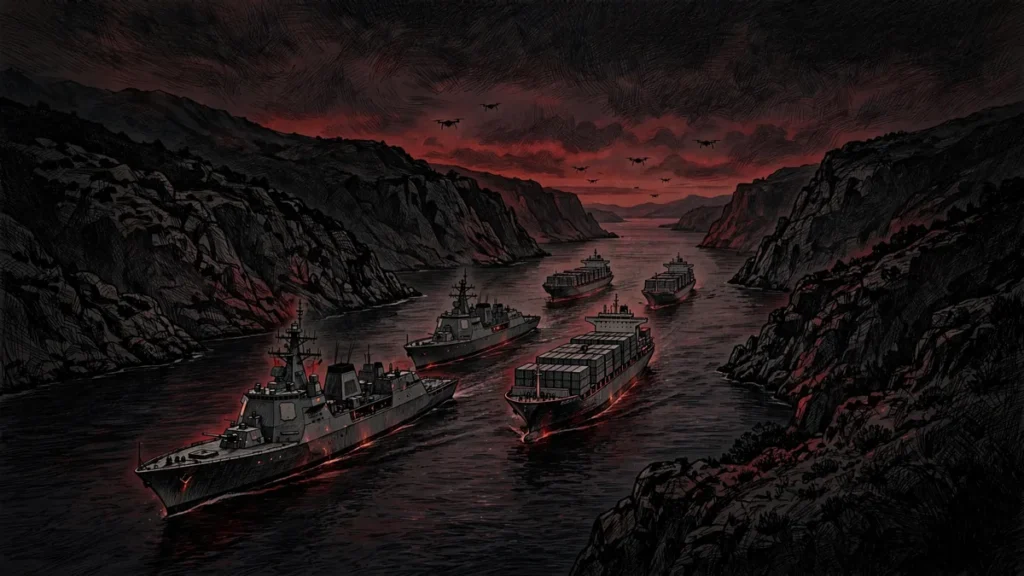
Part of that improvement, according to US officials who spoke to CNN on September 25, 2026, came from intelligence support linked to Chinese groups. The officials said Iran used Chinese-provided satellite imagery to track US escort operations in the Strait of Hormuz and time attacks — firing large numbers of heatseeking drones at ships once they reached a geographic landmark one official called a “knuckle.” The Defense Department declined to comment; Chinese and Iranian officials did not respond. The reporting fits the pattern of escalating tanker attacks in the Strait of Hormuz that WarBrief has been tracking.
(see our explainer on AI in military intelligence)
Where does cyber warfare fit in?
The cyber front ran alongside the kinetic one. Iranian-aligned hackers expanded operations during the war — WarBrief has covered the suspected Iranian hacking campaign against US water and energy infrastructure. CENTCOM reported in September 2026 that it was overhauling its AI targeting protocols — adding AI agents that continuously re-evaluate intelligence and folding open-source data into target vetting to cross-check classified material.
Related: could AI like this ever touch nuclear decision-making? Read our analysis of whether AI could trigger a nuclear war.
AI in the Iran war: by the numbers
| Metric | Figure | Source | Status |
|---|---|---|---|
| Targets struck in first 24 hours of Epic Fury | 1,000+ | Multiple outlets | CONFIRMED |
| Munitions / targets in a 96-hour window | 2,000 / 2,000 | Pentagon AI chief Cameron Stanley, sworn testimony (AFP-reviewed DOJ filing, June 15, 2026) | CONFIRMED |
| Data sources fused by Maven Smart System | 150+ | Bloomberg via multiple outlets | CONFIRMED |
| Palantir Maven contract value | $1.3 billion | Multiple outlets | CONFIRMED |
| Minab school strike dead, incl. children | 150+ / 123 | Bloomberg investigation, Sept 18, 2026 | CONFIRMED |
| Targets struck in first 38 days | 13,000 | White House statement (single-source chain) | REPORTED |
| US adults who had heard nothing of military AI use | 42% | IGA/YouGov poll, Aug 2026 (±3.64 pp) | CONFIRMED (as poll result) |
Caveat: CONFIRMED = two or more independent sources; REPORTED = a single source chain, treat with caution.
What this means for US/UK/EU readers
The Iran war previews how the next Western military operation will be planned: algorithmic targeting is already standard, and the question is no longer whether AI will be used in war but how it will be overseen. The Minab investigation already has consequences — France, Germany, Switzerland and Spain all moved in 2026 to restrict or avoid Palantir’s domestic intelligence contracts, even as the Pentagon deepens its reliance on the same tools. For US readers, the Grok disclosure matters because a private chatbot model is now embedded in a shooting war’s targeting chain with oversight still being written. For British readers, the UK has been drawn into the theater through escort operations and bases like RAF Fairford — linked to the thwarted Iranian plot against RAF Fairford — and British forces would operate under US-led AI targeting in any future coalition campaign.
What to watch next
First, whether CENTCOM’s September targeting-protocol overhaul — AI agents re-checking AI-generated targets, open-source cross-checks — actually prevents another Minab, and whether Congress’s calls for an independent review of AI-related civilian harm produce legislation. Second, the October 4, 2026 “Super Intelligence Force” task force, charged with assessing the federal government’s AI posture within 120 days — the Iran experience will be its central case study. Third, whether the full Pentagon review of the Minab strike is ever released.
Frequently asked questions
How is AI being used in the Iran war?
The US military uses the Maven Smart System, a Palantir-built AI-assisted platform, to fuse satellite imagery, drone feeds, radar and signals intelligence into target recommendations and strike planning. Iran uses AI for drone navigation and target identification. Both sides’ AI use is AI-assisted, not autonomous: humans retain the final decision on strikes.
What is the Maven Smart System?
Maven is the Pentagon’s AI-enabled targeting platform, built by Palantir under a $1.3 billion contract. It fuses data from more than 150 sources into a single battlefield display, ranks targets by strategic importance, and generates strike packages. Its AI models have included Anthropic’s Claude (removed) and xAI’s Grok Gov Model.
Did AI cause the Minab school strike?
A September 2026 Bloomberg investigation found an unreleased Pentagon review blaming a “cascade of preventable failures” — outdated intelligence listing the school as an IRGC facility, rushed approvals, collapsed civilian-protection staffing, and operators over-relying on Maven to flag stale data. The investigation does not conclude AI independently selected the school, and the Pentagon has not publicly accepted responsibility.
Is China helping Iran in the war?
US officials told CNN in September 2026 that intelligence support from Chinese groups — including satellite imagery — helped Iran track US naval escorts and time attacks in the Strait of Hormuz. China and Iran did not comment; the Defense Department declined to comment. Treat this as attributed intelligence reporting.
Who decides what AI targets in the Iran war?
Officially, humans. CENTCOM commander Adm. Brad Cooper said in March 2026 that AI tools help warfighters sift data but humans make the final decisions on what to shoot and when. The open question — highlighted by Minab — is whether human review remains meaningful when machines generate targets faster than people can evaluate them.
Sources
- CNN: Chinese groups aiding Iran’s targeting of US sites, sources say (Sept 25, 2026)
- eWeek: Elon Musk’s Grok AI Helped Direct 2,000 US Strikes in Iran, Pentagon Reveals (based on AFP-reviewed DOJ filing)
- Inside Telecom: Pentagon, Palantir AI Kill Chain Automated School Hit (summarizing Bloomberg investigation, Sept 18, 2026)
- NeoTeo: AI in Iran war — What Maven does and who decides (IGA/YouGov poll data)
- WarBrief Live: Intelligence hub