WarBrief Live | October 7, 2026 | Breaking Analysis
The United States has lost or damaged at least 81 military aircraft during the Iran war, at a replacement cost that could reach $3.3 billion, according to a new Congressional Research Service (CRS) report reported on October 6. The tally — covering everything from stealth fighters to surveillance drones since Operation Epic Fury began on February 28 — is the first comprehensive congressional accounting of how Iran has degraded American airpower.
Key Takeaways
- A new CRS report counts at least 81 US aircraft lost or damaged since February 28, 2026, worth up to $3.3 billion to replace.
- Drones absorbed the worst of it: at least 45 MQ-9 Reapers were lost, shrinking the fleet to 135 airframes.
- Among crewed aircraft, 12 F-15E fighters were destroyed or damaged — including three shot down by friendly fire over Kuwait — plus a destroyed E-3G Sentry surveillance jet.
- The Pentagon’s own figures put the replacement bill between $1.9 billion and $3.3 billion, and warn that rebuilding key missile stockpiles could take at least five years.
What did the CRS report find?
The headline numbers are stark. Since the war with Iran began on February 28, 2026, at least 81 US military aircraft — fixed-wing planes, helicopters, and drones — have been lost or damaged, the Congressional Research Service reports. Replacing them with platforms available today would cost as much as $3.3 billion.
The CRS cautioned that its figures could still change as the conflict continues, with some damage assessments subject to revision. That caveat matters, because earlier US government assessments with earlier cutoff dates give lower totals: the Pentagon’s lead inspector general reported aircraft losses through June 30, while the Congressional Budget Office (CBO) assessed losses through August 1. The CRS figures, reported on October 6, are the most current official tally.
What makes the report politically significant is not just the scale of the losses but where they happened. Much of the damage was inflicted not over Iran, but on the ground at American bases across the Middle East — in Kuwait, Jordan, Saudi Arabia, and Iraq. As the war flared again in early October, with US strikes on Iranian launchers and Iranian retaliation against US bases in Jordan, that vulnerability remains the report’s central warning.
How many US aircraft has the Iran war cost? The by-the-numbers breakdown
| Metric | Figure | Source |
|---|---|---|
| Aircraft lost or damaged (all types) | At least 81 | CRS report (Oct 6, 2026) |
| Full replacement cost | Up to $3.3 billion | CBO methodology, reported Oct 6, 2026 |
| Change-plans replacement cost | $1.9 billion | CBO, through Aug 1, 2026 |
| MQ-9 Reaper drones lost | At least 45 | CRS report; Washington Post reporting (Aug) |
| F-15E Strike Eagles destroyed or damaged | 12 | CRS report |
| E-3G Sentry lost (replacement value) | $500 million | CBO |
| KC-135 tankers destroyed or damaged | 2 destroyed, up to 7 damaged | CBO / The War Zone analysis |
| Service members killed in the war | 18 | Defense Casualty Analysis System |
Caveat: figures above are drawn from reports with different cutoff dates (June 30, August 1, and October), so totals are not directly comparable. Figures attributed to a single source are marked REPORTED where only one outlet has confirmed them; items confirmed by two or more independent sources are treated as CONFIRMED.
Which aircraft did America lose — and how?
The losses split into two very different stories: the drone war, and the much more expensive, much more dangerous losses of crewed aircraft.
The MQ-9 Reaper slaughter
Unmanned aircraft absorbed the bulk of the damage. At least 45 MQ-9 Reaper drones were shot down, crashed, or destroyed on the ground, the CRS found — the largest single line item in the entire tally. The Washington Post reported in August that the Reaper figure had already reached 45, roughly a quarter of the pre-war fleet, citing three US officials. Open-source trackers later raised the count to 47.
The fleet has shrunk visibly. An Air Force general told the Senate in May that the deployable Reaper fleet had dropped to 135 airframes, against a standing requirement of at least 189 deployable drones. Each Reaper costs $30 million to $50 million depending on sensors and weapons, putting the drone losses alone at well over $1.4 billion. The Air Force has begun scrambling for replacements — including buying back unused airframes from General Atomics and pushing a cheaper, more expendable successor dubbed the Massed Modular Aircraft.
Other drones were hit too. An MQ-4C Triton, a $150-million high-altitude surveillance drone of which the Navy owns only 20, went down over the Persian Gulf in April after a lost-link emergency. And in late May, CENTCOM announced that Iran had shot down an MQ-1 over international waters.
F-15Es: friendly fire, shoot-downs, and base strikes
The most politically painful losses were the 12 F-15E Strike Eagle fighters destroyed or damaged. Three of them — worth more than $30 million each — were shot down in friendly fire over Kuwait on March 2, in the war’s opening days. Another F-15E was shot down over Iran on April 3, triggering a dramatic combat search-and-rescue operation that became the costliest single operation of the war for aircraft inventory: more than 150 aircraft and 92 special operators went deep into enemy territory to recover the two ejected crew members, and American forces deliberately destroyed two MC-130J Commando II special operations planes and four MH-6 Little Bird helicopters on a remote airstrip to prevent their capture. That one operation cost north of $400 million in hardware.
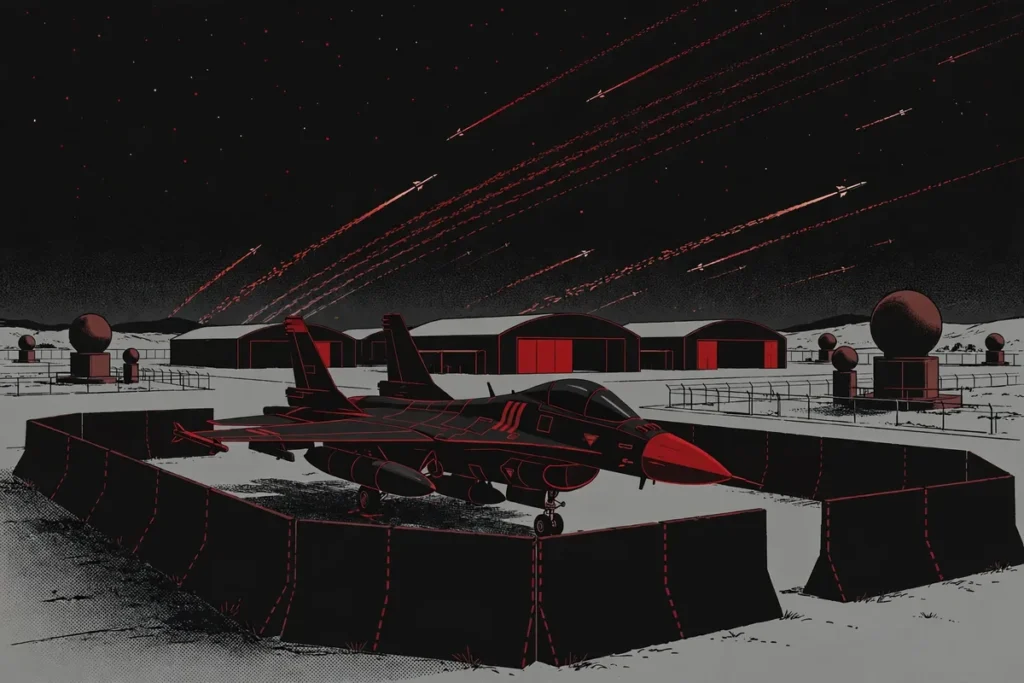
Eight more F-15Es sustained damage when Iran struck Muwaffaq Salti Air Base in Jordan with ballistic missiles on September 9 and 10. Those aircraft were repaired and returned to service — but the episode showed that Iran could reach American aircraft parked at major regional bases.
The half-billion-dollar radar plane
The most expensive single crewed loss was an E-3G Sentry, the airborne early-warning aircraft that directs air battles. Serial number 81-0005 was struck on the taxiway at Prince Sultan Air Base in Saudi Arabia on March 27. The Pentagon’s inspector general lists it as “damaged,” but satellite imagery shows the fuselage cut in half — and the CBO categorizes it as lost in battle, assigning a $500 million replacement value, the cost of an E-7A Wedgetail, the only available replacement since the E-3 is out of production. The CRS tally valued the plane itself at $270 million.
The F-35A stealth fighter appears in the ledger too: one was struck by Iranian fire in mid-March and forced to make an emergency landing — believed to be the first time an F-35 took hostile fire in combat. Two A-10 Warthog close-air-support jets were hit, one lost in April with its pilot ejecting safely over friendly territory, the other damaged on the ground in Jordan. Two KC-135 aerial refueling tankers were destroyed and up to seven more damaged; in a separate non-combat tragedy on March 12, a collision between two KC-135s over western Iraq killed six airmen. An Army AH-64 Apache was shot down near the Strait of Hormuz in June, and open-source researchers identified four more helicopters damaged at regional bases since September 10.
Why do the official numbers keep changing?
The CRS report is the third US government accounting of air losses in as many months, and the numbers keep rising because each report covers a longer window and because aircraft keep being hit.
The Pentagon’s lead inspector general released its first quarterly report to Congress on September 14, covering the period from February 28 through June 30. The Congressional Budget Office followed a day later with a cost assessment through August 1. The CBO’s $1.9 billion figure counts only hardware the Pentagon “would have to change its plans to replace” — aircraft still in production that must actually be rebuilt. The $3.3 billion figure is what it would cost to replace everything lost with platforms available today: the A-10C Warthog is no longer built, so the CBO prices its replacement as an F-35A at $120 million; the F-15E has no active production line, so four lost airframes would be replaced by F-15EXs at $400 million.
The report’s accounting also includes a $500 million charge for a lost THAAD AN/TPY-2 radar — a ground-based air defense asset, not an aircraft — which shows how the tally blends air and air-defense losses. And both reports warned that repair costs and losses after their cutoff dates are not included, pushing the true figure higher. The War Zone’s OSINT-updated tracking estimated the total could top $4 billion once post-August losses and repairs are counted.
What this means for US/UK/EU readers
The aircraft tally is only part of the bill. CENTCOM estimated last month that the total cost of the war in Iran had grown to $43.6 billion, up $5 billion since August, with weapons spending jumping from $21.7 billion to $28.1 billion in just over a month. Eighteen service members have been killed and more than 800 injured, according to the Defense Casualty Analysis System.
The deeper concern is industrial. The inspector general reiterated that munitions spending in Operation Epic Fury has produced “strategic inventory shortfalls and revealed industrial base bottlenecks.” The CBO concluded the US has probably used between one-half and two-thirds of its inventory of Patriot, THAAD, Standard Missile 3, and SM-6 interceptors since June 2025 — and that rebuilding those stocks would take at least five years even with increased production. That assessment aligns with an earlier warning from the Center for Strategic and International Studies about how a sustained fight strains weapons designed for a future conflict with China.
For American taxpayers, the numbers are the clearest picture yet of what seven months of war have cost in hardware. For European readers, the strain matters differently: with US missile stocks depleted and European commanders already on record warning that the Iran commitment is draining combat power from the Pacific, any escalation in Europe or the Indo-Pacific would be fought with thinner arsenals. War-risk insurance surcharges and energy market volatility remain the most direct channels by which the war reaches household budgets in the US and Europe.
What to watch next
Three questions will determine whether the aircraft tally stabilizes or keeps climbing:
- Will the renewed fighting spread? After weeks of relative quiet, US strikes on Iranian launchers near the Strait of Hormuz in early October and Iranian missile retaliation against US bases in Jordan put more aircraft back at risk — the same bases where eight F-15Es were damaged in September.
- Can the Reaper fleet recover? With the fleet at 135 airframes against a 189 requirement, the Air Force’s stopgap purchases and the Massed Modular Aircraft program will be tested every month the war continues.
- Will Congress fund the rebuild? The CRS report gives lawmakers the numbers to debate: a $3.3 billion aircraft bill inside a $43.6 billion war, plus munitions shortfalls that will take half a decade to fix. The next defense appropriations cycle will show how seriously Washington takes the warning.
Frequently asked questions
How many US aircraft have been lost in the Iran war?
At least 81 US military aircraft — fixed-wing planes, helicopters, and drones — have been lost or damaged since the war began on February 28, 2026, according to a Congressional Research Service report published October 6, 2026. The CRS warned the figures could be revised as the conflict continues.
Which aircraft type has suffered the most losses?
The MQ-9 Reaper drone, by a wide margin. At least 45 were lost — roughly a quarter of the pre-war fleet — shrinking the deployable fleet to 135 airframes against a requirement of at least 189.
What was the most expensive single aircraft loss?
An E-3G Sentry surveillance aircraft, serial 81-0005, destroyed on the taxiway at Prince Sultan Air Base in Saudi Arabia on March 27. The CBO assigns a $500 million replacement value — the cost of an E-7A Wedgetail, since the E-3 is out of production.
Why do the CRS, CBO, and inspector general numbers differ?
Each report covers a different cutoff date — June 30 for the inspector general, August 1 for the CBO, and October for the CRS — and they use different accounting methods. The CBO’s $1.9 billion counts only hardware the Pentagon must change plans to replace; the $3.3 billion figure prices replacing everything with platforms available today.
How much has the Iran war cost the US overall?
US Central Command estimated the total cost at $43.6 billion as of September 2026, with munitions spending alone jumping from $21.7 billion to $28.1 billion in just over a month.
Sources
- New York Post: US military has lost 81 planes, drones and helicopters worth $3.3 billion in Iran war: report
- The War Zone: Every American Aircraft Lost or Damaged During the Iran War, Visualized
- WE News English: US Loses or Damages 81 Aircraft in Iran War: Report
- Washington Examiner: Breaking down the military’s nearly $40 billion Iran war