WarBrief Live | October 7, 2026 | AI & Future Warfare
The AI arms race between China and the US is no longer just a technology story — it is becoming a military one. With Washington standing up a new federal task force, Beijing pouring money into homegrown chips, and both sides racing to put artificial intelligence into drones, cyber weapons, and decision-making systems, the AI China–US war competition is reshaping how the Pentagon plans for a future conflict. Here is what is confirmed, what is only reported, and what it could mean.
Key Takeaways
- On October 4, 2026, President Donald Trump announced the “Super Intelligence Force,” a federal task force led by Director of National Intelligence Jay Clayton, with 120 days to recommend the government’s AI role.
- The Pentagon’s own annual report says China is narrowing the AI gap, pursuing “intelligentized warfare,” and pulling its commercial AI sector into military research through military-civil fusion.
- US semiconductor export controls on China remain largely intact under the Biden-era framework, but China is accelerating domestic chips from Huawei and SMIC — though independent analysts estimate the best US AI chips remain about five times more powerful.
- The US military is moving AI into the field: the Replicator drone program, a new counter-drone task force, and a reported $54.6 billion budget request for the Defense Autonomous Warfare Group.
What is the Super Intelligence Force, and what will it do?
On Sunday, October 4, 2026, President Trump wrote on Truth Social that he had created the “Super Intelligence Force” (SIF) and named Director of National Intelligence Jay Clayton to lead it as the administration’s AI czar, according to NPR, USA Today, and the Associated Press. The other named members are Federal Trade Commission Chairman Andrew Ferguson, Under Secretary of Defense for Research and Engineering Emil Michael, and Office of Personnel Management Director Scott Kupor. The group reports to Trump and White House Chief of Staff Susie Wiles.
The task force has 120 days to produce a report assessing AI’s risks and opportunities and recommending the federal government’s role, Reuters reported. Its mandate is to “ensure that America continues to lead the World in Super Intelligence” and to coordinate the government’s engagement with consumers, public-interest groups, religious organizations, critical infrastructure providers, and AI companies.
Two things about the announcement matter for the military picture. First, Trump has been deliberately rebranding “artificial intelligence” as “super intelligence” in federal communications — the task force’s name is partly policy branding, and it should not be read as evidence that true superintelligence exists or that the US possesses it. Second, putting the Pentagon’s research chief on the task force signals that AI competition with China is being treated as a national security mission, not just an industrial one.
The announcement followed a White House meeting on September 30 with top AI executives, where Trump said several companies had signed a voluntary accord that would include internal and external reviews of their work, and the launch of a revamped government website, America.gov, that the White House says is sourced via AI from official government sources. It also landed against a backdrop of public anxiety: a Quinnipiac University poll released last week found 73% of Americans were concerned AI could threaten human survival, and a CNN poll in September found 71% believed the federal government was not doing enough to regulate AI.
How is the Pentagon putting AI into warfighting?
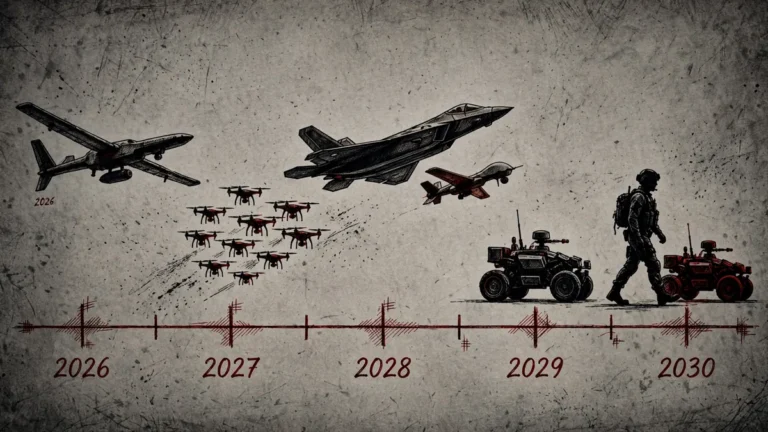
The US military’s most concrete autonomous-weapons program began in 2023, when then-Deputy Defense Secretary Kathleen Hicks launched the Replicator initiative, aiming to field thousands of relatively inexpensive, expendable AI-enabled autonomous systems by 2026 to counter China. A second phase, Replicator 2, was ordered in a September 2024 memo to focus on countering small drones — particularly threats to bases and “force concentration” — with fielding of improved defenses expected within about two years.
That counter-drone push is now moving into deployment. The Pentagon’s Joint Interagency Task Force 401 announced in January 2026 that it had awarded a contract for Fortem Technologies’ DroneHunter F700 systems, which use AI and radar to identify, pursue, and capture intruding drones with nets — and can operate fully autonomously, alone or in cooperation with other DroneHunters, according to Defense News. It is part of a wider Pentagon push to wire AI into future warfare, alongside initiatives like Project Meridian, the Pentagon’s 120-day advisory study on AI in warfare.
Behind the scenes, the military is also wiring AI into its own workforce. In December 2025, the department rolled out GenAI.mil, a platform delivering commercial generative AI tools to millions of personnel, with Google Cloud’s Gemini for Government products first — a rollout that received mixed reviews, per DefenseScoop. And in one notable friction point, Anthropic refused in 2026 to let the Pentagon use its Claude models for “all lawful purposes,” citing the company’s red lines around autonomous weapons and surveillance of US citizens; the administration then designated Anthropic a supply chain risk and ordered federal agencies and military contractors to cease business with it. The legal fight has since split: a California federal court ruled in August 2026 that one of the designations was illegal retaliation against protected expression, while the DC Circuit ruled on September 25, 2026 that the Pentagon’s blacklist was lawful under separate statutory grounds — leaving Claude banned from military use but available to non-defense agencies, according to CNN and Reuters.
Looking further out, the industry publication Defense Security Monitor reported in May 2026 that Replicator had been dissolved in late 2025 and folded into a new Defense Autonomous Warfare Group (DAWG), with the White House requesting $54.6 billion for it in the FY27 budget — a figure it says would represent the largest single commitment to autonomous warfare in history, a point former CIA director David Petraeus echoed. Treat this figure with caution: it comes from a single industry outlet and has not been separately confirmed by the Pentagon.
How is China using AI for its military?
The most authoritative public picture of China’s military AI comes from the Pentagon’s own annual report to Congress on China’s military, released on December 23, 2025. Its assessment: in 2024, China’s commercial and academic AI sectors made progress on large language models and reasoning models that “narrowed the performance gap between China’s models and the U.S. models currently leading the field.”
The report says these tools are useful for coding tasks that assist cyber operations, question-answering that assists military decision-making, and synthetic content that assists influence operations — and that the People’s Liberation Army uses military-civil fusion mechanisms to ensure China’s academic and commercial AI communities continuously support military research and development.
Doctrinally, the Pentagon assesses that China believes “the next revolution in military affairs will occur when militaries transition to ‘intelligentized’ warfare and fully integrate artificial intelligence, big data, advanced computing, and other technologies into the joint force.” The same report adds that China is still developing the concepts and capabilities needed to realize that doctrine — but is actively studying the Russia-Ukraine conflict to identify useful practices for AI and unmanned systems.
In 2024, the report says, China invested in AI for unmanned systems, intelligence-surveillance-reconnaissance (ISR) collection and analysis, decision-making assistance, cyber operations, and information campaigns. It also says Chinese military-linked cyber operations increasingly use AI to map adversaries’ networks, building on the “Volt Typhoon” campaign that targeted critical US military infrastructure — a development that fits the broader pattern of AI-assisted cyber warfare techniques reshaping how states probe each other’s networks.
Washington is responding with economic tools too. In June 2026, the Pentagon updated its Section 1260H list of “Chinese military companies” operating in the US to 188 firms, adding Alibaba, Baidu, BYD, robotics maker Unitree, lidar firms Hesai and RoboSense, and TP-Link. The designation is not a sanctions list, but the Defense Department is barred from contracting directly with listed firms.
Can US chip export controls stop China’s AI progress?
The core US tool in the AI race is export controls on advanced semiconductors. As of September 2026, those controls still largely resemble the framework imposed by the Biden administration in October 2023: advanced chips and servers incorporating them are controlled for China, with transactions involving China-headquartered end users generally subject to a presumption of denial, according to a Reuters explainer.
Enforcement is real: on October 1, 2026, the Justice Department charged a California man with smuggling export-controlled AI servers to China through re-exports via Malaysia and Singapore between 2023 and 2024. And Congress is pushing to go further: the proposed MATCH Act, introduced by a cross-party group of lawmakers in April 2026, would further restrict chipmaking equipment exports to China, halt equipment servicing, and target SMIC, Hua Hong, Huawei, CXMT, and YMTC. It remains proposed legislation, not enacted law. Notably, China was ASML’s largest market in 2025 at 33% of sales, a figure the Dutch company expected to fall to about 20% in 2026.
China’s answer is a state-backed push for self-sufficiency. Huawei’s Ascend 950PR, released in Q1 2026 with 2 petaflops of FP4 compute and domestically produced high-bandwidth memory, is reported by industry outlets to be roughly on par with Nvidia’s H200 in some configurations — though still behind the latest Blackwell offerings in efficiency and software maturity. SMIC has stretched older DUV lithography toward 5nm-class production with analyst-estimated yields of 20–40%, far below TSMC’s 80%+, and Huawei spent 121 billion yuan (about $18 billion) on R&D in the first half of 2026 alone — more than a quarter of sales.
Independent analysts remain skeptical about the gap closing soon. Chris McGuire, writing for the Council on Foreign Relations in December 2025, calculated that the best US AI chips are currently about five times more powerful than the best Chinese AI chips, and estimated that even under aggressive assumptions, Huawei produces only about 5% of Nvidia’s aggregate AI computing power. As Chatham House’s Rowan Wilkinson argued in April 2026, export controls rest on the assumption that chips are AI’s chokepoint — but AI gains are “increasingly no longer just based on raw computing power.”
Could an AI war between the US and China actually happen?
This is the hardest question, and the honest answer is that no one knows — because the war itself would look unlike any previous one. Analysts describe the real risk less as a single “AI decides to attack” moment and more as a contest in which both sides’ AI systems operate at speeds humans cannot supervise: drone swarms fighting drone swarms, cyber weapons striking infrastructure at machine speed, and AI-generated deception confusing the other side’s sensors. The Pentagon’s own China report documents both militaries racing toward exactly these capabilities.
What would decide such a contest is not only algorithms but the physical and industrial foundations underneath them: compute (where the US still leads), data and talent (where both sides are strong), manufacturing scale (where China’s industrial base is an advantage), and energy to power data centers — with the electromagnetic spectrum already a contested battlespace, as our explainer on the invisible battlefield of electronic warfare details. Trump’s September 29 remark that China “will take every data center that we don’t want” was a garbled but telling signal: the administration views energy and compute infrastructure as the new territory of great-power competition.
Readers should be careful with one thing: none of this proves either side is close to a decisive AI military advantage, and “super intelligence” in Trump’s task-force branding is politics, not a capability statement. The confirmed reality is two large militaries investing heavily in AI for intelligence, drones, cyber, and decision support — and a US government now organizing its entire federal AI posture, from chips to safety reviews, around staying ahead of China.
The AI race by the numbers
| Metric | Figure | Status |
|---|---|---|
| Super Intelligence Force mandate | 120 days to report | Confirmed (Oct 4, 2026) |
| Americans concerned AI could threaten human survival | 73% | Confirmed (Quinnipiac, Sept 2026) |
| Americans saying government isn’t regulating AI enough | 71% | Confirmed (CNN, Sept 2026) |
| Chinese military companies on Pentagon list | 188 | Confirmed (June 2026) |
| Best US vs best Chinese AI chip power | ~5x | Analyst estimate (CFR, Dec 2025) |
| Huawei AI compute vs Nvidia’s, aggressive assumptions | ~5% | Analyst estimate (CFR, Dec 2025) |
| Huawei R&D spend, H1 2026 | 121B yuan (~$18B) | Company-reported |
| DAWG FY27 budget request | $54.6B | Reported by one industry outlet, unconfirmed |
| SMIC advanced-node yields | 20–40% | Analyst estimates |
What this means for US, UK, and EU readers
For American readers, the race is already reshaping federal policy: export controls affect jobs in the semiconductor industry, AI data centers are driving local energy debates (only 11% of Americans would support one in their community, per an August 2026 UMass Amherst poll), and the SIF’s 120-day report will likely set the rules your government follows on AI safety. For UK and EU readers, the stakes are alliance ones: Britain and Europe rely on US compute and cloud infrastructure while pursuing their own AI strategies, and any US-China decoupling of AI supply chains raises costs and compliance burdens for European and British tech firms. NATO’s European members are also watching US autonomous-weapons programs closely, because rules for AI in warfare written in Washington will shape what allies can buy, build, and deploy.
What to watch next
Three things matter in the coming months. First, whether Congress advances the MATCH Act or lets it stall — that decides how tight chip controls get. Second, the SIF’s report, due around February 2027, which will reveal whether the Trump administration plans binding AI rules or sticks to voluntary accords. Third, the planned Trump–Xi engagement and any follow-through on AI guardrails: expert proposals for shared red lines on AI in military systems have been published, but none are binding. This article should be updated when the SIF issues its report, when the MATCH Act moves, or when the Pentagon releases its next annual China report.
Read next in this series: Trump’s Super Intelligence Force, explained · Trump’s AI war strategy · superintelligence and the military
Frequently asked questions
What is the Super Intelligence Force?
The Super Intelligence Force is a federal AI task force announced by President Trump on October 4, 2026, led by Director of National Intelligence Jay Clayton. It has 120 days to assess AI’s risks and opportunities and recommend the federal government’s role, coordinating with AI companies, infrastructure providers, and public-interest groups.
Is China catching up with the US in military AI?
According to the Pentagon’s 2025 annual report on China’s military, China narrowed the gap in 2024, particularly in large language models, and is integrating AI into unmanned systems, intelligence analysis, and cyber operations through military-civil fusion. Independent analysts estimate the best US AI chips remain roughly five times more powerful than China’s best.
Can US chip export controls stop China’s AI military progress?
Controls limit China’s access to the most advanced chips, but China is investing heavily in domestic alternatives from Huawei and SMIC, and experts note AI progress increasingly depends on more than raw computing power. Analysts estimate Huawei produces only about 5% of Nvidia’s aggregate AI computing power even under aggressive assumptions.
What is “intelligentized warfare”?
It is the People’s Liberation Army’s doctrine, as described in the Pentagon’s China report, holding that the next revolution in military affairs will come from fully integrating AI, big data, and advanced computing into the joint force. The Pentagon assesses China is still developing the concepts and capabilities to realize it.
Sources
- NPR: Trump names national intelligence chief Jay Clayton as new AI czar (Oct 4, 2026)
- USA Today: Trump names top aides to ‘super intelligence’ AI force (Oct 4, 2026)
- Associated Press: Trump names national intelligence director Jay Clayton to lead federal AI task force (Oct 4, 2026)
- Reuters: What’s the latest with semiconductor export controls? (Sept 23, 2026)
- DefenseScoop: New Pentagon report on China’s military notes Beijing’s progress on LLMs (Dec 26, 2025)
- Defense News: Pentagon task force to deploy AI-powered UAS systems to capture drones (Jan 13, 2026)
- CNN: Federal appeals court rules Pentagon’s blacklist of Anthropic was legal (Sept 25, 2026)
- Reuters: US appeals court declines to block Pentagon’s blacklisting of Anthropic (Sept 25, 2026)
- Reuters: US targets Chinese chipmaking with proposed export restrictions (Apr 3, 2026)