WarBrief Live | October 7, 2026 | AI & Future Warfare
Trump’s AI war strategy is not a war fought by artificial intelligence — it is a plan to weave AI through every layer of American military power, from intelligence analysis and drone swarms to cyber operations and battlefield decision-making. In the span of a week, the administration stood up a new Pentagon command for autonomous warfare, rebranded federal AI as “super intelligence,” and created a White House task force to steer it all. Here is how AI is actually changing the US way of war — and where the hard limits are.
Key Takeaways
- On September 30, 2026, Defense Secretary Pete Hegseth announced the Autonomous Warfare Command (Autowarcom) — set to become a four-star command by October 1, 2027 — to build autonomous and robotic capabilities across the joint force.
- Trump’s strategy has two pillars: a policy push (the “super intelligence” rebrand, the Super Intelligence Force, data-center expansion to outpace China) and a military push (Autowarcom, the Project Meridian study, unrestricted-use AI contracts).
- The Pentagon’s bruising fight with Anthropic reveals the strategy’s core tension: the military wants AI for “all lawful purposes,” while AI labs resist fully autonomous weapons and mass surveillance uses.
- AI-assisted targeting and intelligence are not the same as autonomous killing — the line is drawn by policy (DoD Directive 3000.09) and increasingly by the courts.
- The Project Meridian future-warfare study, co-led by Elon Musk, Palmer Luckey, and Newt Gingrich, is a separate advisory effort — covered in detail here.
What is Trump’s AI war strategy?
The strategy rests on two pillars. The policy pillar is about speed and scale: rebrand AI as “super intelligence” across the federal government, create the Super Intelligence Force under DNI Jay Clayton to coordinate it, and build the data-center infrastructure to power it — with Trump arguing on September 29 that China “will take every data center that we don’t want.” (WarBrief explainer: Trump’s Super Intelligence Force) The stated priority, as CNN reports, is outpacing China and preserving AI-driven economic gains — ranked above addressing public concerns about AI safety, which Trump has largely dismissed.
The military pillar is about converting commercial AI advances into battlefield advantage: a new command dedicated to autonomous systems, a high-profile study of future warfare domains, and contract terms that give the Pentagon unrestricted military use of frontier AI models. Together, the two pillars amount to the most aggressive US military-AI posture in history — and the most contested.
How is the Pentagon already using AI in warfare?
The clearest signal came on September 30, 2026, when Hegseth delivered his “State of the Force” address to some 600 junior officers and enlisted personnel at Marine Corps Base Quantico, Virginia. The headline announcement: an Autonomous Warfare Command — “Autowarcom” — to build and provide autonomous and robotic capabilities across the entire joint force. Reuters reports it would be led by a four-star officer and become a full combatant command by October 1, 2027. Creating a new command is rare — the last was US Space Command in 2019 — and the move reflects a deliberate shift from costly conventional weapons platforms to cheaper, AI-driven autonomous systems that, in the Pentagon’s assessment, have proved decisive in recent conflicts.
Related: our explainer on autonomous warfare breaks down the three levels of military autonomy, from AI-assisted to fully autonomous weapons.
Hegseth’s framing was blunt: “Cheap compute, superintelligence, and advanced commercial manufacturing have enabled the proliferation of low-cost, high-precision strike,” he said, adding that “the pace of war is changing faster than the process to support it.” The same speech launched Project Meridian — a technology study effort co-led by Elon Musk, Palmer Luckey, and Newt Gingrich to identify the domains the US “must conquer” — alongside initiatives on officer commissioning, base resilience, and military chaplaincy.
Behind the announcements sits a contracting machine already in motion. According to technology-industry reporting, frontier AI models entered classified military networks in July 2025 — Anthropic’s Claude was the first approved — under contracts reported at roughly $200 million each, with OpenAI, Google, and xAI holding parallel Pentagon deals. The direction of travel is unmistakable: the Pentagon wants the best commercial AI inside its classified systems, on its own terms.
What is the difference between AI-assisted and autonomous weapons?
This is the distinction the entire debate turns on — and the strategy’s most contested fault line.
AI-assisted warfare means humans use AI to see more, decide faster, and strike more precisely: algorithms sift satellite imagery, fuse signals intelligence, suggest targets, optimize logistics, and draft battle plans. A human still makes the call.
Autonomous weapons select and engage targets without meaningful human input. The Pentagon’s standing policy — DoD Directive 3000.09, last updated in 2023 — requires appropriate levels of human judgment over the use of force. That rule is now under visible strain.
The strain broke into the open in February 2026. After Anthropic refused to drop its two contractual red lines — no fully autonomous weapons, no mass domestic surveillance of Americans — Hegseth demanded the company’s models be “free from usage policy constraints that may limit lawful military applications.” When Anthropic’s CEO Dario Amodei refused, Hegseth designated the company a supply-chain risk under 10 U.S.C. § 3252 on February 27, 2026, and President Trump ordered federal agencies to stop using Anthropic technology. Reuters reported the designation was the first time a US company had been publicly blacklisted under a statute built to protect military systems from foreign sabotage.
The courts then split. On August 27, 2026, US District Judge Rita Lin ruled the blacklisting “illegal and baseless” — unlawful retaliation violating the First Amendment. A month later, on September 25, a divided D.C. Circuit appeals panel (2–1) upheld the Pentagon’s designation. The legal fight continues, but the message is clear: the boundary between AI assistance and AI autonomy is being drawn in courtrooms, not just engineering labs.
Trump’s AI war strategy: the main instruments
| Instrument | What it is | Status |
|---|---|---|
| Autonomous Warfare Command | New four-star command for autonomous/robotic capabilities; operational target October 1, 2027 | CONFIRMED (Reuters, military.com) |
| Project Meridian | Future-warfare study group co-led by Musk, Luckey, Gingrich | CONFIRMED (military.com) |
| Super Intelligence Force | White House AI coordination task force chaired by DNI Clayton | CONFIRMED (CNN, TechCrunch) |
| “All lawful purposes” contracting | Push to strip AI usage-policy limits on military applications | CONFIRMED (Reuters — Anthropic dispute) |
| DoD Directive 3000.09 | Standing policy requiring human judgment over use of force (2023 update) | CONFIRMED (established policy) |
How could AI change the battlefield?
Strip away the branding, and the practical changes fall into recognizable military functions — each moving at a different speed:
- Intelligence: AI fuses satellite imagery, signals intercepts, and open-source data far faster than human analysts, compressing the time from detection to decision. The same tools that track military drone activity worldwide are being pointed at adversary forces in near-real time.
- Targeting: faster sensor-to-shooter loops and low-cost precision strike — the capability Hegseth put at the center of his Quantico speech — let cheaper weapons do work that once required expensive platforms.
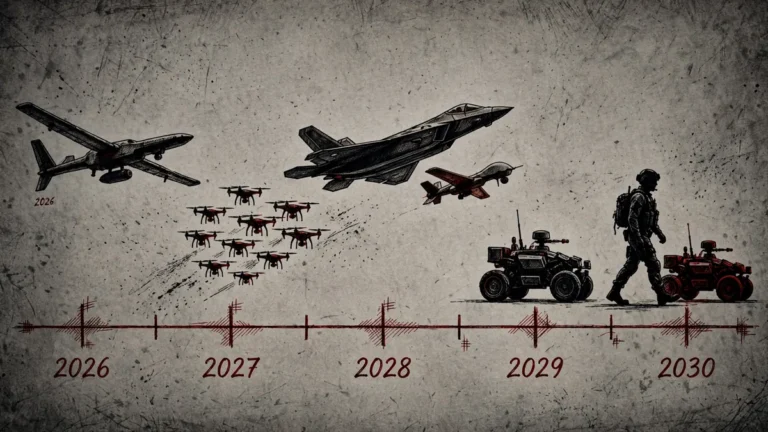
- Drones and swarms: autonomous and semi-autonomous uncrewed systems, from single reconnaissance drones to coordinated swarms, are the area Autowarcom was created to industrialize.
- Cyber operations: AI accelerates both attack and defense in cyberspace — a domain where the stakes were underlined by the breach of 3 million Pentagon personnel records earlier this year.
- Decision support and logistics: wargaming, predictive maintenance, supply routing — the unglamorous backbone where AI adoption is furthest along.
- Electronic warfare: AI-driven signal processing to detect, jam, and deceive adversary sensors.
Read next: The future of war: will AI, drones and robots replace armies?

The critical caveat, repeated because it matters: none of this means machines are deciding whom to kill. AI-assisted is not autonomous — and the fiercest fights of 2026, from the Anthropic blacklisting to the courtroom battles, have been about exactly where that line sits.
What are the risks of AI in warfare?
Three risks dominate expert discussion. Speed: as decision cycles compress, the window for human judgment — and for de-escalation — narrows. Reliability: AI systems hallucinate and misclassify; a false positive in intelligence analysis can become a false targeting decision. Proliferation: the same cheap compute and commercial manufacturing Hegseth celebrated puts capable systems within reach of adversaries and non-state actors, not just the Pentagon.
Reuters notes that experts have warned about unchecked AI development and US–China technology rivalries heightening risks across the security environment — with specialists on both sides calling for guardrails around AI in military systems, including nuclear weapons. The administration’s answer, so far, is that falling behind is the greater danger.
What this means for US/UK/EU readers
United States: The strategy means a defense-tech hiring and contracting boom — and continued fights over data centers in local communities, where energy prices and land use are already shaping midterm races. It also means the legal boundaries of military AI will be set partly by judges, not just generals.
United Kingdom and Europe: NATO allies are watching Autowarcom closely. Interoperability — whether allied forces can plug into increasingly autonomous US systems — and divergent AI governance philosophies will shape coalition warfare for a decade. European capitals, which have tended toward stricter AI guardrails, now face an ally explicitly prioritizing speed over restraint.
Everyone: the norms being set now — what counts as acceptable human control, what AI may never be allowed to decide — will govern conflicts far beyond America’s own wars.
What to watch next
- Autowarcom’s standup milestones on the road to full four-star command status by October 1, 2027.
- The Super Intelligence Force’s 120-day report (expected around February 2027) and whether it touches military AI policy.
- The Anthropic litigation — the next court ruling could redraw the Pentagon’s contracting power over AI labs.
- Whether DoD Directive 3000.09 is revised — pressure to loosen human-judgment requirements is the logical next step of the “all lawful purposes” push.
- Project Meridian’s findings on the domains of future warfare.
Frequently asked questions
Is the US building autonomous killer robots?
The Pentagon is building autonomous and semi-autonomous weapons systems — drones, robotic vehicles, AI-assisted targeting — through the new Autonomous Warfare Command. But fully autonomous weapons that select and kill targets with no human involvement remain restricted by standing policy (DoD Directive 3000.09), and AI companies like Anthropic have fought to keep that line in their contracts. The boundary is contested, not settled.
What is the Autonomous Warfare Command?
Announced by Defense Secretary Pete Hegseth on September 30, 2026, “Autowarcom” is a new military command dedicated to building and providing autonomous and robotic capabilities across the joint force. It is to be led by a four-star officer and become a full combatant command by October 1, 2027 — the first new command since US Space Command in 2019.
What was the Pentagon’s fight with Anthropic about?
The Pentagon demanded Anthropic’s Claude AI be available for “all lawful purposes” without the company’s bans on fully autonomous weapons and mass domestic surveillance. Anthropic refused; Hegseth designated it a supply-chain risk in February 2026 and Trump ordered agencies to drop its technology. A federal judge blocked the move as “illegal and baseless” in August 2026, but an appeals court upheld it in September 2026. Litigation continues.
Does AI decide who to kill in US military operations?
Under current Pentagon policy, no — appropriate human judgment over the use of force is required. AI assists with intelligence, target recognition, and decision support, but the final call is a human one. Critics argue the definition of “appropriate” is eroding as systems get faster and more autonomous; the courts are now part of that argument.
How does Trump’s AI war strategy differ from previous administrations?
Three things stand out: the “super intelligence” rebranding of federal AI, the creation of a DNI-led White House task force plus a dedicated autonomous-warfare command, and an explicit push to strip AI companies’ usage restrictions on military applications — a posture previous administrations approached far more cautiously.
Sources
- Reuters: Pentagon creates ‘Autowarcom’ to expand AI and drone capabilities
- Military.com: Hegseth at Quantico — State of the Force address
- Reuters: US judge blocks Pentagon’s Anthropic blacklisting
- TechCrunch: Trump unveils his new Super Intelligence Force
- USA Today: Trump names top aides to ‘super intelligence’ AI force
- Reason: Judge says Trump’s clampdown on Anthropic violates the First Amendment