
WarBrief Live | October 23, 2026 | Shipping & Logistics
Ukraine is in talks with Poland and Slovakia about moving customs checks on lorries carrying grain exports from the border to inside those countries, the Financial Times reported on October 23, 2026, citing people familiar with the matter. The proposal is aimed at stopping Russian drone attacks on trucks queueing at the frontier. If agreed, it would reshape how Europe’s busiest wartime trade corridor operates — and it could have consequences for food prices well beyond Ukraine’s borders.
Key Takeaways
- Kyiv is negotiating with Warsaw and Bratislava to relocate customs checks for grain-export lorries from the border to inland facilities, according to the FT’s reporting. Neither government has publicly confirmed the talks.
- The push is driven by what Ukraine’s foreign ministry calls a “new security environment where Russia is deliberately trying to strike our borders” — drones targeting trucks near the frontier.
- Ukraine already operates joint border-control points with Moldova and wants to “scale up” the model with other neighbours; Kyiv hopes to finalise an agreement with Poland as soon as possible.
- The stakes are high: Russian strikes on Black Sea ports have pushed roughly 90% of Ukraine’s grain exports through the EU’s overland Solidarity Lanes (September 2026 EU data), making border queues a front line of the trade war.
Why does Ukraine want customs checks moved inside the EU?
The logic is brutally simple: a truck queue is a target. Grain lorries leaving Ukraine for the EU must stop at the border for customs clearance and phytosanitary inspections, sometimes for hours. Those stationary convoys, bunched up within kilometres of Ukrainian territory, sit inside the range of Russian strike drones — and Moscow has shown it is willing to hit them.
Ukraine’s foreign ministry spokesperson Heorhii Tykhyi told the FT the move was driven by a “new security environment where Russia is deliberately trying to strike our borders”. Moving the checks inland — to depots and terminals inside Poland or Slovakia — would let trucks clear the frontier quickly and complete their inspections far from the strike zone.
The ministry also said Kyiv had already set up joint border-control points with Moldova and wanted to “scale up” the initiative with other neighbours, including Poland. Tykhyi said Ukraine wanted to finalise an agreement with Poland as soon as possible, signalling that Warsaw is the priority partner.
How would inland customs checks actually work?
In practice, the model under discussion would let grain trucks cross the Ukraine-EU frontier with minimal dwell time at the border itself. Instead of queueing at the crossing for full customs and sanitary inspection, sealed lorries would travel onward to designated inland clearance points — bonded terminals or logistics hubs inside Poland or Slovakia — where the formalities happen under EU customs supervision.
The concept is not new in European trade — transit procedures already allow goods to move under customs seal before inspections are settled at destination. What is new is applying it at wartime speed as a defensive measure: the less time trucks spend exposed near the border, the smaller the target they present.
A precedent exists in the region. On October 17, Hungarian Prime Minister Peter Magyar said President Volodymyr Zelensky had asked neighbours to allow grain transit modelled on the early-war arrangement — including, as Magyar put it, transporting “maize in sealed trains to Western Europe”. “I said as long as it merely transits the country, there would be no obstacle,” Magyar told RTL.
Several hurdles remain. No agreement has been announced, and moving customs functions touches EU customs law, not just bilateral goodwill. Poland and Slovakia currently restrict imports of Ukrainian grain — while maintaining transit arrangements — a politically sensitive distinction the talks will have to navigate. Farmers’ lobbies in both countries have repeatedly protested against Ukrainian agricultural imports undercutting local prices.
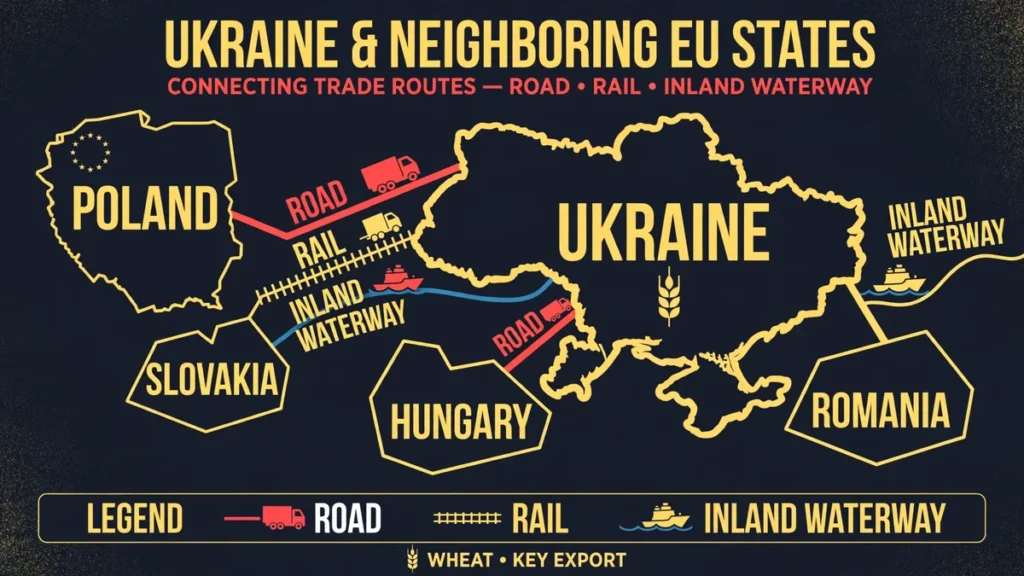
What are the EU’s Solidarity Lanes, and how big are they?
The EU-Ukraine Solidarity Lanes were launched in May 2022 by the EU together with Ukraine and Moldova, after Russia’s invasion disrupted Ukraine’s traditional Black Sea export routes. They are a network of road, rail and inland-waterway corridors designed to keep Ukraine’s imports and exports flowing overland through the EU.
For most of the war they played second fiddle to the Black Sea. That has changed dramatically. According to European Commission figures for September 2026, around 90% of Ukraine’s grain, oilseed and related-product exports now move through the Solidarity Lanes, compared with roughly 10% through the Black Sea. Just two months earlier, in July 2026, the Black Sea corridor still carried about 80% of grain exports — a reversal that shows how fast Russian attacks have redrawn the trade map.
| Metric | Figure | Source |
|---|---|---|
| Grain, oilseed and related-product exports via Solidarity Lanes (Sept 2026) | ~90% | European Commission — CONFIRMED |
| Grain exports via the Black Sea (Sept 2026) | ~10% | European Commission — CONFIRMED |
| Grain exports via the Black Sea corridor (July 2026) | ~80% | European Commission — CONFIRMED |
| Total exports moved via Solidarity Lanes since May 2022 | ~240 million tonnes (of which ~108 Mt agricultural, incl. ~99 Mt grain/oilseeds) | European Commission — CONFIRMED |
| EU maize harvest forecast, 2026 | 50.1 million tonnes — a near two-decade low | Reuters citing European Commission — CONFIRMED |
| Poland/Slovakia customs-check talks | Ongoing discussions reported | Financial Times, citing unnamed sources — REPORTED (not confirmed by either government) |
Caveat: the customs talks rest on a single news report (the FT, via unnamed sources) and have not been confirmed by Warsaw, Bratislava or Brussels. All other figures above come from official EU data.
A grain corridor under fire: the timeline
- May 2022: The EU, Ukraine and Moldova launch the Solidarity Lanes after Russia blockades Ukraine’s seaports, creating overland export routes by road, rail and inland waterway.
- August 2023: Ukraine establishes its own unilateral Black Sea shipping corridor after Russia withdraws from the UN-brokered Black Sea Grain Initiative.
- Early October 2026: Russia hits a cargo ship near Odesa and a vessel in Bulgarian waters is struck by a drone — read our coverage of the Odesa cargo-ship strike and the Bulgaria drone attack in NATO waters.
- October 14, 2026: WarBrief reports on why the Black Sea grain corridor is pushing food prices up as Russian strikes intensify.
- October 17, 2026: President Zelensky asks Poland, Romania, Slovakia and Hungary to allow Ukrainian grain cargoes to transit their territories, citing a Black Sea blockade; Hungary’s prime minister says he has no objection provided the grain only transits (Reuters).
- October 21, 2026: NATO begins rushing aircraft, drones and radars to the Black Sea region as shipping attacks escalate (full story).
- October 23, 2026: The FT reports the Poland/Slovakia customs-check talks. On the same day, the commercial vessel Khoryv, carrying Ukrainian sailors, sank off Romania’s coast; Ukrainian authorities said a drone attack had not been ruled out. The cause remains under investigation.

Why the border-queue battle matters for food prices
Ukraine is among the world’s top producers of wheat, corn and sunflower seeds. When its export logistics slow — whether through port strikes, drone attacks on trucks, or border bottlenecks — global supply tightens and prices feel it. The EU’s own maize harvest is forecast at 50.1 million tonnes this year, a near two-decade low and about a fifth below the average of the past three years, which leaves less slack in the system if Ukrainian flows falter.
The Solidarity Lanes were designed as a wartime workaround; they are now, for grain, the main event. Every friction point on the overland route — a 12-hour border queue, a drone strike on a truck park, a farmers’ protest blocking a crossing — translates into slower exports and upward pressure on prices. Moving customs checks inland would remove one of those friction points while simultaneously hardening the corridor against attack.
This section is educational and does not constitute financial advice.
What the grain-truck deal means for US, UK and EU readers
United States: The US is a major grain exporter itself, so consumers are somewhat insulated — but global wheat and corn prices are set on world markets, and disruption to Ukrainian exports eventually shows up in bread, cereal and animal-feed costs.
United Kingdom: The UK imports a significant share of its food and animal feed. Sustained pressure on Ukrainian grain flows feeds directly into supermarket prices — a familiar story since 2022 that could sharpen if the overland corridor comes under sustained drone attack.
European Union: This is where the deal lands hardest. For hauliers and logistics firms, inland clearance could mean faster turnarounds and less time parked in a strike zone. For Polish and Slovak farmers, the politics are delicate: transit is tolerated, imports are not, and any arrangement will be scrutinised for leakage into domestic markets. For EU consumers, keeping the grain moving is the difference between stable food prices and another inflationary jolt.
What to watch next on the Poland border deal
The immediate question is whether Warsaw and Bratislava confirm the talks — and on what terms. Watch for a joint statement from Kyiv or the Polish government, any EU customs-law dimension from Brussels, and whether the model extends to Romania and Hungary. Also watch the Khoryv investigation: a confirmed drone strike off a NATO coastline would intensify pressure to harden trade corridors at sea and on land. For the broader picture, see our Conflict Zones hub and our Sanctions Tracker.
Frequently asked questions
Why does Ukraine want customs checks moved inside the EU?
To protect grain-export trucks from Russian drone strikes. Long queues at border crossings leave stationary lorries exposed near the frontier; clearing them at inland depots inside Poland or Slovakia would get trucks out of the strike zone faster, according to the FT’s reporting.
What are the EU Solidarity Lanes?
A network of road, rail and inland-waterway corridors launched in May 2022 by the EU, Ukraine and Moldova to keep Ukrainian trade flowing after Russia blockaded its seaports. In September 2026 they carried around 90% of Ukraine’s grain, oilseed and related-product exports, per European Commission data.
Which countries are involved in the customs-check talks?
According to the Financial Times, Ukraine is in talks with Poland and Slovakia. Kyiv has also said it wants to “scale up” a joint border-control model it already operates with Moldova. No agreement has been announced.
Would this apply to all Ukrainian exports or just grain?
The FT report specifically concerns lorries carrying grain exports. Whether the arrangement would extend to other goods has not been reported.
Has Poland agreed to move the customs checks?
Not publicly. The talks were reported by the FT citing unnamed sources; neither Warsaw nor Bratislava has confirmed them. Ukraine’s foreign ministry has said it wants to finalise an agreement with Poland as soon as possible.
Sources
- Reuters: Ukraine seeks to move customs checks inside EU to avoid Russian drones, FT reports (October 23, 2026)
- European Commission: Solidarity Lanes — latest figures, September 2026
- Reuters: Zelenskiy asked neighbours to let grain cargoes through, Hungary PM says (October 17, 2026)
- TRT World: Ukraine wants grain truck checks moved inside EU to avoid Russian drones (October 23, 2026)

Discussion 0
Share analysis, corrections, or context. Be civil — comments are moderated.