
WarBrief Live | October 20, 2026 | Energy & Security
74.6%
EU gas storage fullness, October 18 — lowest October level on record (GIE AGSI+)
€87/MWh
TTF gas benchmark mid-October, a near four-year high (Household Energy Price Index)
+12%
Average rise in residential gas prices across EU capitals, February–September 2026 (HEPI)
14 bcm
Gas demand the EU may have to cut this winter if it turns cold (IEEFA, reported)
Europe’s energy ministers will meet in Luxembourg on October 29 for a session of the EU Energy Council that arrives at the most difficult moment for the continent’s energy security since the 2022 crisis. The EU energy ministers meeting in October 2026 takes place with gas storage at its lowest level for this time of year since records began, wholesale gas prices near €87 per megawatt-hour, and crude oil hovering around $110 a barrel as the Iran war grinds through its eighth month.
The official agenda covers a proposed regulation on electricity network charges, an exchange of views on energy security in the immediate and longer term, and the shape of the EU’s post-2030 energy targets. But the politics of the day will be about one thing: whether 27 ministers can agree on anything concrete to shield households from another winter of painful heating bills.
Key Takeaways
- The EU’s Energy Council meets in Luxembourg on October 29 under the Irish Council presidency, with gas storage at 74.6% — the lowest October level on record — and TTF gas prices near €87/MWh.
- European leaders tasked the Commission at their October 15–16 summit with proposing short-term measures against soaring energy prices; the ministers will now review the options.
- The formal agenda includes a Commission regulation to cut electricity network charges, security of gas supply heading into winter, and post-2030 energy targets — including a proposed 2040 renewables goal.
- Analysts warn a cold winter could force the EU to cut gas demand by about 7%; seasonal models currently point to a mild winter, which would ease the pressure.
What is the October 29 EU Energy Council meeting?
The Transport, Telecommunications and Energy (TTE) Council in its energy formation brings together the energy ministers of all 27 EU member states in Luxembourg on October 29, 2026, under the Irish Council presidency. It is the last scheduled energy ministers’ meeting before the winter withdrawal season begins in earnest — the point in the year when Europe starts drawing down the gas reserves it spent the summer trying to build.
According to the Council’s official forward look published on October 17, ministers will discuss the proposed regulation on network charges, described as aimed at future-proofing electricity bills in the EU. They will also exchange views on energy security in the immediate and longer term, and on potential energy targets for the post-2030 framework — the package of rules that will carry EU energy policy from 2031 toward the 2040 climate goals.
The meeting follows the October 15–16 European Council summit in Brussels, where heads of state and government concluded that soaring energy prices required action and counted on the Commission to propose “new measures to address soaring energy prices in the short term”, according to draft conclusions reported by Agence Europe. Options on the table include a targeted amendment to the Methane Regulation, an extension of the State aid temporary framework for industrial sectors most exposed to high prices, a short-term framework to optimise the capacity and efficiency of European refineries, and an initiative to aggregate energy demand on a voluntary basis.
Why are European gas prices so high this winter?
The proximate cause sits 6,000 kilometres away. The war between the United States, Israel and Iran, which began with strikes on February 28, 2026, has largely closed the Strait of Hormuz — the waterway that normally carries about one-fifth of the world’s liquefied natural gas (LNG). Persian Gulf LNG flows remain roughly 80% below last year’s level, according to ING, forcing Europe and Asia into direct competition for every available spot cargo.
The squeeze has tightened further in October. Yemen’s Houthis said on October 19 that they had launched attacks on Saudi energy, airport and military targets, including an Aramco facility in Yanbu and the Shaybah oilfield — claims Reuters could not independently verify and Saudi authorities did not immediately confirm. Maritime intelligence firm Kpler reported that at least 18 vessels had been attacked over two weeks. On October 20, Brent crude hovered around $110 a barrel — a five-month high — keeping the geopolitical risk premium firmly priced in. For readers tracking the gap between market prices and what fuel actually costs, our explainer on paper vs physical oil prices breaks down why the screen price and the price at the pump diverge.
Europe’s own buffer is unusually thin. The summer injection season was, in the words of the European Network of Transmission System Operators for Gas (ENTSOG), “challenging”: EU underground storage was 72% full on October 1, and 74.6% full on October 18, according to Gas Infrastructure Europe’s AGSI+ platform — the lowest level for this time of year since records began in 2011, and 14.6 percentage points below the five-year average. High summer prices gave traders an incentive to sell gas rather than inject it, and the EU quietly softened its mandatory filling target from 90% to 80% by November 1. Analysts now expect Europe to reach only 75–78%, a clear miss.
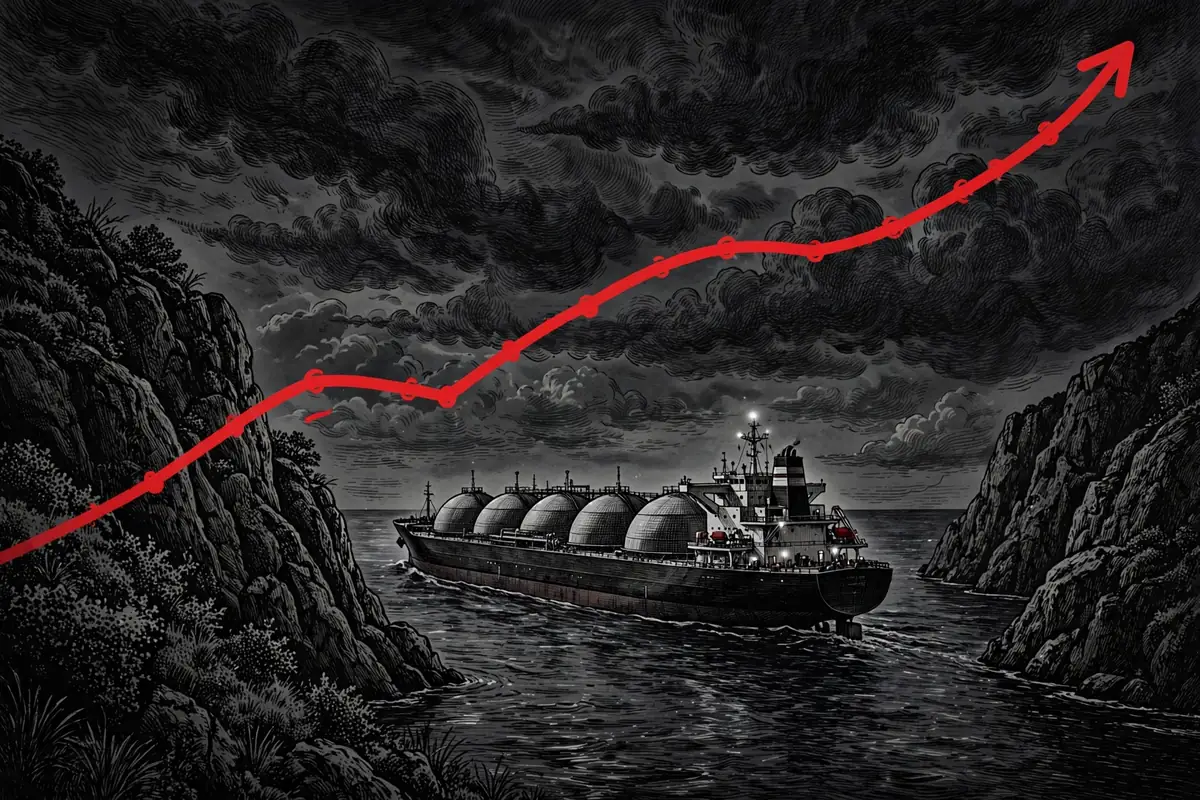
The timeline of the squeeze:
- February 28, 2026: US–Israeli strikes on Iran begin the war; the Strait of Hormuz is largely blocked to energy traffic.
- Spring–summer 2026: Europe competes with Asian buyers for spot LNG cargoes at elevated prices; injections into storage lag.
- July 17, 2026: The Commission adopts its proposal for a regulation on future-proofing electricity bills.
- October 8, 2026: ENTSOG publishes its Winter Supply Outlook, confirming 72% storage and modelling cold-winter and disruption scenarios.
- October 9, 2026: The Institute for Energy Economics and Financial Analysis (IEEFA) warns Europe may need to cut winter gas demand by about 7%.
- October 15–16, 2026: EU leaders ask the Commission for short-term measures against soaring energy prices.
- October 19, 2026: Energy Commissioner Dan Jørgensen meets Visegrad energy ministers in Bratislava on affordability and security of supply; Houthis claim attacks on Saudi energy facilities.
- October 20, 2026: Brent crude trades near $110 a barrel, a five-month high; TTF gas hovers around €80–87/MWh.
- October 29, 2026: Energy ministers meet in Luxembourg; the EU–Canada summit opens in Montreal the same day.
- January 1, 2027: The EU’s full ban on imports of Russian LNG takes effect, removing another source of supply flexibility mid-winter.
By the numbers: Europe’s winter energy balance
| Metric | Figure | Source |
|---|---|---|
| EU gas storage fullness, October 18, 2026 | 74.6% | GIE AGSI+ (confirmed) |
| Storage fullness a year earlier | 82.8% | GIE AGSI+ (confirmed) |
| Five-year average for mid-October | ~89% | Voltstack/AGSI+ history (confirmed) |
| TTF benchmark gas price, mid-October 2026 | ~€87/MWh | Household Energy Price Index (confirmed) |
| TTF benchmark before the Iran war | ~€32/MWh | Household Energy Price Index (confirmed) |
| Residential gas prices, EU capitals, Feb–Sep 2026 | +12% | HEPI (confirmed) |
| Residential electricity prices, EU capitals, Feb–Sep 2026 | +4.2% | HEPI (confirmed) |
| EU diesel / petrol prices, Feb–Oct 2026 | +35% / +23% | EU Weekly Oil Bulletin (confirmed) |
| Brent crude, October 20, 2026 | ~$110/barrel | Reuters (confirmed) |
| Winter demand cut needed if winter is cold | ~7% (14 bcm) | IEEFA (reported) |
| Storage floor in a cold winter with limited LNG | as low as 11% by end of March | ENTSOG outlook (reported) |
| ING forecast: average TTF over winter 2026/27 | €73/MWh | ING (reported) |
CONFIRMED figures are corroborated by two or more independent sources. REPORTED figures come from a single outlet or analyst note and should be treated as provisional.
The diesel and petrol numbers deserve emphasis for readers outside the EU too: with diesel up 35% since February, the crisis at the pump mirrors the one at the boiler. Our analysis of why US diesel still costs over $6 a gallon shows the same refinery and supply-chain pressures operating across the Atlantic.
What is on the ministers’ agenda: network charges, supply security, post-2030 targets
Electricity network charges. The centrepiece legislative item is the Commission’s July 2026 proposal for a regulation on future-proofing electricity bills, which amends Regulation (EU) 2019/943. Network charges — the cost of the wires and grids that carry electricity — make up roughly a quarter of household electricity bills, and the Commission estimates €1.2 trillion of grid investment will be needed by 2040. The proposal sets minimum smart-meter coverage of 50% of final customers by 2030 (rising to 75% by 2033) and storage targets of 200 GW by 2030 and 500 GW by 2040. It is already contested: Article 18(4), which would let member states partly cover network costs from public budgets, is opposed by France’s electricity union UFE as a threat to the level playing field, while grid operators’ group ENTSO-E says the text must better balance affordability for consumers with financeable returns for investors. Expect ministers to probe how far Brussels can go on bill relief without undermining the grid buildout the same regulation is meant to finance.
Security of supply. ENTSOG’s Winter Supply Outlook, published on October 8, models the winter under reference and cold scenarios, including the disruption of the largest offshore infrastructure supplying continental Europe and of all Algerian imports — in both cases assuming no Russian pipeline supply. For the first time, Ukraine’s complete gas system is included in the modelling. The outlook’s message, endorsed by the Commission, is that Europe is prepared for a normal winter but poorly insulated against a severe one. Ministers will also weigh national backstops: Germany has instructed state-owned SEFE to buy and store an additional 8 TWh of gas by December 15, according to ING, and Hungary says its storage is 77% full with reserves for 96 winter days, its energy ministry reported.
Post-2030 targets. The EU has binding renewable energy targets for 2030 (at least 42.5% of the energy mix; the share was 26.2% in 2025) but only an emissions target for 2040 — a 90% net greenhouse-gas cut versus 1990, agreed in 2026. Spain, Portugal and Luxembourg have written to Commissioner Jørgensen urging a binding 2040 renewables target, arguing — in the words of their letter, seen by Bloomberg — that “because of geopolitical uncertainties, and as shown by the consequences of the blockage of the Strait of Hormuz, we need to act fast” to cut fossil-fuel dependence. Italy and Poland, leading critics of the EU carbon market review, are expected to resist anything that looks like new ambition layered onto a price crisis. The Commission’s full post-2030 implementation package, originally expected in December 2026, has been postponed to the first quarter of 2027, Politico reported — another data point ministers will have to digest.

What different sides want from the Luxembourg talks
The Commission, through Jørgensen, is framing the winter as an affordability emergency layered onto a security one — hence the Bratislava meeting with the Visegrad ministers on October 19 and the push for the network-charges regulation. Industry groups, meanwhile, are lobbying to keep carbon-market costs from compounding the energy bill shock; the Agence Europe reporting from the leaders’ summit notes that countries most critical of the ETS review, led by Italy and Poland, may use the price crisis to blunt its ambition.
Market analysts are split on how bad the winter actually gets. ING expects TTF to average €73/MWh over the winter — above its earlier €65 forecast — while Citi’s base case is €56/MWh, citing industrial demand destruction (gas demand down roughly 8% year-on-year in September, nearly 30% below pre-2022 levels in its six-country sample) and faster-than-expected injections. Energy Aspects warns that late-winter price rises could become acute if storage runs low with Hormuz still closed. And traders are watching Washington: the reported US moves on Russia-related sanctions — the Graham Act waiver explained here — add a geopolitical wildcard to supply calculations, with the EU’s own sanctions tracker monitoring how restrictions on Russian energy evolve.
What the October 29 talks mean for your heating bills
For US, UK and EU readers, the meeting’s outcome matters through the bills that land in January and February. The Household Energy Price Index, compiled by Energie-Control Austria, MEKH and VaasaETT, found residential gas prices across EU capitals up 12% on average between February and September, with electricity up 4.2%. London remains among the continent’s most expensive capitals for electricity, although UK domestic gas prices are comparatively lower than in several major European economies.
Three buffers soften the blow, and all three are weakening. Wholesale spikes reach bills with a delay, so the October price surge will bite hardest in the new year. Fixed contracts and government support can cushion households — but several governments have already spent heavily on earlier rounds of support. And a mild winter would reduce consumption: seasonal models currently favour a mild, wet, Atlantic-driven winter under a record-strength El Niño, though that is a forecast, not a guarantee.
For American readers, the US Energy Information Administration’s Winter Fuels Outlook (October 6) expects heating oil to average $5.26 a gallon from November to March, up 34%, with oil-heated households spending about $2,115 — up 21%. Our earlier piece on $106 oil and winter fuel bills and the explainer on how emergency oil releases work remain relevant background. This article is for informational purposes only and is not financial advice.
What to watch after the October 29 meeting
First, the Council conclusions: do ministers endorse the Commission’s short-term toolbox, and with what timeline for legislation? The network-charges regulation still needs co-legislator agreement, so October 29 will show how much political cover the Council is willing to give.
Second, the diplomatic calendar around the meeting. An EU–Gulf Cooperation Council summit takes place in Riyadh on October 24 — directly relevant to LNG supply diplomacy. The EU–Canada summit in Montreal on October 29–30 opens the same day, with energy cooperation expected on its agenda. And COP31 follows in Antalya, Türkiye, from November 9–20, where the EU’s postponed post-2030 package will be scrutinised.
Third, the weather and the storage trajectory. If injections through late October and a mild November keep storage above the mid-70s, the crisis framing eases; a cold snap or a fresh supply disruption would do the opposite. With Gulf LNG still ~80% below last year and the Russian LNG ban taking effect on January 1, Europe enters this winter with less margin for error than at any point since 2022.
Frequently asked questions
What will the EU energy ministers discuss on October 29?
According to the Council’s official forward look, ministers meeting in Luxembourg will discuss the Commission’s proposed regulation on electricity network charges, exchange views on energy security in the immediate and longer term, and consider potential energy targets for the post-2030 framework. The informal but dominant topic will be soaring energy prices and winter preparedness.
How full is EU gas storage before winter 2026?
EU gas storage was 74.6% full on October 18, 2026, according to Gas Infrastructure Europe’s AGSI+ platform — the lowest level for this time of year since records began in 2011, and well below the five-year average of about 89%. The EU softened its November 1 filling target from 90% to 80% this year; analysts expect 75–78%.
Why are European gas prices so high in October 2026?
Three shocks collided: the Iran war has largely blocked the Strait of Hormuz, cutting Persian Gulf LNG flows by about 80% year-on-year; Houthi attacks on Saudi targets and vessel attacks in the Gulf have deepened supply fears; and EU gas storage is unusually thin at under 75%, so traders bid harder for the same spot cargoes. The TTF benchmark reached about €87/MWh — roughly 150% above year-ago levels.
Will Europe run out of gas this winter?
Regulators say no immediate shortage is expected: the Commission endorsed the network operators’ winter outlook on October 8, and ENTSOG’s assessment is that Europe can meet demand in an average winter. The real risk is price, not physical shortage. In a cold winter with limited LNG, ENTSOG modelling suggests storage could fall as low as 11% by end-March, and the EU might have to cut demand by about 7% — figures drawn from scenario modelling, not forecasts of what will happen.
What does the gas price spike mean for household heating bills?
Wholesale spikes reach bills with a delay. Residential gas prices across EU capitals already rose 12% on average between February and September 2026 (electricity up 4.2%), and the October wholesale surge will feed through to bills in the new year. Fixed contracts and government support soften the impact, but the buffers are thinner than in 2022.
Sources
- Council of the EU: Forward look — 19 October to 1 November 2026
- ENTSOG: Winter Supply Outlook 2026/27 press release
- E3G: In critical October meetings, European leaders face winter energy squeeze
- Reuters (via WABX): Brent crude holds near five-month high on Middle East tension
- OE Magazine: Winter energy bills — UK among Europe’s most expensive for electricity
- TFTC: EU NatGas nears multi-year highs as storage deficit persists
- Voltstack: EU Gas Storage Tracker — Winter 2026/27 (GIE AGSI+ data)
- ENTSO-E: Position on the future-proofing electricity bills proposal
- SWP: EU climate policy to 2040 — flexibility and effort sharing
- Oil & Gas 360: Three EU nations call for new 2040 renewable energy goal


Discussion 0
Share analysis, corrections, or context. Be civil — comments are moderated.