WarBrief Live | October 22, 2026 | Intelligence Report
October 2026 has produced a genuine cluster of missile-test activity across Asia — but not the one circulating in some corners of the internet. Confirmed: North Korea’s first submarine-launched cruise missile disclosure in nearly three years, and South Korea’s first hypersonic glide vehicle test. Not confirmed: claims of a new Indian K-4 submarine-launched ballistic missile test this month, which trace back to recycled December 2025 reporting. This report separates the confirmed record from the unverified. See also WarBrief’s intel archive.
Key Takeaways
- North Korea test-fired two types of submarine-launched strategic cruise missiles on October 14 — its first public SLCM disclosure in nearly three years (KCNA, USNI News).
- South Korea tested its first hypersonic glide vehicle on October 8, with President Lee Jae Myung observing (Yonhap).
- There is no verified record of a new K-4 test in October 2026. The verified record stands at two tests from INS Arighaat: November 27, 2024 and December 23, 2025 (Times of India, News18).
- India’s test ranges carried notice-to-airmen windows in October, but which system flew remains unconfirmed by New Delhi.
- The sea-based leg is what makes no-first-use credible — and October shows the whole region racing to secure one.
What October’s missile-test wave confirmed — and what it did not
Confirmed: North Korea’s SLCM comeback. On October 14, the Missile General Bureau test-fired two types of submarine-launched strategic cruise missiles into the East Sea, per KCNA reporting carried October 15 — “strategic” denotes a nuclear-capable system in Pyongyang’s usage. Imagery suggests the launches came from the 3,000-ton Hero Kim Kun Ok submarine; Kim Jong Un did not attend. Corroborated by USNI News, Dong-A Ilbo, Korea JoongAng Daily and AsiaOne. On the underlying technology, see how modern missile guidance and sea-skimming flight profiles work.
Confirmed: South Korea’s hypersonic debut. On October 8, South Korea successfully test-launched its first hypersonic glide vehicle, with President Lee Jae Myung observing, the presidential office said (Yonhap; corroborated by the Korea Times and SBS). North Korea later questioned whether it reached hypersonic speeds — and the launch came five days after North Korea’s own October 3 hypersonic missile test: a clear action-reaction sequence.
Unconfirmed: India’s October windows. IDRW reported on October 4 that a notice to airmen covered October 6–9 at the new Junput DRDO range in the Bay of Bengal. Separately, defense trackers flagged a mid-October window with a roughly 3,550 km danger zone, with analyst speculation — not official statements — suggesting Agni-V MIRV validation or a “Dhvani” hypersonic missile. Unconfirmed by New Delhi; no reputable outlet ties it to the K-4 or INS Arighaat.
Debunked: the “new K-4 test” story. No reputable outlet — not Reuters, AP, BBC, Al Jazeera, the Times of India, News18, The Hindu or the Indian Express — reports any K-4 launch in October 2026. October-dated articles recycle December 2025 reporting: one site’s crawler metadata says “Published: 2026-10-22” while its own page header reads “29 Dec 2025”; another shows “Published: 2025-12-29, Updated: 2026-10-21.”
| Metric | Figure | Source |
|---|---|---|
| DPRK SLCM types tested, Oct 14 | 2 | KCNA via USNI News — CONFIRMED |
| Years since DPRK’s last public SLCM disclosure | ~3 | USNI News — CONFIRMED |
| ROK HGV tests to date | 1 (first) | Yonhap — CONFIRMED |
| K-4 range | ~3,500 km | Times of India, News18, NDTV — CONFIRMED |
| K-4 payload | ~2–2.5 t nuclear | TOI (“two-tonne”); NDTV (“2.5-ton”) — CONFIRMED range |
| Verified K-4 tests from INS Arighaat | 2 (Nov 2024, Dec 2025) | Times of India — CONFIRMED |
| India’s mid-October danger-zone length | ~3,550 km | Defense trackers — REPORTED, unconfirmed |
“CONFIRMED” = two or more reputable sources; “REPORTED” = tracker or secondary claims not yet independently verified.
India’s K-4 program: the verified record
The K-4 is a solid-fuel, two-stage submarine-launched ballistic missile developed by the DRDO and derived from the land-based Agni-III design, per Indian defense reporting. Reputable outlets put its range at about 3,500 km with a nuclear payload in the two-to-2.5-tonne band. Its platform is INS Arighaat, India’s second nuclear-powered ballistic missile submarine (roughly 6,000 tonnes), commissioned on August 29, 2024 and operated by the Strategic Forces Command.
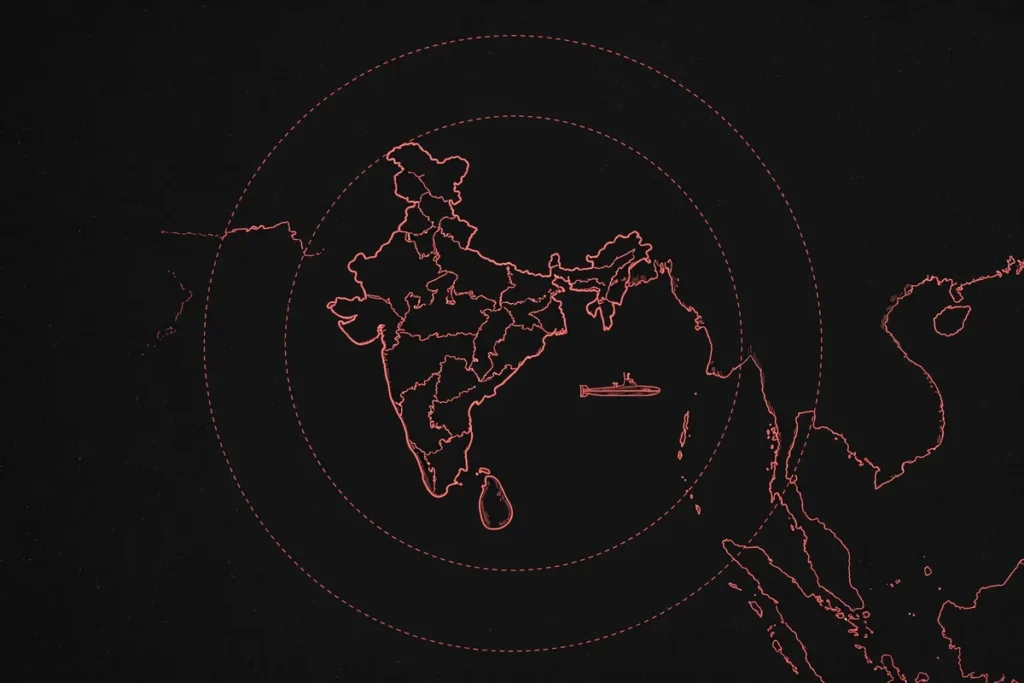
The test record is short and well documented. The first K-4 launch from INS Arighaat took place on November 27, 2024, disclosed via Navy chief Admiral Dinesh Tripathi’s Navy Day press conference (Times of India). The second took place on December 23, 2025, reported on December 25 by the Times of India, News18, Telegraph India and NDTV — both from the Bay of Bengal. The Defence Ministry issued no official statement on either test (Times of India, Telegraph India, The Hindu’s BusinessLine). Recycled articles’ “second test following an earlier launch last year” describes December 2025 versus November 2024 — correct for that date. There is no verified third test.
Why the sea-based leg decides India’s deterrent credibility
India’s 2003 nuclear doctrine commits to no-first-use and “credible minimum deterrence.” The sea-based leg is what makes that believable: submarines on patrol cannot be destroyed in a first strike, so no adversary can be confident of disarming India. That survivable second strike is the entire logic of the SSBN program — and the K-4’s 3,500 km reach from the Bay of Bengal puts continental targets in range, the same logic behind France’s M51.3 SLBM modernization.
October’s pattern reinforces the point. North Korea’s SLCM comeback is a bid for the same survivable strike option at smaller scale; South Korea’s HGV answers with a weapon built to defeat missile defenses. Three countries, one month, one competition: who can credibly threaten retaliation after a first blow.
What October’s firings mean for US/UK/EU readers
The significance is alliance posture, not imminent conflict — missile tests are routine signaling. But the SLCM comeback after a three-year pause expands the scenarios US and South Korean planners must cover, feeds extended-deterrence consultations in Seoul and Tokyo, and adds momentum to hypersonic-defense spending in the US, UK and Europe. Readers tracking chemical, biological and nuclear threats in modern geopolitics should note the trend line: delivery systems are proliferating faster than arms-control frameworks can track.
Assessment and outlook
October 2026 confirmed an Indo-Pacific missile modernization wave — not a new Indian SLBM milestone. The verified K-4 record remains two tests; India’s October activity sits in the unconfirmed land-based category. The bigger development is on the Korean Peninsula: a nuclear-armed state returning to submarine-launched cruise missiles after three years, answered within days by its rival’s hypersonic debut. Watch for follow-on SLCM launches from Pyongyang, further ROK HGV tests, and whether New Delhi confirms what flew in its October windows. See WarBrief’s intel archive for the running picture.
Frequently asked questions
Did India test the K-4 missile in October 2026?
There is no verified record of it. No reputable outlet reports a K-4 launch in October 2026; October-dated articles recycle December 2025 reporting. The confirmed tests from INS Arighaat are November 27, 2024 and December 23, 2025.
What is the K-4 missile?
A DRDO-developed, solid-fuel, two-stage submarine-launched ballistic missile: roughly 3,500 km range, a two-to-2.5-tonne nuclear payload, launched from India’s SSBNs including INS Arighaat.
What does “strategic” mean in North Korea’s SLCM announcement?
In Pyongyang’s terminology, “strategic” denotes a nuclear-capable system. The October 14 test was its first public SLCM disclosure in nearly three years.
Sources
- Times of India: India test-fires 3,500 km missile from nuclear submarine (Dec 25, 2025)
- Times of India: Navy chief on the first K-4 launch from INS Arighaat (Dec 2024)
- Telegraph India: India tests nuclear-capable K-4 missile from INS Arighaat (Dec 2025)
- Yonhap: South Korea successfully test-launches first hypersonic glide vehicle (Oct 8, 2026)
- USNI News: North Korea tests first submarine-launched cruise missile in nearly 3 years (Oct 15, 2026)
- Dong-A Ilbo: North Korea’s SLCM test (Oct 16, 2026)
- IDRW: India plans first missile test from new Junput range (Oct 4, 2026)