
WarBrief Live | October 21, 2026 | Defense Technology
Mach 2.8
Publicly stated top speed of the BrahMos cruise missile
~5 m
Terminal flight altitude of sea-skimming missiles
>1,500 km
Range of China’s DF-21D anti-ship ballistic missile (CRS, citing the Pentagon)
>185 km
Range of Norway’s stealthy Naval Strike Missile (Kongsberg)
How do anti-ship missiles work? Put simply, they are guided weapons built for one job: finding and destroying a ship at sea. In 2026 it is the weapon that keeps admirals awake at night — from subsonic sea-skimmers that hug the waves to evade radar, to ballistic missiles that fall from space onto moving carriers. This explainer walks through how they work, why they fly so low, what separates a cruise missile from a ballistic one, and the layered defences warships use to survive. Where a figure rests on a single or secondary source, it is marked as reported rather than confirmed.
Key Takeaways
- Anti-ship missiles strike in three phases: a launch platform cues the target, the missile flies the middle leg on inertial navigation and satellite positioning, and a terminal seeker takes over for the final lock.
- Sea-skimming at roughly 5–20 metres above the waves keeps the missile below the radar horizon, shrinking a warship’s warning time to tens of seconds.
- Cruise missiles (Harpoon, Exocet, NSM, BrahMos) stay low and slow; anti-ship ballistic missiles (China’s DF-21D and DF-26) trade from space at ranges above 1,500 km.
- Warships defend in layers: long-range interceptors, point-defence missiles, gun systems like Phalanx, and soft-kill tricks such as the Nulka decoy.
- Commercial shipping is now in the blast radius: Kpler said at least 18 vessels had reportedly been attacked in the two weeks to October 19.
What is an anti-ship missile?
An anti-ship missile is a precision-guided missile designed to detect, approach and strike naval vessels — and increasingly, merchant ships. It can be launched from surface warships, submarines, aircraft or shore-based coastal batteries, and its range spans from a few dozen kilometres to thousands of kilometres.
The category divides into two families. The first is the anti-ship cruise missile: an air-breathing weapon that flies most of its route at low altitude before homing onto its target. The American Harpoon, the French Exocet, Norway’s Naval Strike Missile (NSM) and the Indian-Russian BrahMos all belong here. The second is the anti-ship ballistic missile: a rocket that boosts into space and re-enters at hypersonic speed with a manoeuvrable re-entry vehicle steered onto a moving ship — China’s DF-21D and DF-26 are the canonical examples, with ranges above 1,500 km and around 4,000 km respectively, according to the Congressional Research Service’s study of China’s naval modernisation, which cites Pentagon assessments.
How does an anti-ship missile find its target?
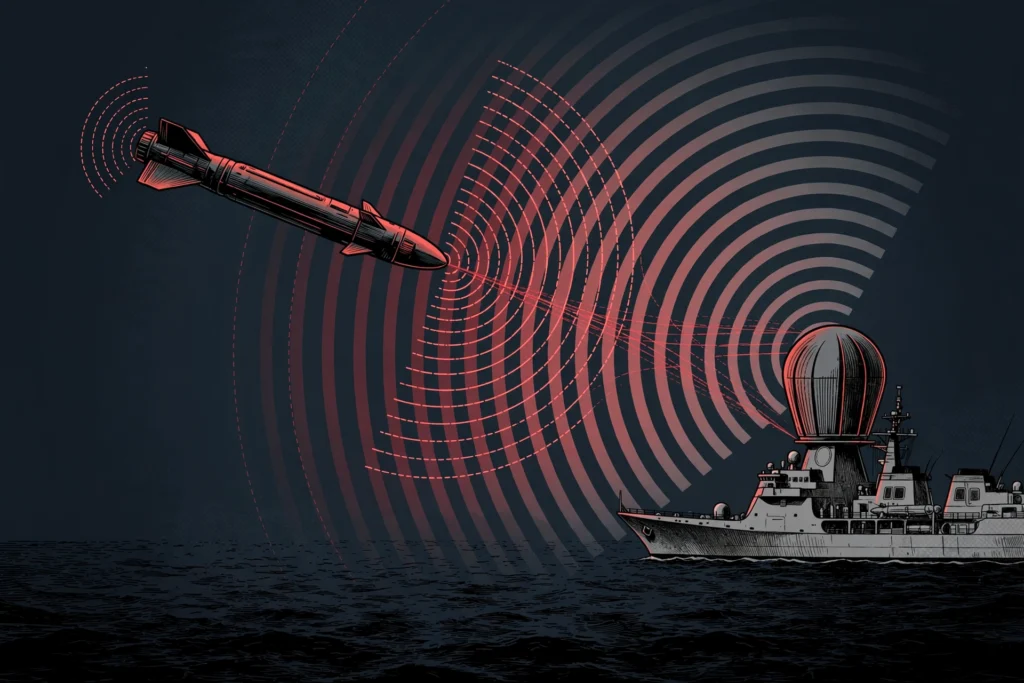
Finding a ship in open ocean is the hard part — the missile must solve it three times over. As specialist analysts describe the kill chain, it runs in three phases. First, a launch platform or a third-party sensor (a ship’s radar, a maritime patrol aircraft, a drone, a satellite, or an over-the-horizon radar) fixes the target’s approximate position and hands it to the missile at launch.
Second comes the mid-course phase: the missile flies toward that box of ocean on inertial navigation corrected by satellite positioning, and may receive course updates by datalink. Finally, in the terminal phase, the seeker goes active — or rather, the missile’s own sensors take the shot. The most common terminal seeker is active radar homing: the missile emits its own radar pulses and homes on the reflection. Others, like the NSM, use a passive imaging-infrared seeker that emits nothing at all, comparing the heat picture ahead to an onboard library — which also makes the missile invisible to radar-warning receivers. Multi-mode seekers combine two or more of these methods so that a single countermeasure cannot break the lock. Once locked, the weapon is “fire and forget”: it needs no further help from the launcher.
Why do anti-ship missiles fly so low over the sea?
Sea-skimming is about stealing reaction time. Radar cannot see around the curvature of the Earth: a ship’s radar mast at 30 metres above the waterline will only detect a missile flying 5 metres above the waves at roughly 32 kilometres, according to specialist analysis — which leaves about 100 seconds of warning against a high-subsonic weapon, and far less against a supersonic one or when heavy sea clutter swallows the return.
Typical sea-skimmers hold roughly 5 metres above calm seas to around 20 metres in rough water, where larger waves force the missile to fly higher to avoid them. In some profiles the missile is detectable only about 20–40 seconds from impact, per secondary specialist accounts — figures to treat as reported, not measured fact.
Some missiles add a final trick: the pop-up manoeuvre. The weapon climbs sharply in the last kilometres, then dives onto the deck from above, attacking where the ship’s armour and sensors are thinnest. Early Harpoon blocks reportedly climbed to around 1,800 metres before diving, according to specialist accounts; later blocks flew a pure sea-skimming finish or made the manoeuvre selectable.
Anti-ship missiles by the numbers
The table below uses only figures where two or more sources agree. Reported figures carry an attribution instead.
| Metric | Figure | Source |
|---|---|---|
| BrahMos speed | ~Mach 2.8 | BrahMos Aerospace, via Army Technology / Army Recognition |
| BrahMos publicly stated range | ~290 km | BrahMos Aerospace, via Army Technology / Army Recognition |
| BrahMos warhead | 200–300 kg | BrahMos Aerospace, via Army Technology / Army Recognition |
| BrahMos terminal altitude | As low as ~5 m | BrahMos Aerospace, via Army Technology / Army Recognition |
| Harpoon speed / warhead | ~850 km/h subsonic / 221 kg warhead | Boeing fact sheets, via consistent fact-sheet mirrors |
| Harpoon guidance | Sea-skimming cruise + active radar terminal homing | Boeing fact sheets, via consistent fact-sheet mirrors |
| Naval Strike Missile range | >185 km (115 miles) | Kongsberg, via Defence-Blog / Hiwars |
| NSM seeker | Passive imaging infrared (emits nothing) | Kongsberg, via Defence-Blog / Hiwars |
| DF-21D range | >1,500 km (~810 nm) | Congressional Research Service, citing Pentagon assessments |
| DF-26 range | ~4,000 km (~2,160 nm) | Congressional Research Service, citing Pentagon assessments |
Reported, not independently confirmed: claims of a 650 km BrahMos range and Mach 3.5 top speed (Wikipedia); Exocet Block 3 “200 km class” range figures; and radar-horizon warning-time calculations.
Cruise vs ballistic: what is the difference?
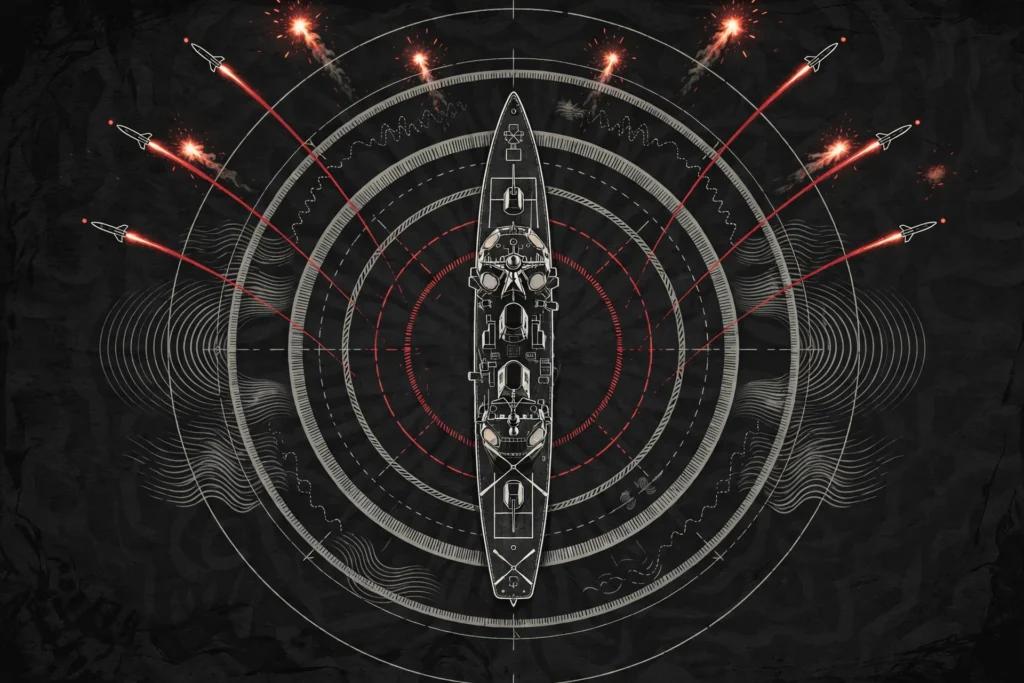
The two families attack from opposite directions. A cruise missile stays inside the atmosphere, uses a turbojet or ramjet, and trades speed or stealth for a low, flat flight path. The subsonic Harpoon has been the Western workhorse since 1977; the Exocet became famous in the Falklands War; the NSM adds stealth shaping and a silent imaging-infrared seeker; and the BrahMos adds raw speed at roughly Mach 2.8 on a liquid-fuel ramjet. All of them must survive the ship’s defences in the final seconds.
An anti-ship ballistic missile skips the atmosphere problem entirely: it is launched like a ballistic missile, arcs into space, and its manoeuvrable re-entry vehicle — a MaRV — steers onto the moving ship during the plunge. The Congressional Research Service, citing the Pentagon, identifies the DF-21D as a DF-21 variant purpose-built to hold aircraft carriers at risk in the western Pacific, and the DF-26 as an intermediate-range weapon the US Defense Department says can strike naval as well as ground targets. In August 2020, according to the CRS citing press reports and a public statement by then-INDOPACOM commander Admiral Philip Davidson, China fired DF-21D and DF-26 missiles into the South China Sea and successfully hit a moving target ship south of the Paracel Islands — the first publicly confirmed demonstration of the capability.
How can warships defend against anti-ship missiles?
Navies answer in layers, because no single system catches everything. The outer layer is area air defence: long-range surface-to-air missiles such as the SM-2 and SM-6. The SM-6 carries a dual-mode seeker — semi-active plus active radar, derived from the AIM-120 AMRAAM — and, as USNI Proceedings describes, cooperative engagement networks let it shoot at targets beyond the launching ship’s own radar horizon, cued by off-board sensors such as airborne early-warning aircraft. It even has a secondary anti-ship mode.
Closer in come point-defence missiles — the Evolved SeaSparrow (ESSM) and the Rolling Airframe Missile — then the last-ditch guns: close-in weapon systems like the American Phalanx, a self-contained automated mount built around a 20 mm six-barrel Gatling gun firing 3,000–4,500 rounds per minute, guided by Ku-band radar and an infrared camera on Block 1B mounts.
Then there is soft-kill: defeating the missile’s brain instead of its body. Electronic-warfare suites such as the AN/SLQ-32 jam or spoof seekers; chaff clouds throw false radar echoes; and active decoys like Nulka — an Australian-designed hovering rocket that seduces radar-homing missiles away from the ship — are, per published profiles, fitted to more than 150 Australian, Canadian and US warships. The layers buy what naval engineers call “shots on goal”: every layer the missile survives is one it might not.
Why the Red Sea made this question urgent again
This is no longer a naval-college abstraction. On October 7, an armed small boat opened fire on the container ship CUL Klang — a China United Lines vessel with a Chinese crew sailing from Port Klang — north of the Bab el-Mandeb at around 06:15 UTC, according to the EU Naval Force’s Maritime Security Centre; all crew were reported safe, and no group claimed responsibility, with some outlets noting the possibility of a fishing-boat warning-shots incident. It has not been confirmed as a Houthi anti-ship attack.
The wider trend is real, though. Ship-tracking firm Kpler said in a note issued on October 19 that at least 18 vessels had reportedly been attacked over the previous two weeks, as reported by outlets including the Business Times — a figure to attribute to Kpler, not to treat as an independently confirmed count. The pattern links back to the chokepoint geography explained in our Bab el-Mandeb vs Strait of Hormuz comparison, the Houthi escalation across the region, and the strike on Aden Palace. And it sits inside the same naval reality examined in our piece on naval warfare lessons from the Iran war: ships that cannot defeat the missile threat do not sail in contested water.
What anti-ship missile threats mean for US/UK/EU readers
You do not need to live near a naval base to feel this. When ships come under fire near chokepoints like the Bab el-Mandeb or the Strait of Hormuz, war-risk insurance premiums spike, some owners reroute around the Cape of Good Hope — adding weeks and thousands of miles — and the cost lands in fuel prices, freight rates and the price of imported goods in American, British and European shops. Air-travel advisories and cancelled sailings follow the same logic: the missile threat shapes civilian life long before any warship is involved.
The strategic layer matters too. NATO has responded to attacks on civilian shipping in the Black Sea by deploying additional aircraft, drones and radars — covered in our conflict zones reporting — because the line between a “military” weapon and an economic weapon has effectively vanished.
What to watch next in naval missile warfare
Three threads will decide the next decade. First, the range race: anti-ship ballistic missiles and hypersonic glide vehicles are pushing the threat ring ever further from shore, which is why the US Navy invests so heavily in over-the-horizon targeting networks. Second, the defence race: navies are testing laser weapons and other directed-energy point defences as a cheap answer to cheap missiles. Third, the commercial thread: if Red Sea and Gulf attacks continue at the current tempo, shipping insurance and rerouting will quietly reshape global trade — which is exactly why an explainer on how these weapons work belongs on every reader’s radar.
Frequently asked questions
How does an anti-ship missile find its target?
In three phases: a launch platform or third-party sensor supplies the target’s rough position, the missile flies the middle leg on inertial navigation and satellite positioning (sometimes with datalink updates), and in the terminal phase its own seeker — usually active radar, sometimes passive imaging infrared — locks on for a fire-and-forget finish.
Why do anti-ship missiles fly so low over the sea?
To stay below the radar horizon. A warship’s radar can only see a missile flying a few metres above the waves at a few dozen kilometres, leaving tens of seconds of warning. Sea clutter in rough water adds to the hiding effect, though it also forces the missile to fly slightly higher.
What is the difference between active radar and imaging infrared seekers?
Active radar homing emits radar pulses and homes on the reflection — effective but detectable by the target’s radar-warning receivers. Imaging infrared is passive: it emits nothing and compares the heat picture ahead against an onboard library, making the missile harder to detect before impact. Multi-mode seekers combine both.
How does the Nulka decoy protect a warship?
Nulka is an Australian-designed hovering rocket decoy that presents a large, attractive radar target away from the ship, seducing radar-homing missiles into chasing it instead. Per published profiles it is fitted to more than 150 Australian, Canadian and US warships.
What do anti-ship missiles do differently from other missiles?
They are purpose-built for the maritime environment: sea-skimming flight profiles to beat radar, seekers tuned to pick ships out of sea clutter, and warheads designed to damage or sink vessels — including anti-ship ballistic missiles that re-enter from space to strike moving targets at ranges above 1,500 km.
Sources
- Congressional Research Service: China Naval Modernization (R33153) — DF-21D/DF-26 capabilities
- USNI Proceedings: SM-6 dual-mode seeker and cooperative engagement capability
- Military & Aerospace Electronics: Navy air defence against sea-skimming threats
- Defence-Blog: Denmark orders more Norwegian Naval Strike Missiles
- Army Technology: BrahMos supersonic cruise missile
- Safety4Sea: Armed small boat opens fire on container ship CUL Klang in the Red Sea
- Business Times: Kpler on at least 18 vessels reportedly attacked in two weeks
- MiGFlug: How anti-ship missile guidance, seekers and sea-skimming work

Discussion 0
Share analysis, corrections, or context. Be civil — comments are moderated.