
WarBrief Live | November 5, 2026 | Explainer
1
time NATO’s Article 5 has been invoked since 1949
1
time the CSTO’s Article 4 has been invoked since 1992
16
articles in the Makkah pact, locking its members in for 10 years
32
members of NATO after Sweden joined in March 2024
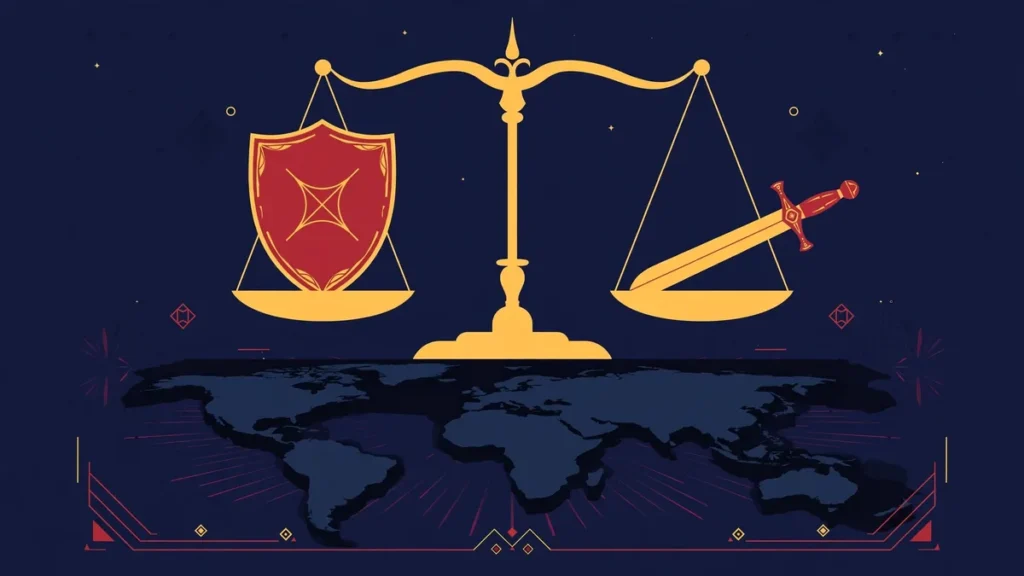
A mutual defence pact is a treaty in which an attack on one member counts as an attack on all of them — but the promise is not automatic war: every pact leaves each government to decide what help it sends.
The phrase is back in the news because Turkey’s parliament began ratifying the Makkah Joint Defence Agreement on November 5, 2026, a trilateral pact with Pakistan and Saudi Arabia built around exactly that promise. The same words sit at the heart of NATO’s Article 5, the CSTO’s Article 4 and the ANZUS treaty — yet the four pacts promise very different things. Understanding the gap between the slogan and the small print is the difference between reading a headline and understanding what a government has actually signed up to.
Key Takeaways
- “Attack on one is attack on all” is a political promise written into a treaty, not a tripwire that starts a war by itself.
- NATO’s Article 5 has been invoked only once, after the September 11, 2001 attacks; the CSTO’s equivalent clause has been invoked once, in Kazakhstan in January 2022.
- The wording decides the obligation: NATO and the CSTO name armed force as a possible response, ANZUS only requires each party to “act to meet the common danger”, and the Makkah pact requires immediate assistance without binding any party to use force.
- The new Makkah pact between Pakistan, Saudi Arabia and Turkey is built more for joint capacity building than for NATO-style collective defence — and it locks its three members in for at least 10 years.
What is a mutual defence pact?
A mutual defence pact is a treaty in which two or more states agree that an armed attack on any one of them will be treated as an attack on all of them, and that the others will come to the victim’s aid. The legal foundation is Article 51 of the United Nations Charter, which preserves the “inherent right of individual or collective self-defence if an armed attack occurs against a Member of the United Nations”. Every modern pact cites that right, expressly or by design: it is what makes collective defence lawful without waiting for the UN Security Council to act.
Lawyers call the trigger a casus foederis — the case that brings the treaty into operation. But pacts sit on a spectrum. At one end are consultation agreements, where an attack obliges allies to talk. At the other are treaties that name armed force as an available response. And the spectrum matters more than the slogan: two pacts can carry the same “attack on one” language and commit their members to very different things.
Three features decide how strong a pact really is. First, the trigger: what counts as an attack, and where must it happen? Second, the obligation: must a member send troops, or only help in whatever way it chooses? Third, the decision rule: who decides the pact has been triggered, and by what vote? The answers are written into each treaty — and they are the reason the world’s most famous mutual defence clause has been used only once in 77 years.
How does NATO Article 5 actually work?
NATO’s collective defence clause is Article 5 of the North Atlantic Treaty, signed in Washington in 1949 by 12 founding states. The alliance has since grown to 32 members, after Finland joined in April 2023 and Sweden became the 32nd ally on March 7, 2024. The clause itself is one paragraph, and its most important words are the ones people usually skip:
“The Parties agree that an armed attack against one or more of them in Europe or North America shall be considered an attack against them all and consequently they agree that, if such an armed attack occurs, each of them, in exercise of the right of individual or collective self-defence recognized by Article 51 of the Charter of the United Nations, will assist the Party or Parties so attacked by taking forthwith, individually and in concert with the other Parties, such action as it deems necessary, including the use of armed force, to restore and maintain the security of the North Atlantic area.”
Three things in that text are routinely misunderstood. First, “such action as it deems necessary” means each ally decides its own response. Article 5 does not order any country to send troops; it obliges each to assist, and leaves the form of that assistance — from intelligence sharing to armed force — to the government concerned. Second, invoking Article 5 is a political decision of the North Atlantic Council, taken by consensus: all 32 allies must agree the clause applies. Third, the clause is geographically bounded. It covers an armed attack “in Europe or North America”; an attack on an ally’s forces or interests elsewhere does not automatically trigger it.
The clause has also been stretched into new domains. At the Wales Summit in September 2014, NATO agreed that a cyberattack with effects comparable to a conventional armed attack could trigger Article 5, with the decision taken by the North Atlantic Council on a case-by-case basis, according to the NATO Cooperative Cyber Defence Centre of Excellence. No cyberattack has ever crossed that threshold in practice, and allies have deliberately left the threshold undefined.
What counts as an “armed attack” is itself a legal question. The International Court of Justice held in its 1986 Nicaragua judgment that only the most grave uses of force — judged by their scale and effects — qualify. A border skirmish, a sabotage incident or a cyber intrusion that causes no physical destruction would not, on that test, trigger a collective defence clause at all.

When have ‘attack on one’ clauses actually been invoked?
NATO’s Article 5 has been invoked exactly once. After the September 11, 2001 attacks on the United States, the North Atlantic Council agreed on September 12, 2001 that the attacks would be regarded as covered by Article 5 if they were determined to have been directed from abroad, and confirmed that determination on October 2, 2001. On October 4, NATO agreed a package of eight support measures, including intelligence sharing, overflight clearances and access to ports and airfields. NATO’s own account records that the Alliance then launched Operation Eagle Assist, flying seven AWACS radar aircraft over the United States from October 9, 2001 to mid-May 2002, with 830 crew members from 13 countries flying more than 360 sorties, followed by the naval Operation Active Endeavour in the Mediterranean, which ran until 2016.
The only other invocation of a comparable clause came from the Collective Security Treaty Organization, the Russian-led alliance of six post-Soviet states. Article 4 of the 1992 Collective Security Treaty states that if one member undergoes aggression — an armed attack menacing its safety, stability, territorial integrity and sovereignty — it will be considered aggression against all members, and the others shall immediately provide the necessary help, “including military one”, at the attacked state’s request. Kazakhstan invoked it on January 5, 2022, after protests over fuel prices turned into violent unrest and President Kassym-Jomart Tokayev claimed foreign terrorists were attempting a coup. CSTO troops began arriving the next day; the force numbered about 2,500, according to the CSTO secretary-general, and withdrawal began on January 13 and was completed by January 19, 2022.
Just as revealing are the times the clause was not used. Kyrgyzstan asked for CSTO help during ethnic violence in 2010 and was refused; Armenia asked in 2021, during its border crisis with Azerbaijan, and was refused. The lesson is that a mutual defence clause is only as reliable as the allies’ willingness to agree that the trigger has been met — and that internal unrest, however violent, is treated differently from an attack by another state.
The CSTO’s own fragility is now on display. Armenia froze its participation in the alliance in February 2024 and stopped paying its contributions in May of that year, saying the organisation had failed to meet its security obligations during the clashes with Azerbaijan in 2021 and 2022. Yerevan remains formally a member, but the CSTO’s secretary-general has said Armenia has effectively withdrawn, and its membership may be discussed at the CSTO summit in Moscow on November 11, 2026. A pact whose members dispute whether it works is a reminder that the signature is the easy part.
How is the Makkah pact different from NATO Article 5?
The Makkah Joint Defence Agreement, signed on August 7, 2026 by Pakistan’s Prime Minister Shehbaz Sharif, Saudi Crown Prince Mohammed bin Salman and Turkish President Recep Tayyip Erdoğan, is the newest “attack on one” pact — and the weakest in strict legal terms. Its 16 articles make it one of the longest collective security texts in existence, but as the Indian Express reported after obtaining the full text, its mutual defence obligations are deliberately not NATO-like.
Article 1 commits the three parties to protecting each other’s independence, sovereignty, territorial integrity and internationally recognised borders. Article 2 reaffirms the “attack on one is an attack on all” principle: “If one of the Parties is subjected to an armed attack… by another country, the Parties shall immediately assist the attacked Party” with “all means of mutual assistance that they can provide to one another.” But the clause does not bind any party to the use of force, and it leaves the means of assistance open. By contrast, the North Atlantic Treaty and the Collective Security Treaty both specify the use of force as a response, and the Gulf Cooperation Council’s Joint Defence Agreement of 2000 explicitly lists “military armed force” as a possible response.
The pact’s real weight lies elsewhere. Article 3 turns the agreement toward defence capacity building, and seven further articles cover regular consultations on international security, joint counterterrorism, personnel exchanges and joint training, technology sharing and joint defence production, intelligence sharing and logistical support in wartime and peacetime. In other words, the Makkah pact is less a promise to fight together than a framework to build the ability to fight together — and to signal, to Iran and to Washington alike, that the three states now stand together. It also locks them in: none of the three can withdraw during the first 10 years after the pact enters into force, and the text refers to them as “core parties”, leaving the door open to more members.
Turkey’s parliament began the ratification process on November 5, 2026, after the text was submitted on October 20. The pact’s first institutions are already taking shape: the three states have agreed to base a permanent secretariat in Riyadh and have held a first ministerial session of their Strategic Political and Defence Committee in Istanbul. For the full background on the pact itself, see our earlier explainer on the Mecca Defence Agreement.
| Pact | Signed | Members | Trigger wording | What the treaty actually requires |
|---|---|---|---|---|
| NATO Article 5 | 1949 | 32 | “An armed attack against one… shall be considered an attack against them all” | Each ally takes “such action as it deems necessary, including the use of armed force” |
| CSTO Article 4 | 1992 | 6 (Armenia’s participation frozen since 2024) | Aggression against one “will be considered” aggression against all | Necessary help “including military one”, at the attacked state’s request |
| ANZUS Article IV | 1951 | 3 | An attack on one “would be dangerous to its own peace and safety” | Each party will “act to meet the common danger in accordance with its constitutional processes” |
| GCC Joint Defence Agreement | 2000 | 6 | Aggression against one member is aggression against all | Explicitly lists “military armed force” as a possible response |
| Makkah Joint Defence Agreement | 2026 | 3 | “If one of the Parties is subjected to an armed attack… the Parties shall immediately assist” | Immediate assistance “with all means” they can provide — no binding use-of-force obligation |
By the numbers: all wording is quoted from the treaty texts or the full-text reporting cited below. CONFIRMED invocation figures: NATO Article 5 has been invoked once, after the September 11, 2001 attacks; CSTO Article 4 has been invoked once, in Kazakhstan in January 2022. No other invocation figure is stated because none is confirmed on the public record.
What does a mutual defence pact not guarantee?
The most important gap is the oldest one: no mutual defence pact guarantees that troops will arrive. ANZUS, the 1951 security treaty between Australia, New Zealand and the United States, is the clearest example. Its Article IV says each party “declares that it would act to meet the common danger in accordance with its constitutional processes” — language chosen deliberately because the US Congress was unwilling to ratify a treaty that appeared to bypass its power to declare war. The obligation is to act, not necessarily to fight; the action can range from diplomatic representations to armed force. NATO’s Article 5 works the same way in practice, whatever its sterner reputation: “such action as it deems necessary” is a choice, not an order.
A pact also guarantees nothing about whether allies will agree an attack happened. Attribution is the hard part in cyberattacks and sabotage, and the “armed attack” threshold excludes most hostile acts below the level of war. A state that suffers a crippling ransomware attack or a pipeline explosion may find its allies sympathetic and its treaty silent.
Geography is a third limit. NATO’s clause covers Europe and North America; ANZUS covers the Pacific Area. An attack on an ally’s forces outside the treaty area does not trigger the clause, however serious it is. And internal crises are generally outside it altogether — which is why the CSTO refused Kyrgyzstan in 2010, and why Kazakhstan’s 2022 invocation was framed, controversially, as a response to aggression from outside rather than to domestic protest.
Finally, a pact is a promise, not a capability. The reason NATO’s Article 5 worked in 2001 was not the sentence in the treaty but decades of joint planning, interoperable forces and political trust built beforehand. That is why the Makkah pact’s seven capacity-building articles may matter more than its Article 2: without joint training, shared logistics and compatible equipment, a promise to assist is a press release. Readers who want the American side of the same question — who inside the US government actually decides to use force — can read our explainer on the War Powers Resolution.
What the Makkah pact means for US/UK/EU readers
For readers in the United States, Britain and Europe, the Makkah pact matters in four concrete ways. First, energy. A formal defence commitment between Saudi Arabia, Turkey and nuclear-armed Pakistan changes the security calculus of the world’s largest oil-exporting region, and Gulf security shocks feed directly into the fuel prices Western households pay. Brent crude has already fallen below $94 this week as midterm results cooled the Iran war premium, as we reported in our analysis of why oil prices fell in November 2026 — but a new defence bloc is the kind of structural change that can move prices again if it is tested.
Second, travel. The Iran war has already disrupted Gulf aviation, with Etihad’s Riyadh and Dammam suspensions extended through November 19 and regional carriers reporting cancellations across UAE airports. Any escalation involving a Makkah pact member would deepen those disruptions overnight, and the pact gives airlines and travellers a new variable to watch.
Third, markets and defence industry. The pact’s technology-sharing and joint-production articles point to more Turkish and Pakistani defence exports to the Gulf, and to European and American firms competing for a share of the same budgets. This is educational context, not financial advice: the pact changes who buys what, not what any individual should buy.
Fourth, diplomacy. Turkey is a NATO ally that has now signed a second mutual defence commitment outside the alliance, with a 10-year lock-in. That raises a question Western capitals will have to answer sooner or later: what happens if Turkey’s two promises ever point in different directions? The pact’s drafters clearly hope the question never arises. The history of mutual defence pacts suggests it eventually will.
What to watch next as the Makkah pact takes effect
The first test is procedural: Turkey’s parliament began considering ratification on November 5, 2026, and the pact’s next steps depend on all three capitals completing their domestic approvals. The second test is institutional: whether the Riyadh secretariat and the Strategic Political and Defence Committee move from announcements to a real work programme of joint exercises, intelligence sharing and production deals. The third test is the one no drafter can schedule: whether the clause is ever invoked, and whether the assistance that follows looks anything like the promise.
Two dates belong on the calendar. The CSTO summit in Moscow on November 11, 2026 may decide Armenia’s future in the Russian-led alliance — a live demonstration of what happens when a mutual defence pact stops working. And the ADMM-Plus defence ministers’ forum, Asia’s looser alternative to binding pacts, offers a useful contrast: consultation without commitment, chosen deliberately by states that watched binding promises fail. The Makkah pact’s authors chose the opposite. The next few years will show whether they chose well.
For the wider picture, see our conflict zones hub, which tracks the wars and standoffs where these promises are most likely to be tested.
Frequently asked questions
What is a mutual defence pact?
A treaty in which an attack on one signatory counts as an attack on all of them, grounded in the UN Charter’s Article 51 right of collective self-defence. The exact obligation depends on the wording: some pacts name armed force as a response, others only require each party to assist in whatever way it chooses.
Does NATO Article 5 mean automatic war?
No. Article 5 says each ally will take “such action as it deems necessary, including the use of armed force”, and invoking it requires agreement in the North Atlantic Council. Each government decides its own response, and the clause has been invoked only once, after the September 11, 2001 attacks.
Can a cyberattack trigger Article 5?
Possibly. At the Wales Summit in September 2014, NATO agreed that a cyberattack with effects comparable to a conventional armed attack could trigger Article 5, with the decision taken by the North Atlantic Council on a case-by-case basis. No cyberattack has ever crossed that threshold in practice.
Is the Makkah pact as strong as NATO Article 5?
No. Its Article 2 requires immediate assistance if a member is attacked, but it does not bind any party to use military force, and it leaves the means of assistance open. The pact’s main weight is joint capacity building — training, technology sharing and defence production — and it locks its three members in for at least 10 years.
Has the CSTO’s mutual defence clause ever been used?
Once. Kazakhstan invoked Article 4 on January 5, 2022, after violent unrest that President Tokayev described as foreign-backed aggression. About 2,500 CSTO troops deployed, and withdrawal was completed by January 19, 2022. Earlier requests from Kyrgyzstan in 2010 and Armenia in 2021 were not granted.
Sources
- NATO: Collective defence and Article 5
- NATO: Sweden officially joins NATO
- The Indian Express: Mecca Defence Pact — Full Text of Turkey, Pakistan and Saudi Arabia’s Mutual Defence Deal Explained
- Human Security Centre: The CSTO and its deployment in Kazakhstan
- Parliament of Australia: The ANZUS alliance
- NATO CCDCOE: NATO Summit to Update Cyber Defence Policy
- United Nations: Repertory of Practice, Article 51
Discussion 0
Share analysis, corrections, or context. Be civil — comments are moderated.