
WarBrief Live | November 4, 2026 | Explainer
Ballistic missiles are harder to intercept than cruise missiles because they fly higher, fall faster, and give defenders far less time in the final phase of flight. A cruise missile is easier to hit once it is found, but harder to find in the first place. That split — ballistic missiles are easier to detect but harder to stop, cruise missiles are harder to detect but easier to stop — explains one of the starkest numbers of the current war in Ukraine.
Key Takeaways
- A ballistic missile follows a high arc, often leaving the atmosphere, then re-enters at hypersonic speed — above Mach 5.
- A cruise missile stays inside the atmosphere, powered for most of its flight, flying low and slowly by comparison — usually subsonic.
- On the night of November 2-3, 2026, Ukrainian data cited by the Institute for the Study of War put interception of ballistic and anti-ship missiles at 17.65 percent, against 83.05 percent for cruise missiles.
- Stopping a ballistic warhead usually means a direct hit-to-kill collision at several kilometres per second, with almost no margin for error.
- Layered defences — Patriot, THAAD, SM-3 and Arrow at different altitudes — exist precisely because no single system covers the whole arc.
At a glance: 17.65% of ballistic and anti-ship missiles intercepted on November 2-3, 2026 (Ukrainian Air Force data via ISW) | 83.05% of cruise missiles intercepted in the same barrage | Mach 5+ typical ballistic re-entry speed | Minutes, not hours, from launch to impact for short-range ballistic missiles.
What happened on November 2-3, and what did it reveal?
Overnight on November 2-3, 2026, Russian forces launched a large combined strike against Ukrainian energy infrastructure, the Institute for the Study of War (ISW) reported, citing Ukrainian President Volodymyr Zelensky. The barrage comprised 289 strike drones, 17 ballistic missiles and 59 cruise missiles, aimed principally at energy facilities in nine oblasts. Ukrainian state operator Ukrenergo said its facilities were targeted more than 20 times overnight and during November 3, in one of the largest strikes on energy infrastructure since the full-scale invasion began.
The interception split is what makes the night a useful case study rather than just another strike report. Data from the Ukrainian Air Force, as cited by ISW, suggests Ukrainian forces intercepted only 17.65 percent of ballistic and anti-ship missiles, while intercepting 83.05 percent of cruise missiles. Those are not directly comparable samples — the ballistic figure groups ballistic and anti-ship missiles together, and ISW notes that Ukraine stopped regularly reporting missile interception numbers on August 11 — but the gap is consistent with the physics described below, and with the pattern analysts have documented across the war. The same ISW assessment records that the strike campaign aims to impose rising costs on Ukrainian society and coerce Ukraine into capitulating over the winter, which is why the interception gap matters beyond a single night: it determines how much of each barrage gets through.
How does a ballistic missile actually fly?
A ballistic missile is, in essence, a rocket that throws its warhead along a curved path and then lets gravity do the rest. Its flight has three phases. In the boost phase, rocket motors burn for a few minutes, producing an intense infrared signature that satellites can spot quickly. In the midcourse phase, the booster falls away and the warhead coasts — for longer-range missiles, outside the atmosphere — along a predictable arc governed by gravity. In the terminal phase, the warhead re-enters the atmosphere and dives towards its target at very high speed.
That shape is the source of both its strength and its one exploitable weakness. Because the midcourse arc is governed by gravity, it is broadly predictable once tracked well enough — but predicting it precisely enough to collide with it, at several kilometres per second, is a different problem entirely. As Interesting Engineering’s explainer on interceptor missiles puts it, interception is often compared to hitting a bullet with another bullet, except the target may be travelling several times the speed of sound and the whole engagement may last only minutes for a short-range ballistic missile.
Why are ballistic missiles so hard to intercept?
Speed is the first and largest problem. A ballistic warhead re-entering the atmosphere typically exceeds Mach 5, and longer-range warheads travel far faster. At those speeds, the terminal window — the time between a defender’s radar firmly tracking the warhead and the warhead striking — can be measured in tens of seconds for systems defending a local area. Every step must work in sequence: detection, tracking, trajectory prediction, interceptor launch, and a collision precise enough to destroy the warhead. Failure at any one step means a miss.
Altitude compounds the problem. Much of a ballistic missile’s flight takes place where ordinary air-defence systems cannot reach at all — above the atmosphere, or at altitudes only specialised exoatmospheric interceptors can engage. A defender may therefore have only one or two realistic engagement opportunities, rather than a long window in which to take repeated shots. The Jerusalem Post’s explainer on why ballistic missiles are nearly impossible to intercept stresses the same chain: early detection, a fused picture from multiple sensors, a predicted impact point refined within seconds, and an interceptor whose tens of thousands of components must all perform.
Then come countermeasures and manoeuvre. Some ballistic missiles carry decoys designed to confuse discrimination — the task of telling the real warhead apart from debris and decoys in the threat cloud. Others, including manoeuvrable re-entry vehicles and hypersonic glide vehicles, can change direction during descent, breaking the predictability that makes a purely ballistic arc interceptable at all. Finally, there is saturation: a battery can only launch a limited number of interceptors quickly, so a salvo of dozens of missiles can exhaust even a capable defence. A high interception rate still lets some weapons through when the salvo is large enough.
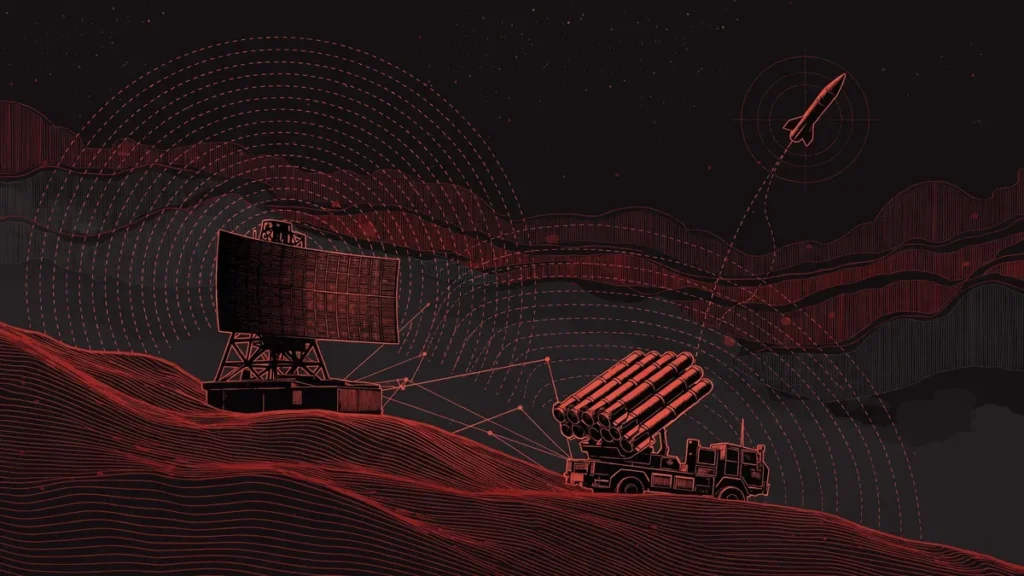
Why are cruise missiles easier to shoot down — but harder to spot?
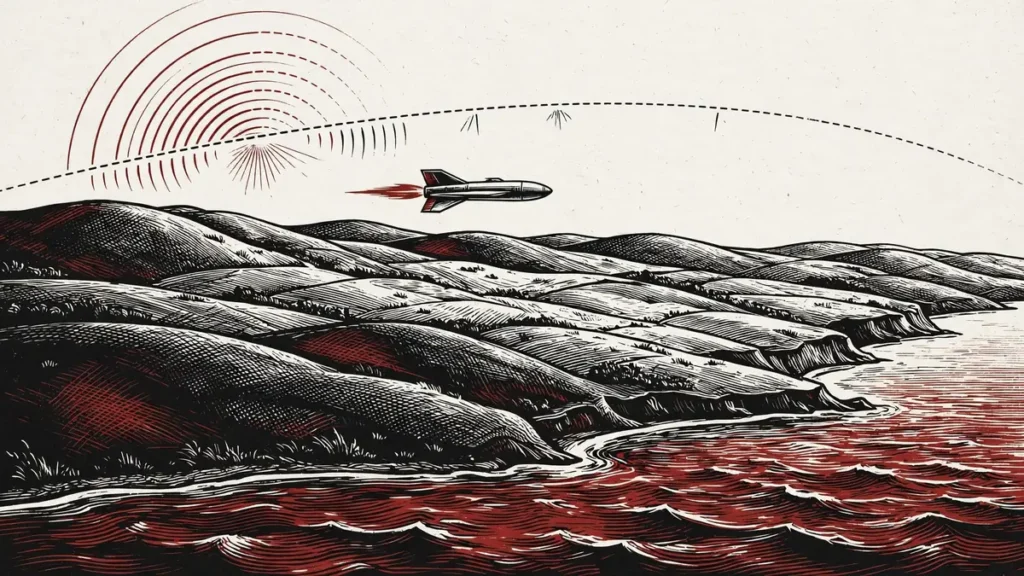
A cruise missile is closer to a small unmanned aircraft than to a rocket. It stays inside the atmosphere for its whole flight, powered by a jet engine, and it can be guided and re-routed throughout. Most cruise missiles fly subsonically, though some are supersonic. That lower speed is decisive once the missile is tracked: ordinary air-defence systems, fighter aircraft and even some ground-based guns have time to engage a target travelling at a few hundred metres per second, where a ballistic warhead travelling at several kilometres per second would be gone before most of them could react.
The cruise missile’s advantage lies earlier in the chain, in detection. Flying at low altitude — sometimes only tens of metres above ground or sea — it hides below radar horizons, exploits terrain masking, and presents a small radar cross-section. Analysts summarise the trade-off, including in Interesting Engineering’s ballistic-versus-cruise comparison, as a tie with opposite strengths: cruise missiles are harder to find, ballistic missiles are harder to stop. A defence that is excellent at tracking high-altitude threats can still be surprised by a low-flying cruise missile threading a radar gap — which is why cruise-missile defence relies heavily on airborne early-warning aircraft, overlapping low-altitude radar coverage, and patrols, not just ground batteries.
There is also a cost and precision difference worth noting. Cruise missiles are generally cheaper than ballistic missiles of comparable range and more accurate, often to within metres, because they are guided for the whole flight. Ballistic missiles, unguided for most of their arc, have historically been less precise — though modern guidance has narrowed that gap considerably. The choice between them is therefore not simply “better or worse”: it is a trade between speed and survivability on one side, and stealth, precision and cost on the other.
How do Patriot, THAAD, SM-3 and Arrow fit together?
No single interceptor covers a ballistic missile’s whole arc, so modern missile defence is layered by altitude and range. The Arms Control Center’s fact sheet on ballistic missile defence, drawing on Missile Defense Agency and Government Accountability Office sources, describes the four-step sequence every system must complete: detection, discrimination, fire control, and killing — hitting the warhead with the interceptor.
At the top of the stack, the US Ground-based Midcourse Defense system and the Navy’s Aegis system with SM-3 interceptors are designed to engage warheads during midcourse flight, when an intercontinental missile may spend around 20 minutes in space. THAAD — Terminal High Altitude Area Defense — engages short- and intermediate-range ballistic missiles at high altitude, including outside the atmosphere, covering a wide area. Patriot PAC-3 is the lower tier: it defends specific bases and cities during the terminal phase, inside the atmosphere, using hit-to-kill interceptors that collide directly with the incoming warhead rather than exploding nearby. Israel’s Arrow system plays a comparable upper-tier role. The layers overlap deliberately: if one layer fails, another still has a chance.
Hit-to-kill is worth pausing on, because it explains why precision requirements are so unforgiving. Rather than detonating a warhead near the target, a hit-to-kill interceptor must physically collide with a warhead travelling at several kilometres per second. The kinetic energy of that collision destroys the target — but the interceptor’s seeker, guidance and divert thrusters must place it within metres of the aim point, after a flight of tens or hundreds of kilometres, against a target that may be manoeuvring or masked by decoys. That is the engineering reality behind the phrase “hitting a bullet with a bullet”.
By the numbers: ballistic versus cruise missiles
| Metric | Figure | Source |
|---|---|---|
| Ballistic and anti-ship missiles intercepted, Nov 2-3, 2026 | 17.65% (CONFIRMED via ISW citing Ukrainian Air Force data) | ISW, November 3, 2026 assessment |
| Cruise missiles intercepted, Nov 2-3, 2026 | 83.05% (CONFIRMED via ISW citing Ukrainian Air Force data) | ISW, November 3, 2026 assessment |
| Ballistic missiles launched, Nov 2-3, 2026 | 17 (CONFIRMED, Zelensky via ISW) | ISW, November 3, 2026 assessment |
| Cruise missiles launched, Nov 2-3, 2026 | 59 (CONFIRMED, Zelensky via ISW) | ISW, November 3, 2026 assessment |
| Typical ballistic re-entry speed | Above Mach 5, hypersonic (CONFIRMED, general physics) | Interesting Engineering; Arms Control Center |
| Typical cruise missile speed | Mostly subsonic, some supersonic (CONFIRMED, general) | Interesting Engineering |
Caveat: the November 2-3 interception percentages group ballistic and anti-ship missiles together and are derived from Ukrainian Air Force data as reported by ISW; they are not a pure ballistic-only rate, and Ukraine stopped regularly publishing missile interception figures on August 11, 2026, so single-night figures should not be treated as a standing average.
What the interception gap means for US/UK/EU readers
For readers in the United States, Britain and Europe, the gap has three practical consequences. First, it shapes what air-defence aid actually buys: additional Patriot batteries and interceptors improve terminal defence, but they do not by themselves close a ballistic-missile gap, because interceptors are consumed quickly, cost millions each, and must be stockpiled before a barrage rather than improvised during one. The November 2-3 figures are a reminder that even a well-equipped defence will leak against a large ballistic salvo.
Second, it affects energy and price exposure. The November 2-3 barrage targeted Ukrainian energy infrastructure at the start of the heating season, and Ukrenergo reported serious damage and outages in at least five oblasts. When ballistic missiles get through at higher rates, energy facilities — power plants, substations, gas infrastructure — face a systematically higher risk than facilities threatened only by slower weapons, and that risk feeds into European energy prices and winter resilience planning.
Third, it explains allied procurement priorities: layered systems, airborne early warning for low-flying cruise missiles, and upper-tier interceptors for ballistic threats are not interchangeable purchases. A country that buys only low-altitude defences remains exposed to the high arc; a country that buys only upper-tier systems remains exposed to cruise missiles hugging the terrain. The debate in European capitals is therefore less about whether missile defence works in the abstract than about which layer is thinnest — and the November 2-3 numbers suggest, for Ukraine at least, that the ballistic layer is the thin one.
What this is not: three common misunderstandings
First, “harder to intercept” does not mean “impossible to intercept”. Ballistic missiles are intercepted regularly, including in Ukraine and in Israel, and layered systems exist precisely because interception is difficult but achievable. The claim in some commentary that ballistic missiles cannot be stopped at all is contradicted by the very data in this article: 17.65 percent is low, but it is not zero.
Second, “easier to detect” does not mean “easy to stop”. A ballistic launch is usually visible to satellites within minutes, but visibility is not engagement: the defender must still track, predict and collide with the warhead, and may have only seconds in the terminal phase. Early warning buys decision time for civil defence and for launching interceptors; it does not guarantee a kill.
Third, interception percentages from a single night are not a system’s report card. They depend on salvo size and mix, which systems were in place, interceptor stockpiles, weather, electronic warfare, and whether “intercepted” counts physical destruction, suppression, or both. Treat the November 2-3 split as an illustration of the physics, not as a fixed performance rating for any named system.
What to watch next in missile defence
Watch three things. One, interceptor stockpiles and production: the binding constraint in Ukraine’s case has repeatedly been the number of advanced interceptors available, not just the number of launchers. Two, the spread of manoeuvrable and hypersonic weapons, which attack the predictability assumption that makes ballistic interception possible at all — if a warhead can manoeuvre late in flight, even a well-tracked arc becomes a moving target. Three, sensor fusion: the integration of satellite, radar and airborne sensors into a single tracking picture, which is the least visible but arguably most important improvement, because a better picture buys the seconds that make an intercept possible.
The underlying physics will not change. A weapon that falls from space at hypersonic speed will always be harder to hit than one that flies low and slow — and a weapon that flies low and slow will always be harder to see coming. Defence, therefore, will remain a layered compromise, and the side that manages both halves of that compromise best will leak least.
Frequently asked questions
Why are ballistic missiles harder to intercept than cruise missiles?
Because they re-enter the atmosphere at hypersonic speed, above Mach 5, after flying a high arc that often leaves the atmosphere. Defenders have only seconds in the terminal phase to track, predict and collide with the warhead, and only specialised high-altitude interceptors can reach it at all.
Are cruise missiles easier to intercept?
Yes, once they are tracked — most fly subsonically and stay within reach of ordinary air defences. The difficulty is finding them first, because low-altitude flight hides them below radar horizons and behind terrain.
What do the November 2-3, 2026 interception figures show?
Ukrainian Air Force data cited by ISW put interception of ballistic and anti-ship missiles at 17.65 percent, against 83.05 percent for cruise missiles, in the November 2-3 barrage of 17 ballistic missiles, 59 cruise missiles and 289 drones. The figures group ballistic and anti-ship missiles together and cover a single night, so they illustrate the gap rather than rating any system.
Can any system stop a ballistic missile?
Yes. Systems including Patriot PAC-3, THAAD, SM-3 and Arrow have intercepted ballistic missiles in testing and in combat. Success requires a layered system — detection, discrimination, fire control and a hit-to-kill collision — and even capable defences leak against large salvos.
What is hit-to-kill interception?
It is an interception method in which the interceptor physically collides with the incoming warhead at very high speed, destroying it with kinetic energy rather than an explosive warhead. It demands metre-level precision at closing speeds of several kilometres per second.
Sources
- Institute for the Study of War: Russian Offensive Campaign Assessment, November 3, 2026
- Interesting Engineering: Explained: How interceptor missiles find and destroy incoming targets
- The Jerusalem Post: Why ballistic missiles are nearly impossible to intercept
- Interesting Engineering: Ballistic vs cruise missiles: Which weapon carries the real edge
- Arms Control Center: Fact Sheet: An Introduction to Ballistic Missile Defense
Read next: How the Patriot Battery Detects, Tracks and Intercepts Missiles · Conflict Zones hub · US Approves $2.1 Billion Patriot Missile Sale to Ukraine, Explained · How Anti-Ship Missiles Work: Guidance, Sea-Skimming, Defences



Discussion 0
Share analysis, corrections, or context. Be civil — comments are moderated.