
WarBrief Live | October 28, 2026 | Explainer
At a glance: A Patriot battery is a radar, a fire-control station, and up to eight launchers working as one unit | PAC-3 interceptors destroy ballistic missiles by direct impact | A new battery is reported to cost about $1.1 billion | One battery defends a point, not a country
When a ballistic missile is reported inbound, the weapon most often named in the response is the Patriot. The patriot missile system explained in this article is not a single missile: it is a complete air and missile defense battery, built around a phased-array radar, a fire-control station, and mobile launchers, that detects a threat, tracks it, and fires an interceptor to meet it in the air. Understanding how those parts fit together explains both why commanders value the system so highly and why they can never have enough of it.
Key Takeaways
- Patriot is a battery, not a lone missile: radar, engagement control station, launchers, power, and communications must all deploy together.
- The modern PAC-3 interceptor kills by direct impact, known as hit-to-kill, rather than by exploding near its target.
- The system is a point defense: it protects a base, a city district, or a port, not an entire country or coastline.
- Its limits are magazine depth, cost, and time: interceptors are expensive, slow to build, and consumed fast in a heavy missile campaign.
- Washington’s reported movement of an additional Patriot system from Texas to Israel, reported by The Wall Street Journal on October 28, 2026, is a reminder of how scarce deployable batteries are when several theaters need them at once.
What is the Patriot missile system?
Patriot, short for Phased Array Tracking Radar to Intercept on Target, is the U.S. Army’s primary air and missile defense system, designated MIM-104. The Center for Strategic and International Studies (CSIS) describes it as a system initially designed against aircraft that has been upgraded over decades to engage ballistic and cruise missiles, loitering munitions, and aircraft. Eighteen countries currently operate Patriot, according to CSIS, which makes it the most widely shared high-end air defense system in the Western alliance.
The system’s history explains its shape. The U.S. Army began the program in the 1960s as a replacement for static Hawk and Nike Hercules batteries, renamed it Patriot in 1976, and activated its first Patriot battalion in May 1982. Software upgrades in the 1980s gave it a first capability against tactical ballistic missiles, and it entered combat in the 1991 Gulf War. Every major variant since then has been an answer to a new threat: faster ballistic missiles, low-flying cruise missiles, and now drones and maneuvering weapons that do not fly a simple predictable arc.
How does a Patriot battery work, step by step?
A standard battery is built from a small number of large, truck-mounted pieces. At its heart is the fire-control section: the AN/MPQ-65 phased-array radar set, the AN/MSQ-104 engagement control station, an antenna mast group, and an electric power plant. Around that core sit the launchers, typically up to eight M903 launching stations, plus reload vehicles, communications, and maintenance support. A battalion adds an information coordination center that ties several batteries together and links them to wider air defense networks.
The sequence from detection to intercept runs in seconds, but each step has a distinct job. First, the radar searches the sky, detects a fast-moving object, and begins tracking it, measuring its speed, direction, and likely impact point. Because the radar is a phased array, it steers its beam electronically rather than physically swinging an antenna, so it can follow many targets at once while still guiding interceptors already in flight. Second, the engagement control station, staffed by operators, classifies the track, judges whether it is hostile and worth engaging, and selects the best interceptor for the threat. Third, the chosen launcher fires, and the radar continues to feed guidance updates to the interceptor until its own seeker takes over for the final approach.
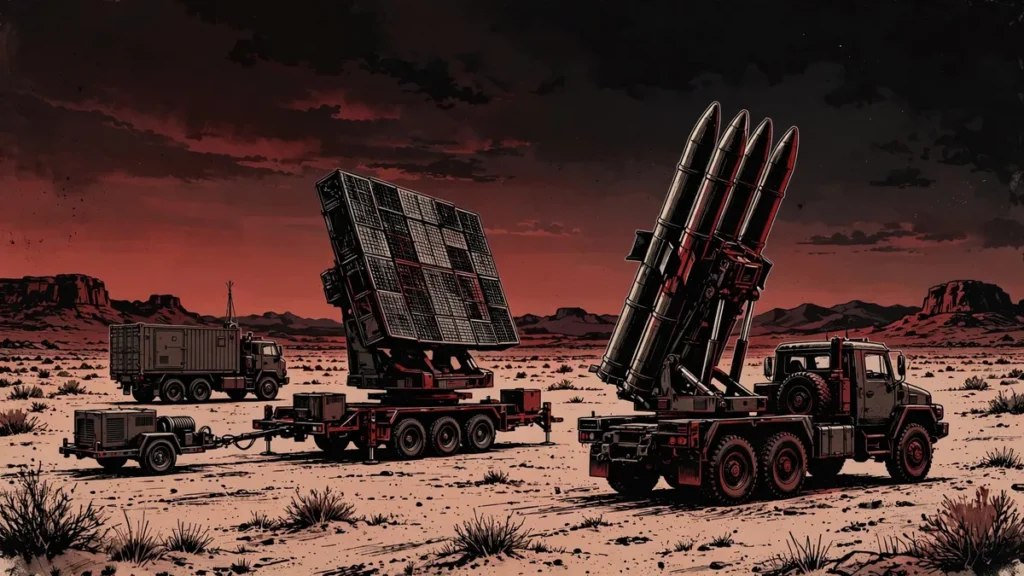
That division of labor is why Patriot is described as a detection-to-kill system: one radar performs search, identification, tracking, and engagement guidance, where many older surface-to-air systems needed several different radars for the same jobs. It is also why the battery is powerful but fragile as a package. If the radar is damaged, jammed, or forced to move, the launchers around it cannot fight at full capability on their own.
What is the difference between PAC-2 and PAC-3 interceptors?
The launchers carry two interceptor families, and the difference between them is the difference between two ways of killing a target. PAC-2 missiles, including the Guidance Enhanced Missile (GEM-T) variant, are larger missiles that use a blast-fragmentation warhead: they detonate near the target and destroy it with fragments. They are suited to aircraft and cruise missiles, and open-source estimates put their engagement reach against aircraft at up to about 160 kilometers in ideal conditions, with a much shorter effective envelope against fast ballistic warheads.
PAC-3 missiles work differently. The current PAC-3 Missile Segment Enhancement (MSE), built by Lockheed Martin, is a smaller, more agile missile that destroys its target by direct collision, a method called hit-to-kill. It uses an active radar seeker, small attitude-control thrusters, and a dual-pulse solid rocket motor to maneuver violently in the final seconds of flight, steering itself into a warhead traveling several times the speed of sound. A single M903 launcher can carry four PAC-2 missiles, sixteen older PAC-3 missiles, or twelve PAC-3 MSE missiles, so a battery’s total load depends entirely on which mix its commanders choose.
That mix is a tactical choice, not a technical detail. PAC-2 rounds give a battery reach against aircraft and cruise missiles; PAC-3 MSE rounds give it its best chance against ballistic missiles. Loading one means carrying fewer of the other, and once a launcher is empty, reloading under fire is slow and dangerous work. Magazine depth, the number of ready rounds a battery holds, is therefore one of the most important numbers in any Patriot deployment, and one of the least reported.
By the numbers: what a Patriot battery costs and carries
| Metric | Figure | Source |
|---|---|---|
| Complete new battery, with missiles | About $1.1 billion (reported estimate) | CSIS estimate cited by the Congressional Research Service, via Reuters reporting |
| Hardware alone (radar, control station, launchers, power) | About $400 million of that total | Same reported estimate |
| PAC-3 MSE interceptor, flyaway price | About $4 million per round | U.S. Army budget figures, via Reuters and trade reporting |
| Launchers per battery | Up to 8 | CSIS / U.S. Army battery composition |
| M903 launcher load | 4 PAC-2, or 16 PAC-3, or 12 PAC-3 MSE | Open-source battery data |
| Countries operating Patriot | 18 | CSIS Missile Threat |
Caveat: cost figures vary by configuration, contract year, and whether training, spares, and support are included; export packages routinely cost more per missile than U.S. Army flyaway prices. Figures above are reported estimates, not a single official price list.
The cost asymmetry is the system’s most discussed weakness. Firing a roughly $4 million interceptor at a drone costing a fraction of that amount is a losing exchange if repeated often enough, and doctrine against ballistic threats often fires two interceptors at a single target, doubling the cost of one engagement. Production compounds the problem: building a PAC-3 MSE takes roughly two years from start to finish, according to manufacturing reporting, and output has struggled to keep pace with demand from Ukraine, the Middle East, and European buyers at the same time. On October 27, 2026, the United States selected Poland to host a European PAC-3 MSE maintenance facility, a reported step toward easing that sustainment bottleneck for allied batteries.
What can Patriot stop, and what can it not stop?
Patriot’s confirmed strengths are against the threats it was built for: aircraft, cruise missiles, and tactical ballistic missiles inside its engagement envelope. Its combat record includes intercepts in the Gulf War, in the Middle East, and, since 2023, in Ukraine, where Patriots supplied by the United States and allies have intercepted Russian ballistic and cruise missiles, including the Kinzhal air-launched ballistic missile, according to defense reporting. That record is why the system remains the benchmark other air defenses are measured against.
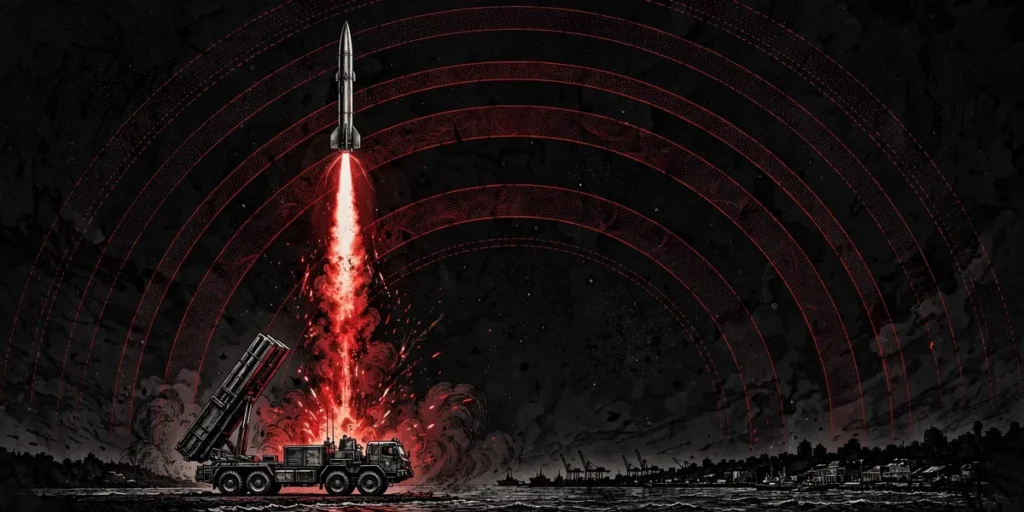
Its limits are equally clear, and commanders plan around them. Patriot cannot defend a whole country: it is a point defense system, designed to protect fixed assets such as airfields, logistics hubs, ports, and population centers, and it takes hours to emplace and tear down, so it cannot maneuver with frontline forces. It is not designed to intercept intercontinental ballistic missiles; that job belongs to higher-tier systems such as THAAD for terminal high-altitude defense and ground-based interceptors for homeland defense. And it can be saturated: enough missiles arriving at once can exhaust a battery’s ready rounds, which is why Patriot batteries are layered with shorter-range defenses below them and THAAD and fighter aircraft above them.
The system also carries a cautionary history on automation. During the 2003 invasion of Iraq, Patriot batteries shot down a Royal Air Force Tornado and a U.S. Navy Hornet in friendly-fire incidents that killed all three crew members, a failure investigators linked in part to automated engagement processes. Modern batteries keep a human operator in the engagement decision, but the incidents remain a standard case study in why speed must not remove human judgment from the firing chain.
Why is a Patriot battery moving now?
The immediate news context is the warning Washington delivered to Gulf governments this week. The Wall Street Journal reported on October 28, 2026 that the United States had told several Gulf Arab countries, through diplomatic and military channels, to be prepared for a possible short, intense military campaign against Iran after the November 3 midterm elections. The same reporting said the U.S. military is sending an additional Patriot system to Israel from Texas, has moved troops off vulnerable bases in the Middle East, has been restocking munitions, and has bombers, fighters, an additional carrier strike group, and a Marine expeditionary unit preparing or due in the region in November.
Two cautions apply to that reporting, and this explainer keeps them separate from the system’s technical facts. First, the Journal reported that President Donald Trump has not decided to go ahead and is leaning toward a large post-election attack that could target Iranian infrastructure and nuclear sites; a leaning is not a decision, and the alternative of a negotiated deal remains open in the same reporting. Second, the destination in that reporting is Israel, not the Gulf: Gulf states are the warned audience, while the additional battery is reported as going to Israel. WarBrief’s own coverage of the Gulf warning carries the full checklist of reported buildup moves.
The movement still illustrates the core scarcity problem. The United States has a limited number of Patriot battalions, and demand now spans Ukraine, Israel, Gulf partners, and the Indo-Pacific at once. Moving one battery is therefore never a routine shuffle: it means accepting thinner coverage somewhere else, or relying on allies and shorter-range systems to fill the gap until interceptors and launchers can be replaced. That trade-off, more than any single intercept, is why a Patriot deployment is read by allies and adversaries alike as a signal of intent.
What Patriot deployments mean for US/UK/EU readers
For readers in the United States, the United Kingdom, and Europe, a Patriot deployment matters in four concrete ways. First, energy and shipping: a credible air defense umbrella over Gulf and Israeli infrastructure lowers, but does not remove, the risk that a missile campaign disrupts oil and gas flows, and markets price that risk into fuel costs long before any launch. Second, travel: airspace closures and airline rerouting around a missile-threatened region, a pattern seen repeatedly in the Iran war, can add hours and cost to Europe-Middle East-Asia routes even when no aircraft is hit.
Third, defense budgets: every battery moved or promised creates a replenishment bill. European governments are already among the largest Patriot buyers, and the reported Polish maintenance facility shows how sustainment, not just purchase, is becoming a European industrial question. Fourth, personal security is indirect but real: Patriot batteries protect the bases and hubs through which Western forces, aid, and evacuations move, which is why their placement is treated as a strategic decision rather than a technical one. None of this makes Patriot a shield for civilians in London, Paris, or New York; it makes it a tool whose scarcity shapes what Western governments can credibly promise their partners.
What comes next for Patriot?
The system’s next chapter is already in testing. The U.S. Army is replacing the AN/MPQ-65 radar with the Lower Tier Air and Missile Defense Sensor (LTAMDS), an active electronically scanned array radar designed to give 360-degree coverage instead of the current radar’s narrower sector, and is networking batteries through the Integrated Battle Command System (IBCS), which lets any sensor cue the best shooter across a wide area. Lockheed Martin has also disclosed PAC-3 Edge, a candidate future interceptor intended to extend range and altitude against hypersonic and advanced missile threats at roughly the cost of the current MSE, according to company statements reported by Reuters.
None of those upgrades changes the basic equation in the near term: batteries remain scarce, interceptors remain expensive, and demand remains high. The question for the next deployment is therefore not only whether Patriot can stop the next missile, but whether enough interceptors will be in the right place, loaded in the right mix, when it arrives. For a fuller account of how the system has performed in its hardest current test, see WarBrief’s account of Patriot air defense in Ukraine, and for the wider context of air defense choices, the comparison of anti-drone systems and conflict zones hub.
Frequently asked questions
What does Patriot stand for?
Patriot stands for Phased Array Tracking Radar to Intercept on Target. The name describes its radar: a phased array that steers its beam electronically to track targets and guide interceptors, rather than a mechanically rotating dish.
How does a Patriot battery shoot down a ballistic missile?
The radar detects and tracks the incoming missile and predicts its impact point. Operators in the engagement control station authorize an engagement, a launcher fires a PAC-3 interceptor, and the interceptor’s own seeker guides it into a direct, hit-to-kill collision with the warhead. Against ballistic threats, batteries often fire two interceptors at one target to raise the chance of a kill.
What is the difference between PAC-2 and PAC-3?
PAC-2 missiles use a blast-fragmentation warhead that explodes near the target, and are best against aircraft and cruise missiles. PAC-3 missiles, especially the MSE variant, destroy targets by direct impact and are the battery’s primary weapon against ballistic missiles. A launcher carries four PAC-2s, sixteen older PAC-3s, or twelve PAC-3 MSEs.
Can one Patriot battery protect a whole country?
No. Patriot is a point defense system that protects a specific site, such as an air base, port, or city district. Protecting a country requires many batteries layered with other systems, and even then coverage has gaps that attackers can probe.
Why are Patriot missiles so expensive and in short supply?
Each PAC-3 MSE costs about $4 million in flyaway terms, takes roughly two years to build, and uses precision seekers, thrusters, and motors from a long supplier chain. Heavy use in Ukraine and the Middle East has consumed stocks faster than factories can replace them, which is why allies are building new maintenance and production capacity in Europe.
Sources
- CSIS Missile Threat: Patriot
- Sandboxx: The Ultimate Guide to the Patriot Air Defense System
- WIO News: Patriot Missile System — Why It Is So Hard to Replace
- Military Machine: Patriot Missile System Cost
- The Wall Street Journal: U.S. Warns Gulf of Possible Short, Intense Renewal of Iran War After Midterms
- The National: Live — Iran War, U.S. Warns Gulf Allies



Discussion 0
Share analysis, corrections, or context. Be civil — comments are moderated.