WarBrief Live | October 31, 2026 | Intelligence Report
The October 30 approval of 500 PAC-3 interceptors for Ukraine commits allied money to a production line that cannot deliver this winter. Its value lies in the 2030s, not on today’s battlefield.
Executive summary. On October 30, 2026, the United States approved the possible sale of 500 Patriot PAC-3 MSE interceptors to Ukraine, valued at an estimated 2.1 billion dollars and financed entirely by partners and allies. What is CONFIRMED is the approval and the funding mechanism. What is REPORTED, from people briefed on the decision cited by Reuters, is that the missiles have not yet been built and are not expected until a couple of years into the 2030s. This report assesses why that gap exists. For the announcement itself, see our breaking explainer: US Approves $2.1 Billion Patriot Missile Sale to Ukraine, Explained.
Key Takeaways
- 500 PAC-3 MSE interceptors approved October 30, 2026, for an estimated 2.1 billion dollars; no United States funds are involved.
- Lockheed Martin built 620 PAC-3 MSE interceptors in 2025 and plans about 2,000 a year by the end of 2030, so Ukraine’s 500 compete with a long global queue.
- Open-source estimates put United States Patriot stocks down roughly 65 percent since the Iran war began, which is why existing stockpiles dominate the winter debate.
- Zelenskyy’s counter-proposal is a swap: transfer interceptors from stocks now, at about 100 a month for winter, and replenish later from this production.
How does the production math work?
Lockheed Martin delivered 620 PAC-3 MSE interceptors in 2025, a company record, up from about 517 in 2024 and about 388 in 2023. Its January 2026 framework agreement aims to raise annual capacity from about 600 to approximately 2,000 by the end of 2030. The July 2026 contract funding that expansion is worth up to 58.62 billion dollars, and Lockheed says it will triple capacity and grow employment at its Camden, Arkansas, plant from about 1,200 to about 1,850.
At the 2025 output of 620 a year, 500 interceptors represent roughly ten months of total world production, before any other customer is served. At the planned 2,000 a year, they represent about three months. But Ukraine does not get the whole line: 18 other countries use Patriot, and CSIS analysts note that about half of annual production goes to allies and partners. The queue explains the reported early-2030s window.
| Metric | Figure | Source |
|---|---|---|
| PAC-3 MSE delivered in 2025 | 620 (company record) | Lockheed Martin (CONFIRMED) |
| Planned annual capacity | About 2,000 by end of 2030 | Lockheed Martin (CONFIRMED plan) |
| July 2026 production contract | Up to 58.62 billion dollars | US Army / Lockheed Martin (CONFIRMED) |
| US Patriot stock change since the Iran war | Down roughly 65 percent (estimate) | CSIS (REPORTED estimate) |
CONFIRMED figures are from official or company statements; REPORTED figures are open-source estimates.
Why are interceptor stocks so thin?
CSIS estimates that the United States held about 2,330 Patriot interceptors before the war with Iran and between 759 and 827 by late July 2026, a depletion of roughly 65 percent, with THAAD stocks falling from about 452 to between 234 and 278. The Congressional Budget Office estimated on September 15 that the United States has probably used between one-half and two-thirds of its inventory of certain missile defense interceptors since June 2025, and that rebuilding them would probably take at least five years. Reuters reported in August that interceptors earmarked for Ukraine had been diverted to the United States military and Gulf allies.
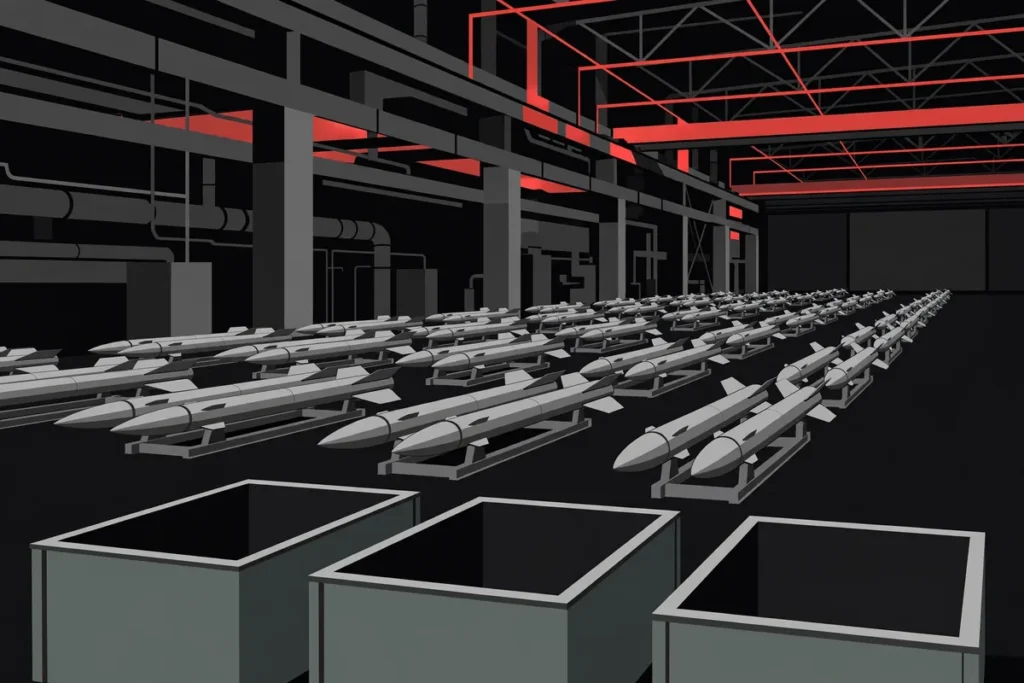
President Volodymyr Zelenskyy said Ukraine received an average of about 12 Patriot interceptors a month during 2026 against a requirement to counter about 150 incoming Russian ballistic missiles a month. Those are Kyiv’s figures, not independently verified consumption data. Either way, the interceptors Ukraine needs this winter must come from magazines that already exist.
What does JUMPSTART change about who pays?
JUMPSTART, the Joint Ukraine Multinational Program, Services, Training and Articles Rapid Timeline, was established in 2022 so third-party countries can contribute funds for Ukraine to buy American equipment through the United States foreign military sales system. The State Department’s wording is blunt: Canada, Germany, and Norway contribute through JUMPSTART, the balance comes from national funds financed by the European Union’s Ukraine Support Loan, and no United States funds are involved. Reuters notes the program was used in August to buy 3,350 air-launched cruise missiles worth 825 million dollars.
The model lets Washington approve a large defensive package without a United States appropriation, but it does not solve the timing problem. It sits alongside the NATO-coordinated Prioritized Ukraine Requirements List (PURL), under which allies buy American weapons for Ukraine. NATO’s General Alexus Grynkewich said on October 30 that allied-bought American weapons deliveries were continuing without delays, according to Bloomberg: PURL moves existing production and stocks, while this sale funds future production.
Assessment and outlook
Assessment. This sale is best read as a production reservation, not a battlefield reinforcement. It secures Ukraine a place in a production line tripling toward 2,000 interceptors a year by 2030, it validates the JUMPSTART donor model at a scale of 2.1 billion dollars. It does not change the winter of 2026-27. The binding constraint is not money or political will, but the physical rate at which interceptors are built, and the competing claims on that rate from the United States, 18 allied users, and a stockpile rebuild the CBO puts at five years or more.
What to watch next. Congressional review, which generally runs about 30 days for a sale to Ukraine; whether any ally acts on the stock-transfer proposal, the only route that changes this winter’s air defense. For background on how the system itself works, see How Patriot Air Defense Works in Ukraine, and for the allied procurement pipeline, see Ukraine’s NATO Procurement Deal. The WarBrief Intel hub carries our full intelligence reporting.
Frequently asked questions
When will Ukraine receive the 500 Patriot interceptors?
No delivery date was given in the State Department announcement. People briefed on the decision told Reuters the unbuilt missiles are not expected until a couple of years into the 2030s. That timetable is REPORTED, not confirmed.
Who is paying for the Patriot sale?
Canada, Germany, and Norway through the JUMPSTART program, plus national funds financed by the European Union’s Ukraine Support Loan. The State Department states that no United States funds are involved. The split between donors has not been published.
Why can the missiles not be delivered this winter?
They have not been manufactured yet, and current output is about 600 a year against a global queue of 19 Patriot users plus a United States stockpile rebuild. Only existing stocks could reach Ukraine this winter.
Sources
- Al Jazeera: US greenlights $2.1bn Patriot missile sale to Ukraine
- Breaking Defense: US greenlights 500 Patriot missiles for Ukraine, with $2.1 billion to be paid by allies
- Lockheed Martin: Lockheed Martin and Department of War Advance Landmark Acquisition Transformation to Accelerate PAC-3 MSE Production
- Defence Security Asia: US Patriot Interceptor Stocks Plunge an Estimated 65% After Iran War
- Kyiv Independent: US approves $2.1 billion Patriot missile sale to Ukraine as NATO commander dismisses delivery concerns
- The Statesman: Ukraine seeks urgent Patriot deliveries after US approves $2.1 billion missile sale