WarBrief Live | October 29, 2026 | Intelligence Report
On October 28, 2026, Russian President Vladimir Putin called SpaceX chief Elon Musk a “genius” and said Moscow is in close contact with American partners, including Musk, over satellite operations — days after Ukraine’s military satellite links were restored after a ten-day speed restriction. The remarks, at a Russia-Africa summit exhibition in Moscow, put the war’s least visible front in plain view: the satellite networks carrying drone video and logistics.
Key Takeaways
- Putin praised Musk on October 28 while Russia presented its Rassvet project: about 30 satellites in orbit against Starlink’s roughly 10,000.
- Putin’s claim of coordination with US partners, including Musk, rests on his remarks alone, unconfirmed independently.
- Ukraine’s Starshield service was capped at about 160 km/h from October 14, hampering interceptor drones, before speeds returned on October 24.
- Who ordered the cap is unconfirmed: Musk denies responsibility; the White House denies ordering it.
- A Russian rival network changes little near-term, but one commercial provider can become a war-fighting chokepoint.
What did Putin actually say about Musk?
Putin spoke during a presentation by Digital Development Minister Maksut Shadayev on Russia’s effort to build its own equivalent of Starlink. According to Reuters, Putin interrupted: “Just a second, I want to point out this is just our first step. Elon Musk is a genius, he’s just a real genius.”
Shadayev said Russia had launched more than 30 satellites for Rassvet, built by private firm Bureau 1440. He put Musk’s constellation at more than 5,000 satellites; Orbital Radar puts the actual Starlink figure close to 10,000. “Over 5,000 — while we are only taking our first steps,” Putin replied, adding that the task now was “to move from quality to quantity.”
Most consequential was the contact claim: “We are in close contact with our American partners — including Mr Musk — because it is very important, in orbit, not to get in each other’s way and to maintain a certain level of discipline and order,” Putin said. That claim is CONFIRMED only as a statement he made; its extent and nature are UNVERIFIED.
Why did Ukraine’s Starshield limits matter so much?
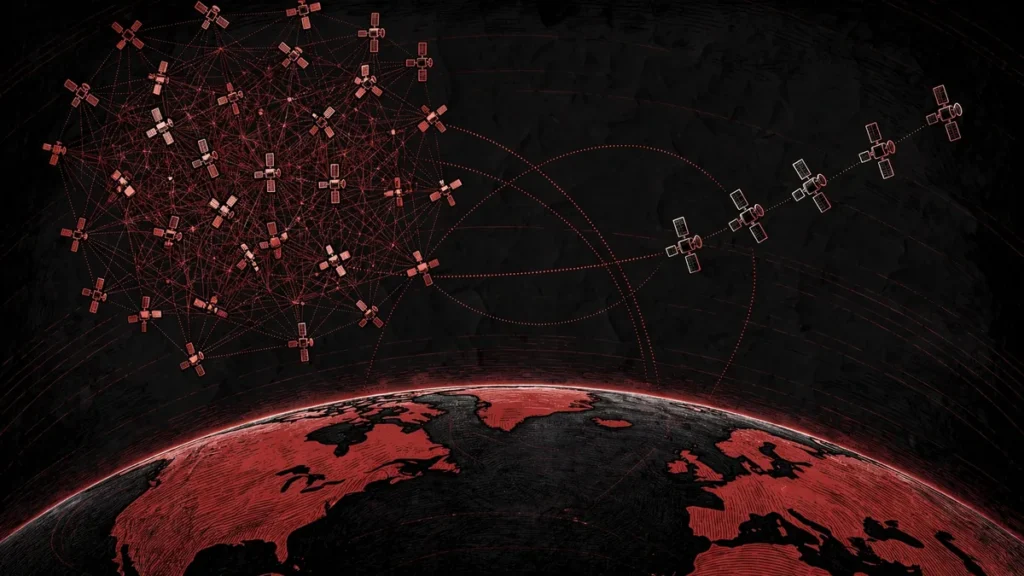
Starlink, developed by Musk’s SpaceX, has been used by Ukraine’s military throughout the war for drone operations and communications. Starshield is its military-grade version, operated for government users. On October 14, 2026, Ukrainian units began losing Starshield connections on fast-moving equipment: terminals dropped their links above about 160 km/h (100 mph).
The timing exposed a specific vulnerability. Ukraine relies on interceptor drones to shoot down Russian jet-powered Shahed-type attack drones, which need a stable satellite link at speed. Ukrainian officials said the cap hampered drone interception and slowed frontline logistics. The restrictions began days after a row between Kyiv and Washington over a US-Russia diesel deal — a sequence Reuters reported, without establishing causation.
The restoration was messy. US President Donald Trump said on October 22 that the problem had been resolved, but Ukrainian officials reported restrictions still in place the next day. On October 24, President Volodymyr Zelenskyy said speeds had returned to pre-restriction levels, and the defence ministry recorded stable connections above 400 km/h. Hours later, Musk accused Ukraine’s military of violating commercial Starlink’s terms of service by using it for offensive drone strikes. He denied responsibility for the Starshield restrictions, saying Starshield is controlled by the US government. The White House denies ordering the cap, while Reuters-cited officials pointed to a White House order. Who ordered the cap is therefore UNCONFIRMED.
By the numbers: two constellations, one chokepoint
| Metric | Figure | Source |
|---|---|---|
| Rassvet satellites launched since March 2026 | 32 | Orbital Radar (reported) |
| Rassvet satellites in orbit | 31, with 26 in a working orbit at about 509 km | Orbital Radar (reported) |
| Starlink satellites in orbit | Close to 10,000 (company figures cited by BBC/CNBC: over 11,000) | Orbital Radar / SpaceX (estimates vary) |
| Starshield speed cap, October 14–24, 2026 | About 160 km/h (100 mph) | Ukrainian officials, Reuters (confirmed) |
| Restored Starshield speeds | Above 400 km/h on October 24; up to 470 km/h by October 26 | Ukraine defence ministry (confirmed) |
Figures marked “reported” rest on a single tracker or outlet; “confirmed” figures are corroborated by two or more reputable sources. The scale gap is the story.
What does a Russian Starlink rival change — and what does it not?
In the near term, very little on the battlefield. About 30 satellites cannot provide the continuous, low-latency coverage thousands of low-orbit satellites deliver, and Russia’s stated next step — “from quality to quantity” — is a multi-year industrial task. What Rassvet does change is the diplomatic picture: Moscow is signalling it will not accept permanent dependence on a US commercial network.
The deeper lesson runs the other way. The October episode showed a privately owned, US-controlled network can throttle a military’s operations without a shot being fired — and neither Kyiv nor the owner could immediately say who gave the order. That ambiguity is itself a vulnerability: a capability whose control chain is disputed cannot be planned around with confidence.
What this means for US, UK and EU readers
The satellite battle is not abstract for Western readers. The same constellations that carry Ukrainian drone feeds also carry civilian broadband, and the orbital-coordination problem Putin raised — thousands of satellites sharing low orbit — applies to every Western operator. The episode also previews a policy fight over military reliance on a single billionaire-owned network. Senator Richard Blumenthal has given Musk until November 5 to explain it.
Assessment and outlook
Putin’s praise reads as two messages at once: acknowledgement of an engineering lead Russia cannot yet match, and a bid for a seat at the table governing low orbit. The verified core is narrower: satellite connectivity is now a war-fighting layer with a single dominant provider, a ten-day restriction demonstrably degraded Ukrainian operations, and who controls that layer is unresolved.
What to watch: further disruption reports; new Rassvet launches; the November 5 deadline for Musk’s explanation to senators; and whether Ukraine’s November 6–10 Abu Dhabi talks touch on communications guarantees.
Frequently asked questions
Did Putin say he talks directly to Elon Musk?
Putin said Russia is “in close contact with our American partners — including Mr Musk” about orbital coordination. That is his claim, not confirmed direct talks.
What is Rassvet?
Rassvet is Russia’s satellite internet constellation, built by Bureau 1440. About 30 satellites launched since March 2026, far short of Starlink’s roughly 10,000.
What happened to Starshield in Ukraine in October 2026?
From October 14, Starshield terminals lost connection above about 160 km/h, hampering interceptor drones. Speeds were restored above 400 km/h by October 24, per Ukraine’s defence ministry.
Who ordered the Starshield speed cap?
Unconfirmed. Musk denies responsibility and says Starshield is US-government controlled; the White House denies ordering it.
Sources
- Reuters: Putin salutes Musk’s genius as Russia plays catch-up with Starlink
- AFP: Putin calls Elon Musk a ‘genius’ as Russia races to build its own satellite internet network
- Kyiv Independent: Putin calls Musk ‘genius’ as Ukraine recovers from Starshield throttling
- Indian Express: How the Starlink, Starshield pause exposed Ukraine’s drone vulnerability
- UNITED24 Media: Starshield speed caps fully lifted in Ukraine
- Reuters: Ukraine says Starlink and Starshield back at 400 kph after week of throttling