Pakistan’s military says it is “cautiously optimistic” about its mediation between Iran and the United States, its spokesman told Reuters on October 30 — Islamabad’s first public assessment since a regional delegation visited Tehran earlier in the week. The comment is deliberately modest: it claims momentum, not a breakthrough, and it comes paired with a warning about “powerful spoilers and detractors” who believe the continuation of the conflict serves their interests.
The assessment matters because of who carries the message and how often he has travelled. Field Marshal Asim Munir, Pakistan’s chief mediator in the effort to de-escalate the eight-month-old war, has been to Tehran twice in October, most recently on October 26 alongside the Saudi defence minister and the Turkish intelligence chief — turning a bilateral shuttle into a four-nation channel.
What Islamabad actually said
The remarks came from Lieutenant General Ahmed Sharif Chaudhry, director general of Inter-Services Public Relations (ISPR), speaking to Reuters in Rawalpindi on Friday, October 30 — his first interview since the delegation returned.
“Why would the Field Marshal be going twice if it is not for some positivity? So yes, of course,” Chaudhry said when asked whether the visits indicated progress. “The word that we would use is always cautiously optimistic,” he added.
What he did not do is equally informative. He declined to say what was discussed in Tehran, or whether the United States had backed the trip. That silence is standard for a mediation channel, but it limits what can be claimed: the record shows meetings, not agreed terms. Reading the mediation as near a deal would go beyond what Islamabad itself has said.
The spoilers were left unnamed, and this report does not speculate on their identity. The point, as stated, is structural: in a war that has redrawn regional alliances and disrupted shipping and oil supplies, more than one actor may calculate that continued fighting serves its interests better than a settlement.
Two Tehran trips in one month
Munir’s October shuttle is the spine of the mediation track. He travelled to Tehran twice in the month, most recently on October 26 accompanied by Saudi Defence Minister Prince Khalid bin Salman and Turkish intelligence chief Ibrahim Kalin.
Following the talks, Mohsen Rezaei, secretary of Iran’s Supreme National Security Council, said regional security should be ensured by regional countries without foreign intervention, called the discussions positive, and said closer cooperation could help resolve regional problems. The four agreed to continue dialogue on regional peace and security.
The timing matters. The comments came as Qatari mediators arrived in Tehran in another bid to revive the June ceasefire that collapsed months later, and as reporting described a Qatari draft deal with a seven-day timeline of daily steps for each side, with several countries as guarantors. The tracks run in parallel: Islamabad builds political cover; Doha supplies the text. Our earlier report covers the Vance letter, the Qatar draft and its 7-day plan.
The defence pact behind the diplomacy
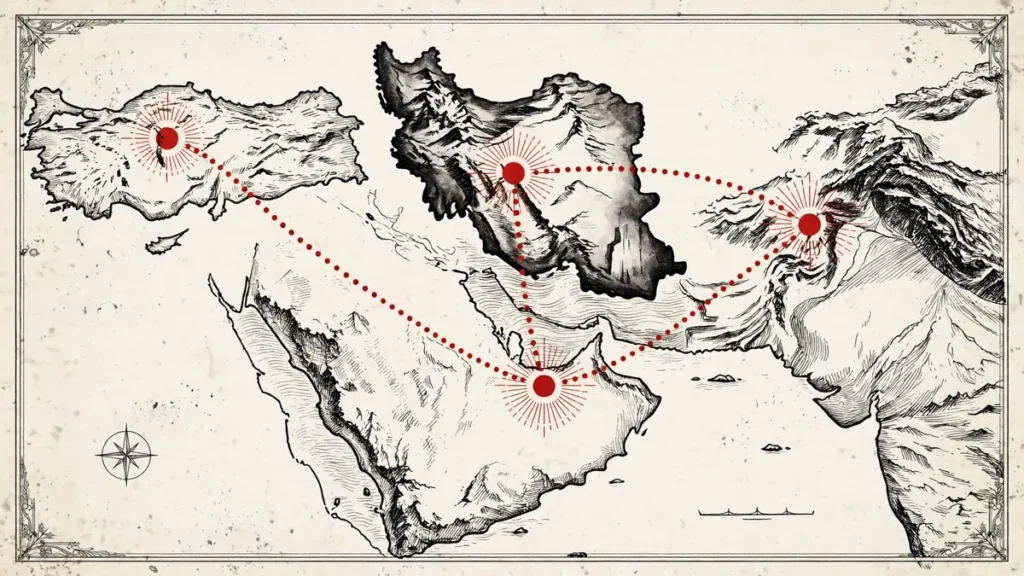
The mediation does not stand alone. Pakistan, Saudi Arabia and Turkiye signed the Mecca Joint Defence Agreement on August 7, under which an attack on any signatory is treated as an attack on all. The pact has gained significance as the war redraws regional alliances, and the October 26 Tehran visit was its most visible diplomatic outing yet.
Chaudhry used the interview to address the pact’s open edges. Asked whether Iran could join, he said the wording does not bar new members: “Anyone who has a shared vision of collective deterrence and regional peace, why not? Everyone is most welcome,” adding that it was for the political leadership of the three principal parties to decide. On more Pakistani troops for Saudi Arabia, he said that would depend on the situation and the two countries’ political leadership.
He also drew two lines: a commitment to defending Saudi Arabia and the holy sites of Mecca and Medina, and, in the same breath, “We are not part of the Yemeni conflict, which is an intra-Yemen conflict.” The distinction matters because Saudi-Houthi fighting has been reignited by the Iran conflict.
Why the optimism is only cautious
Three constraints explain the qualifier. First, the mediation has produced process, not outcome: visits and a dialogue commitment, but no announced agreement and no confirmed American endorsement. Second, the Qatar draft still awaits Tehran’s response, and the sequencing disputes that stalled earlier rounds are publicly unresolved. Third, the military track is moving the other way: our assessment of what a US campaign against Iran could achieve after the midterms sets out why reported American planning narrows the diplomatic window, and the October 29 strikes in our report on what October 29 changed show how quickly battlefield events overtake talks.
Pakistan’s leverage is real but bounded. It is one of few states with working channels to Tehran, Riyadh, Ankara and Washington at once, and the pact gives its shuttle a weight a lone mediator would lack. But it also creates an entanglement risk: the closer Islamabad ties its credibility to the Saudi-Turkish bloc, the harder it becomes to present itself in Tehran as a neutral broker rather than a bloc envoy.
Assessment and outlook
The most likely near-term outcome is continued shuttle diplomacy without a public breakthrough: further Munir travel, a Tehran response to the Qatari draft, and periodic spoiler events. The formulation signals three audiences at once: Tehran, that the channel is serious; Washington, that an off-ramp exists; and domestic audiences, that Islamabad is not overselling a deal it cannot yet deliver.
What to watch: Tehran’s response to the Qatar draft; whether Munir makes a third Tehran trip; whether pact membership moves from hypothetical answer to a political track; and whether reported post-midterm military planning hardens into deployments that crowd out the mediation window. If the shuttle continues and the draft gains traction, the track will have earned its optimism. If either stalls, the qualifier will have been the honest part of the statement.
Frequently asked questions
What did Pakistan actually say about the Iran mediation?
On October 30, military spokesman Lt Gen Ahmed Sharif Chaudhry told Reuters that Pakistan is “cautiously optimistic” about mediating between Iran and the United States, citing Field Marshal Asim Munir’s two October Tehran visits as a positive sign, while warning of unnamed “powerful spoilers and detractors.”
Who joined Munir on his latest Tehran visit?
Saudi Defence Minister Prince Khalid bin Salman and Turkish intelligence chief Ibrahim Kalin accompanied Munir to Tehran on October 26; the four countries agreed to continue dialogue on regional peace and security.
Could Iran join Pakistan’s defence pact with Saudi Arabia and Turkiye?
The Mecca Joint Defence Agreement, signed August 7, does not bar new members, Chaudhry said — but the decision rests with the political leadership of the three principal parties.
Sources
- Reuters, “Pakistan military ‘cautiously optimistic’ on Iran-US mediation,” October 30, 2026 — reuters.com
- Al Jazeera, “Pakistan army ‘cautiously optimistic’ about US-Iran mediation efforts,” October 30, 2026 — aljazeera.com
- Geo News, October 31, 2026 — geo.tv
- The Express Tribune, October 30, 2026 — tribune.com.pk
- WarBrief, Intelligence Reports; Iran’s Diplomacy Crossroads; After the Midterms; US Strikes on Iran’s Naval Targets