
WarBrief Live | October 8, 2026 | Defense Technology
How Patriot air defense works is suddenly one of the most urgent questions in the Russia-Ukraine war. On October 7, 2026, Reuters reported that Ukraine has “virtually run out” of Patriot interceptors just as Russia ramps up ballistic missile strikes — and only the American-made Patriot system can reliably stop Russia’s Iskander-M ballistic missiles. A day earlier, the U.S. Defense Logistics Agency moved to let Ukraine repair its Patriot radars and power systems at home instead of shipping damaged hardware abroad. This is the full explainer: what the system is, how it kills a ballistic missile, why the missiles are gone, and what comes next.
Key Takeaways
- A Patriot battery combines a phased-array radar, an engagement control station, up to eight launchers, and interceptor missiles in one mobile system.
- PAC-2 interceptors explode near a target; PAC-3 missiles destroy it by direct “hit-to-kill” impact — the only method reliable against ballistic warheads.
- Reuters reports Ukraine has virtually run out of Patriot interceptors as the United States diverts air-defense resources to the Gulf, while Russia builds an estimated 700–800 ballistic missiles a year.
- The U.S. Defense Logistics Agency began procuring depot-level test equipment on October 6 so Ukraine can repair Patriot radar and power components domestically; industry responses close October 9.
- Lockheed Martin raised PAC-3 MSE output to about 620 missiles in 2025, with a Pentagon plan to reach 2,000 a year by 2030 — but wartime consumption can absorb entire production lines.
What is the Patriot air defense system?
Patriot — originally “Phased Array Tracking Radar to Intercept on Target” — is a mobile, medium-to-long-range air and missile defense system developed for the U.S. Army and built today by Raytheon (the radar and system) with Lockheed Martin building the PAC-3 interceptors. It entered service in the 1980s and has been continuously upgraded; the versions defending Ukraine combine PAC-2 and PAC-3 interceptors on the same launchers.
The system is designed to defend against aircraft, cruise missiles, drones, and — uniquely among systems available to Ukraine — short- and medium-range ballistic missiles in their terminal phase, the final plunge toward the target. According to a NATO fact sheet summarized by the Congressional Research Service, a Patriot battery has six major components: a power plant (two vehicle-mounted 150-kilowatt generators), the radar set, the engagement control station, launcher stations, the antenna mast group, and the interceptor missiles themselves.
What are the parts of a Patriot battery, and what does each do?
The heart of the battery is the AN/MPQ-65 radar set, a passive electronically scanned array — a flat panel of more than 5,000 individual elements that steer the radar beam electronically, many times per second, with no moving dish. The Missile Defense Advocacy Alliance notes it can track up to 100 targets at once at ranges beyond 100 kilometers, with a NATO fact sheet putting detection range in excess of 150 kilometers. Because one radar performs search, identification, tracking, and engagement, Patriot is unusual: it is a “detection-to-kill” system, where most rival systems need several separate radars.
The Engagement Control Station (ECS) is the only manned station in a fire unit and the battery’s brain. Operators there calculate intercept trajectories, select targets, and control the launch sequence; the ECS communicates with the launchers and can coordinate with other Patriot batteries and battalion command. The Antenna Mast Group (OE-349) is the communications backbone, and the Electric Power Plant keeps radar, ECS, and communications running.
The shooters are M901/M902/M903 launcher stations on trucks. Each launcher carries four PAC-2 missiles or sixteen of the smaller PAC-3 missiles, and the newest M903 launchers can mix both types. A battery typically fields up to eight launchers, so a full PAC-3 battery can hold over 100 ready rounds — on paper. In Ukraine, batteries reportedly number around ten, and empty launchers have become a familiar sight as stocks run dry.

How does a Patriot missile intercept a ballistic missile?
The engagement follows a tight sequence. The radar detects a launch or incoming track, the ECS classifies the threat and computes a firing solution, and a launcher fires an interceptor toward a predicted intercept point. While the interceptor climbs, the radar keeps tracking it and sends course updates. In the final seconds, the interceptor’s own seeker takes over.
What happens at the end depends on the missile. PAC-2 interceptors (including the GEM-T variant) use proximity fusing: they detonate near the incoming missile, shredding it with blast and fragmentation — effective against aircraft and cruise missiles, and the earlier answer to ballistic threats. PAC-3 interceptors, built by Lockheed Martin, use “hit-to-kill”: the missile physically rams the incoming warhead at extreme speed, destroying it through pure kinetic energy. That precision is what makes PAC-3 the weapon of choice against ballistic missiles, where a near miss can still let a warhead through. The Missile Defense Advocacy Alliance puts the PAC-3 MSE’s range at about 30 kilometers against ballistic targets.
Doctrine typically fires two interceptors at one incoming ballistic missile to raise the kill probability — which is why consumption runs at roughly double the number of incoming weapons.
Why can only Patriot systems intercept Russia’s Iskander missiles?
The Iskander-M (9M723) is a short-range ballistic missile that flies a depressed, maneuvering trajectory at hypersonic speed, with decoys and evasive maneuvers in the terminal phase. Ukraine’s Soviet-era S-300s and its Western NASAMS, IRIS-T, and SAMP/T batteries are excellent against aircraft, cruise missiles, and drones, but they lack the radar speed, interceptor kinematics, and hit-to-kill precision to reliably catch a maneuvering ballistic warhead. As Reuters reported on October 7, the Iskander-M “can only be intercepted by US-made Patriot air defence systems” — which is precisely why Russia has seized on the interceptor shortage to intensify ballistic strikes, and why the EU’s newest sanctions package of 1,646 designations targets the production chain behind those missiles.
By the numbers: Ukraine’s interceptor math
| Metric | Figure | Source |
|---|---|---|
| Interceptors Ukraine says it has vs. what it needs | ~1% of requirement | Zelenskyy to CNN, August 2026 — CONFIRMED |
| US stockpile share Ukraine says it needs for winter | 5% (10% to destroy all Russian ballistic missiles) | Zelenskyy to CNN, August 2026 — CONFIRMED |
| PAC-3 MSE interceptors built in 2025 | ~620 (up from ~500 in 2024) | Lockheed Martin, via CNN — REPORTED |
| Planned annual PAC-3 MSE output by 2030 | 2,000 | Pentagon seven-year plan, via CNN — REPORTED |
| Cost per interceptor | $3–4 million | Army Recognition estimate — REPORTED |
| PAC-3 MSE range vs. ballistic targets | ~30 km | Missile Defense Advocacy Alliance — CONFIRMED |
| Radar detection range | >150 km; tracks up to 100 targets | NATO fact sheet via CRS — CONFIRMED |
| Raytheon GEM-T contract for Ukraine | $3.7 billion, signed April 14, 2026 | Raytheon, via Army Recognition — REPORTED |
| DLA depot-equipment procurement responses close | October 9, 2026 | DLA notice, via Army Recognition — CONFIRMED |
| Estimated Russian ballistic missile production | 700–800 per year | Industry/analyst estimates — REPORTED |
Caveat: figures marked CONFIRMED come from two or more primary or wire sources; REPORTED figures come from a single defense publication or manufacturer statements and should be treated as estimates.
Why is Ukraine running out of Patriot interceptors?
The shortage is an industrial math problem, not a funding one. In an August 2026 interview with CNN, President Volodymyr Zelenskyy said Ukraine had “two-and-a-half times less interceptors” than in 2025 while Russia fields twice as many ballistic missiles per month as before. Kyiv’s deliveries of air-defense missiles in 2026 fell to roughly a third of 2025 levels, and in one reported attack Ukraine failed to intercept a single one of 28 ballistic missiles fired at the Kyiv area.
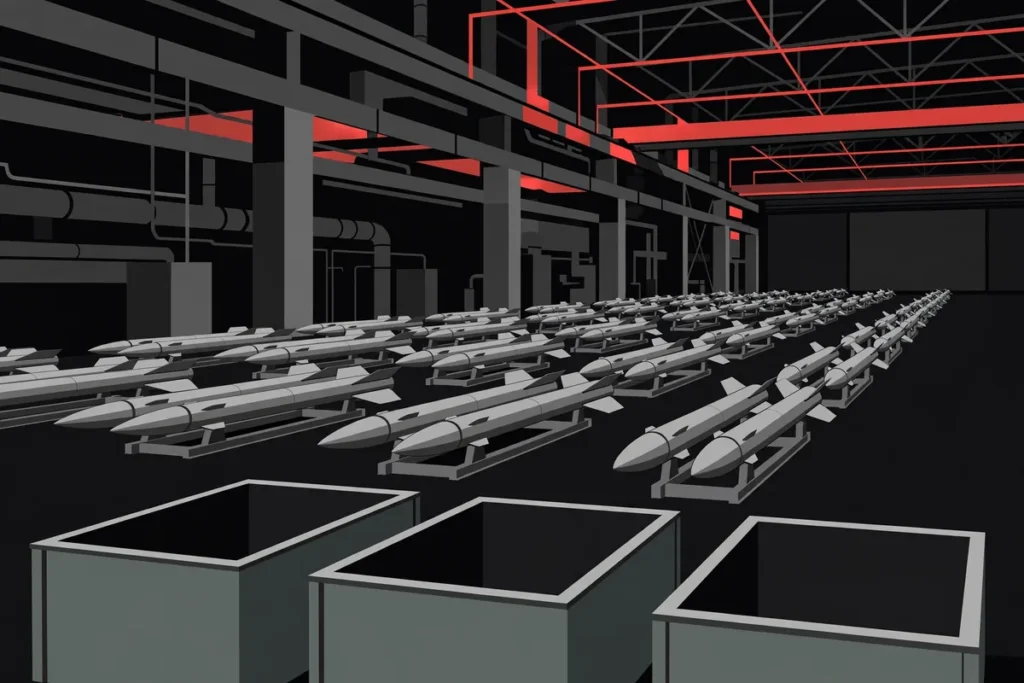
Three forces are draining the pool. First, consumption is brutal: firing two interceptors per incoming ballistic missile, at $3–4 million each, means a single heavy raid can burn hundreds of millions of dollars of inventory in an hour. Second, global demand exploded after the United States and Israel went to war with Iran in February 2026 — coalition forces reportedly fired large numbers of interceptors in the opening days, and Gulf air-defense needs now sit ahead of Ukraine in the delivery queue. Third, production cannot scale fast: a PAC-3 MSE takes specialized rocket motors, seekers, and guidance electronics, and even the expanded 2025 output of ~620 missiles a year is fewer than two a day.
The industry is responding. Lockheed Martin is expanding toward 2,000 PAC-3 MSEs a year by 2030, Raytheon signed a $3.7 billion contract in April 2026 for GEM-T interceptors for Ukraine with support from the new COMLOG facility at Schrobenhausen, Germany, and Zelenskyy discussed co-production with Raytheon in July 2026. But a Ukrainian production line is a years-long project, not a winter solution.
Can Ukraine repair its Patriot systems at home now?
Separate from the missile shortage, the United States is fixing the other half of the readiness equation: repair. On October 6, 2026, the U.S. Defense Logistics Agency began a sole-source procurement with Raytheon to deliver a complete suite of Patriot Depot Test Equipment to Ukraine’s domestic maintenance network, according to Army Recognition’s account of the DLA notice. The package includes GETS-1000 and PAT24X diagnostic stations, radar-transmitter and high-voltage power-supply test gear, cooling-system equipment, installation, training, reference units, and five years of spare parts.
The logic is straightforward: field maintainers swap out a failed radar or power assembly to get a battery firing again, but without depot-level test equipment the damaged unit must be shipped abroad for deep diagnosis — a slow loop that shrinks the pool of spare assemblies. With the test stations in-country, Ukrainian technicians can diagnose, repair, retest, and return components to service themselves. Raytheon is considered the only qualified supplier, though other firms may seek qualification before responses close on October 9.
The honest limit: depot repair fixes reusable hardware, not consumed missiles. It returns radars and power supplies to service faster, but every ballistic engagement still costs interceptors that no test station can regenerate. Ukraine faces two separate equations — hardware readiness and munition supply — and the DLA move solves only the first.
Background and timeline
- February 2026: The United States and Israel go to war with Iran, diverting large volumes of Patriot interceptors to the Gulf and the Middle East.
- April 14, 2026: Raytheon signs a $3.7 billion contract for GEM-T interceptors for Ukraine, backed by the COMLOG facility at Schrobenhausen, Germany.
- July 2026: Zelenskyy discusses interceptor co-production with Raytheon representatives; Russia escalates ballistic strikes on Ukrainian cities.
- August 2026: Zelenskyy tells CNN Ukraine holds about 1% of the interceptors it needs and asks Washington for 5% of the U.S. stockpile to get through winter.
- September 25, 2026: Zelenskyy says U.S. President Donald Trump has made a “final decision” to allow Ukraine to manufacture Patriot missiles under license — a years-long industrial project.
- October 6, 2026: The U.S. Defense Logistics Agency begins procuring Patriot depot test equipment so Ukraine can repair systems domestically; responses close October 9.
- October 7, 2026: Reuters reports Ukraine has “virtually run out” of Patriot interceptors as the U.S. diverts resources to the Gulf; EU envoys approve 1,646 new Russia sanctions designations, more than half targeting the ballistic-missile production chain.
Different perspectives
Kyiv frames the shortage as an emergency of allied priorities: Zelenskyy’s team argues that a fraction of the U.S. stockpile — 5% for the winter, 10% to end the ballistic threat — would decide the air campaign, and that diverting interceptors to the Gulf while Ukrainian cities burn is a strategic misallocation. Washington’s position, as reflected in White House statements, is that no decisions on transfers or licensed production are guaranteed and that protecting sensitive technology and U.S. readiness constrains what can move.
Moscow, meanwhile, treats the gap as a window: with Patriots thinned out, Russia has intensified ballistic strikes precisely because the Iskander-M faces no other credible interceptor in Ukraine’s arsenal. European capitals sit between the two pressures — expanding sanctions on Russia’s missile industry, as this week’s 1,646 designations show, while their own Patriot stocks and production lines are stretched thin.
What this means for US/UK/EU readers
The interceptor crisis is not only Ukraine’s problem. U.S. Patriot stocks in Europe are described as heavily drawn down, which directly affects NATO’s own air-defense posture at a moment when the alliance is expanding deterrence on its eastern flank. For American taxpayers, each $3–4 million interceptor fired against a threat is a budget line; the Pentagon’s seven-year expansion to 2,000 PAC-3 MSEs a year is a multi-billion-dollar industrial commitment that will compete with other defense priorities.
For European readers, the war is accelerating a continental rearmament bill: Germany’s COMLOG facility, new EU sanctions on missile-industry suppliers, and pressure to fund Ukrainian air defense all land on national budgets. And for energy markets — a WarBrief intelligence theme worth watching — every escalation in strike campaigns feeds the geopolitical risk premium already rattling diesel and crude prices, as covered in our reporting on the EU’s newest Russia sanctions and the air-defense costs of the Iran war.
What to watch next
Three dates matter. October 9 is the deadline for industry responses to the DLA depot-equipment procurement — watch whether any competitor challenges Raytheon’s sole-source position. The EU foreign ministers’ meeting will formally adopt the 1,646 new sanctions designations aimed at Russia’s missile supply chain. And winter is the real deadline: with heating season approaching and Russian strikes targeting energy infrastructure, Ukraine’s remaining interceptors must be rationed against the heaviest raid tempo of the year. Any U.S. decision on licensed Patriot production in Europe or Ukraine would shape the 2027–2030 picture, not this winter’s.
Frequently asked questions
How does a Patriot missile intercept a ballistic missile?
The radar detects and tracks the incoming missile, the engagement control station computes a firing solution, and a launcher fires an interceptor toward a predicted meeting point. Radar updates guide it mid-flight; in the final seconds the interceptor’s own seeker takes over. PAC-3 missiles then destroy the target by direct “hit-to-kill” impact, while older PAC-2 missiles detonate nearby with a fragmentation warhead.
How many Patriot batteries does Ukraine have?
Ukraine is reported to operate around ten Patriot batteries, supplied by the United States, Germany, the Netherlands, and other partners. The exact number is not officially confirmed, and the binding constraint is no longer launchers but interceptor missiles.
Why can only Patriot systems intercept Russia’s Iskander missiles?
The Iskander-M flies a fast, maneuvering, depressed trajectory that defeats slower or less precise defenses. Ukraine’s NASAMS, IRIS-T, SAMP/T, and Soviet-era systems lack the radar speed and hit-to-kill interceptor kinematics needed for reliable ballistic intercepts. Reuters confirmed in October 2026 that only the Patriot can do the job in Ukraine’s arsenal.
How much does a Patriot interceptor missile cost?
Estimates put a PAC-3 MSE interceptor at $3–4 million each, with PAC-2/GEM-T variants somewhat cheaper. Doctrine often fires two interceptors per incoming ballistic missile, so a single raid can consume tens of millions of dollars of inventory.
Why is Ukraine running out of Patriot interceptors?
Wartime consumption far exceeds production: Lockheed Martin built about 620 PAC-3 MSE missiles in all of 2025, while Ukraine can burn through dozens in a single raid. The U.S.-Iran war diverted interceptors to the Gulf, pushing Ukraine down the delivery queue, and production expansion toward 2,000 missiles a year will not arrive until around 2030.
Sources
- Reuters: EU envoys approve new Russia sanctions listings, diplomats say (October 7, 2026)
- Army Recognition: US to help Ukraine repair Patriot air defense systems domestically as Russian missile attacks intensify (October 6, 2026)
- CNN: Zelenskyy interview on Ukraine’s Patriot interceptor needs (August 12, 2026)
- Congressional Research Service: PATRIOT Air and Missile Defense System for Ukraine
- Missile Defense Advocacy Alliance: Patriot Advanced Capability-3 Missile
- Missile Defense Advocacy Alliance: AN/MPQ-53/65 Radar



Discussion 0
Share analysis, corrections, or context. Be civil — comments are moderated.