
WarBrief Live | November 18, 2026 | Defense Technology
| 3,000 km claimed range | 1,150 kg warhead | ~$600,000 unit cost | ~100 a month production |
The FP-5 Flamingo is Ukraine’s homegrown long-range cruise missile: a 3,000 km weapon with a 1,150 kg warhead, built for about $600,000, that Kyiv says struck the Crimean Bridge on November 17. It is the largest ground-launched cruise missile Ukraine has fielded, and it matters because Kyiv built it without asking Washington for permission to use it.
Ukraine revealed the Flamingo in August 2025, and within a year it had moved from a pink-painted prototype to a weapon Kyiv credits with hitting refineries, rocket plants and, most recently, the railway section of the bridge to Crimea. Every headline figure attached to the missile — the range, the warhead, the price — comes from its maker, Fire Point, or from media reporting of the maker’s claims. No official Ukrainian specification sheet has ever been published, so this explainer separates what is confirmed from what is only reported, figure by figure.
Key Takeaways
- The FP-5 Flamingo is a Ukrainian ground-launched cruise missile built by Fire Point, with a claimed range of 3,000 km and a warhead of 1,150 kg.
- It costs roughly $600,000 per missile — about a quarter of a Tomahawk — and Fire Point says it builds about 100 a month.
- Its engine is a recycled Soviet-era AI-25TL turbojet from the L-39 trainer aircraft, and that engine supply is the programme’s main bottleneck.
- Kyiv says Flamingo missiles struck the Crimean Bridge railway section on November 17, 2026, its highest-profile use so far.
What is the FP-5 Flamingo?
The FP-5 Flamingo is a ground-launched, jet-powered cruise missile developed by the Ukrainian defence firm Fire Point. It was first publicly revealed on August 17, 2025, when Associated Press photojournalist Efrem Lukatsky photographed a test launch at a hidden facility in southern Ukraine. The Associated Press reported on the weapon four days later, on August 21, 2025, in a piece that introduced Fire Point to a global audience.
Fire Point was founded in 2022, after Russia’s full-scale invasion, by a group of friends from non-military backgrounds — including construction, game design and architecture — who first built one-way attack drones, the FP-1 and FP-2, before moving to cruise missiles. The Flamingo is launched from a truck-based transporter-erector-launcher, using a booster to get airborne, and the launcher is designed to resemble an ordinary commercial truck while it is on the road, so it can move through traffic before launch preparations begin.
The name has two competing origin stories, and both are on the record. The Associated Press reported that the nickname “Flamingo” came about because early production units were painted pink due to an error at the factory. The Economist and Politico, by contrast, reported that the name was chosen to highlight the role of women in senior positions at the company, with test prototypes painted pink to support the name. Fire Point’s chief technology officer has denied the factory-error version. Either way, the pink prototypes are part of the weapon’s public identity — and of its appeal as a symbol of Ukraine’s homegrown arms industry.
Defence analysts have also noted a close resemblance between the Flamingo and the FP-5 cruise missile advertised by the Milanion Group, a defence firm based in the United Arab Emirates, at the IDEX 2025 exhibition in Abu Dhabi. Defense Express concluded that the two designs were the same weapon, pointing to the identical straight fixed wing, the engine mounted above the fuselage and matching dimensions. Fire Point has not confirmed any licensing link with Milanion, so the connection remains an analyst assessment, not a confirmed fact.
How far can the Flamingo fly — and how big is its warhead?
Fire Point claims a range of 3,000 km (about 1,900 miles) for the Flamingo, a figure repeated by the Associated Press, The War Zone and UNITED24. At that range, the missile could in theory reach targets anywhere in the European part of Russia and as far as Novosibirsk — but it had not been shown to strike targets at anywhere near that range as of June 2026, and no confirmed strike has been documented at 3,000 km.
The warhead is the Flamingo’s most striking feature. Fire Point and the Associated Press put it at 1,150 kg (about 2,540 lb), which the manufacturer says is roughly two and a half times the warhead of an American Tomahawk Block V. Other figures circulate: the Kyiv Independent has reported 1,000 kg, while the manufacturer has also quoted up to 1,200 kg. The discrepancy is a reminder that all of these numbers are maker claims, not independently verified specifications. Analysts who have examined photographs of the warhead section assess that it is most likely built around a repurposed Soviet air bomb — probably a FAB-1000, with the larger FAB-1500 considered unlikely given the warhead’s size — but that too is an assessment, not a confirmed fact.
Speed figures also vary by source. The manufacturer gives a maximum speed of about 950 km/h, with a cruising speed of roughly 650–900 km/h depending on the mission profile. The Milanion brochure for the near-identical FP-5 claims a top speed of up to 1,500 km/h. Fire Point says the missile’s circular error probable — the radius within which half of all shots are expected to land — is about 14 metres. A single flight can last up to four hours, at altitudes from as low as 20 metres to as high as 10 km, and launch preparation takes roughly 20 to 40 minutes.
What is the Flamingo made of? The engine bottleneck
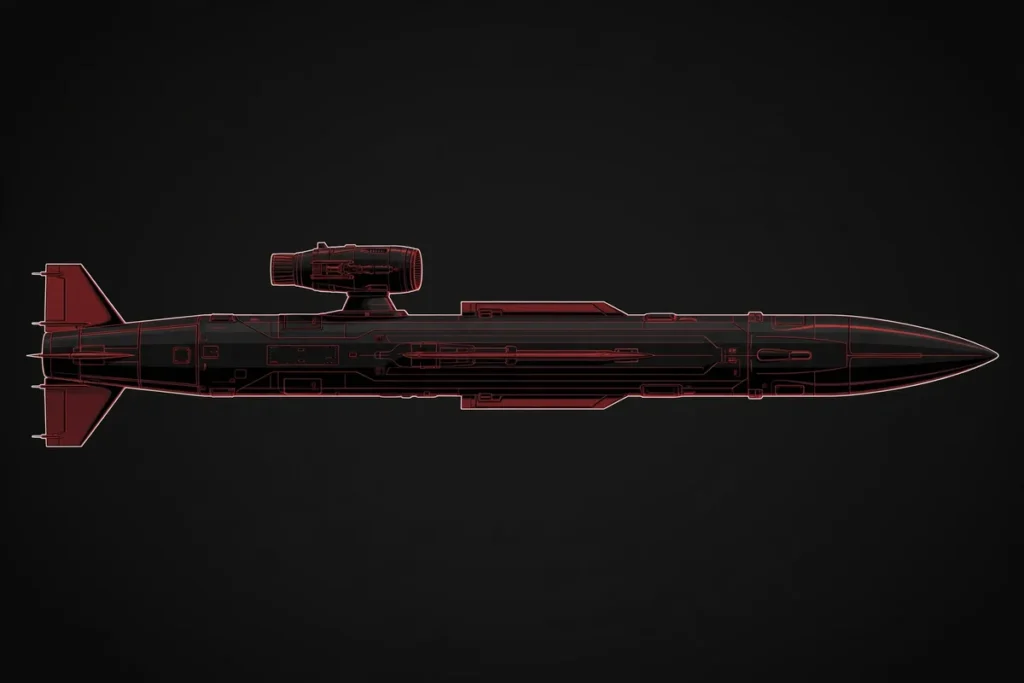
The Flamingo’s design philosophy is range, payload and affordability over stealth or speed. It is a large subsonic missile without an expensive suite of stealth technologies: a fibreglass monocoque body, a fixed straight wing instead of folding assemblies, and a turbojet engine bolted on top of the fuselage rather than integrated inside it. That simplicity is what makes it cheap to build — and it is also what makes it big. At about 14 metres long and 6,000 kg at takeoff, with a wingspan of 6 metres on early versions and about 7 metres on later ones, it is nearly five times heavier at takeoff than a Tomahawk, and much harder to hide and transport.
The engine is the programme’s defining constraint. The Flamingo flies on the Ivchenko AI-25TL, a Soviet-designed turbojet originally built for the L-39 Albatros jet trainer — an engine that produces about 17 kN of thrust and weighs roughly 350 kg. Some of the engines in use have been recovered from landfill dumps, according to defence reporting. There are only so many AI-25 engines left in the world, and Fire Point has said it has tested five different engine types as replacements. Reuters reported on August 4, 2026 that the company was assembling the first 10 prototypes of an engine of its own design. Analysts estimate a more modern engine could lift the stated range by about 15 percent, to roughly 3,450 km — an estimate, not a confirmed new specification.
Production has scaled fast. Fire Point executive Iryna Terekh told The Guardian in August 2026 that the company was producing approximately 100 FP-5 missiles per month, and the company said in July 2026 that one missile cost slightly less than $600,000. In August 2025 the company had said it aimed to reach 210 missiles a month by the end of that year. The unit cost is the number that gets the most attention in Western defence circles: at roughly $600,000, a Flamingo costs about a quarter of a Tomahawk, which runs $1.5 million to $2.5 million per unit depending on the variant, while carrying more than twice the explosive and flying roughly twice as far.
Flamingo vs Tomahawk: how does it compare?
The comparison with the American Tomahawk is the frame Fire Point itself invites, and on paper the Flamingo wins on the three numbers that matter most to a buyer: range, payload and price. The trade-offs are size, preparation time and accuracy. The Flamingo needs 20 to 40 minutes of launch preparation, against a Tomahawk’s much faster cycle, and its 6,000 kg takeoff weight makes it far harder to move and conceal. Its guidance — satellite plus inertial navigation, with a reported 14-metre circular error probable — is cruder than the Tomahawk’s GPS, terrain-matching and image-matching suite.
| Metric | FP-5 Flamingo | Tomahawk Block V |
|---|---|---|
| Claimed range | 3,000 km | ~1,600 km (unclassified) |
| Warhead | 1,150 kg | ~450 kg |
| Unit cost | ~$600,000 | $1.5–2.5 million |
| Takeoff weight | ~6,000 kg | About a fifth of the Flamingo |
| Top speed | ~950 km/h (claimed) | Subsonic |
The strategic point of the comparison is not the table but the politics. Britain and France restricted Ukraine’s use of the Anglo-French Storm Shadow cruise missiles in 2024, the US quietly blocked the use of American ATACMS missiles against targets inside Russia, and Washington held off on giving Ukraine Tomahawks. The Flamingo is Kyiv’s answer to that constraint: a weapon with Tomahawk-class reach that Ukraine owns outright, built in Ukrainian factories, with no foreign government able to veto its use. That is why the missile matters beyond its specifications.
Flamingo by the numbers
| Metric | Figure | Source | Status |
|---|---|---|---|
| Claimed range | 3,000 km | Fire Point via AP, The War Zone, UNITED24 | CONFIRMED (maker claim) |
| Warhead | 1,150 kg | AP, The War Zone, UNITED24 | CONFIRMED (maker claim) |
| Maximum speed | ~950 km/h | Fire Point via Ukrainska Pravda | CONFIRMED (maker claim) |
| Top speed, brochure | Up to 1,500 km/h | Milanion brochure via The War Zone | REPORTED (single source) |
| Unit cost | Slightly under $600,000 | Fire Point, July 2026 | CONFIRMED (maker claim) |
| Monthly output | ~100 missiles | The Guardian, August 2026 | CONFIRMED (company statement) |
| Accuracy (CEP) | ~14 m | Fire Point via AP | REPORTED (maker data) |
| First reported combat use | September 2026 | President Zelenskyy via Ukrainska Pravda | CONFIRMED (official statement) |
| Flamingos intercepted, Nov 16 | 4 claimed | Russian Defence Ministry via Zvezda | REPORTED (unverified) |
Caveat: all performance figures are manufacturer claims or media reporting of those claims; no official Ukrainian specification sheet for the FP-5 has been published, and where sources disagree both figures are shown.
Has the Flamingo been used in combat?
Yes — on Kyiv’s account, repeatedly. The first reported combat use came in September 2026, when President Volodymyr Zelenskyy said Flamingo missiles struck the Volgogradpromproekt plant in Russia, which makes chemicals for specialised applications. In October 2026 Zelenskyy confirmed that Flamingo missiles had been used in real combat operations on at least nine occasions, including coordinated strikes alongside Neptune cruise missiles. A reported strike on the RKC Progress rocket plant in Samara followed on August 15, 2026, although damage there could not be independently verified.
The highest-profile use so far came on the night of November 16–17, 2026, during Ukraine’s seven-stage operation against the Crimean Bridge. Zelenskyy said Palianytsia missile-drones struck the road section, while Neptune, Ruta and FP-5 Flamingo systems were used against the railway section. Ukrainska Pravda reported that OSINT analysis of footage of the impact matched a Flamingo striking the railway section, and Fire Point co-founder Denys Shtilerman shared imagery of the strike. WarBrief covered the full operation in our explainer on the Crimean Bridge attack.
Russia, for its part, claims to have shot Flamingos down. On November 16 its Defence Ministry said its air defences had intercepted four Flamingo cruise missiles and 2,049 drones in a single day — figures that could not be independently verified, and which Ukraine has not commented on. Earlier, in February 2026, Moscow said it had intercepted five Flamingos fired at an arsenal near Kotluban in the Volgograd region. An investigation by Ukrainska Pravda in May 2026 examined publicly documented Flamingo launches and found that early results were mixed — a reminder that a weapon’s advertised range and payload do not guarantee accuracy, reliability or penetration of Russian air defences.

What the Flamingo means for US/UK/EU readers
For readers in the United States, Britain and the EU, the Flamingo is not a weapon that will ever be fired at them — it is a signal about how the war is changing, and about where European defence money is going. Three things matter.
First, the supply question is now partly a European industrial question. German defence manufacturer Diehl Defence entered negotiations with Fire Point in June 2026, according to the Financial Times, to build a domestic production line for the FP-5 in Germany, potentially adding a far more advanced infrared and multi-mode seeker to improve terminal guidance under electronic warfare. If that line is built, a Ukrainian missile becomes a German-made product too, with German jobs and German export-control politics attached.
Second, the money question reaches beyond Ukraine. The United Arab Emirates’ EDGE Group has been reported to be preparing to buy roughly a 30 percent stake in Fire Point, a deal valuing the company at about $2.5 billion, according to BBC News Ukraine. A wartime startup founded in 2022 is, on that valuation, one of the most significant defence investments of the war — and a sign that Gulf capital sees Ukrainian weapons as an export industry, not just a wartime expedient.
Third, the escalation question. The Flamingo lets Ukraine strike military-industrial targets up to 3,000 km inside Russia without Western permission, and Kyiv has used it against refineries, rocket plants and the Crimean Bridge. For European readers that means the deep-strike campaign — and with it, the pressure on Russian fuel supplies, air defences and logistics — is no longer gated by decisions in Washington. It also means Russia’s air-defence problem is getting harder: Moscow must now defend against a cheap, mass-produced cruise missile alongside Ukraine’s drone swarms, and its claims of intercepting Flamingos are part of that contest.
What to watch next for the Flamingo programme
The first thing to watch is the engine. Fire Point’s own turbojet — the first 10 prototypes were being assembled in August 2026 — is the difference between a weapon limited by a dwindling stock of Soviet trainer engines and one Ukraine can build at scale indefinitely. If the new engine flies, analysts estimate the range could rise by about 15 percent; if it does not, production will stay capped by however many AI-25s can be found, bought or salvaged.
The second is Germany. A Diehl production line would give the Flamingo a second manufacturing base inside NATO, a better seeker, and a political constituency in Berlin. Watch for a signed agreement rather than another round of talks — the Financial Times report dates to June 2026, and no deal has been confirmed since.
The third is what comes next from Fire Point itself. The company has shown ballistic missiles — the FP-7 tactical ballistic missile, with a reported 200–300 km range, and the much larger FP-9 — but as of November 14, 2026 the FP-9 had not been publicly confirmed as combat-ready. The Flamingo proved Fire Point could build a long-range cruise missile; the ballistic programme will show whether it can build a family of weapons. And the fourth is the interception record: how many Flamingos Russia actually shoots down, versus how many it claims to, will decide whether the missile stays a strategic asset or becomes an expensive way to test Russian air defences.
Frequently asked questions
What is the FP-5 Flamingo?
The FP-5 Flamingo is a Ukrainian ground-launched cruise missile built by the defence firm Fire Point. It was revealed in August 2025, has a claimed range of 3,000 km and a warhead of 1,150 kg, and is Ukraine’s longest-range homegrown strike weapon.
How far can the Flamingo missile fly?
Fire Point claims a range of 3,000 km, a figure repeated by the Associated Press, The War Zone and UNITED24. That would put targets anywhere in the European part of Russia within reach, but no strike has been confirmed at anywhere near that distance.
How big is the Flamingo’s warhead?
The manufacturer and the Associated Press put the warhead at 1,150 kg, roughly two and a half times the warhead of an American Tomahawk Block V. Some sources report 1,000 kg and the manufacturer has also quoted up to 1,200 kg, so the exact figure is not settled.
How much does a Flamingo missile cost?
Fire Point said in July 2026 that one FP-5 costs slightly less than $600,000 — about a quarter of a Tomahawk, which costs $1.5 million to $2.5 million per unit. The company said in August 2026 that it builds about 100 missiles a month.
Has the Flamingo been used in combat?
Yes, according to Kyiv. President Zelenskyy said Flamingos were first used in combat in September 2026, confirmed at least nine uses by October 2026, and said they struck the railway section of the Crimean Bridge on November 17, 2026. Russia claims to have intercepted some Flamingos, but those claims are unverified.
Sources
- Drone & Defense: Flamingo Missile — Ukraine’s FP-5 Cruise Missile in Combat
- 19FortyFive: Ukraine’s FP-5 Flamingo Cruise Missile Carries a Bigger Warhead Than an American Tomahawk
- Ukraine World: FP-5 Flamingo — Ukraine’s Cruise Missile Evolves
- Army Recognition: Germany Could Produce Ukrainian FP-5 Flamingo Cruise Missiles
- Ukrainska Pravda: Ukrainian Forces Used Flamingo Missile to Strike Crimean Bridge
- Times of India: From Drones to Cruise Missiles — Inside Ukraine’s Op to Cripple Putin’s Prized Bridge
- Defense Express: Ukraine’s “Flamingo” Is the FP-5 Missile With 3,000 km Range and a One-Ton Warhead
- The Defence Blog: Russia Reports Its Biggest Ukrainian Drone Attack of the War


Discussion 0
Share analysis, corrections, or context. Be civil — comments are moderated.