WarBrief Live | November 15, 2026 | Intelligence Report
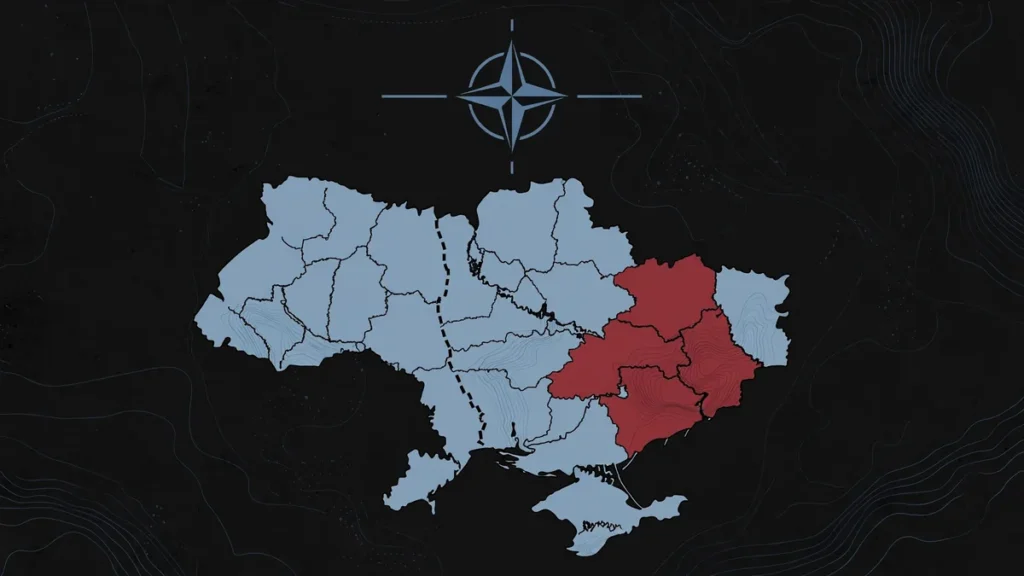
US negotiators asked Ukraine whether it would withdraw from the Donbas in exchange for NATO membership — a proposal President Volodymyr Zelenskyy disclosed on November 14, 2026, after two days of talks in Abu Dhabi.
The proposal is a question, not an offer: Washington has not confirmed it, Kyiv refuses to cede territory, and Moscow’s reported counter-demands run the other way.
Key Takeaways
- US negotiators in Abu Dhabi asked, for the first time, whether Ukraine would withdraw from the Donbas if admitted to NATO.
- Zelenskyy said Kyiv will not cede territory, but would put the question to a referendum if the US and NATO partners confirmed a package of guarantees, army funding and reconstruction money.
- The US has not confirmed it, no concrete offer exists, and NATO membership needs unanimous allied consent.
- Moscow’s reported counter-proposal, an unofficial “non-paper” from Abu Dhabi, would bar NATO expansion and roll back the alliance in Eastern Europe.
What did the US propose in Abu Dhabi?
Russian and Ukrainian delegations met in Abu Dhabi on November 10–11, 2026, in the first direct talks in nine months, mediated by US special envoy Steve Witkoff and Jared Kushner. The talks ended without a breakthrough; the one concrete result was agreement on a prisoner exchange involving more than 1,000 people.
Zelenskyy spoke to reporters on November 13; his office released the remarks on November 14. He said: “The Americans raised a question: ‘What if Ukraine joins NATO? Would Ukraine withdraw from Donbas?’ This was the first time this had been raised.” The territory is the part of the Donbas — the Donetsk and Luhansk regions — that Russia does not control.
The proposal is Zelenskyy’s account, not a published US document, and Washington has not confirmed it. Kushner, without referring to it, said “several new ideas emerged from these discussions and are now being explored.”
Why is Kyiv’s answer conditional?
Zelenskyy reiterated that Ukraine is not prepared to give up its territory, but said that if Kyiv received a comprehensive package — security guarantees, a strong and well-funded army, and funds to rebuild — he would put the question to a national referendum. “If the American side confirms precisely this to us, together with other NATO partners, then I will ask our Ukrainian society what it thinks: do we accept it or not? I have no right to make that decision on my own. But we need specifics, and we don’t have them yet.”
Neutrality is off the table: Zelenskyy rejected it, saying it would require changing the constitution and would not guarantee lasting security. “If Putin expects Ukraine’s neutrality to be enshrined, that’s not going to happen,” he said. Admitting a new member also requires unanimous allied consent, so the offer is not Washington’s alone to make.
What is Moscow demanding instead?
Putin has long called Ukrainian NATO membership a red line, citing it as one reason for the full-scale invasion in 2022. Moscow demands a withdrawal from the parts of the Donbas Kyiv still controls — the same ground the US proposal would have Kyiv surrender voluntarily.
The New York Times reported on November 13 that it had obtained an unofficial Russian “non-paper” from the talks, described by two sources involved as Russia’s opening position. It repeats Moscow’s 2021 ultimatums — NATO should pull back forces and bases from states that joined since 1997, cease expansion, and stop military activity in Eastern Europe — and add new ones: France and the United Kingdom should not use their nuclear weapons to protect other European states, and Ukraine could join the EU but not its common defence policy. Moscow has not confirmed the document; treat its contents as reported, not established.
The Institute for the Study of War assesses that US proposals for Ukrainian NATO membership are implicit rejections of Russian demands to stop NATO expansion and reform the European security architecture. The fighting underlines the stakes: Russian forces launched 96 drones at Ukraine overnight on November 13–14, and Russian attacks remain concentrated on the Dobropillya and Kostyantynivka directions.
What happens next?
Europe’s seat is now settled in principle. The White House said on November 13 that the US delegation ensured Europe will join future talks, and Europe has designated national security advisers from Germany, France, the United Kingdom, Italy and Poland, plus an EU representative, for technical-level talks. No European leaders have been designated yet.
On November 19, more than 20 leaders gather in Berlin for the Coalition of the Willing summit. Chancellor Friedrich Merz set two priorities: funding Ukraine’s defence in 2027 and a unified position on future peace negotiations. President Donald Trump will meet Putin and Xi Jinping at the APEC leaders’ meeting in China on November 18–19 to discuss nuclear proliferation and Iran; the White House said Ukraine will likely not be discussed.
No comprehensive ceasefire has been agreed. Zelenskyy also answered a Kremlin proposal for a localised ceasefire around Kostyantynivka on November 14, warning it would let Russian forces reinforce and seize the town. The monitoring question is covered in our explainer on ceasefire monitoring.
Assessment
The proposal changes the negotiation even if it never becomes an offer: NATO membership is now on the table as a bargaining chip, raised by the US side rather than demanded by Kyiv.
Three obstacles decide whether it goes further. First, unanimity: all 32 allies must agree, and none has endorsed the trade. Second, Moscow: the proposal contradicts every demand in Russia’s reported non-paper. Third, Kyiv’s conditions: a referendum needs a specific, confirmed package that does not yet exist, and neutrality is constitutionally and politically closed.
The most likely near-term result is diplomatic: the proposal gives the Berlin summit a concrete question to answer, and the next round of talks a framework to test. Watch whether Washington confirms or clarifies the proposal, what Berlin says about guarantees, and whether a date is set for the next round. The prisoner exchange — more than 1,000 people — is the one deliverable already agreed; its execution will be the first test of whether Abu Dhabi produced anything durable.
Frequently asked questions
Did the US offer Ukraine NATO membership in exchange for the Donbas?
No. President Zelenskyy said US negotiators raised it as a question in Abu Dhabi, the first time the linkage had been raised. No concrete offer exists, and the US has not confirmed his account.
Would Ukraine give up the Donbas?
Zelenskyy said Kyiv will not cede territory. He would only put it to a referendum if the US and NATO partners confirmed such a package.
Can NATO admit Ukraine while the war is ongoing?
Admission needs unanimous allied consent; no member has formally proposed it. The proposal is a negotiating question raised by US envoys, not a membership invitation.
Sources
- ISW: Russian Offensive Campaign Assessment, November 14, 2026
- Al Jazeera: US suggested Ukraine cede Donbas for NATO membership, November 14, 2026
- CNN: US floated Ukraine swapping land for NATO membership, November 14, 2026
- Firstpost: US floats Nato membership in possible territorial trade-off, November 14, 2026
- Ukrinform: Merz outlines priorities for Berlin summit, November 13, 2026
More intelligence reports from WarBrief Live.