
WarBrief Live | November 13, 2026 | Energy & Oil
Ukraine’s military says it has struck all five of Russia’s largest oil refineries since October 30, in a campaign Kyiv calls “long-range sanctions”. Industry sources say about 30% of Russia’s refining capacity is temporarily offline.
5 of 5
largest Russian refineries hit since October 30 — General Staff, November 12
~30%
of Russia’s refining capacity temporarily cut — Reuters, citing industry sources
>120M
tonnes a year: combined capacity of the plants hit, about 36% of the total — reported
$95.82
Brent crude settled on Thursday, November 12, up 3.3% on the day
Key Takeaways
- Ukraine’s General Staff confirmed on November 12 that its forces have struck Russia’s five largest refineries — Omsk, Kirishi, Ryazan, Nizhny Novgorod and Yaroslavl — since October 30, plus the smaller Novokuibyshevsk and Saratov plants.
- Confirmed damage is so far concentrated at two plants: Kirishi, hit on the night of November 9, and Saratov, hit on November 7. Damage at the other three has not been independently confirmed.
- Reuters, citing two industry sources, reported that the strikes have temporarily cut about 30% of Russia’s refining capacity, with nine of the country’s 35 major refineries hit or disrupted.
- Overnight on November 12–13, drones struck the Lukoil refinery city of Volgograd, killing four people in an industrial zone — a fresh attack that extends the campaign into a third week.
- For fuel buyers, the campaign pulls in two directions: tighter Russian diesel supply pushes diesel prices up, while displaced Russian crude pushes crude prices down. Brent settled at $95.82 on November 12, driven mainly by the Hormuz crisis, not the refinery strikes.
What did Ukraine’s General Staff confirm on November 12?
On November 12, the General Staff of the Armed Forces of Ukraine said its forces had struck five of Russia’s largest oil refineries since October 30: Omsk, Kirishi, Ryazan, Nizhny Novgorod and Yaroslavl. The statement, published on the General Staff’s social media channels and reported by Ukrinform, described the refineries as “among the five most powerful” in Russia and said smaller plants at Novokuibyshevsk and Saratov had also been attacked.
The claim matters because it reframes a string of separate strikes as a single campaign. Until November 12, each attack had been reported on its own — Saratov on November 7, Kirishi on November 9, Omsk on November 11. The General Staff’s statement ties them together and presents them as a deliberate strategy: in Kyiv’s words, “long-range sanctions” aimed at the fuel that supplies Russia’s military and the revenue that finances its war. Whether the five plants were all seriously damaged is a different question from whether they were all attacked — and the evidence so far is uneven.
What is confirmed is the list of targets and the dates of at least three of the strikes. What remains unverified is the extent of the damage at Ryazan, Nizhny Novgorod and Omsk, where the public evidence is limited to Ukrainian statements and reports of a fire. That distinction runs through this article: confirmed facts are labelled as such, and single-source claims are marked reported.
Which five refineries were hit, and what was damaged?
Omsk, November 11. Ukraine’s Special Operations Forces said they struck the Gazprom Neft refinery at Omsk, Russia’s largest oil-processing plant, setting off a fire. The plant sits about 2,500 kilometres from the Ukrainian border — a measure of how far Ukraine’s long-range drones now reach — and processes more than 21 million tonnes of crude a year, with a refining depth of about 99%, according to Ukrainian reports. This was the third strike on Omsk, after earlier attacks in July and October. The fire itself is confirmed by Ukrainian statements; the extent of the damage to processing units has not been independently verified.
Kirishi, November 9. On the night of November 9, Ukrainian forces struck the KINEF refinery (Kirishinefteorgsintez) in the Leningrad region. The General Staff said the attack damaged the plant’s primary crude unit — an atmospheric distillation unit — and two cooling units. Kirishi processes about 20 million tonnes a year and is one of Russia’s most important suppliers of fuel to the north-west. Of the five, Kirishi is one of the two where specific damage has been described by Kyiv and corroborated in Ukrainian reporting.
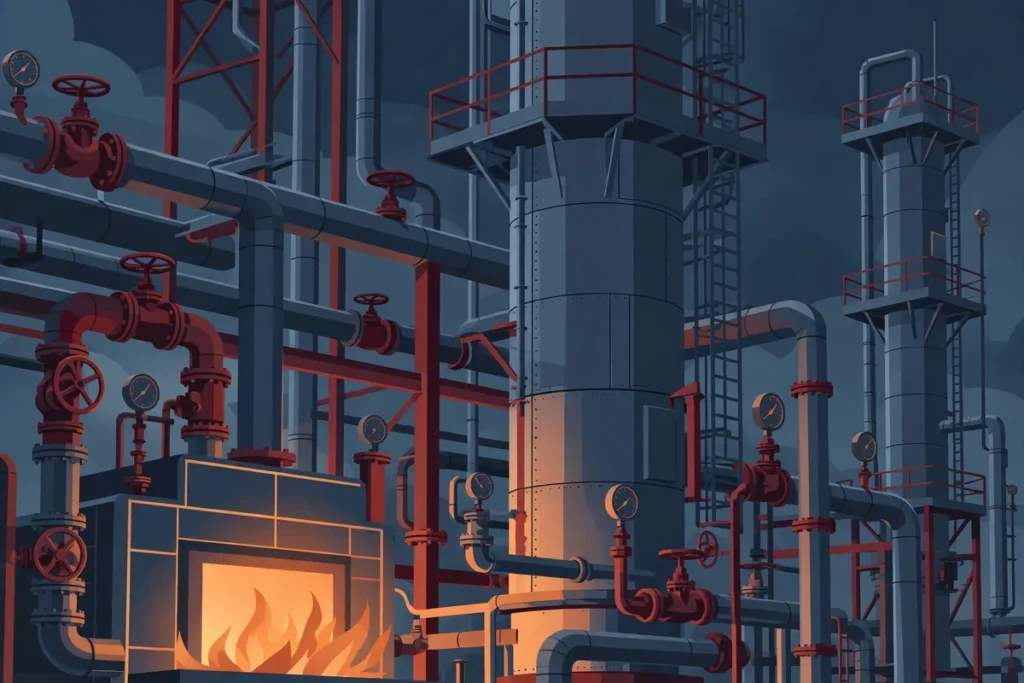
Saratov, November 7. Two days earlier, Ukraine targeted the Saratov Oil Refinery, which processes about 7 million tonnes of crude a year. The General Staff said the strike hit the plant’s only primary processing unit and halted its operations. WarBrief covered the Saratov strike as a single event on November 7; the November 12 statement now places it inside the wider campaign.
Ryazan and Nizhny Novgorod. Both plants are named in the General Staff’s list of the five largest refineries hit since October 30, but no dated strike or specific damage has been publicly described for either in the November 12 statement. They should be treated as confirmed targets of the campaign and unconfirmed in terms of damage — a gap that matters, because a refinery can be attacked without losing processing capacity.
The two smaller plants named alongside the five — Novokuibyshevsk and Saratov — are described by Kyiv as “no less important” to Russia’s military supply chain. Novokuibyshevsk was first struck on October 30, the date the General Staff uses as the start of the campaign.
How much of Russia’s refining capacity is offline?
The most widely cited figure comes from Reuters, which reported on November 10, citing two industry sources, that Ukrainian strikes since late October had temporarily reduced Russia’s oil refining capacity by about 30%. The same reporting said at least nine of Russia’s 35 major refineries had been hit or disrupted in roughly ten days, and that daily crude processing had fallen by about 200,000 tonnes, to roughly 700,000 tonnes a day. The word “temporarily” carries weight here: refineries can restart after repairs, and Moscow has repeatedly brought damaged plants back online during this war.
A second figure comes from the Ukrainian side. Arms manufacturer Fire Point put the combined annual capacity of all the plants targeted between October 30 and November 11 at more than 120 million tonnes of crude a year — about 36% of Russia’s total — according to the Kyiv Post. That is a measure of the capacity of the plants attacked, not the capacity destroyed, and it should be read as reported rather than confirmed. An earlier Ukrainian claim, that strikes had put 43% of Russia’s refining capacity out of operation, is likewise a Kyiv figure, not an independently verified one. The Reuters estimate of about 30% temporarily offline is the more conservative and better-sourced number, and it is the one this article uses as its headline figure.
The domestic consequences inside Russia are already visible in policy. Reuters reported that Moscow has extended its ban on diesel exports by producers through January, with exceptions for some foreign sales — a step that protects domestic supply at the cost of export revenue. Russia, traditionally one of the world’s largest diesel exporters, has been forced to prioritise its own market before, and the extension suggests officials expect the outages to last into the winter, when diesel demand rises. WarBrief examined how the earlier wave of strikes reshaped the global diesel market in October; the November campaign extends the same logic further.
By the numbers
| Metric | Figure | Source |
|---|---|---|
| Largest Russian refineries struck since October 30 | 5 — Omsk, Kirishi, Ryazan, Nizhny Novgorod, Yaroslavl | General Staff of the Armed Forces of Ukraine, November 12 (CONFIRMED) |
| Omsk refinery annual capacity | More than 21 million tonnes | Ukrainian General Staff / United24 Media (CONFIRMED as stated) |
| Brent crude, November 12 settlement | $95.82 a barrel, up 3.3% | CNBC TV18 / Business Recorder (CONFIRMED) |
| WTI crude, November 12 settlement | $88.74 a barrel, up 2.6% | Business Recorder (CONFIRMED) |
| People killed in Volgograd industrial-zone attack, November 13 | 4 killed, 2 injured | Governor Andrei Bocharov, via Reuters (CONFIRMED) |
| Share of Russian refining capacity temporarily cut | About 30% | Reuters, citing two industry sources (REPORTED) |
| Major Russian refineries hit or disrupted in about ten days | 9 of 35 | Reuters, citing industry sources (REPORTED) |
| Combined capacity of plants targeted, October 30 – November 11 | More than 120 million tonnes a year, about 36% of the total | Fire Point, via Kyiv Post (REPORTED) |
| Volgograd refinery operations after November 13 strike | Reported suspended | UNN (REPORTED) |
| Ukrainian drones claimed downed overnight, November 12–13 | 1,198 across 17 regions | Russian Defence Ministry (CLAIM, unverified) |
Figures marked CONFIRMED rest on two or more sources or on official statements. Figures marked REPORTED come from a single source or a party to the conflict and have not been independently verified.
What happened overnight in Volgograd?
The campaign did not stop with the November 12 announcement. Overnight on November 12–13, drones struck the southern Russian city of Volgograd, home to a large Lukoil refinery. Regional governor Andrei Bocharov said four people were killed and two injured in an attack on an industrial zone in the city, the deadliest attack on Volgograd so far, Reuters reported on November 13. The refinery processes about 14 million tonnes of crude a year — roughly 5% of Russia’s total refining volume, according to Lukoil’s own figures cited by Reuters.
Two points need care. First, there was no official confirmation that the refinery itself was hit, and Lukoil did not reply to a request for comment. Ukrainian outlet UNN reported that the refinery had suspended operations, and residents reported long queues at local petrol stations, according to the Russian outlet ASTRA — both reported, not confirmed. Second, the human cost is confirmed: four workers killed in an industrial area that also houses a chemical factory. The Volgograd strike is the latest in the campaign, but it sits outside the “five largest” list the General Staff published on November 12 — a reminder that the campaign is wider than those five plants.
The same night was one of the largest aerial exchanges of the war. Russia’s Defence Ministry claimed its air defences intercepted and destroyed 1,198 Ukrainian drones across more than 15 regions — a claim that has not been independently verified. Ukraine’s Air Force said Russia launched 117 strike drones overnight and that 80 were shot down or jammed. Russian strikes hit a hospital in Kyiv, a residential building in Rivne and homes and a kindergarten in Vinnytsia, according to Ukrainian officials.
What the refinery strikes mean for US/UK/EU fuel prices
For drivers and hauliers in the US, the UK and the EU, the campaign pulls fuel prices in two opposite directions, and which force wins depends on the fuel.
Diesel is where the pressure points up. Russia is a major diesel exporter, and every tonne of refining capacity taken offline is a tonne of diesel that does not reach the market. Moscow’s decision to extend its diesel export ban through January is designed to keep domestic pumps supplied, but it removes Russian diesel from a global market that is already tight. European diesel buyers, who have spent four years replacing Russian supply, are the most exposed; US diesel prices, which WarBrief examined in October when they passed $6 a gallon in parts of the country, are sensitive to any global diesel squeeze.
Crude oil points the other way. If Russia cannot refine its crude, more of it is pushed onto the export market as unrefined crude, which can weigh on crude prices. That is one reason Brent has not surged on the refinery news alone. Brent settled at $95.82 a barrel on November 12, up 3.3% on the day — but that rise was driven mainly by the Middle East: attacks on Saudi energy infrastructure, explosions reported on tankers in the Strait of Hormuz, and President Trump’s remark that the US does not need a deal with Iran. WarBrief’s analysis of why oil fell below $90 even as tankers burned in Hormuz explains how the two conflicts pull the market in different directions. The costs of the tanker war — insurance, rerouting and shipping — are a separate and larger driver of today’s prices than the refinery campaign.
OPEC+ is the other factor. The group held its December output targets steady on November 1, and its full meeting on November 29 will decide 2027 quotas — a decision that will matter more for pump prices than any single week’s refinery damage. WarBrief’s preview of the November 29 OPEC+ meeting sets out what is at stake. Goldman Sachs has warned that Brent could reach $140 a barrel in 2027 in a severe Gulf supply-disruption scenario — a scenario, not a forecast, and one driven by the Iran war rather than the refinery campaign. For context on how governments cushion oil shocks, see our explainer on how emergency oil releases work.
Educational note: this article explains energy markets; it is not financial advice.
Different perspectives
Kyiv’s view: the campaign is working. Ukraine presents the refinery strikes as “long-range sanctions” — a way of imposing costs on Russia’s war economy that does not depend on Western governments agreeing new sanctions packages. The November 12 statement’s “five out of five” framing is deliberate: it tells domestic and Western audiences that no major Russian refinery is beyond reach, including Omsk, 2,500 kilometres from the border.
Moscow’s view: Russian officials have consistently downplayed the damage, emphasised air-defence interceptions — 1,198 drones claimed downed in a single night — and pointed to the civilian cost of the strikes, including the four deaths in Volgograd. The export ban extension is presented as a precaution, not an admission of shortage. Independent verification of damage at Russian refineries remains difficult, and Moscow does not publish repair timelines.
The market’s view: traders are treating the refinery campaign as a diesel story, not a crude story. The Reuters industry sources behind the 30% figure are the most market-relevant voices in this story: they describe a temporary, repairable loss of capacity, not a permanent destruction of Russia’s refining industry. Refineries have been repaired and restarted before in this war, and the key question for markets is not how many plants were hit, but how long each one stays down.
What to watch next in Russia’s refinery campaign
First, the Volgograd question: whether the Lukoil refinery was actually hit and how long it stays shut. A confirmed shutdown there would extend the campaign’s reach to a sixth major plant and add about 5% of national refining volume to the offline total. Second, repair timelines at Kirishi and Saratov, the two plants with confirmed damage to primary units — a distillation unit can take weeks or months to replace, depending on parts and sanctions on equipment. Third, winter demand: diesel consumption rises in cold weather, and Moscow’s export ban runs through January, which sets up a test of whether domestic supply holds. Fourth, the OPEC+ meeting on November 29, which will set 2027 quotas against a backdrop of two simultaneous oil wars. And fifth, the diplomacy: the strikes come days after US-mediated talks in Abu Dhabi, where envoys discussed a large prisoner exchange, and as an energy ceasefire announced by President Trump has failed to take hold — a reminder that the refinery campaign is also a negotiating lever.
Frequently asked questions
Which Russian refineries has Ukraine hit since October 30?
Ukraine’s General Staff said on November 12 that its forces have struck Russia’s five largest refineries — Omsk, Kirishi, Ryazan, Nizhny Novgorod and Yaroslavl — since October 30, plus the smaller Novokuibyshevsk and Saratov plants. Overnight on November 12–13, drones also struck the Volgograd industrial zone, home to a Lukoil refinery, though it has not been officially confirmed that the refinery itself was hit.
How much of Russia’s refining capacity is offline?
Reuters reported on November 10, citing two industry sources, that about 30% of Russia’s refining capacity had been temporarily reduced, with nine of the country’s 35 major refineries hit or disrupted. Ukraine’s arms manufacturer Fire Point put the combined capacity of the plants targeted at more than 120 million tonnes a year, about 36% of the total — but that is the capacity of the plants attacked, not the capacity destroyed.
Will the refinery strikes raise fuel prices in the US and Europe?
They are more likely to raise diesel prices than petrol or crude prices. Russia is a major diesel exporter, and its export ban through January removes Russian diesel from the market. Crude prices are pulled the other way, because unrefined Russian crude is pushed onto the export market. Brent settled at $95.82 on November 12, driven mainly by the Hormuz crisis rather than the refinery strikes.
What is Russia’s diesel export ban?
Moscow has banned diesel exports by producers through January, with exceptions for some foreign sales, according to Reuters. The ban protects domestic fuel supply while refineries are being repaired, at the cost of export revenue. Russia has used similar bans before during refinery outages.
How far can Ukrainian drones reach inside Russia?
The Omsk refinery, struck on November 11, sits about 2,500 kilometres from the Ukrainian border — the furthest of the five plants named. Ukraine has steadily extended the range of its long-range strike drones through 2026, and the November campaign shows that distance no longer protects Russia’s largest refineries.
Sources
- Reuters: Four killed in Ukrainian drone strike on industrial zone in Russia’s Volgograd, official says
- Ukrinform: Ukrainian forces strike five of Russia’s largest oil refineries since Oct 30
- UNN: “Distance no longer provides protection”: General Staff confirms strikes on all 5 of Russia’s largest oil refineries
- United24 Media: Five Out of Five: Ukraine Strikes All of Russia’s Largest Oil Refineries in Less Than Two Weeks
- The Hindu: Russia says four killed in major Ukraine drone barrage
- CNBC TV18: Brent near $96: Oil rebounds from recent lows as Trump says US doesn’t need deal with Iran

Discussion 0
Share analysis, corrections, or context. Be civil — comments are moderated.