WarBrief Live | November 10, 2026 | Intelligence Report
China is conducting area-denial drills in the Western Pacific with its Liaoning carrier group, Taiwan’s defence minister said on November 10 — a large, unannounced deployment of more than 100 Chinese naval and coast guard vessels that United States analysts assess is a rehearsal for isolating Taiwan.
Key Takeaways
- Taiwan Defence Minister Wellington Koo confirmed on November 10 that China is conducting “area denial” drills in the Western Pacific with the Liaoning carrier group and other naval formations.
- Taiwan’s National Security Council reported more than 100 People’s Liberation Army Navy and China Coast Guard vessels in the Western Pacific, in two concentrations between Taiwan and its partners.
- The Institute for the Study of War assesses the deployment may be a major unannounced exercise simulating the isolation of Taiwan — larger than the PLA’s Justice Mission 2025 exercise.
- Beijing has not formally declared any drills. China’s defence ministry said last month that the Liaoning’s training was an “annual routine” not directed at any country.
By the numbers: the Western Pacific deployment
| Metric | Figure | Status and source |
|---|---|---|
| PLAN and Coast Guard vessels in the Western Pacific | More than 100 | Confirmed — Taiwan National Security Council, November 3 |
| PLA task forces between Taiwan and Guam | Four, from three theatre commands | Assessed — Institute for the Study of War, November 6 |
| PLA air sorties around Taiwan on November 2 | 49 | Confirmed — Taiwan defence ministry, via ISW |
| Aircraft sorties, ships and official ships in 24 hours to November 7 | 11 sorties, 10 ships, 3 official ships | Confirmed — Taiwan defence ministry |
| Formal drill announcements by Beijing | None | Confirmed — Reuters, November 10 |
Figures marked “assessed” are analyst judgements based on observed movements, not official announcements.
What did Taiwan confirm on November 10?
Speaking to reporters at parliament on November 10, Defence Minister Wellington Koo said: “China has indeed conducted area denial drills in the Western Pacific with the Liaoning carrier group and other naval training formations.” It is the first time Taipei has characterised the activity in those terms.
The numbers behind the statement come from Taiwan’s National Security Council. Secretary-General Joseph Wu posted on his X account last week details of deployments of more than 100 Chinese naval and Coast Guard ships operating off Taiwan, in the South China Sea and into the Pacific. Taiwan’s defence ministry also reported a large rise in Chinese air force aircraft around Taiwan last week, although China has not formally declared any drills.
Koo was blunt about the intent he sees behind the activity. “We believe that this kind of military deterrence is intended to undermine peace and stability in the Indo-Pacific region,” he said, adding that Taiwan would use joint intelligence, surveillance and reconnaissance and exchange intelligence with allies to monitor the activity and respond appropriately. The WarBrief Live intelligence desk is tracking the deployment alongside the wider pattern of pressure on Taiwan.
What does the deployment look like?
The clearest public picture comes from the Institute for the Study of War (ISW), which assessed on November 6 that China “may be conducting a major, unannounced military exercise that simulates surrounding and isolating Taiwan” to demonstrate that it can cut Taiwan off from air and sea during a conflict.
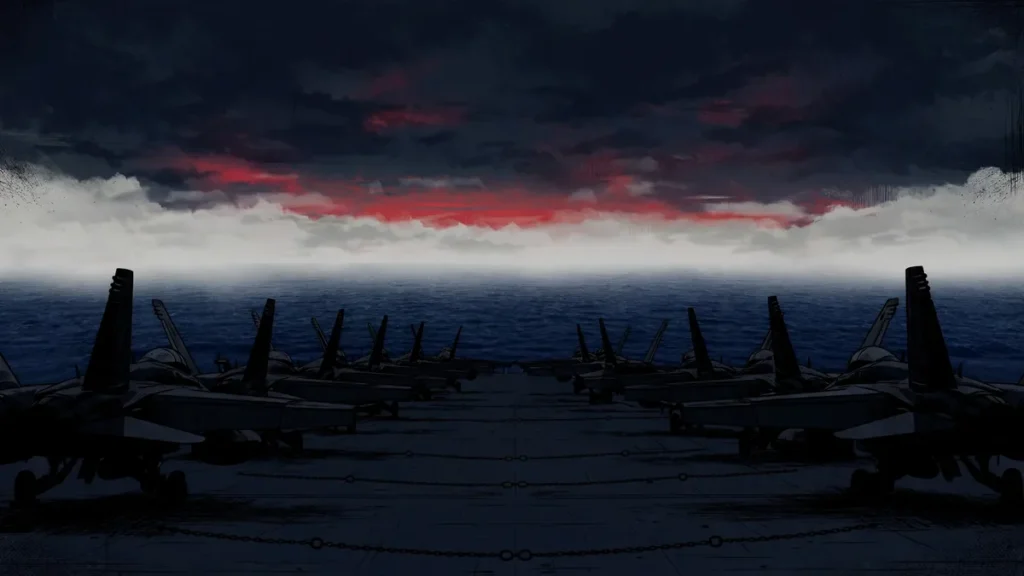
ISW identified two main concentrations. The first consists of four task forces from three PLA theatre commands operating between Taiwan and Guam, including the Liaoning carrier strike group, which moved to the Western Pacific via the Basilan Strait between October 23 and 26. The second includes at least six China Coast Guard vessels and an unspecified number of PLA Navy vessels surrounding Taiwan.
The air picture matches the scale at sea. Taiwan’s defence ministry detected 49 air sorties around Taiwan on November 2, and in the 24 hours to 6 a.m. on November 7 it detected 11 PLA aircraft sorties, 10 PLAN ships and three official ships, with nine of the 11 sorties crossing the Taiwan Strait median line into Taiwan’s northern and southwestern air defence identification zones.
Satellite imagery adds a further element. Imagery from November 2 detected the PLA Navy’s most advanced aircraft carrier, the Fujian, leaving its base in Sanya, Hainan, due east, possibly toward southern Taiwan, and at least three other major surface combatants left the base between October 26 and November 2. The scale of these deployments, ISW assessed, suggests the PLA is conducting a major exercise that simulates isolating Taiwan — greater in vessel numbers and geographic range than the PLA’s most recent exercise around Taiwan, Justice Mission 2025. Readers can compare with WarBrief Live’s earlier coverage of China’s Coast Guard patrols east of Taiwan and the October live-fire drills in five zones around the island.
Why has Beijing said nothing — and what does the silence signal?
The most striking feature of the deployment is the absence of an announcement. The PRC normally announces and names major exercises targeted against Taiwan, and has done so for the last four, ISW noted — yet at the time of its November 6 assessment Beijing had announced nothing.
ISW’s assessment is that the decision not to announce a major exercise “departs from recent precedent and may aim to create the impression that the PLA can isolate Taiwan at will.” The institute has separately assessed that the PRC aims to erode Taiwanese confidence in its own defence and in the willingness of the United States to come to its aid. That reading treats the silence itself as the message.
The timing sharpens the signal. The drills come ahead of the APEC summit in Shenzhen next week, where US President Donald Trump is expected to meet Chinese President Xi Jinping again, and ahead of Taiwan’s local elections at the end of this month.
What does this mean for US, UK and EU readers?
Area denial — anti-access/area denial, or A2AD — means keeping an outside force from intervening in a conflict. In the Taiwan context, it means stopping US or allied forces from coming to Taipei’s aid should Beijing attack. That is why a deployment of this size matters beyond the strait: it tests the credibility of the deterrent that underpins the security of the whole Western Pacific.
For European readers, the direct exposure is commercial rather than military. Sustained large-scale drills near Taiwan raise the risk premium on shipping through the region and add uncertainty to supply chains that already absorbed a year of disruption in the Red Sea and the Strait of Hormuz. For American readers, the question is sharper: whether the deployment changes the calculus in Washington about how quickly US forces could reach Taiwan in a crisis — the exact capability the drills appear designed to challenge. The WarBrief Live conflict zones hub carries the wider picture of the region’s flashpoints.
Assessment and outlook
The evidence supports a careful reading: a large, coordinated deployment consistent with an isolation exercise, confirmed in outline by Taiwan’s government and assessed in detail by ISW, but not formally declared by Beijing. The Fujian imagery remains the least certain element — satellite pictures show the carrier leaving Sanya, not its destination.
What to watch next: whether Beijing names the exercise or continues to call the activity routine training; whether the Fujian is confirmed operating near southern Taiwan; whether the deployment persists past the APEC summit; and whether the United States or its allies respond with their own visible naval movements in the Philippine Sea.
Frequently asked questions
What are area-denial drills?
Anti-access/area denial, or A2AD, is a military concept aimed at keeping an outside force from intervening in a conflict. In the Taiwan context, it means stopping US or allied forces from coming to Taipei’s aid should Beijing attack.
Has China announced these drills?
No. China has not formally declared any drills. Its defence ministry said last month that the Liaoning carrier’s training was an “annual routine” not directed at any particular country. Taiwan’s defence minister confirmed on November 10 that the drills are taking place.
Why does the timing matter?
The drills come ahead of the APEC summit in Shenzhen next week, where US President Donald Trump is expected to meet Chinese President Xi Jinping again, and ahead of Taiwan’s local elections at the end of this month.
Sources
- Reuters: Taiwan says China is conducting ‘area denial’ drills in Western Pacific
- Taipei Times: Taiwan says China is conducting area-denial drills in Western Pacific
- Taipei Times: PLA may be simulating Taiwan isolation: report
- Institute for the Study of War: China & Taiwan Update, November 6, 2026
- The Japan Times: Taiwan says China is conducting area-denial drills in the Western Pacific