
WarBrief Live | November 1, 2026 | Breaking Analysis
North Korea says it tested a cluster warhead for a tactical ballistic missile on October 31, 2026, and plans to field four warhead types by the end of the year. What investigators confirmed, and what remains only a claim from Pyongyang, is the distinction that matters.
At a glance
- Claimed area: 11.9 to 12.9 hectares for the Standard Type 2 warhead — Pyongyang’s figure, not independently verified.
- Warhead types: Four categories, for special and standard purposes, to be available to units by the end of 2026, according to KCNA.
- Test date: October 31, 2026, announced by KCNA on November 1, 2026.
- Reported missile: Hwasong-11Na (KN-24), identified by a Seoul analyst from photographs — not named by KCNA in the reports reviewed.
Key Takeaways
- North Korea’s state news agency, KCNA, reported on November 1, 2026 that its Missile Administration had tested a tactical ballistic missile cluster warhead the previous day to assess its combat applicability and destructive power.
- South Korea’s Joint Chiefs of Staff said they detected a missile fired on October 31 from the Jeongju area of North Pyongan Province toward the West Sea, and that South Korea and the United States had tracked related movements before the launch.
- The headline figure — a target area of 12 to 13 jongbo, or about 11.9 to 12.9 hectares — comes only from Pyongyang. No independent verification has been published, and KCNA did not disclose the missile’s flight distance, launch time or launch site.
- Seoul analyst Shin Jong-woo assessed the missile as the Hwasong-11Na (KN-24), often described as North Korea’s version of the US ATACMS. That identification rests on photograph analysis, not on a KCNA statement naming the missile.
- The test matters less as a single explosion than as a claimed step toward choice: four warhead types that commanders could select for different targets, with photographs pointing at the kind of hardened hangars and depots South Korea protects.
What did North Korea test on October 31?
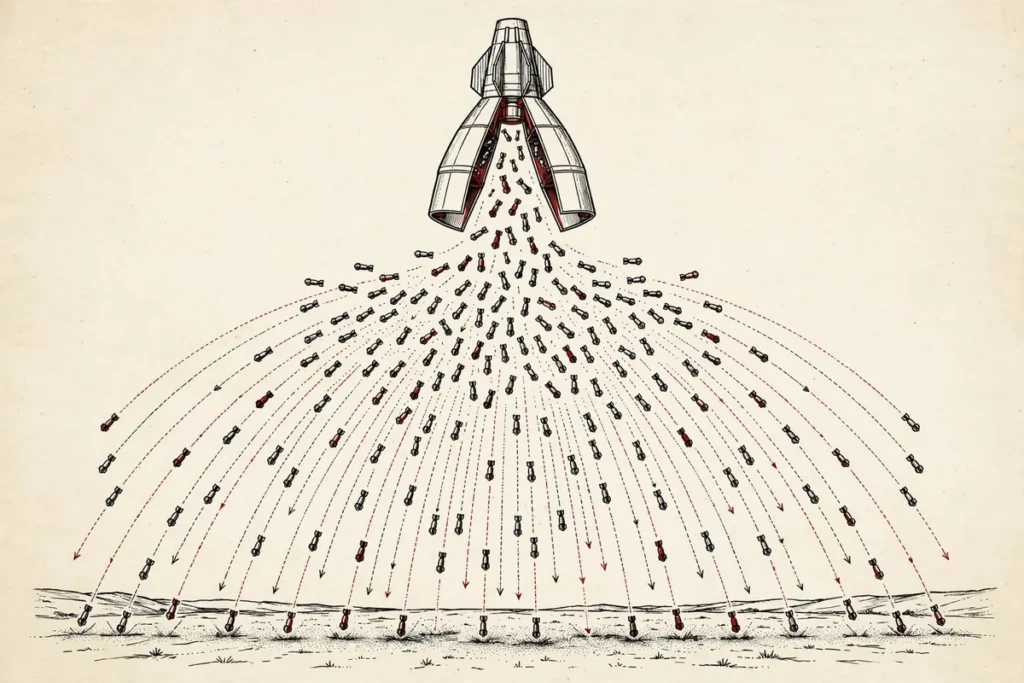
According to KCNA, as reported by Yonhap-derived coverage in The Korea Herald’s business edition, the test was carried out by the Missile Administration — described in some reports as the General Bureau of Missile Industry — to assess the combat applicability and destructive power of a tactical ballistic missile “scatter warhead”. In plain language, that is a cluster warhead: one warhead that opens in flight and disperses many smaller submunitions over a wide area, rather than striking a single point.
The test was overseen by Kim Jong-sik, first vice department director of the Central Committee of the Workers’ Party of Korea, according to Seoul Economic Daily’s Yonhap-based report. The Ballistic Missile System Institute and the Warhead Institute under the Missile Administration were the bodies that, in KCNA’s account, confirmed the result for the Standard Type 2 warhead. Kim Jong Un was not reported to have attended this test, a contrast with April 2026, when he watched a cluster-warhead test in person.
Photographs released with the KCNA report showed a missile launching from a mobile launcher, the warhead bursting in mid-air, and submunitions scattering and exploding across a target area. Malay Mail, carrying Agence France-Presse reporting, described one image showing multiple cluster impacts on an island target. Those photographs are the main public evidence for the test’s mechanics. They are also, by their nature, selected by the state that conducted the test: they show what Pyongyang chose to show, at the moment it chose to show it.
South Korea’s military response was measured and, in one respect, unusually quiet. The Joint Chiefs of Staff said they detected the missile fired from the Jeongju area toward the West Sea — the Yellow Sea — on October 31, but did not announce it that day. Instead, they announced the detection the following day, after analysing flight distance, altitude and other technical parameters. Yonhap-derived reporting notes that Japan’s Defence Ministry also made no announcement, consistent with a short-range, low-altitude flight flown at reduced range for a warhead test rather than a maximum-range demonstration.
What is a cluster warhead, and how does it work?
A cluster warhead trades a single large blast for coverage. The missile carries a container of submunitions; at a chosen point in flight, the warhead opens and the submunitions disperse, falling across an area rather than converging on one aim point. The military logic is straightforward: against a dispersed target — parked aircraft, vehicles in the open, troops, or a depot complex — a spread of smaller explosions can damage more of the target set than one unitary warhead of the same total weight.
That same spread is the reason cluster weapons are controversial. Submunitions that fail to explode on impact remain as unexploded ordnance, dangerous to anyone who later enters the area, including civilians and clearance teams. The 2008 Convention on Cluster Munitions was written precisely around that problem: it prohibits use, transfer, production and stockpiling by its parties. Its supporters argue that the area effect and the dud risk together make the weapon indiscriminate in practice, even when aimed at a military target.
It is important to be precise about who that prohibition binds. The Convention binds its 112 states parties. North Korea never joined it. Neither did South Korea or the United States, both of which are listed among the states that produce or have produced cluster munitions. The test is therefore not a breach of a treaty North Korea signed; it is a development inside a weapons category that a large part of the world has banned but the Korean peninsula’s two states have not.
Why does the Hwasong-11Na identification matter?
Shin Jong-woo, secretary-general of the Korea Defense and Security Forum, assessed the missile in the KCNA photographs as the Hwasong-11Na, known outside North Korea as KN-24. The Hwasong-11Na is a single-stage, solid-fuelled, short-range ballistic missile that outside analysts compare with the US Army Tactical Missile System, or ATACMS, because of its outward resemblance and its role: a mobile, road-launched weapon for striking targets at tactical depth, rather than a long-range strategic system.
Open-source assessments of the KN-24 family put its reported operational range at about 410 kilometres, with a payload in the region of 400 to 500 kilograms. Those figures describe the missile family in general, as reported in open sources; they are not measurements from the October 31 test, for which KCNA published no flight distance. The distinction matters, because a cluster warhead’s value depends on both halves of the system: a missile accurate and mobile enough to reach the target area, and a warhead that can then cover it.
Shin’s analysis also noted a first: a wheeled transporter-erector-launcher launch of the Hwasong-11Na combined with a cluster-munition test, disclosed for the first time. The wheeled launcher matters for survivability. A weapon that can move on roads, hide, and launch quickly is harder to find and strike before launch than a fixed site — and that, for South Korean and US planners, is part of the threat picture even before the warhead type is considered.
The identification itself should be read with the right weight. It is an analyst’s assessment from photographs, reported by Yonhap-derived outlets. KCNA’s own report, as carried in those outlets, did not name the missile. Treating the Hwasong-11Na label as confirmed by Pyongyang would overstate the evidence; treating it as a guess would understate it, since it comes from a named Seoul analyst working from the released imagery.
What is confirmed, and what remains unverified?
This is the section to return to if the headlines blur. The test itself is confirmed in the narrow sense that matters for a news report: KCNA announced it, and South Korea’s Joint Chiefs independently said they detected a missile launch on the same day from the same region. The launch happened. Everything about how well the warhead performed rests, so far, on a single source: the state that fired it.
| Metric | Figure | Source |
|---|---|---|
| Test date | October 31, 2026 (announced November 1) | CONFIRMED — KCNA announcement + South Korean detection |
| Launch area | Jeongju area, North Pyongan Province, toward the West Sea | CONFIRMED — South Korea’s Joint Chiefs of Staff |
| Claimed devastation area, Standard Type 2 | 12 to 13 jongbo (about 11.9 to 12.9 hectares) | REPORTED — KCNA claim only, not independently verified |
| Warhead types to be fielded | Four categories, by the end of 2026 | REPORTED — KCNA statement via Missile Administration director |
| Missile identification | Hwasong-11Na (KN-24) | ASSESSED — Shin Jong-woo, from photographs, not KCNA |
| Flight distance and launch time | Not disclosed | CONFIRMED AS UNDISCLOSED — KCNA report omits both |
Caveat: figures marked REPORTED or ASSESSED are single-source or analyst claims. They are not confirmed performance data, and the 11.9 to 12.9 hectare figure in particular should not be quoted as a measured fact.
Two absences in the KCNA report are themselves informative. First, the report was not carried in Rodong Sinmun, the Workers’ Party newspaper read by ordinary North Koreans, according to Yonhap-derived reporting. A test announced to the outside world but not trumpeted at home fits a pattern of signalling to Seoul and Washington rather than domestic mobilisation. Second, KCNA gave no flight distance or launch time, which is normal for a warhead-effects test flown at reduced range, but it also means outside analysts cannot independently reconstruct the trajectory from the public record.
Why are arched-roof targets drawing attention?
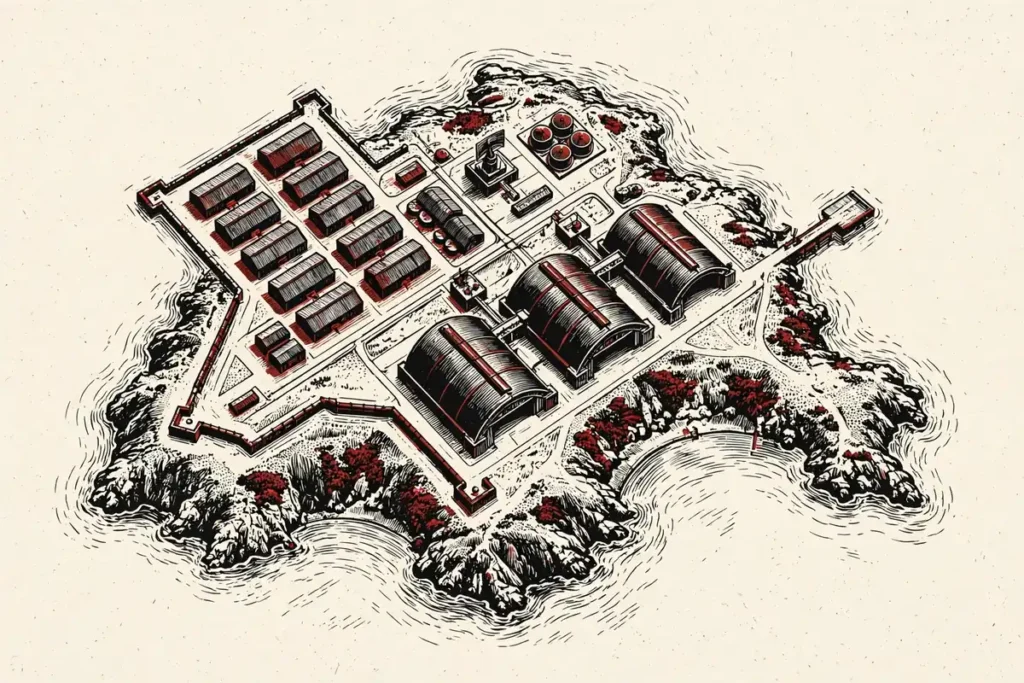
The most analytically interesting detail in the released photographs is not the explosion itself but the target. Shin Jong-woo assessed that the arched roof of the target building in the test was estimated to simulate a South Korean military facility. Seoul Economic Daily’s report put it more concretely: the photographs showed the destruction of structures believed to mimic South Korean military aircraft hangars and ammunition depots.
That reading, if correct, tells us what kind of war the warhead is designed for. A unitary warhead is efficient against a hardened point target. A cluster warhead is efficient against an area target: aircraft parked outside shelters, vehicles, fuel and ammunition stored across a depot, or personnel in the open. Hardened hangars with arched roofs are designed to resist blast and fragments; a test that models them is testing whether a spread of submunitions can defeat, bypass or overwhelm that protection by hitting roofs, entrances and exposed equipment around them.
None of this proves intent to strike a specific base. Test targets are chosen to demonstrate a capability, and analysts infer the intended target set from the shape of the mock-up. The honest formulation is: the photographs show a target that analysts assess as modelled on South Korean hangar and depot structures. That is a meaningful signal about the weapon’s intended role, and it is not the same as evidence of a planned attack.
What does this test mean for US, UK and EU readers?
For readers in the United States, the direct implication is alliance management. South Korea and the United States tracked the launch together before it happened, according to the Joint Chiefs, and maintained readiness. A cluster-capable tactical missile does not change the US-South Korea alliance’s posture overnight, but it adds a specific planning problem: protecting dispersed, high-value targets — airfields, depots and command nodes — against a weapon designed to saturate an area rather than hit a point. That is a defence-planning and missile-defence question, and it is one reason the test was tracked closely even though it was not announced on the day.
For UK and European readers, the implication is less direct but not abstract. North Korea’s missile programme is watched in Europe for two reasons: the precedent it sets for cluster weapons, and the programme’s links to Russia’s war in Ukraine. Open-source reporting has linked KN-24 missiles to Russian use in Ukraine, and North Korea’s own recent activity — including the October 29 salvo of about ten missiles and a drone exhibition — has been read in Seoul as a broader show of force. A new warhead option for a missile family already associated with that war is therefore relevant to European security debates, even though the October 31 test itself was a Korean peninsula event.
For travellers and markets, the honest answer is that this test, on its own, changes little in the short term. It was a test, not an attack; no airspace closure, shipping disruption or market move has been attributed to it in the reporting reviewed. The risk to watch is cumulative: a series of tests that, taken together, signal a faster move from demonstration to deployment, and any follow-up test that confirms the four warhead types are entering unit service.
Different perspectives: deterrence, defence and humanitarian concern
From Pyongyang’s perspective, as presented in KCNA’s own framing, the test is about combat applicability: proving that a warhead works, and that units will be able to choose among four types according to operational aims and target characteristics. That framing — choice, flexibility, fielding by the end of the year — is the language of a programme moving from testing to operations, and it is deliberately timed: the announcement came on November 1, a day after the test and amid a busy week of North Korean weapons activity.
From Seoul’s perspective, the response has been to demonstrate detection without escalation. The Joint Chiefs confirmed the launch a day later, emphasised prior tracking with the United States, and said precise analysis was still needed given the short range and low altitude. That is a familiar pattern: confirm the fact, withhold judgement on performance, and avoid giving Pyongyang either a propaganda victory or a crisis it can exploit.
From a humanitarian and arms-control perspective, the concern is not about this test’s target — an island range — but about the weapon category. Cluster munitions leave unexploded submunitions behind, and the Convention on Cluster Munitions exists because states that signed it judged that legacy risk unacceptable. North Korea, South Korea and the United States are all outside that Convention, which means the debate on the peninsula is not about treaty compliance. It is about whether a weapon that saturates an area can be used in a way that respects the distinction between military targets and civilians — a question that becomes acute if such a weapon were ever used near populated areas or airfields close to towns.
There is also a regional backdrop that should not be read as cause and effect. Malay Mail’s AFP-based report noted that the test came against the backdrop of growing tensions over a landmine explosion along the heavily fortified inter-Korean border that wounded three South Korean soldiers, which North Korea denied causing. The test and the border incident are separate events; linking them causally would go beyond the reporting. What they share is a deteriorating border atmosphere in which each side is signalling resolve.
What to watch next on the Korean peninsula
First, whether North Korea conducts follow-up tests. Seoul’s military authorities are monitoring for further tests and for signs that the warheads are moving toward full operational deployment, according to Herald reporting. A second test with a different warhead type, or a test that names the missile, would strengthen the claim that four types are genuinely entering service.
Second, whether the April precedent repeats. In April 2026, North Korea tested a cluster warhead on the Hwasong-11Ra, with Kim Jong Un in attendance. The October test used a different missile family member, if Shin’s identification is correct, and Kim was not reported present. The pattern to watch is whether cluster warheads spread across more of North Korea’s tactical missile inventory, or remain tied to one or two systems.
Third, the South Korean and US public response. The decision not to announce the launch on the day, and to announce detection the next day after analysis, suggests a deliberate communications posture. If a follow-up test is announced in real time, or if Seoul publishes its own assessment of the warhead’s performance, that would signal a shift in how the alliance wants the test to be read.
Fourth, the calendar. KCNA’s own deadline — four types available to units by the end of 2026 — gives the claim a falsifiable horizon of about two months. By early 2027, analysts will be able to judge whether the fielding claim was a programme milestone or an announcement timed for effect.
Read next: North Korea’s October 29 Missile Salvo: What It Signals · North Korea’s Drone Push: Kim’s Call for ‘Absolute Dominance’ · North Korea Hypersonic Missile Test, Explained · Conflict Zones hub
Frequently asked questions
What did North Korea test on October 31, 2026?
According to KCNA, a tactical ballistic missile cluster warhead, tested to assess its combat applicability and destructive power. South Korea’s Joint Chiefs confirmed they detected a missile launch that day from the Jeongju area toward the West Sea.
What is a cluster warhead?
A warhead that opens in flight and disperses many smaller submunitions over a wide area, instead of delivering a single explosion to one point. It is designed to damage dispersed targets such as parked aircraft, vehicles and depot complexes.
Can North Korea’s warhead really devastate 12 to 13 hectares?
That figure is Pyongyang’s claim for its Standard Type 2 warhead, not an independently verified measurement. KCNA did not publish flight distance, launch time or test data that would allow outside verification, so the figure should be quoted as a claim.
What is the Hwasong-11Na (KN-24)?
A North Korean single-stage, solid-fuelled short-range ballistic missile, often compared with the US ATACMS. Seoul analyst Shin Jong-woo assessed the October 31 missile as a Hwasong-11Na from photographs; KCNA did not name the missile in the reports reviewed.
Are cluster munitions banned?
The Convention on Cluster Munitions, in force since 2010, prohibits their use, transfer, production and stockpiling by its 112 states parties. North Korea, South Korea and the United States never joined the Convention, so the test is not a breach of that treaty by North Korea.
Sources
- The Korea Herald (Business): N. Korea unveils cluster warhead test, vows to deploy 4 warhead types by year’s end
- Seoul Economic Daily: North Korea Tests Cluster Warhead It Says Can Flatten 18 Soccer Fields
- Malay Mail (AFP): North Korea says its latest cluster bomb can devastate 13 hectares
- The Korea Times: N. Korea tests cluster bomb mountable on tactical ballistic missiles
- NoCut News: North cluster missile estimated as ‘Hwasong-11Na’
- Hwasong-11B (KN-24) — background on the missile family
- Convention on Cluster Munitions — parties and scope



Discussion 0
Share analysis, corrections, or context. Be civil — comments are moderated.