
WarBrief Live | October 9, 2026 | Indo-Pacific
On October 19, 2026, the United States and Japan will begin Keen Sword 27, the 18th iteration of their biennial joint field exercise — and this year’s edition carries a first that puts the Taiwan Strait’s fragile military balance back in the headlines. For the first time, US Marines will deploy the NMESIS anti-ship missile system on Yonaguni, Japan’s westernmost inhabited island, roughly 110 km from Taiwan, as part of a drill mobilising some 45,000 Japanese personnel alongside American forces and seven partner nations. This Keen Sword 27 exercise October 2026 preview matters because it publicly reveals how Washington and Tokyo now plan to fight in the island chains: small, mobile, unmanned missile teams scattered across remote islands rather than carrier groups parked in the open.
Key Takeaways
- Keen Sword 27 runs October 19–29, 2026, across Japan’s southwestern islands, with approximately 45,000 Japanese troops plus US forces and contingents from seven partner nations.
- US Marines will deploy the NMESIS anti-ship missile system on Yonaguni — about 110 km from Taiwan — for the first time, with a missile range covering Taiwan’s eastern approaches.
- Japan will field its new Type 25 long-range surface-to-ship missile (roughly 1,000 km range) in an exercise for the first time.
- This is a temporary training deployment, not a permanent basing decision; neither government has disclosed how many launchers will land on Yonaguni or whether any missile will be fired.
What is Keen Sword 27?
Keen Sword is the field-training phase of the US-Japan bilateral joint exercise series, held once every two years and counted among the largest American exercises with Japan. The 27th in the Keen series (and the 18th field-training iteration, in the numbering used by Japan’s Joint Staff) runs October 19–29, 2026, concentrated in Japan’s southwestern islands though spanning multiple maritime sectors.
Japan’s Joint Staff announced the exercise on September 29. It will commit approximately 45,000 personnel, 6,100 vehicles, 40 vessels and 260 aircraft — a scale that makes it one of the largest bilateral drills in the region this year. Exercise controllers are Admiral Tateki Tawara, commander of the JSDF Joint Operations Command, and Admiral Stephen Koehler, commander of the US Pacific Fleet. Alongside the two hosts, Australia, Canada, France, Germany, the Netherlands, New Zealand and the Philippines are participating, according to Defense War Room’s reporting.
Training events include integrated air and missile defence, bilateral joint offensive anti-ship operations, amphibious landings, island deployment and reinforcement, and live-fire drills. The emphasis on offensive anti-ship operations is itself notable: it signals the alliance is training for combined sea denial across the Yonaguni–Taiwan gap, not only for the static defence of Japanese islands. For context on how these drills fit into the wider regional flashpoint, see our conflict zones hub.
What is NMESIS, and why does Yonaguni matter?
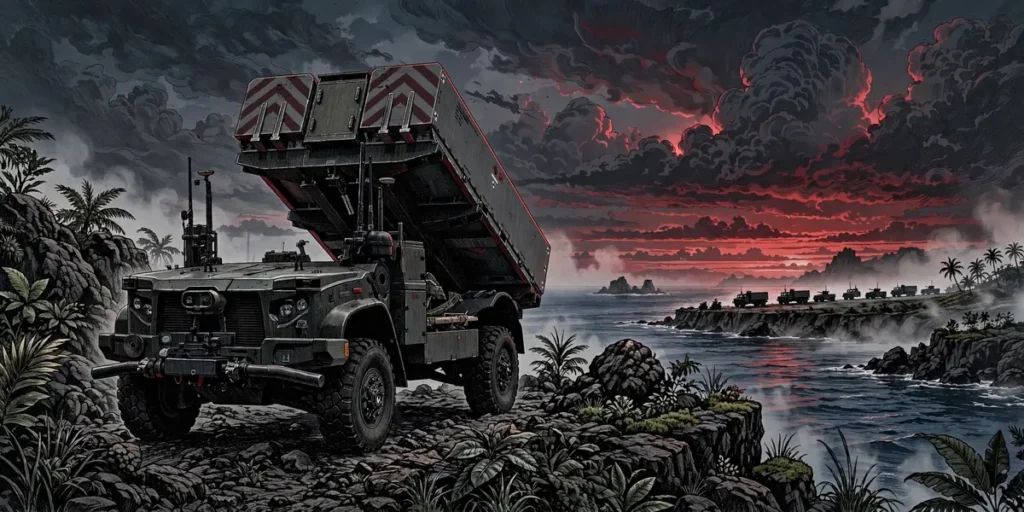
NMESIS — the Navy-Marine Expeditionary Ship Interdiction System — mates a remotely operated launcher called ROGUE-Fires, an uncrewed derivative of the Oshkosh Joint Light Tactical Vehicle, with two Naval Strike Missiles. The JLTV-based carrier has no crew cab and runs in teleoperated or leader-follower mode, so Marines can emplace, fire and displace the launcher without exposing a crew at the firing point — the core design answer to keeping island-based missiles alive inside an adversary’s weapons engagement zone.
The Naval Strike Missile (designated RGM-184A in US service, built by Norway’s Kongsberg with Raytheon) is a high-subsonic, sea-skimming cruise missile with publicly reported range beyond 185 km (about 115 miles) and a roughly 120–125 kg blast-fragmentation warhead. Its passive imaging-infrared seeker emits no radar energy, denying a target’s electronic-warfare sensors an early warning. The missiles are operated by the Okinawa-based 12th Marine Littoral Regiment, which formally received NMESIS and the Marine Air Defense Integrated System (MADIS) in June 2026; the Hawaii-based 3rd Marine Littoral Regiment fielded NMESIS first in late 2024 and took it to the Philippines’ northern Batanes Islands during Balikatan.
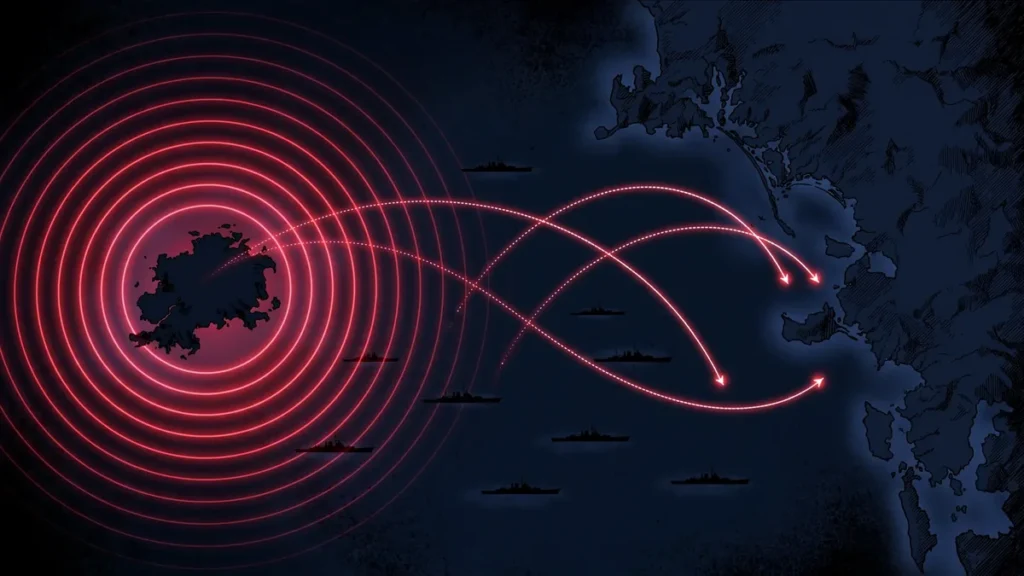
Yonaguni is what makes this deployment strategically pointed. Japan’s westernmost inhabited island sits about 110 km east of Taiwan — roughly 130 km closer than Ishigaki, where NMESIS appeared during the 2025 Resolute Dragon exercise without firing. That envelope, per Defense War Room, covers the full channel to Taiwan’s east coast and the passage toward Iriomote, waters a Chinese carrier has already transited. The JGSDF has stationed a coastal observation unit on Yonaguni since March 2016, and Japan’s Okinawa Defense Bureau said on October 2 that US and Japanese forces will establish a joint coordination centre at the island’s garrison during the exercise, with equipment moving through Yonaguni Airport and Kubura fishing port — a practical test of the transport routes needed to insert and sustain forces there.
Keen Sword 27 will also bring MADIS to Yonaguni for the first time, providing mobile short-range protection against drones, helicopters and low-flying aircraft — the principal vulnerability of dispersed missile teams. The concept is dispersion, concealment and displacement: small NMESIS elements move to temporary firing positions, receive targeting data from another part of the force, launch, and relocate before an opponent completes its own targeting cycle. Distributed across islands such as Yonaguni and Ishigaki, they could force hostile surface groups to account for missile threats from several directions simultaneously. For background on the grey-zone pressure these islands already face, read our piece on Taiwan’s coast guard as a second navy.
By the numbers: Keen Sword 27 at a glance
| Metric | Figure | Source | Status |
|---|---|---|---|
| Exercise dates | October 19–29, 2026 | Japan Times; Defense War Room | CONFIRMED |
| JSDF personnel committed | ~45,000 (plus 6,100 vehicles, 40 vessels, 260 aircraft) | Japan Joint Staff, September 29 | CONFIRMED |
| Yonaguni–Taiwan distance | ~110 km (68 miles) | Japan Times; Army Recognition | CONFIRMED |
| NMESIS missile range | Beyond 185 km (~115 miles) | Public specifications via Defense War Room | CONFIRMED |
| Japan Type 25 missile range | ~1,000 km | Press reports via Defense War Room | CONFIRMED |
| Participating nations | 9 (US, Japan + 7 partners) | Defense War Room | CONFIRMED |
| Number of NMESIS launchers on Yonaguni | Not disclosed | — | NOT DISCLOSED |
| Any missile to be fired during the exercise | Not announced | Defense War Room | UNCONFIRMED |
Caveat: figures marked CONFIRMED are stated by at least two sources. Items marked NOT DISCLOSED or UNCONFIRMED have no confirmed public figure; anything reported by a single source should be treated as REPORTED, not fact.
Why is the US putting missiles 110 km from Taiwan?
The short answer is sea denial along the First Island Chain — the arc of allied territory that could constrain Chinese naval operations in a Taiwan crisis. The slightly longer answer involves timing. As The Japan Times reported, US military hardware in the Asia-Pacific has been depleted by deployments to the Middle East for the war against Iran, including the aircraft carrier USS George Washington, which is usually based in Japan. Mobile, land-based fires that can be flown onto an island in days are a way to restore deterrence credibility without a carrier permanently on station — a shift our report on the USS Abraham Lincoln’s record deployment helps explain.
There is also a messaging layer. The Japan Times notes that Prime Minister Sanae Takaichi played up alliance strength after a recent summit with President Donald Trump in New York, even as Beijing presses her to retract earlier remarks suggesting Japan might mobilise militarily in any collective effort to defend Taiwan. Japan’s own contribution underscores the point: the Ground Self-Defense Force’s upgraded Type 12, now designated the Type 25 Surface-to-Ship Guided Missile, entered service at Camp Kengun on March 31, 2026 with roughly 1,000 km of range, and Keen Sword 27 would mark the first time Japan’s long-range stand-off missiles feature in an exercise. Army HIMARS will deploy to nearby Ishigaki, while the Army’s Typhon launcher is expected to move to Okinawa. Together, NMESIS on Yonaguni and the 25SSM on the main islands rehearse two layers of one anti-ship architecture: short-range mobile fires at the closest point to Taiwan, and a 1,000 km outer layer from Kyushu.
What could go wrong: the Beijing reaction and other risks
Beijing will almost certainly treat the Yonaguni deployment as a provocation aimed at it. A Chinese foreign ministry spokeswoman said last year that Japan’s plans to permanently station surface-to-air missiles on Yonaguni from 2030 would “create regional tension and provoke military confrontation,” and Chinese state media criticised last year’s move sending NMESIS to the Philippines for exercises, according to The Japan Times. Expect PLAN activity near Yonaguni and the Sakishima passages during the exercise window — Japan’s Joint Staff reported in September 2024 that the PLAN carrier Liaoning transited between Yonaguni and Iriomote, the first Chinese carrier confirmed in those waters.
There are domestic risks too. Japanese media reports anticipate local opposition to the continued missile presence on Yonaguni, a small island community hosting a growing garrison. And the operational concept has a genuine vulnerability: launchers that arrive for an 11-day exercise and leave impose a far lighter planning burden on the PLAN than launchers based forward year-round. Whether any NMESIS element stays in the Sakishima Islands after October 29 is one of the key indicators to watch. For a sense of how regional actors are arming in parallel, see our explainer on North Korea’s hypersonic missile test this month.
What this means for US/UK/EU readers
Keen Sword 27 is a military exercise, not an imminent conflict — but the geography it spotlights sits on top of your supply chains and savings. A large share of East Asia’s maritime trade passes the Taiwan Strait and its approaches; a genuine crisis there would spike shipping insurance, reroute LNG and container traffic, and jolt the semiconductor supply chain on which electronics and car industries depend. Exercises like this one are designed precisely to deter that scenario, and deterrence drills are normally priced in by markets rather than panicked over. That said, watch oil and freight rates around the October 19–29 window: if PLAN vessels shadow the exercise or Beijing stages a major counter-drill, energy desks will move first. Travellers should see no disruption to flights over the Ryukyus, but check advisories if tensions visibly escalate. This is educational context, not financial advice.
What to watch next
- Launcher count: how many NMESIS vehicles actually land on Yonaguni, and whether MADIS or Japanese air defences visibly cover the launch sites.
- The 25SSM: whether Japan’s new Type 25 conducts a live firing at Oyanohara in Kumamoto — that would be its operational debut.
- After October 29: whether any NMESIS element remains in the Sakishima Islands, or everything sails home.
- Beijing’s response: PLAN activity near Yonaguni, coast-guard patrols, and the tone of foreign-ministry statements during the exercise.
- Takaichi’s handling: how Japan’s prime minister balances alliance messaging with Chinese economic pressure.
Frequently asked questions
What is the Keen Sword 27 exercise?
Keen Sword 27 is the 18th field-training iteration of the US-Japan bilateral joint exercise series, running October 19–29, 2026. Japan’s Joint Staff has committed roughly 45,000 personnel, 6,100 vehicles, 40 vessels and 260 aircraft, with forces from the United States and seven partner nations training in integrated air and missile defence and joint offensive anti-ship operations across Japan’s southwestern islands.
What is NMESIS?
NMESIS — the Navy-Marine Expeditionary Ship Interdiction System — is an unmanned, JLTV-based mobile launcher carrying two Naval Strike Missiles (range beyond 185 km). Operated by the Okinawa-based 12th Marine Littoral Regiment, it is designed to let small Marine units threaten enemy ships from islands and then relocate before being targeted.
How close is Yonaguni to Taiwan, and what can NMESIS hit from there?
Yonaguni is about 110 km east of Taiwan, Japan’s closest point to the island. With a missile range beyond 185 km, an NMESIS battery on Yonaguni can cover the channel to Taiwan’s east coast and the passages through the southern Ryukyu Islands — waters Chinese warships have transited.
Is the United States permanently basing missiles on Yonaguni?
No. The deployment is for the 11-day exercise only, and neither government has said launchers will remain afterwards. The permanent garrison is Japanese: the JGSDF has held a coastal observation unit there since 2016, an electronic-warfare unit is reportedly slated to stand up in fiscal year 2026, and a Type 03 surface-to-air missile unit is planned by fiscal year 2030, according to Japanese media reports.
Why is China opposed to the deployment?
Beijing views US anti-ship missiles 110 km from Taiwan as preparation for intervention in a Taiwan crisis. A Chinese foreign ministry spokeswoman said Japan’s missile plans for Yonaguni would create tension and provoke confrontation, and Chinese state media previously criticised NMESIS deployments to the Philippines.
Sources
- The Japan Times: U.S. to put missile system on island near Taiwan for drills
- Defense War Room: US Marines Set First NMESIS Yonaguni Deployment Near Taiwan
- Army Recognition: US Marines Deploy NMESIS Anti-Ship Missile System on Japan Island Closest to Taiwan for First Time
- TaiwanPlus: US Moves ‘Ship-Killer’ Missiles Within 110KM of Taiwan
- Zona Militar: Japan will deploy 45,000 personnel and 260 aircraft to rehearse the defense of its islands alongside the U.S. Armed Forces


Discussion 0
Share analysis, corrections, or context. Be civil — comments are moderated.