
WarBrief Live | November 6, 2026 | International Security
20.9M
barrels of oil a day passed through the Strait of Hormuz in the first half of 2025 (EIA)
67%
fall in weekly Suez container transits after the Red Sea attacks began (UNCTAD)
3,500
miles of coastline patrolled by the Union blockade of the Confederacy, 1861–1865
33M
tonnes of grain shipped under the Black Sea Grain Initiative before it collapsed
A naval blockade works by placing warships — and sometimes mines — across a coast or strait so no vessel can enter or leave without being stopped, searched or turned back. It is armed force applied to trade, and under international law it counts as an act of war.
That legal weight is why blockades are rare, slow and expensive — and why they still matter. When shipping through the Strait of Hormuz is threatened, or the Red Sea becomes too dangerous for container ships, the world feels it at the petrol pump and the supermarket shelf within weeks. Blockades recur across the conflicts tracked on our conflict-zones hub. This explainer sets out how blockades are built, how they are enforced, what the law actually requires, and what history shows about whether they work.
Key Takeaways
- A blockade is physical. Warships, aircraft and mines stop vessels from moving. Sanctions and embargoes are legal and financial barriers, enforced by banks and customs — not by guns.
- For a blockade to be lawful it must be declared, notified to all states, actually effective, and applied impartially — and it must not be used to starve a civilian population.
- Enforcement follows a ladder: hail and query, visit and search, diversion or capture. Force against a merchant ship is lawful only if the vessel resists after a warning.
- Blockades rarely seal a coast completely. They work by raising the cost and risk of every voyage until trade withers — as the Black Sea grain corridor and the Red Sea diversions both show.
What is a naval blockade, exactly?
A naval blockade is a belligerent operation intended to prevent vessels of all nations from entering or leaving specified ports or coastal areas belonging to an enemy. The point is not to sink ships. It is to cut off the enemy’s trade, supplies and revenue until its war effort — and its economy — can no longer be sustained.
The distinction from other economic weapons matters. Sanctions are measures not involving armed force: asset freezes, trade bans and severed banking ties, authorised for the UN Security Council by Article 41 of the UN Charter. A blockade sits on the other side of that line. Article 42 of the Charter expressly lists “blockade” among the actions involving air, sea or land forces that the Council may authorise when non-force measures are inadequate. In plain terms: sanctions are coercive diplomacy, while a blockade is an act of war. We set out the full comparison in our companion explainer on naval blockade vs sanctions.
Blockades are also distinct from sieges. A siege aims to capture a defended place; a blockade aims to strangle movement, and it is usually directed at an entire country or region rather than a single fortress. And a blockade is not the same as closing a strait to your own shipping or laying mines in it — those are different acts with different legal consequences, as the Hormuz cases below show.
How is a blockade enforced: the visit, search and capture ladder
Enforcement is a sequence, not a single act. First comes the declaration: the blockading power must announce the blockade and notify all belligerent and neutral states, specifying when it starts, how long it lasts, where it applies and how far it extends, and the period within which neutral vessels may leave the blockaded coast. That is the requirement of paragraphs 93–94 of the San Remo Manual on International Law Applicable to Armed Conflicts at Sea, adopted in 1994 and the most widely used statement of the customary rules.
Then comes the picket line. Warships take station off the coast or at the chokepoint, supported today by maritime patrol aircraft, satellites, drones and AIS vessel tracking. A ship approaching the line is hailed and queried. If there are reasonable grounds to suspect it of carrying contraband or breaching the blockade, it is visited and searched — a boarding party goes aboard and inspects the cargo. A vessel found in breach can be diverted to a friendly port or captured as a prize. It may be attacked only if, after a prior warning, it intentionally and clearly refuses to stop or resists visit, search or capture. That is the rule in paragraph 67 of the San Remo Manual, and it is what keeps a blockade a policing operation at sea rather than open season on merchant shipping.
Neutral ships are not exempt. A blockade must be applied impartially to the vessels of all states, and neutral merchant vessels must submit to visit and search. What protects them is the procedure: they cannot lawfully be attacked merely for being present, and a blockade must not bar access to the ports and coasts of neutral states. Any cessation, temporary lifting or extension of a blockade must be declared and notified in the same way as its start.
Close, distant or loose: the three kinds of blockade
Not every blockade looks the same. Naval doctrine traditionally distinguishes three forms, and the choice between them is a trade-off between effectiveness and cost.
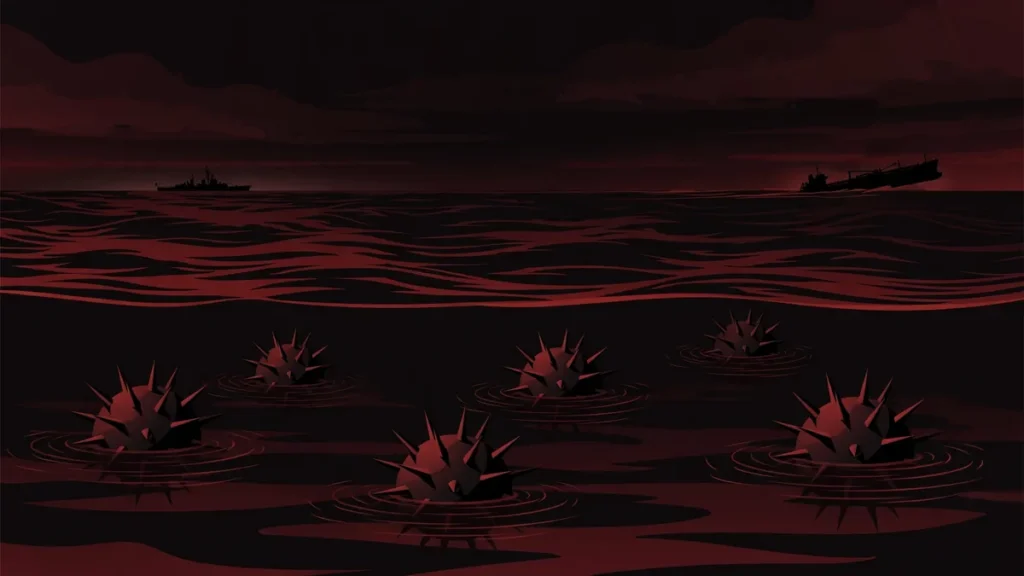
A close blockade places warships within sight of the blockaded coast, so that interception is immediate. It is the most effective form and the hardest to sustain: the blockading ships must remain continuously at sea, exposed to storms and to attack from the shore, usually far from any support. A distant blockade keeps the blockading force well away from the coast and intercepts shipping at chokepoints or along the sea lanes instead. It is cheaper and safer, but leakier — small, fast vessels can slip through. A loose blockade is a close blockade with the ships withdrawn just over the horizon, out of sight of the coast but close enough to strike: its purpose is to lure the enemy’s ships out and catch them at sea.
Modern technology has blurred these categories. A distant blockade enforced by satellite tracking, long-range patrol aircraft and sea mines can be tighter than a 19th-century close blockade ever was. But the legal test has not changed since the Declaration of Paris in 1856: a blockade, to be binding, must be effective — maintained, in the Declaration’s words, “by a force sufficient really to prevent access to the coast of the enemy.” The San Remo Manual repeats the point in paragraph 95: a blockade must be effective, and whether it is effective is a question of fact, not of declaration. A blockade declared on paper and never enforced is not a blockade at all.
What is the difference between a blockade and a quarantine?
Sometimes the most important thing about a blockade is what it is called. In October 1962, President John F. Kennedy ordered a naval “quarantine” of Cuba after U-2 photographs revealed Soviet missile sites 90 miles from Florida. He deliberately avoided the word “blockade” because a blockade is legally an act of war — and his own Secretary of State, Dean Rusk, and Vice President Lyndon Johnson had both recently testified to Congress that a blockade of Cuba would be exactly that.
The quarantine was a narrower operation: American warships would stop Soviet vessels and turn back any carrying offensive weapons, while other shipping could pass. The legal adviser’s office framed it as a defensive measure that would not be an act of war, and the wording let the United States win the support of the Organization of American States. On October 23, 1962, Kennedy issued Proclamation 3504, “Interdiction of the Delivery of Offensive Weapons to Cuba,” and the quarantine line took effect the next day. Soviet ships turned back. The crisis ended on October 28, when Khrushchev agreed to dismantle the missiles, and the quarantine itself was lifted on November 20, 1962, once the Soviet IL-28 bombers had also been withdrawn. The US State Department’s own account records the episode as the closest the two superpowers came to nuclear war.
The lesson travels. Governments still reach for softer labels — “quarantine”, “interdiction”, “maritime exclusion zone” — when they want the effect of a blockade without its legal consequences. The San Remo Manual’s drafters anticipated this: the commentary records that the blockade rules apply to blockading actions regardless of the name a state gives them. What matters is what the warships do, not what the press release calls it.
How do mines turn a strait into a blockade?
Mines are the cheapest way to close a stretch of water. A minefield needs no warship on station, no boarding party and no declaration. It simply makes the water too dangerous to use — and the danger lasts long after the conflict that laid the mines has moved on.
The Strait of Hormuz shows the mechanism. Since October 2026, Iran’s Revolutionary Guard has claimed that tankers transiting the strait struck naval mines, and seven tankers have been reported damaged in mine incidents — claims that are reported, not independently confirmed. The United States is reported to maintain a naval counter-blockade on Iranian oil exports in parallel. Neither side has declared a formal blockade of the strait, yet the effect on shipping is blockade-like: vessels reroute, war-risk insurance premiums surge, and owners weigh whether a cargo is worth the transit. Our coverage of the Hormuz mine incidents tracks each claim as it is reported — and labels it as a claim, because attribution in a mine incident is genuinely hard to establish.
That ambiguity is the point. A mine is deniable in a way a warship is not. But mining a strait without declaration is not a lawful blockade: it creates a hazard to all shipping, including neutral shipping, without the notification, impartiality and humanitarian safeguards the law requires. It is one reason the Hormuz tanker campaign is tracked so closely by insurers, navies and energy markets alike — and why shadow-fleet tankers with switched-off transponders and falsified flags have become a fixture of the route.
What does international law actually require?
There is no single treaty on blockades. The rules are customary international law, restated most authoritatively in the San Remo Manual and in national law-of-war manuals. Five requirements recur in every serious treatment of the subject, including the Arctic Review’s survey of blockade law.
- Declaration and notification. The blockade must be declared and notified to all belligerent and neutral states, with its commencement, duration, location and extent specified.
- Effectiveness. It must be maintained by a force sufficient really to prevent access. Effectiveness is a question of fact.
- Impartiality. It must be applied impartially to the vessels of all states, and must not bar access to the ports and coasts of neutral states.
- No starvation. A blockade is prohibited if its sole purpose is to starve the civilian population, or if the expected civilian harm is excessive relative to the concrete military advantage.
- Humanitarian passage. If the civilian population is inadequately supplied with food or other essentials, the blockading power must allow free passage of those supplies, and must allow the passage of medical supplies.
Outside wartime, a different tool applies. Under Article 25(3) of the UN Convention on the Law of the Sea, a coastal state may temporarily suspend innocent passage in specified areas of its territorial sea if essential for its security — a peacetime power, not a blockade, and one that must be non-discriminatory and time-limited. Israel’s naval blockade of Gaza, in place since 2007, is the most prominent modern example of a declared, long-running blockade, and its legality has been contested in courts, at the United Nations and in the press ever since — a reminder that the law of blockade is argued as much as it is applied.
Three blockades that show how it works
The Union blockade, 1861–1865. President Abraham Lincoln proclaimed the blockade of Confederate ports on April 19, 1861. It had to cover 3,500 miles of Atlantic and Gulf coastline, including 180 possible ports of entry and 12 major ports. The Union Navy began with 42 ships in active service and only three suitable for blockade duty; by the end of the war it had commissioned around 500. Union ships destroyed or captured about 1,500 blockade runners over four years, out of roughly 8,000 blockade-running trips. Early on, only about one in ten attempts was intercepted; by 1864 the figure was one in three. Most runners still got through — yet the blockade worked, because the small, fast ships that could evade it carried only a fraction of the cotton and supplies the Confederacy needed. The measure of a blockade is not the ships it catches. It is the trade that never sails.
The Black Sea, 2022–2023. Russia blockaded Ukraine’s Black Sea ports from the start of its full-scale invasion in February 2022, cutting off the route that carried the great majority of Ukraine’s grain exports. The UN-brokered Black Sea Grain Initiative, signed in July 2022, reopened three ports for a restricted list of agricultural goods and shipped about 33 million tonnes before Russia withdrew on July 17, 2023. Ukraine answered by announcing its own temporary corridor on August 10, 2023, hugging the territorial waters of Romania, Bulgaria and Türkiye, and backing it with naval drones that pushed Russia’s Black Sea Fleet back from the route. The corridor worked: by July 2026 it carried around 80 per cent of Ukraine’s grain, oilseed and related exports, according to European Commission figures, even as Russian attacks on Odesa’s ports continued. The lesson is that a blockade can be defeated without a fleet — by a corridor through friendly waters, and by weapons that make the blockader’s own ships unsafe.
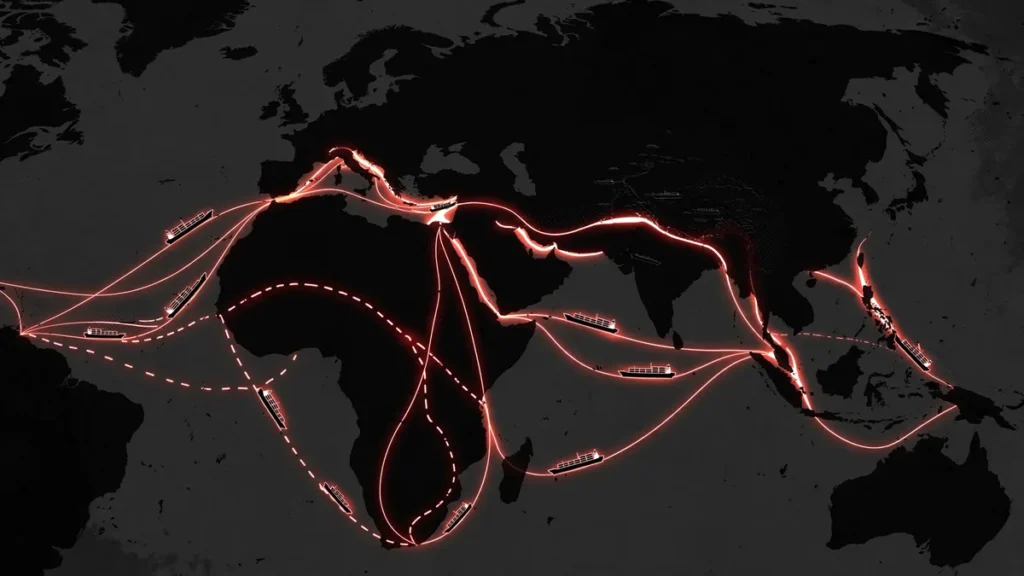
The Red Sea, 2023–2024. No blockade was ever declared in the Red Sea. From November 2023, Houthi forces in Yemen attacked commercial vessels in the Bab el-Mandeb strait, and the effect was indistinguishable from one. Weekly container-ship transits through the Suez Canal fell 67 per cent from peak levels, and overall canal traffic fell 42 per cent, according to the UN Conference on Trade and Development. Container spot rates from Shanghai to Europe rose 256 per cent in the first weeks of the crisis. Shipping lines diverted around the Cape of Good Hope, adding roughly ten days to two weeks to Asia–Europe voyages and pushing up fuel use and emissions. A non-state actor with drones and missiles had imposed blockade costs on the world’s busiest trade artery without a single warship on station.
By the numbers
| Metric | Figure | Source | Status |
|---|---|---|---|
| Oil flows through the Strait of Hormuz, first half of 2025 | 20.9 million barrels/day | US Energy Information Administration | CONFIRMED |
| Share of world petroleum liquids consumption via Hormuz | About 20% | US Energy Information Administration | CONFIRMED |
| Fall in weekly Suez container transits after Red Sea attacks | 67% from peak | UNCTAD | CONFIRMED |
| Grain shipped under the Black Sea Grain Initiative | About 33 million tonnes | United Nations | CONFIRMED |
| Ukraine grain exports via its Black Sea corridor, July 2026 | About 80% | European Commission | CONFIRMED |
| Union blockade coastline, 1861–1865 | 3,500 miles | Historical record | CONFIRMED |
| Blockade runners captured or destroyed, 1861–1865 | About 1,500 | Historical record | CONFIRMED |
| Tankers reported damaged by mines in Hormuz since October 2026 | Seven | Iranian claims in press reports | REPORTED |
Figures marked CONFIRMED rest on two or more independent sources; the REPORTED figure rests on a single claimant and has not been independently verified.
What a blocked strait means for US/UK/EU readers
Blockades feel distant until they reach a household bill, and they reach it through three channels. The first is fuel. About 20.9 million barrels of oil a day passed through the Strait of Hormuz in the first half of 2025, roughly a fifth of world petroleum liquids consumption, according to the US Energy Information Administration — and a credible threat to the strait pushes crude prices up within hours, feeding through to petrol, diesel and heating costs in the US, the UK and the EU. The second is food. When the Black Sea was blocked, wheat prices spiked worldwide; Ukraine’s grain corridor exists precisely because bread prices in importing countries depend on it. The third is goods: Red Sea diversions added roughly ten days to two weeks to Asia–Europe voyages, and the extra fuel, charter time and insurance showed up in the price of everything shipped in a container.
There are also second-order effects worth watching. A blocked strait raises war-risk insurance premiums, which shipowners pass on as surcharges. It pushes governments to build bypasses — pipelines around Hormuz, rail around the Black Sea — that take years and billions to deliver. And it changes where navies deploy: South Korea’s decision to extend its Cheonghae anti-piracy mission toward Hormuz, covered in our report on the Cheonghae deployment, is a direct answer to a strait under threat. For readers, the practical signals are simple: watch crude prices, watch container freight rates, and watch whether insurers are still willing to cover the route.
Why blockades often fail — and when they work
Most blockades leak. The Union Navy caught perhaps one in three runners by 1864 and still never sealed the Confederate coast. Ukraine broke the Black Sea blockade with a corridor and drones. Shipping lines simply went around the Red Sea. The reasons recur: coasts are long, ships are fast, neutrals resent being stopped, and the blockader’s own warships are tied down, burning fuel and exposed to attack, for as long as the blockade lasts.
What makes a blockade work is not a perfect seal but cumulative pressure over time. A blockade is a slow weapon: it takes months to empty warehouses, drain foreign reserves and break the will to keep fighting. It works best when the target has no alternative route, no friendly neighbour willing to transship, and no way to replace what the sea used to bring. It fails when the target finds a corridor, a pipeline, a new supplier — or when the blockader’s own costs, legal exposure and diplomatic friction exceed the gain. That is why the question to ask of any blockade is never “is the coast sealed?” It is “how much trade is still moving, at what price, and for how much longer can the target afford it?”
Read next: our companion explainer on naval blockade vs sanctions, the Hormuz mine incidents and what a shadow fleet is.
Frequently asked questions
What is a naval blockade in simple terms?
A naval blockade is when a country at war uses warships — and sometimes aircraft or mines — to stop ships from entering or leaving an enemy’s ports or coast. Its aim is to cut off the enemy’s trade, supplies and income until it can no longer sustain its war effort.
Is a naval blockade an act of war?
Yes. Under international law a blockade is an act of war, which is why governments are careful about the word. In the Cuban Missile Crisis of 1962, President Kennedy called the US operation a “quarantine” precisely to avoid declaring a blockade, since his own officials had testified that a blockade would be an act of war.
What is the difference between a blockade and a quarantine?
A blockade stops all shipping to and from a coast and is an act of war. A quarantine, as used in 1962, was a narrower operation that stopped only ships carrying offensive weapons. The label is political; under the San Remo Manual, the blockade rules apply to blockading actions regardless of what a government calls them.
Can a blockade stop neutral ships?
Yes. A blockade must be applied impartially to the vessels of all states, and neutral merchant ships must submit to visit and search. A neutral ship can be captured if it breaches the blockade, and attacked only if it refuses to stop or resists after a warning. A blockade must not, however, bar access to the ports and coasts of neutral states.
How long can a blockade last?
As long as the armed conflict lasts and the blockade remains effective. The blockading power must declare any cessation, temporary lifting or extension in the same way it declared the blockade itself, and must lift it when the conflict ends or the blockade can no longer be enforced.
Sources
- US Department of State, Office of the Historian: The Cuban Missile Crisis, October 1962
- San Remo Manual on International Law Applicable to Armed Conflicts at Sea, 12 June 1994
- Arctic Review of Law and Politics: Naval Blockade
- The National: Shipping transits through Suez Canal plunge 42% amid Houthi attacks (UNCTAD)
- Ports Europe: Ukraine’s Black Sea corridor now carries most grain exports, EU data shows
- Bernama: Gulf States Dominate Strait of Hormuz Oil Traffic (EIA data)
- Union blockade, American Civil War (historical record)


Discussion 0
Share analysis, corrections, or context. Be civil — comments are moderated.