
WarBrief Live | November 15, 2026 | Geopolitics
More than 20 heads of state and government will meet in Berlin on Thursday, November 19, 2026, for a Coalition of the Willing summit on Ukraine. German Chancellor Friedrich Merz, who is hosting the meeting at the Federal Chancellery, has set two goals: agree funding for Ukraine’s defence in 2027, and settle a common European position ahead of future peace talks with Russia.
Key Takeaways
- More than 20 leaders are expected in Berlin on November 19, 2026, hosted by Chancellor Friedrich Merz at the Federal Chancellery under the banner “United for Peace in Ukraine and European Security”.
- Two stated priorities: funding for Ukraine’s defence in 2027, and a unified position ahead of future peace talks with Russia. Postwar security guarantees and European representation in negotiations are also on the agenda.
- President Volodymyr Zelenskyy was invited by Merz on November 3 and wants a single European representative for peace talks named by the end of November — ideally in Berlin.
- The summit is an invitation to talk, not a decision: no troop deployment, no binding guarantee and no peace settlement will be agreed in advance. The test is whether Berlin produces concrete numbers and a joint declaration.
What is the Coalition of the Willing Berlin summit?
The Coalition of the Willing is the group of Ukraine’s supporters that coordinates military aid, post-ceasefire security guarantees and diplomacy, led in practice by France, Germany and the United Kingdom — the E3 format. WarBrief’s intelligence hub tracks the coalition’s meetings and the wider diplomacy around the war. Its members set out a framework for possible future guarantees in a declaration issued in Paris on January 6, 2026, and have met repeatedly since, most recently on the sidelines of the European Political Community summit in Dublin on November 12.
Merz announced the Berlin meeting on November 3, 2026, at a joint press conference with Zelenskyy in the German capital, and has described it as the moment the coalition moves from discussion to decisions on the scale of support for 2027. The German government says the meeting will address diplomatic coordination, possible postwar security guarantees for Ukraine and continued assistance to Kyiv. French President Emmanuel Macron and British Prime Minister Andy Burnham are expected to attend, along with Italian Prime Minister Giorgia Meloni, and more than 20 heads of state and government have been invited. EU High Representative Kaja Kallas will attend as an institutional representative, and Merz has said Italy and Poland are involved in the coordination as well.
Zelenskyy was invited by Merz at the November 3 press conference and publicly thanked the Chancellor for the invitation. His attendance matters because the summit’s second priority — a common position ahead of peace talks — only carries weight if Kyiv is in the room when it is set.
What will the Berlin summit decide on November 19?
Merz spelled out the agenda in Dublin on Friday, November 13. Speaking to journalists, he said: “We will gather in Berlin with more than 20 heads of state and government from the coalition. We want to achieve two things: first, funding for Ukraine’s defense for the coming year, 2027; and second, to once again establish a unified position on future peace negotiations.” He added that the meeting would also address European representation in future negotiations aimed at ending the war.
The funding question is the concrete deliverable. Merz has said the leaders will agree on the scale of continued assistance in 2027, primarily military support, and has pointed to a NATO agreement on €70 billion in military assistance for Ukraine in 2026 while urging partners to fulfil their commitments. What Berlin has not published in advance is any figure for 2027 — that number, if one emerges, will be the summit’s headline result.
The second priority, a unified position, is the harder one. The coalition must agree what it would accept in a settlement, what guarantees it is prepared to offer once a ceasefire holds, and who speaks for Europe when talks with Russia resume. Merz has said he sees no need to open an institutional debate about a new format at this stage, arguing that the E3 arrangement, with Italy and Poland involved, has proved effective.
What the summit will not do is equally important. The German government’s announcement is an invitation to talks, not an agreement on deploying troops or a completed peace settlement. No binding guarantee will enter into force in Berlin, and no deployment will be authorised there. The Paris framework for guarantees is conditional on a ceasefire, and the operational and legal details — force size, composition, duration, rules of engagement, parliamentary approvals — remain unresolved.
| Metric | Figure | Source | Status |
|---|---|---|---|
| Leaders expected in Berlin, November 19 | More than 20 | Chancellor Merz, via Ukrinform, November 13 | CONFIRMED |
| NATO military assistance to Ukraine agreed for 2026 | €70 billion | Merz, cited by Nexus Europa | REPORTED |
| Leaders at the Dublin coordination meeting, November 12 | Around 20 | Ukrainian President’s Office, via The New Voice of Ukraine | CONFIRMED |
| Proposed guarantee elements in the Paris Declaration | Five | European Council, January 6, 2026 | CONFIRMED |
| Days from announcement (November 3) to summit (November 19) | 16 | Calendar | CONFIRMED |
Figures marked CONFIRMED are corroborated by two or more sources; REPORTED figures rest on a single attributed source and may change.
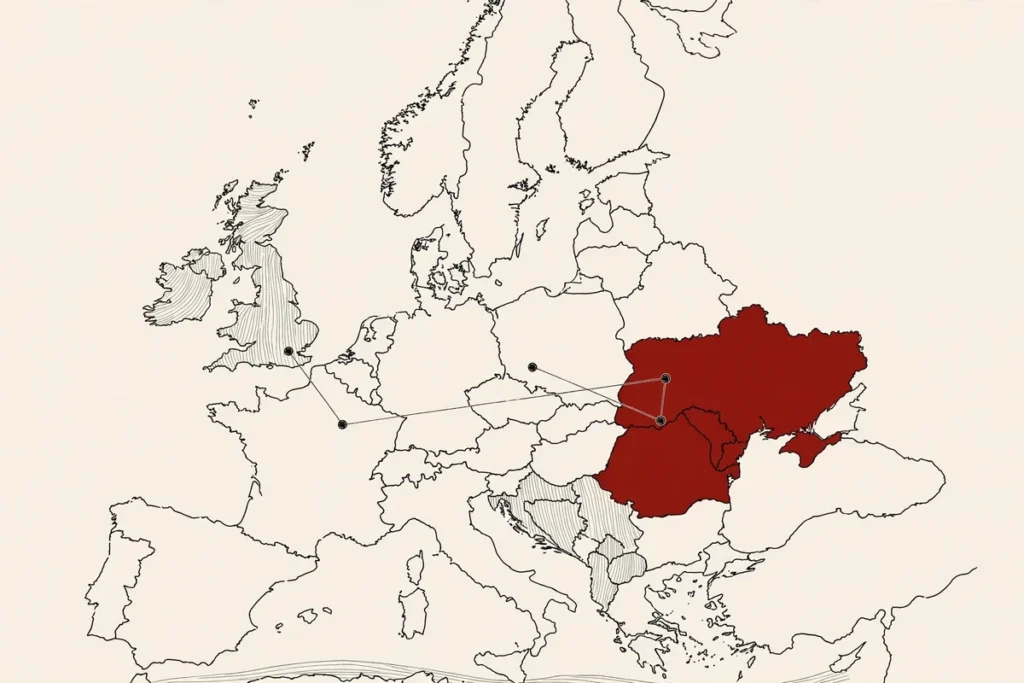
Background and timeline: from Paris to Dublin to Berlin
The Berlin summit is the latest step in a diplomatic sequence that has accelerated sharply since the start of November, as US-brokered contacts with Moscow resumed and European capitals moved to secure a seat at the table.
- January 6, 2026: The Coalition of the Willing, Ukraine and the United States issue the Paris Declaration, setting out five proposed elements of future security guarantees, conditional on a ceasefire entering into force.
- August 2026: The British House of Commons Library reports that key details of the proposed guarantees remain unresolved, including the force’s size, composition, capabilities, duration and rules of engagement.
- November 3, 2026: Merz announces the Berlin summit at a joint press conference with Zelenskyy in Berlin and invites the Ukrainian president to attend on November 19.
- November 10–11, 2026: US, Russian and Ukrainian delegations hold trilateral talks in Abu Dhabi, the first direct three-way encounter since February. The only tangible outcome is an agreement to prepare a large-scale prisoner exchange; no ceasefire text is published.
- November 11, 2026: Zelenskyy, speaking to reporters during a visit to Denmark, calls for a single European representative for peace talks to be agreed by the end of November, ideally at the Berlin summit on November 19.
- November 12, 2026: President Vladimir Putin receives US envoys Steve Witkoff and Jared Kushner in Moscow. The same day, Zelenskyy meets around 20 leaders on the sidelines of the European Political Community summit in Dublin — a meeting organised by Burnham — to discuss air-defence missiles, energy assistance and shelter construction.
- November 13, 2026: Merz, speaking in Dublin, outlines the summit’s two priorities. Italian Prime Minister Giorgia Meloni is confirmed to be travelling to Berlin for the meeting.
- November 19, 2026: Coalition of the Willing summit, Federal Chancellery, Berlin.
What security guarantees are actually on the table?
The guarantees under discussion are the five elements set out in the January 6 Paris Declaration: US-led monitoring and verification of a ceasefire; long-term support for Ukraine’s armed forces; potential multinational reassurance measures in the air, at sea and on land; arrangements to respond if Russia attacks again after a settlement; and closer cooperation on training, weapons production and intelligence. The declaration also envisaged a US–Ukraine–coalition coordination cell at the coalition’s Paris operational headquarters.
Two conditions limit what Berlin can promise. First, the guarantees as framed would take effect only once a ceasefire enters into force, and multinational reassurance measures would be deployed at Ukraine’s request only after a credible cessation of hostilities. Second, binding response commitments still have to be finalised, and no government has completed the legal approvals a deployment would require. A statement of common purpose in Berlin would not, on its own, resolve parliamentary or constitutional requirements in the participating states.
The guarantees debate is also running alongside a reported US proposal raised at Abu Dhabi — that Ukraine leave Donbas in return for NATO membership. WarBrief’s assessment of that proposal, published on November 15, treats it as REPORTED, based on Zelenskyy’s account, with the United States not having confirmed it. If the proposal is real, it raises the stakes in Berlin: the coalition would need to decide whether a NATO-for-territory exchange is acceptable, or whether its own guarantees framework is the alternative. For the background on how NATO consultation works in this context, see our explainer on Article 4.
Why the Berlin summit matters for Ukraine’s 2027 defence funding
Funding is where the summit either delivers or disappoints. Ukraine’s winter needs are immediate — air-defence missiles, F-16 ammunition and energy assistance dominated the Dublin discussions on November 12 — but the 2027 figure is what lets Kyiv and its defence industry plan beyond the next few months. Germany is among Kyiv’s most important military, financial and humanitarian supporters, and as host Merz carries the political weight of the announcement; a specific, jointly agreed number would signal that European support is budgeted, not merely rhetorical.
The risk is a summit that restates commitments without attaching figures. Merz himself framed the test in Dublin: the point of gathering more than 20 leaders is to agree the scale of assistance, not to repeat it. If Berlin ends with a declaration that reaffirms readiness to provide guarantees and support, but names no 2027 total and no timetable, it will read as process rather than progress — and it will leave the funding question to be fought again in national capitals and at the next EU budget round.
The funding decision also interacts with the diplomatic track. A funded 2027 strengthens Kyiv’s hand in any negotiation; an unfunded one weakens it. That is why the two priorities Merz named are linked rather than separate: money is leverage, and a common position without money behind it is a statement, not a strategy. Our report on how Europe secured a seat at the Ukraine talks, from Abu Dhabi to Dublin, sets out the diplomatic sequence that made Berlin necessary.
What the Berlin summit means for US, UK and EU readers
For readers in the United States, Berlin is a test of the transatlantic division of labour. Washington is running its own channel with Moscow through the Abu Dhabi talks and the Witkoff–Kushner mission, and Merz used his Dublin remarks to urge the United States to avoid surprising its European and Ukrainian partners. A Berlin outcome that names a European representative would give Washington a single counterpart; a summit that fails to do so leaves the US negotiating with a continent rather than a delegation.
For readers in the United Kingdom, the summit is a measure of Britain’s post-Brexit security role. Burnham co-hosts through the E3 format and organised the Dublin coordination meeting, and any reassurance force or monitoring arrangement would almost certainly involve British personnel. The funding figure also matters for the UK defence budget debate, since a European 2027 total sets the context for Britain’s own commitments.
For readers in the European Union, the stakes are the most direct: the 2027 funding total will feed into national budgets and EU defence-industrial planning, the guarantees question touches the security architecture of the continent, and the representation debate — whether Europe speaks through one envoy or through the E3 plus Italy and Poland — will shape how the EU is treated in any settlement. Energy markets will also watch the summit: a credible funding and guarantees package tends to steady European energy prices, while a summit that ends in visible disagreement would do the opposite. There is no direct travel disruption expected from the summit itself, beyond the usual security cordon around the Chancellery on November 19.
Different perspectives
Kyiv’s position is the most urgent. Zelenskyy wants funding secured, guarantees defined and a European representative named — and he has set a deadline, the end of November, with Berlin on November 19 as his preferred venue for the decision. Ukraine’s argument is that a settlement negotiated without Europe, or without a funded defence behind it, would not hold.
Berlin, Paris and London take a more sequenced view. Merz has argued that security guarantees should be addressed after a peace has first been achieved, and that the E3 format works well enough without a new institutional debate. The E3’s caution reflects the legal and parliamentary realities: no capital wants to promise a deployment it cannot authorise.
Rome has been the most publicly critical. Meloni has described the EU’s engagement with the peace talks as disorganised and has pressed for a special European envoy, writing to European Council President António Costa to demand one. Costa agreed to put the issue on the agenda of an informal summit in Dublin, which is why the representation question arrives in Berlin with real political momentum behind it.
Moscow is not a participant in the Berlin meeting, and its terms remain the central obstacle to any settlement. The Kremlin’s readout of the November 12 meeting with the US envoys restated Russia’s long-standing demands, and nothing in the public record suggests Moscow has softened its position on territory or on NATO. Washington, meanwhile, continues its own track: the Abu Dhabi channel produced a prisoner-exchange agreement in principle, and the reported NATO-for-Donbas proposal — still unconfirmed by the US — hangs over the Berlin discussions as an alternative framework the coalition has not endorsed.
What to watch next in Berlin on November 19
Five things will tell you whether the summit delivered. First, the 2027 funding figure: a specific total, with national shares, is the strongest possible outcome. Second, the joint declaration: whether it names concrete measures or repeats previous promises. Third, any language on security guarantees — whether the five Paris elements are reaffirmed, refined or left untouched. Fourth, the representation question: whether a European envoy or a named negotiating format emerges, or whether the issue is deferred to the informal Dublin summit. Fifth, the reaction from Kyiv and Washington in the hours afterwards, which will show whether Berlin’s position is treated as a basis for talks or as a European statement made in parallel to them.
WarBrief will cover the summit as it happens. Read next: our report on how Europe got a seat at the Ukraine talks, our analysis of what the Abu Dhabi talks actually agreed, and our explainer on NATO Article 4.
Frequently asked questions
What is the Coalition of the Willing Berlin summit?
It is a meeting of more than 20 heads of state and government from the Coalition of the Willing, the group of Ukraine’s supporters led by France, Germany and the United Kingdom, hosted by German Chancellor Friedrich Merz in Berlin on Thursday, November 19, 2026. The meeting is billed “United for Peace in Ukraine and European Security” and will discuss 2027 defence funding for Ukraine, a common position ahead of peace talks with Russia, postwar security guarantees and European representation in negotiations.
Who is attending the Berlin summit on November 19?
German Chancellor Friedrich Merz is hosting, with French President Emmanuel Macron and British Prime Minister Andy Burnham expected to attend, along with Italian Prime Minister Giorgia Meloni. President Volodymyr Zelenskyy was invited by Merz on November 3. EU High Representative Kaja Kallas will attend as an institutional representative, and more than 20 heads of state and government have been invited in total.
What are the two priorities for the Berlin summit?
Merz set them out in Dublin on November 13: first, funding for Ukraine’s defence in 2027; second, a unified position on future peace negotiations with Russia. The meeting will also address European representation in negotiations and postwar security guarantees for Ukraine.
Will the Berlin summit agree security guarantees for Ukraine?
No, not in any binding sense. The guarantees under discussion follow the five elements set out in the January 6, 2026 Paris Declaration and are conditional on a ceasefire entering into force. Berlin can reaffirm and refine that framework, but it cannot authorise a deployment or create a binding guarantee; force size, rules of engagement and legal approvals all remain unresolved.
How does the Berlin summit relate to the Abu Dhabi talks?
The Abu Dhabi talks on November 10–11, 2026 brought US, Russian and Ukrainian delegations together and produced an agreement in principle on a large-scale prisoner exchange, but no ceasefire text. Berlin is Europe’s response: a chance for Ukraine’s supporters to agree their own funding and negotiating position before the next round of talks with Russia, rather than learning the terms afterwards.
Sources
- Ukrinform: Merz outlines two key priorities for Coalition of the Willing summit in Berlin
- The Economic Times: Ukraine’s allies to meet in Berlin next week
- Free Malaysia Today: Ukraine’s allies to meet in Berlin next week
- La Presse: Meloni to travel to Berlin on Thursday for Coalition of the Willing meeting
- Interfax-Ukraine: Merz invites Zelenskyy to Berlin meeting of Coalition of the Willing on Nov 19
- The New Voice of Ukraine: Zelenskyy meets 20 world leaders in Dublin on Ukraine support
- Europäische Morgenpost: Merz calls Berlin summit on Ukraine guarantees for 19 November; commitments remain open

Discussion 0
Share analysis, corrections, or context. Be civil — comments are moderated.