
WarBrief Live | November 11, 2026 | Explainer
In December 1994, Ukraine gave up the world’s third-largest nuclear arsenal in exchange for written security assurances from Russia, the United States and the United Kingdom. The deal, signed in Budapest on December 5, 1994, is the Budapest Memorandum — and it is back at the centre of the debate over Ukraine’s future, as negotiators in Abu Dhabi discuss what security guarantees for Kyiv should look like this time.
Key Takeaways
- On December 5, 1994, Ukraine agreed to join the Nuclear Non-Proliferation Treaty as a non-nuclear-weapon state and transfer its inherited Soviet nuclear arsenal to Russia for dismantlement.
- In return, Russia, the United States and the United Kingdom promised to respect Ukraine’s sovereignty and borders, never to use force or economic coercion against it, and to seek United Nations Security Council action if Ukraine were attacked.
- The memorandum was a political agreement, not a treaty: it contained no enforcement mechanism and no promise that anyone would defend Ukraine militarily.
- Russia’s annexation of Crimea in 2014 and its full-scale invasion in 2022 are widely regarded as direct violations of the memorandum — which is why Kyiv now insists any new guarantees must be binding.
What is the Budapest Memorandum?
The Budapest Memorandum on Security Assurances is a set of three substantially identical political agreements signed on December 5, 1994, at the Conference on Security and Co-operation in Europe summit in Budapest, Hungary. The signatories were Ukraine, Russia, the United States and the United Kingdom. France and China gave separate, individual assurances in their own documents. The memorandum was registered with the United Nations as document A/49/765, and its full text is published in the United Nations Treaty Collection.
The deal was the endpoint of three years of difficult negotiation after the collapse of the Soviet Union. When the USSR dissolved in December 1991, Ukraine woke up holding, on paper, the world’s third-largest nuclear arsenal — Soviet weapons stationed on its territory. The question of what would happen to them dominated relations between Kyiv, Moscow and Washington for the next three years, and the memorandum was the answer the four governments settled on.
What did Ukraine give up in 1994?
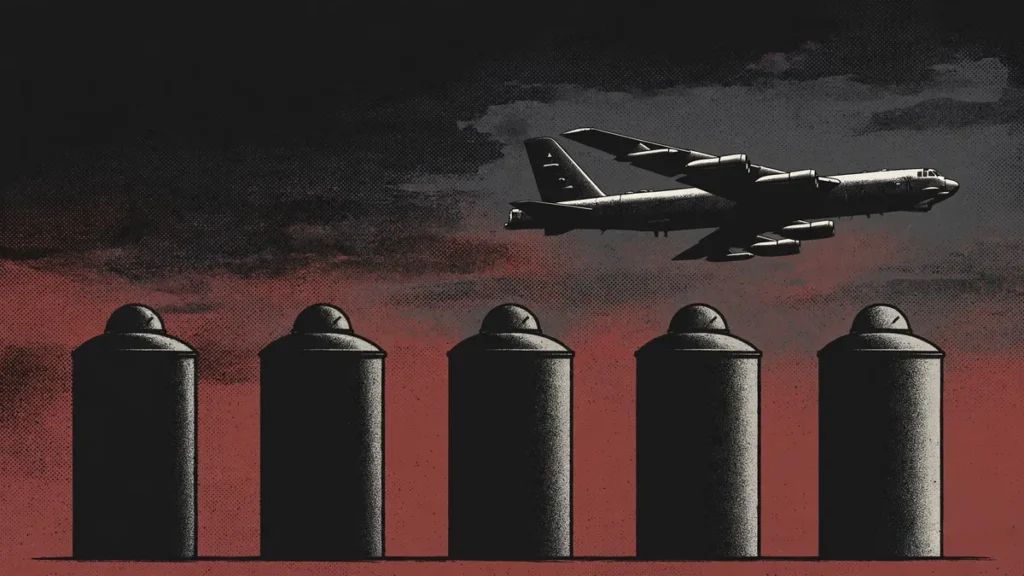
Ukraine’s inherited arsenal was enormous. According to the Belfer Center for Science and International Affairs at Harvard Kennedy School, Ukraine relinquished approximately 1,900 strategic nuclear warheads, 176 intercontinental ballistic missiles and 44 strategic bombers. The Nuclear Threat Initiative puts the number of tactical nuclear weapons at between about 2,650 and 4,200. The Encyclopedia of Ukraine confirms the figure of some 1,900 strategic warheads.
There is an important qualification that is often missed in retellings of this story: Ukraine never had operational control of these weapons. The launch codes stayed in Moscow, and the missiles could not have been fired from Kyiv. What Ukraine held was physical custody of a vast arsenal it could not independently use — and, in the view of Western governments at the time, a dangerous proliferation risk. By 1996, all of the warheads had been transferred to Russia, and Ukraine had completed its denuclearisation. The last strategic bomber was dismantled in May 2001.
The story has a bitter coda. A 2024 investigation by Radio Free Europe/Radio Liberty, comparing serial numbers in archives and aviation registries, concluded that at least six of the Tu-160 bombers Ukraine handed over in 1999 are in active Russian service today, and that Kh-55 cruise missiles from the same transfer have been used against Ukraine.
What did the memorandum promise in return?
The memorandum’s text is short — six numbered commitments — and its wording matters, because the gap between what it says and what people remember it saying is the heart of the argument about it. The full text, as filed with the United Nations, commits Russia, the United States and the United Kingdom to:
- Respect Ukraine’s independence, sovereignty and existing borders, in accordance with the principles of the CSCE Final Act.
- Refrain from the threat or use of force against Ukraine’s territorial integrity or political independence, and to ensure that none of their weapons would ever be used against Ukraine except in self-defence or in accordance with the Charter of the United Nations.
- Refrain from economic coercion designed to subordinate Ukraine’s sovereign rights to their own interest.
- Seek immediate United Nations Security Council action to assist Ukraine if it became the victim of an act of aggression, or the object of a threat of aggression, in which nuclear weapons were used.
- Not use nuclear weapons against any non-nuclear-weapon state party to the Non-Proliferation Treaty, except in the case of an attack on themselves, their allies or their forces by such a state in association or alliance with a nuclear-weapon state.
- Consult with one another if a situation arose that raised a question about these commitments.
Read carefully, the list promises restraint and a process — not protection. Nothing in the six points obliges the United States or the United Kingdom to come to Ukraine’s defence with armed force, and nothing sets out a penalty if a signatory breaks its word. As the Belfer Center’s history of the negotiations records, Ukraine’s leaders pushed hard for legally binding security guarantees, but the United States was unwilling to give them, and the negotiators drafted assurances instead.
Why did Ukraine agree to give up its nuclear weapons?
Ukraine did not surrender its arsenal in a single decision. The path ran through three steps, each trading disarmament for something Kyiv wanted at the time:
- May 1992 — the Lisbon Protocol: Ukraine, Belarus and Kazakhstan agreed to join the START I arms-reduction treaty and to accede to the Non-Proliferation Treaty as non-nuclear-weapon states as soon as possible.
- January 14, 1994 — the Trilateral Statement: signed in Moscow by the presidents of Ukraine, Russia and the United States, it committed Ukraine to eliminate all nuclear weapons from its territory within a specified period, in return for economic support and security assurances.
- December 5, 1994 — the Budapest Memorandum: signed alongside Ukraine’s formal accession to the Non-Proliferation Treaty, it recorded the assurances in writing.
Kyiv’s calculation was practical as well as diplomatic. Ukraine received enriched uranium for its nuclear power plants from Russia and economic assistance from the United States in exchange for the weapons. The arsenal was also a liability: maintaining it without Moscow’s codes, spare parts or command infrastructure was not a realistic option, and holding on to it would have left Ukraine isolated from Western finance and recognition at the moment of its independence. The memorandum was, in that sense, the price of becoming a recognised, non-nuclear state in good standing.
Not everyone in Kyiv was convinced. President Leonid Kuchma later remarked, after the deal was done: “If tomorrow Russia goes into Crimea, no one will raise an eyebrow.” The remark, recorded by Dr Jenny Mathers of Aberystwyth University in The Conversation, captured a fear inside the Ukrainian leadership that the assurances would prove worthless against the one signatory that mattered most.
Was the Budapest Memorandum legally binding?
This is the most argued question about the document, and the honest answer is that it depends on what “binding” is taken to mean. The memorandum was deliberately drafted as a political agreement rather than a treaty. It was not submitted to the United States Senate for ratification, and it contains no enforcement clause, no automatic military response and no specified consequences for violation. US officials later clarified that it did not extend to automatic military intervention.
That does not mean the document is legally meaningless. It was registered with the United Nations, its language uses the word “obligation” in the clause on the use of force, and the signatories reaffirmed the commitments in a joint Russian-American declaration in December 2009, after the START treaty expired. But as a practical matter, the memorandum gave Ukraine a right to complain and to demand consultations — not a right to expect allied troops. The distinction between “assurances” and “guarantees” is not pedantry: it is the difference between a promise not to attack and a promise to defend.
The debate has a human footnote. In 2023, former US president Bill Clinton, who signed the memorandum for the United States, publicly expressed regret at his role in it. He revealed that in 2011, Vladimir Putin had told him that Russia’s leaders did not consider themselves bound by the agreement.
How was the memorandum broken?
The first alleged breach came early. The Encyclopedia of Ukraine records that Russia first violated the memorandum in 2003, when it threatened to seize Tuzla Island in the Sea of Azov. The decisive breaches followed a decade later: Russia’s seizure and annexation of Crimea in 2014, its support for separatists in eastern Ukraine, and its full-scale invasion in February 2022. Each step contradicted the memorandum’s first two commitments — to respect Ukraine’s borders and to refrain from the threat or use of force against it.
Russia has argued in response that the memorandum was not a formal treaty and that the change of government in Kyiv in 2014 altered the situation. The text of the document does not condition its commitments on Ukraine’s internal politics or on its staying outside Western alliances, and the United States, the United Kingdom and most of the international community regard the annexation of Crimea and the 2022 invasion as violations. The European External Action Service has said the same.
The Western signatories’ response to the breach was not the military defence the memorandum never promised. Instead, the United States and its allies imposed sanctions, supplied weapons and intelligence, and — from 2023 onwards — began signing bilateral security agreements with Kyiv. According to then US Secretary of State Antony Blinken, by mid-May 2024 Ukraine had concluded or was negotiating such agreements with 32 countries, including Canada, the United Kingdom and the United States.
| Metric | Figure | Source |
|---|---|---|
| Strategic nuclear warheads given up | ~1,900 | Encyclopedia of Ukraine; Belfer Center |
| Intercontinental ballistic missiles | 176 | Belfer Center; Nuclear Threat Initiative |
| Strategic bombers | 44 | Belfer Center; Nuclear Threat Initiative |
| Tactical nuclear weapons | 2,650–4,200 (NTI estimate) | Nuclear Threat Initiative |
| Signatories to the memorandum | 4 — Ukraine, Russia, US, UK | UN document A/49/765 |
| Bilateral security agreements concluded or in negotiation (May 2024) | 32 countries | US State Department, via Encyclopedia of Ukraine |
Figures for warheads, missiles and bombers are the widely cited estimates from the Belfer Center and the Nuclear Threat Initiative; the tactical-weapons figure is an NTI range, not a precise count. The memorandum’s text is the primary source for the commitments themselves.
Why the memorandum is back at the centre of the Abu Dhabi talks
The Budapest Memorandum is not history. It is the document Kyiv’s negotiators measure every new proposal against — and the reason they insist that the next set of promises must be binding. On November 11, 2026, two days of US-mediated talks between Russian and Ukrainian delegations in Abu Dhabi concluded with agreement on a large exchange of prisoners of war but no major breakthrough on ending the war, according to the Associated Press. US envoys Jared Kushner and Steve Witkoff were due to travel to Moscow to meet President Vladimir Putin, and then to Dublin to meet President Volodymyr Zelenskyy.
The lesson Kyiv draws from 1994 is that assurances without enforcement invite the very aggression they are meant to deter. That is why the Ukrainian delegation has pressed for guarantees that would be written into law, backed by named countries, and enforceable in practice — rather than the political commitments of the memorandum. The draft peace plan currently under discussion, by contrast, offers only what Dr Mathers describes as a “bland assurance” that Ukraine would receive reliable security guarantees, while imposing a limit on the size of Ukraine’s armed forces, preventing it from joining NATO and banning the troops of NATO member states on its territory. The gap between those two positions — binding guarantees on one side, a restated assurance on the other — is the central unresolved question of the talks. Our coverage of the negotiations is in Abu Dhabi Ukraine Talks: Day One’s Outcome and Day Two’s Stakes and Europe Joins the Abu Dhabi Ukraine Talks: What Changed, Who Is Going.
What the Budapest Memorandum means for US/UK/EU readers
For readers in the United States, the United Kingdom and the European Union, the memorandum matters for three concrete reasons. First, it is the reason the security-guarantee debate is so difficult: the two Western signatories of 1994 are now the countries being asked to underwrite Ukraine’s security in a binding form, and their own record — assurances given, assurances broken, no enforcement — is part of the negotiation. Second, it shapes the non-proliferation argument that Western governments will make to other states: if giving up nuclear weapons is followed by invasion, the incentive for countries such as Iran or North Korea to disarm weakens, and the cost of future proliferation crises rises. Third, it is a live input into defence spending and alliance politics across Europe, where governments on NATO’s eastern flank cite the memorandum’s failure when arguing for larger forces, permanent allied deployments and binding commitments rather than declarations.
The memorandum also carries a warning for the talks themselves. A deal that repeats 1994’s formula — warm words, no enforcement — would not be a new guarantee at all. It would be the Budapest Memorandum a second time.
Read next: our conflict zones hub for the full picture of the war in Ukraine, and Abu Dhabi Ukraine Talks Open as Europe Watches from Outside for how the negotiations began.
Frequently asked questions
What is the Budapest Memorandum in simple terms?
In December 1994, Ukraine agreed to give up the Soviet nuclear weapons on its territory and join the Nuclear Non-Proliferation Treaty as a non-nuclear state. In exchange, Russia, the United States and the United Kingdom signed a memorandum promising to respect Ukraine’s sovereignty and borders, not to use force or economic coercion against it, and to seek United Nations Security Council action if Ukraine were attacked.
Did the Budapest Memorandum guarantee Ukraine’s security?
No. It offered security “assurances”, not guarantees. The text contains no promise that any signatory would defend Ukraine militarily and no enforcement mechanism. Ukraine’s leaders had pushed for legally binding guarantees, but the United States was unwilling to give them, so the negotiators drafted assurances instead.
Did Russia violate the Budapest Memorandum?
The United States, the United Kingdom and most of the international community regard Russia’s annexation of Crimea in 2014 and its full-scale invasion of Ukraine in 2022 as direct violations of the memorandum’s commitments to respect Ukraine’s borders and refrain from the use of force. Russia argues the document was not a formal treaty and that the 2014 change of government in Kyiv altered the situation; the memorandum’s text contains no such condition.
Why does the Budapest Memorandum matter now?
Because it is the yardstick for the security guarantees being negotiated for Ukraine today. Kyiv insists the next guarantees must be binding and enforceable, precisely because the 1994 assurances were neither — and were broken by one of their own signatories. The Abu Dhabi talks in November 2026 are, in part, a negotiation about how not to repeat Budapest.
Sources
- United Nations Treaty Collection: Memorandum on security assurances in connection with Ukraine’s accession to the Treaty on the Non-Proliferation of Nuclear Weapons (UN doc A/49/765)
- Belfer Center, Harvard Kennedy School: Budapest Memorandum at 25 — Between Past and Future (Budjeryn & Bunn, March 2020)
- Encyclopedia of Ukraine: Budapest Memorandum
- The Conversation (via Aberystwyth University): Dr Jenny Mathers on the Budapest Memorandum and security guarantees
- Associated Press (via NPR Illinois): Russia and Ukraine agree to a prisoner exchange as talks end with no big breakthrough (November 11, 2026)
- Wikisource: Ukraine Memorandum on Security Assurances (full text, UN doc A/49/765)
Discussion 0
Share analysis, corrections, or context. Be civil — comments are moderated.