
WarBrief Live | November 11, 2026 | Breaking Analysis
4+ hours
Day-one session length in Abu Dhabi
1,000 for 1,000
Prisoner-swap formula discussed
10 regions
Hit in overnight Russian strikes
3 rounds
Earlier trilateral rounds in Jan–Feb 2026
Day one of the Abu Dhabi Ukraine talks ended with no deal, no ceasefire and no joint statement — but with a ‘constructive’ verdict, a prisoner-exchange discussion and a Donbas-for-security question. Day two must decide if that is real progress.
The two-day session in Abu Dhabi, which opened on November 10, 2026, is the first trilateral meeting of Russian, Ukrainian and American negotiators since February. The Abu Dhabi Ukraine talks day two session on November 11 is the final scheduled day, and it carries the harder agenda: de-escalation steps on energy and the Black Sea, and the possibility of a meeting between the three leaders. What day one produced was narrower but not empty. The delegations talked for more than four hours, spent most of that time on the substance of security guarantees for Ukraine, and — according to President Volodymyr Zelenskyy — discussed a large prisoner exchange. They also confronted, directly, the question that has blocked every previous round: whether Ukraine could trade territory in the Donbas for guarantees that Russia will not attack again.
Key Takeaways
- Day one of the Abu Dhabi Ukraine talks (November 10) ran for more than four hours and ended with no joint statement, no ceasefire and no deal — but President Volodymyr Zelenskyy called it “constructive and quite substantive” and US Secretary of State Marco Rubio called it “productive”.
- The delegations discussed a large prisoner exchange on a 1,000-for-1,000 or 1,500-for-1,500 formula, and Zelenskyy said the Americans would carry that agenda to Moscow.
- The US side raised exchanging Donbas for security guarantees. Zelenskyy asked what those guarantees would actually be — NATO membership or something NATO-like — and said giving up Donbas would not stop Vladimir Putin.
- Day two, on November 11, is set to cover de-escalation steps on energy and the Black Sea, and possibly a leaders-level trilateral meeting — while the war continued overnight, with Russian strikes hitting five energy substations.
What happened on day one in Abu Dhabi?
The talks opened at around 06:30 GMT on November 10, Reuters reported, with the delegations meeting in private. The United States is represented by special envoy Steve Witkoff and Jared Kushner. Russia’s delegation is led by Kremlin aide Vladimir Medinsky, with Deputy Foreign Minister Sergei Ryabkov attending for the first time and senior military officer Yuri Zhigarlovsky also present. Ukraine’s team is headed by foreign intelligence chief Rustem Umerov, alongside presidential chief of staff Kyrylo Budanov, Davyd Arakhamia, Serhii Kyslytsia and Vadym Skibitskyi. Before the trilateral session, the American envoys met Ukrainian and European officials to discuss the peace process, and Witkoff said they had talked about building on existing European security institutions after the war.
The session lasted more than four hours, The National reported, and ended with no joint or separate statements. That silence is itself informative: neither side claimed a breakthrough, and no ceasefire or political agreement was announced. What the participants did say, afterwards, was consistent across all three delegations. Zelenskyy said the first day had been “constructive and quite substantive” and that the negotiators had “spoke in detail about the substance of security guarantees for Ukraine and the foundations for ensuring these guarantees function over the long term”. Rubio described the session as productive. A US official told The National: “I do believe that now we’re in a position where there is a shot at trying to make serious progress to end the war.”
The tone is a deliberate contrast with the last trilateral round in February, after which the process stalled for nine months. Kushner said the return to talks followed two months of “good discussions” with the Russian and Ukrainian leadership separately, and that good ideas had been raised on how to bridge the gaps. The UAE’s foreign minister, Sheikh Abdullah bin Zayed, welcomed the talks and said he hoped the two-day discussions would result in “practical steps” towards ending the war. The agenda, as set out by Umerov before the talks, was to end hostilities, secure reliable post-war security guarantees, ensure Ukraine’s economic recovery and advance humanitarian efforts. That is the same agenda day two inherits — with the hardest item, territory, still unresolved. Our day-one opening coverage sets out how the session was arranged; this article covers what it produced.
What is the Donbas-for-security trade?
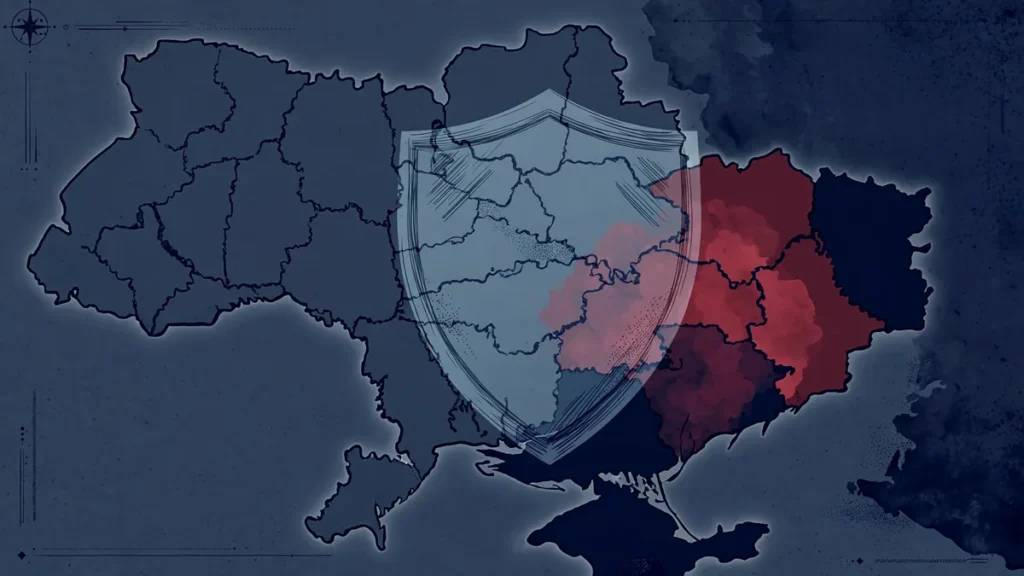
The Donbas-for-security trade is the idea that Ukraine would withdraw from territory in the Donbas — the eastern region Russia has demanded in full — in exchange for security guarantees designed to prevent another Russian invasion. It is the central question of the Abu Dhabi talks, and it is also the question on which the two sides are furthest apart in public.
A US official told Reuters before the talks that American negotiators believe Zelenskyy and Putin may each be willing to compromise on territory, “each ceding a little”. Under the proposed deal described to Reuters, Ukraine would get an end to the war, security guarantees and a roadmap to accession to the European Union. But a senior Ukrainian official strongly denied that the government would consider any such concessions, saying the issue of territory could be discussed only at a leaders’ level and only in the context of appropriate security guarantees for Ukraine.
Zelenskyy addressed the proposal directly on November 10, in an interview with DR Nyheder reported by Ukrinform. He said the American side had proposed exchanging Donbas for security guarantees, and that he had asked for clarification on what exactly those guarantees would entail — in particular, whether they would include NATO membership or a mechanism similar to the alliance. “Ceding Ukrainian land for peace is just abstract words,” he said. “I don’t believe that if we give up Donbas, Putin will stop. He’ll take a break, and then he’ll be back in a year, two, or five.”
The argument behind that answer is military as well as political. The Donbas contains the heavily fortified defensive lines Ukraine has held through four and a half years of full-scale war, and Zelenskyy has said Ukraine’s leverage in the talks is increasing because its forces have recently retaken some territory in Donetsk, while Russia is suffering heavy losses — a claim Moscow disputes. Reuters noted that Russian front-line advances have slowed to a virtual halt this year. Publicly, there has been no sign that Putin is willing to drop his insistence that Ukraine surrender the entire Donbas before a peace deal can be struck, and Zelenskyy has staunchly refused to hand over land his forces have died defending. That is why the trade, if it is ever agreed, can only be settled by the leaders themselves — a point both Kyiv and the American side now accept. Our preview of the talks set out the positions each side brought to Abu Dhabi.
By the numbers: day one in figures
| Metric | Figure | Source |
|---|---|---|
| Day-one session length | More than 4 hours | The National — CONFIRMED |
| Earlier trilateral rounds in 2026 | 3 (January–February; last in Geneva, February 18) | Outlook India — CONFIRMED |
| Ukrainian regions hit in overnight strikes | 10 | Ukrainian PM Serhii Koretskyi via The National — CONFIRMED |
| Energy substations hit overnight | 5 | Koretskyi via The National — CONFIRMED |
| Drones claimed intercepted, Leningrad region | 146 | Russian claim, reported by Al Jazeera — REPORTED |
| Prisoner-swap formula discussed | 1,000 for 1,000, or 1,500 for 1,500 | Zelenskyy, reported by APA — REPORTED |
Figures marked CONFIRMED appear in at least two reputable sources or in direct official statements. Figures marked REPORTED rest on a single source or on one party’s own claim and are attributed, not asserted as fact. Discussed is not agreed: no prisoner exchange, ceasefire or deal was announced on day one.
What day two must settle: energy, the Black Sea and a leaders’ meeting
Day two of the Abu Dhabi Ukraine talks has a defined agenda, and Zelenskyy set it out himself. “Tomorrow there will be more on de-escalation steps — energy, the Black Sea, and a trilateral meeting at the leaders’ level, if possible,” he said, according to APA. Each of those three items is a test of whether day one’s constructive tone can survive contact with the war itself.
Energy is the most urgent. On the night before the talks, Russia carried out attacks in 10 Ukrainian regions, hitting five major energy substations, Prime Minister Serhii Koretskyi said. A truce on striking energy targets announced by President Donald Trump last month quickly fell apart, Reuters reported, and the pattern since then has been escalation on both sides: Ukraine has stepped up strikes on Russian oil refineries in recent weeks, while Moscow has pounded Ukraine’s electricity infrastructure and cities. A de-escalation step on energy would be the first concrete relief for Ukrainian civilians heading into winter — and the first measurable test of whether either side will restrain itself while talking.
The Black Sea is the second test. Grain trade through the Black Sea has stalled because of drone attacks on ships and ports, and Turkish-led efforts to resume traffic have so far proven unsuccessful, The National reported. Wheat was trading at close to multi-month lows on November 10 as markets awaited the results of the talks. Kremlin spokesman Dmitry Peskov declined to say whether resuming shipping in the Black Sea would be on the agenda at all. No joint statement was issued on day one, and no grain-corridor deal was announced — despite claims of a breakthrough circulating in some online aggregators, which no major outlet confirmed. That gap between online claims and confirmed reporting is itself worth noting: the only verified position on the Black Sea is that it is on day two’s agenda, not that it has been settled.
The third item, a leaders-level meeting, is where the territory question would have to be settled. Both Kyiv and Washington now say territory can only be discussed by the leaders, and Zelenskyy raised the possibility of a trilateral meeting at that level as part of day two’s business. No follow-up round had been announced by the morning of November 11, and no date for a leaders’ meeting exists. If day two produces one — even a conditional one — that would be the clearest sign that the Abu Dhabi round has moved beyond process and into substance. For the wider context of the war these talks are trying to end, see our conflict zones hub.

Why a prisoner swap is the most likely early result
If the Abu Dhabi round produces anything concrete in the short term, it is most likely to be a prisoner exchange. Humanitarian issues were at the centre of day one alongside security guarantees: Zelenskyy confirmed the talks were addressing the exchange of prisoners and the return of children, and the UAE has previously helped negotiate the exchange of hundreds of prisoners. Kyrylo Budanov, the head of the presidential office, said considerable attention was planned for the humanitarian track, and that prisoner exchanges needed to be intensified.
Zelenskyy said the issue of a large-scale exchange was discussed in Abu Dhabi on the formula “1,000 for 1,000, perhaps 1,500 for 1,500”, APA reported, adding that “with this agenda, the Americans will go to Russia”. That wording matters. The exchange was discussed, not agreed — and the Americans, not the Russians, are carrying the proposal forward. Territory, by contrast, was raised by the Russians during the meeting, and Zelenskyy noted that it was a matter for the leaders. The split tells its own story: humanitarian steps are where the two sides can move without conceding their core positions, while territory is where neither side can move at all without a leaders’ decision.
That is why the prisoner discussion is the item to watch first when day two ends. A confirmed exchange — even a large one — would not end the war, and it would not resolve the Donbas question. But it would be the first verifiable deliverable of a process that has produced none in nine months, and it would give both capitals something concrete to show for returning to the table. If no exchange is announced, the round will be judged on the far harder question of whether the security-guarantee discussion produced anything that can be written down.
What the Abu Dhabi talks mean for US, UK and EU readers
For readers in the United States, Britain and Europe, the Abu Dhabi talks matter in three concrete ways: energy, food prices and European security.
On energy, the war’s direct costs are still being paid at home. Russia’s strikes on Ukrainian substations and Ukraine’s strikes on Russian refineries both feed into the energy markets that set heating and fuel prices in Europe, and the collapse of last month’s energy-targets truce removed the one restraint that had briefly limited that damage. A de-escalation step on energy in Abu Dhabi would be the first thing in weeks to point in the other direction. Sanctions on Russian energy remain in force alongside the military pressure, and neither side’s negotiating position assumes they will be lifted quickly.
On food, the Black Sea question reaches supermarket shelves. Ukraine is a major grain exporter, and the stalling of Black Sea grain trade has kept wheat markets watching every statement from Abu Dhabi — wheat was trading near multi-month lows on November 10 as traders awaited the outcome. A working shipping arrangement would ease pressure on global grain prices; a failure would leave the corridor dependent on the same drone-threatened routes that stalled it.
On security, the talks are about more than Ukraine. Trump has said the deal under discussion could be a big agreement involving all of Europe, and Rubio said before the talks that there had been “advances” in what Europe’s post-conflict security architecture could look like. G7 foreign ministers are discussing Ukraine in Paris this week, with Ukraine’s foreign minister Andrii Sybiha joining them. Europe has also become the main funder of Ukraine’s budget and military purchases since the United States slashed direct aid after Trump took office — which is why European governments insisted on a seat at the process, and why they held separate consultations with Kyiv on November 10 even though Russia does not want them in the room. Europe’s separate role in the talks is explained in our earlier coverage.
What is confirmed, and what is still unverified
What investigators and reporters have confirmed: the talks took place on November 10–11 in Abu Dhabi, the first trilateral round since February; the delegations and their leaders; a session of more than four hours on day one; security guarantees, de-escalation, humanitarian steps and the post-war economy on the agenda; no joint statement, ceasefire or deal announced on day one; Zelenskyy’s “constructive and quite substantive” verdict and Rubio’s “productive”; a prisoner-exchange discussion on a 1,000-for-1,000 or 1,500-for-1,500 formula; the US side raising a Donbas-for-security exchange and Zelenskyy rejecting the premise; and overnight Russian strikes on 10 Ukrainian regions including five energy substations.
What remains unverified or only reported: Russia’s claim that it intercepted 146 drones in the Leningrad region, reported by Al Jazeera as a Russian claim rather than a confirmed interception; the prisoner-exchange formula itself, which rests on Zelenskyy’s account of what was discussed rather than on an agreed text; claims in some online aggregators of a Black Sea grain-corridor revival, which no major outlet confirmed; and characterisations of White House “cautious optimism”, which secondary outlets have reported but which the substantive on-record version — a US official telling Reuters that both leaders may each cede a little territory — already covers more precisely. Arrest is not conviction, a claim is not a confirmation, and a discussion is not an agreement: those distinctions are the difference between reporting on these talks and repeating them.
How Moscow, Kyiv, Washington and Europe read day one
Moscow’s public line has not moved. Medinsky noted at the start of the talks that the Russian delegation “has become bigger and more professional”, and Russia continues to demand the entire Donbas, the withdrawal of Ukrainian forces from Donetsk, Luhansk, Zaporizhzhia and Kherson, a permanent bar on Ukrainian NATO membership and limits on Ukraine’s military. Foreign Minister Sergey Lavrov reaffirmed after the European consultations that Moscow would not agree to the EU’s demand for an immediate ceasefire, accusing the bloc of trying to buy time. The Russian position, in short, is that the talks are a venue to restate its terms, not to soften them.
Kyiv’s reading is that the talks are worth having because its leverage is growing. Zelenskyy said on the eve of the negotiations that Ukraine’s leverage was increasing as a result of its battlefield performance, including retaking some territory in Donetsk, and that Russia was suffering “record losses” — a claim Moscow disputes. At the same time, Kyiv has drawn a hard line: no deal without concrete security guarantees from the United States and other NATO allies, and no territorial concession decided below leaders’ level. The Donbas answer Zelenskyy gave on November 10 — that giving up the region would invite a renewed attack in a year, two or five — is the clearest statement of that line.
Washington’s reading is that a deal is closer than it has been in months. Trump said both sides were “tired of fighting” and showed a “very strong inclination” to find an end to the war, and he predicted after a private meeting with Russian envoy Kirill Dmitriev at the White House last week that a peace agreement could emerge soon. His envoys’ framing — “a shot at trying to make serious progress” — is more cautious than the president’s, but it is still the most optimistic American language about these talks since the process restarted. Diplomacy around the war has also run through the White House in other formats, including the recent White House meeting hosted by Melania Trump.
Europe’s reading is that it cannot be a bystander to a settlement about its own security. The EU said after the November 10 consultations that any arrangements must respect Ukrainian sovereignty, territorial integrity and independent decision-making, and provide Kyiv with credible security guarantees. France and other European countries have insisted that no lasting peace could be achieved without addressing European security, and that this required European involvement. Russia, meanwhile, has made it clear that it does not want the Europeans in the negotiations at all — which is why the European role in Abu Dhabi has run on a parallel track, with the Ukrainian delegation briefing its allies separately. That parallel track is likely to become the main argument after the round ends: whether a deal negotiated trilaterally can hold without the Europeans who would have to guarantee it.
What to watch next in Abu Dhabi
- Any statement at the end of day two: a joint statement, or even separate statements, would be the first formal output of the round. Day one produced none.
- A prisoner-exchange announcement: the 1,000-for-1,000 or 1,500-for-1,500 formula is the most likely concrete result. Watch for numbers, dates and whether the Americans’ trip to Moscow follows.
- Energy de-escalation: any agreement to stop striking energy infrastructure — or a fresh round of overnight strikes — will show whether the talks restrain the war or merely accompany it.
- The Black Sea: any shipping arrangement, or any confirmation that the subject was even discussed, after Peskov declined to say whether it was on the agenda.
- A leaders’ meeting: any signal of a Trump–Putin–Zelenskyy meeting, or a date for one, would be the round’s biggest outcome. Territory can only be settled at that level.
- Paris and the markets: the G7 foreign ministers’ discussion in Paris, and wheat and energy prices after the round ends, will show how seriously governments and markets take the result.
Frequently asked questions
What happened on day one of the Abu Dhabi talks?
The Russian, Ukrainian and American delegations met in Abu Dhabi on November 10, 2026, for more than four hours, in the first trilateral round since February. They discussed security guarantees for Ukraine, humanitarian steps including a large prisoner exchange, and the Donbas question. No joint statement, ceasefire or deal was announced. President Volodymyr Zelenskyy called the day “constructive and quite substantive” and US Secretary of State Marco Rubio called it “productive”.
What is the Donbas-for-security trade?
It is the idea that Ukraine would withdraw from territory in the Donbas in exchange for security guarantees against another Russian invasion. The US side raised the proposal, according to Zelenskyy, who asked what the guarantees would actually be — NATO membership or something NATO-like — and said giving up Donbas would not stop President Vladimir Putin. Russia demands the entire Donbas; Ukraine has refused to surrender land its forces have died defending.
Will there be a ceasefire after the Abu Dhabi talks?
No ceasefire was announced on day one, and the talks’ stated agenda is security guarantees, de-escalation and humanitarian steps rather than an immediate ceasefire. Russia has rejected the EU’s demand for an immediate ceasefire. A de-escalation step on energy or Black Sea shipping is more likely in the short term than a full ceasefire.
What happens on day two of the talks?
Day two, on November 11, is set to cover de-escalation steps on energy and the Black Sea, and possibly a trilateral meeting at the leaders’ level, according to Zelenskyy. The delegations are the same as day one: Witkoff and Kushner for the United States, Medinsky for Russia and Umerov for Ukraine. No follow-up round had been announced by the morning of November 11.
Who is at the Abu Dhabi talks?
The United States is represented by special envoy Steve Witkoff and Jared Kushner. Russia’s delegation is led by Kremlin aide Vladimir Medinsky, with Deputy Foreign Minister Sergei Ryabkov and military officer Yuri Zhigarlovsky. Ukraine’s team is headed by foreign intelligence chief Rustem Umerov, with Kyrylo Budanov, Davyd Arakhamia, Serhii Kyslytsia and Vadym Skibitskyi. European officials held separate consultations with Kyiv on November 10.
Read next: Budapest Memorandum: What Ukraine Gave Up and Was Promised — what Kyiv surrendered in 1994, the six assurances it received, and why the deal is the yardstick for the guarantees now being negotiated.
Sources
- Reuters: Russia, Ukraine to meet for US-backed talks after Trump says broad deal possible
- The National: Abu Dhabi hosts Russia and Ukraine for security-focused peace talks
- Al Jazeera: Russia claims interception of 146 drones in Leningrad region
- Ukrinform: Zelensky explains why Ukraine cannot trade Donbas for security guarantees
- APA: In Abu Dhabi, the issue of a large-scale exchange of 1,000 for 1,000 or 1,500 for 1,500 was discussed — Zelenskyy
- Kursiv: Ukraine and Russia hold talks in Abu Dhabi as Trump says both are tired of war
- Outlook India: Russia-Ukraine Peace Talks 2026 — Abu Dhabi Talks, Donbas Dispute And Key Issues


Discussion 0
Share analysis, corrections, or context. Be civil — comments are moderated.