
WarBrief Live | November 10, 2026 | Geopolitics
21
APEC member economies meeting in Shenzhen
Nov 18–19
33rd APEC Economic Leaders’ Meeting
~1,000
Delegates at the APEC CEO Summit, Nov 17–18
$14bn
US arms package for Taiwan still stalled
Will Donald Trump, Xi Jinping and Vladimir Putin sit down together in Shenzhen? The meeting is possible but not confirmed, and the uncertainty is the story dominating the run-up to the APEC leaders’ summit on November 18–19, 2026.
Key Takeaways
- The 33rd APEC Economic Leaders’ Meeting takes place in Shenzhen on November 18–19, 2026, with Xi Jinping hosting leaders from the forum’s 21 member economies.
- A first-ever Trump–Xi–Putin trilateral is being discussed but has NOT been confirmed: Beijing says only that it is “in communication” with the relevant parties.
- Trump said on November 8 that he thinks the three leaders will meet, raising denuclearisation and ending the war in Iran; the Wall Street Journal reported on November 9 that the US and China remain split over the format and agenda.
- The US–China trade truce has been extended to January 10, 2027, and a reported $14 billion arms package for Taiwan remains stalled — both will shadow the summit.
- The APEC CEO Summit on November 17–18 brings about 1,000 business and political delegates to Shenzhen, with the Free Trade Area of the Asia-Pacific on the agenda.
What is APEC, and who is gathering in Shenzhen?
APEC — Asia-Pacific Economic Cooperation — is a 21-member forum focused on trade and economic cooperation across the Pacific Rim. It is not a security alliance and not a negotiating body in the treaty sense: its decisions are non-binding and taken by consensus, which is why the leaders’ meeting produces declarations and work programmes rather than enforceable agreements. That informality is also what makes it useful as a venue for sideline diplomacy — the bilateral and trilateral meetings around the summit often matter more than the formal agenda.
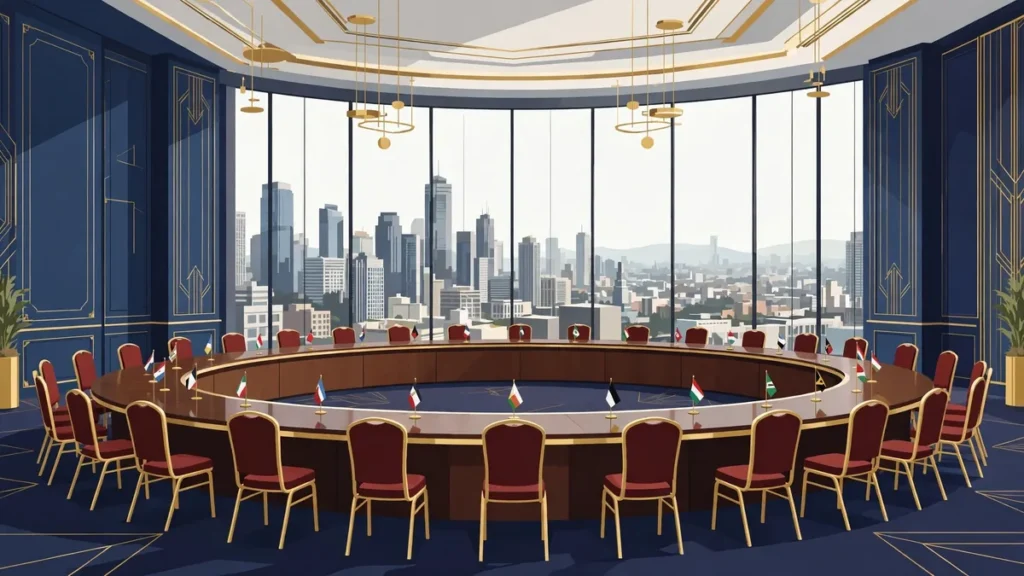
China is hosting APEC for the third time, and the first time since 2014. The host year’s theme is “Building an Asia-Pacific Community to Prosper Together”, with openness, innovation and cooperation named as the priorities. The main venue is the Shenzhen International Exchange Center in the Xiangmi Lake area of Futian district, in the city that has become the symbol of China’s export-driven rise.
The closing week of China’s host year runs from November 14 to 19. The Concluding Senior Officials’ Meeting takes place on November 14–15, the APEC Business Advisory Council holds its fourth meeting on November 14–16, the APEC CEO Summit runs on November 17–18, and the 33rd APEC Economic Leaders’ Meeting closes the week on November 18–19. All three of the leaders at the centre of the trilateral speculation are expected to attend the leaders’ meeting.
The summit season in the region is crowded. The ASEAN Summit in Manila gathered 20 leaders earlier in the month, and the planned Quad leaders’ summit in Manila is part of the same diplomatic calendar — but Shenzhen is the one where the three most powerful leaders in the world could, for the first time, sit in the same room.
Will Trump, Xi and Putin actually meet?
Short answer: nobody has confirmed it, and the three capitals are saying different things. The idea was first put forward by Putin, according to a Wall Street Journal report in October, and Putin discussed the possibility with US envoy Steve Witkoff during talks in St Petersburg on October 21, according to Kremlin aide Yury Ushakov. The Financial Times reported on November 3 that officials from the three countries had been holding undisclosed talks on a trilateral summit for two weeks, with Washington and Moscow pressing Beijing to agree to host it.
Beijing moved from silence to acknowledgement on November 4, when Foreign Ministry spokesperson Mao Ning told reporters that China was in contact with Washington and Moscow about a meeting of the three heads of state. A day earlier, Kremlin spokesperson Dmitry Peskov had said that work was under way to organise it. On November 9, Foreign Ministry spokesperson Guo Jiakun did not rule the meeting out when asked about it, saying Beijing was “in communication with relevant parties”. Russian Deputy Foreign Minister Andrei Rudenko has reportedly said no final decision has been made.
“China is maintaining communication with relevant parties on a meeting of the heads of state of China, Russia and the United States.” — Mao Ning, Chinese Foreign Ministry spokesperson, November 4, 2026
Trump is the most bullish of the three. Speaking to reporters on November 8, he said he expected a three-way meeting on the sidelines of the summit, with nuclear arms control and the war in Iran on the agenda. The Hindu reported his remarks as the clearest public signal yet that Washington wants the meeting to happen.
“One of the meetings, I think, will be with President Putin and President Xi, and that’ll be interesting. We’re talking a lot of things, including denuclearisation, but we’ll be talking a lot of things. We’re trying to end the war in Iran.” — Donald Trump, November 8, 2026
The obstacle is the agenda. The Wall Street Journal reported on November 9, citing people familiar with the matter, that the United States and China had failed to bridge their differences over the format and agenda for a trilateral meeting. Washington wants nuclear arms control to be a key topic — the New START treaty limiting US and Russian nuclear arsenals expired in February 2026, and Trump has argued for a new framework that includes China. Beijing is expected to refuse to take part in negotiations on the issue. That disagreement is the main reason the meeting remains unconfirmed eight days out.
One subject is already off the table. Xi told German President Frank-Walter Steinmeier on November 1 that Ukraine would not be discussed, calling it a European conflict. Steinmeier said afterwards that Xi had been surprised by rumours of a summit and denied that preparations were under way for a meeting of the three countries on Ukraine. That matters because Putin originally proposed the meeting as a way to discuss ending the war in Ukraine — the one topic Beijing has now publicly excluded.
If the three leaders do meet, it would be the first trilateral summit of its kind: they have met in pairs but never all three together in formal talks. It would also be the third Trump–Xi bilateral meeting this year, after Trump’s visit to Beijing in May and Xi’s visit to Washington in September, according to The Hindu.
What is on the APEC 2026 agenda?
The formal agenda is trade, and China’s headline objective is a standalone leaders’ outcome on the Free Trade Area of the Asia-Pacific (FTAAP) — the long-running proposal for a pan-regional free trade zone. China tabled the proposal at the third Senior Officials’ Meeting in Dalian in August, in the year that marks the 20th anniversary of the FTAAP agenda. The text of the proposed outcome has not been published, and because APEC outcomes require consensus among all 21 economies, its scope is not yet clear.
The APEC CEO Summit on November 17–18 is where the business agenda gets argued in public. Hosted by the China Council for the Promotion of International Trade under the theme “To Prosper and Win the Future Together”, it will bring together around 1,000 political and business representatives from APEC economies, with well-known US companies — including Amazon, Walmart, Apple, Google, ExxonMobil and Microsoft — already registered to attend, according to the council. The agenda covers the FTAAP, connectivity, artificial intelligence, the digital economy, the development of the Guangdong–Hong Kong–Macao Greater Bay Area, and sustainable development.
Two bilateral files will shadow the summit even if they never reach the formal agenda. The first is trade: the United States and China agreed to extend their trade truce by two months, until January 10, 2027, from its original expiry date of November 10, 2026 — a decision that removes an immediate tariff cliff but leaves the underlying dispute unresolved. The second is Taiwan: a second US arms package for the island worth about $14 billion has stalled after Trump described it as a “bargaining chip” that he was holding in “abeyance” following his meeting with Xi in May, Reuters reported on November 5. Trump approved an earlier $11 billion sale last December, the largest ever for Taiwan, and Taipei officials have said the new package could be pushed into 2027.
The security backdrop is tense. China confirmed area-denial drills by the Liaoning carrier group in the Western Pacific in the days before the summit, as our intelligence report on the Liaoning drills explains, and Taiwan confirmed it was tracking the exercises. The drills are a reminder that the summit takes place against a live military build-up in the same waters APEC’s trade routes cross.
By the numbers: Shenzhen 2026
| Metric | Figure | Source |
|---|---|---|
| APEC member economies | 21 | APEC / Xinhua — CONFIRMED |
| Leaders’ meeting | November 18–19, 2026 | Xinhua — CONFIRMED |
| CEO Summit delegates | ~1,000 | CCPIT / Xinhua — CONFIRMED |
| US–China trade truce extended to | January 10, 2027 | Asia Economy / Wall Street Journal — CONFIRMED |
| Taiwan arms package stalled | ~$14 billion | Reuters — CONFIRMED |
| Previous Taiwan arms sale (Dec 2025) | $11 billion | Reuters — CONFIRMED |
| Trump–Xi–Putin trilateral meeting | NOT CONFIRMED | Chinese Foreign Ministry — UNCONFIRMED |
Figures marked CONFIRMED are corroborated by two or more sources. The trilateral meeting itself remains unconfirmed — Beijing says only that it is “in communication” with the relevant parties, and the Wall Street Journal reported on November 9 that the US and China have not agreed on a format or agenda.
Why the trilateral matters — and why Beijing is cautious
For Washington, a three-way meeting is a legacy-defining photo and a venue to press denuclearisation. Trump has framed it as a chance to talk about nuclear weapons with the leaders of the world’s two other major nuclear powers, and about ending the war in Iran — a subject on which he said on November 9 that the conflict was “effectively over” militarily, even as the US naval blockade of Iranian ports continues. Our report on the November 10 tanker attacks near Hormuz shows how quickly that file can change.
For Moscow, the meeting is a route back to the top table: a trilateral with the US and Chinese presidents would signal that Russia is a peer in great-power diplomacy despite the war in Ukraine and its exclusion from Western forums. Putin’s original proposal tied the meeting to Ukraine; Beijing’s refusal to discuss Ukraine there undercuts that framing, but the symbolism alone is valuable to the Kremlin.
For Beijing, the calculation is more complicated. The Lowy Institute argued on November 10 that a trilateral summit lets Washington look powerful but could cost Beijing dearly with Europe, which would read a three-way carve-up of security questions as a “Yalta 2.0” — a reference to the 1945 conference where great powers redrew Europe’s map. Poland’s foreign minister, Radosław Sikorski, made the same point publicly, warning that Putin wants Ukrainian territory he has failed to conquer handed to him as a gift. Xi’s insistence that Ukraine is a European conflict, not an APEC subject, is Beijing’s way of keeping the summit about trade while avoiding a photograph that Europe would read as a spheres-of-influence deal.
The caution is also practical. A trilateral that produces no agreement would be worse than no meeting at all: it would advertise division among the three leaders a week before the G20 in Florida, where Trump is expected to meet Xi again in December. Beijing’s preference is to keep the option open — “in communication”, never confirmed — until the agenda is settled on its terms.
What the Shenzhen summit means for US/UK/EU readers
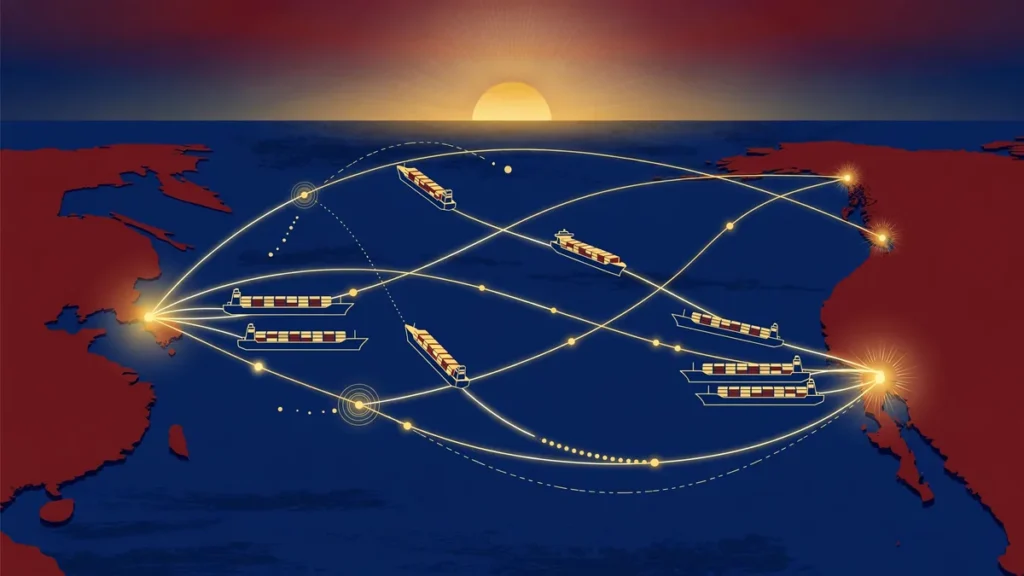
The most direct effect is on prices and trade. The extension of the US–China trade truce to January 10, 2027 removes the immediate threat of a new tariff escalation before Christmas, which matters for American consumers and for European exporters caught between the two economies. If the leaders’ meeting produces a standalone FTAAP outcome, it would be a signal — not a binding deal — that Asia-Pacific economies intend to keep cutting trade barriers among themselves, with or without Washington.
For European readers, the nuclear question matters most. New START expired in February 2026 with no replacement, and a trilateral that put arms control on the table would be the first serious attempt at a new framework. If China refuses, as expected, Europe faces a world in which the only treaty limiting US and Russian arsenals is gone and no negotiation has replaced it. The exclusion of Ukraine from the trilateral’s agenda, if it happens at all, is a separate signal: Kyiv’s future will not be decided in Shenzhen, whatever the format.
For American readers, the Taiwan file is the one to watch. The $14 billion arms package is a bargaining chip in the US–China relationship, and its fate will be read in Taipei as a measure of how far Washington will go to arm the island while negotiating with Beijing. The package’s delay into 2027, which Taipei officials now say is possible, would be a concrete cost of the summit’s diplomacy.
For travellers and businesses, Shenzhen itself will be on a security footing through Leaders’ Week, with cordons around the Xiangmi Lake venue and the Futian central business district. The CEO Summit’s US corporate attendance — Amazon, Walmart, Apple, Google, ExxonMobil and Microsoft among them — is a reminder that, for all the geopolitical tension, American business still wants a seat in the room.
What to watch next in Shenzhen
- November 14–15: The Concluding Senior Officials’ Meeting sets the final agenda. Any mention of a trilateral in the officials’ readout would be the first formal signal.
- November 17–18: The CEO Summit — watch the leaders’ speeches and panel appearances, and whether Trump, Xi or Putin use the business stage to preview the leaders’ meeting.
- November 18–19: The leaders’ meeting itself. Confirmation of a trilateral would likely come at short notice, possibly only once all three leaders are in Shenzhen.
- The Taiwan file: Any movement on the $14 billion package, or any mention of it in the Trump–Xi bilateral, would be the summit’s most concrete security outcome.
- After Shenzhen: The G20 in Florida in December, where Trump is expected to meet Xi again — and where a trilateral that failed to happen in Shenzhen could be attempted a second time.
Read next: our intelligence report on China’s Liaoning area-denial drills ahead of the summit, the ASEAN Summit Manila 2026 preview for the rest of the region’s summit season, and our conflict zones hub for ongoing Indo-Pacific coverage.
Frequently asked questions
When is the APEC summit in Shenzhen?
The 33rd APEC Economic Leaders’ Meeting takes place in Shenzhen on November 18–19, 2026. The wider Leaders’ Week runs from November 14 to 19, including the Concluding Senior Officials’ Meeting on November 14–15 and the APEC CEO Summit on November 17–18.
Will Trump, Xi and Putin meet at APEC 2026?
Not confirmed. Trump said on November 8 that he thinks the three leaders will meet, and the Kremlin says work is under way. Beijing says only that it is “in communication” with the relevant parties, and the Wall Street Journal reported on November 9 that the US and China have not agreed on a format or agenda. Xi has said Ukraine will not be discussed.
What is APEC?
Asia-Pacific Economic Cooperation is a 21-member forum focused on trade and economic cooperation. Its decisions are non-binding and taken by consensus, and the leaders’ meeting is as important for the bilateral and trilateral meetings on its sidelines as for its formal agenda.
What is on the agenda at APEC 2026?
China is seeking a standalone leaders’ outcome on the Free Trade Area of the Asia-Pacific, alongside discussions of connectivity, artificial intelligence, the digital economy, the Greater Bay Area and sustainable development. The US–China trade truce and the stalled $14 billion Taiwan arms package will shadow the formal agenda.
Why does the Taiwan arms package matter for APEC?
The package, worth about $14 billion, has stalled after Trump called it a “bargaining chip” held in “abeyance” following his May meeting with Xi. Taipei officials have said it could be pushed into 2027, and its fate will be read as a measure of how Washington balances arming Taiwan against negotiating with Beijing.
Sources
- Al Jazeera: What a Trump-Xi-Putin summit would mean — and what it wouldn’t
- The Hindu: Trump says likely to meet Putin, Xi at China APEC summit
- TRT World: Beijing confirms contacts on possible Xi-Putin-Trump summit
- Lowy Institute: Yalta 2.0 — A Trump-Xi-Putin summit has little upside for Beijing
- Asia Economy: US, China at odds over summit format and nuclear arms control
- China Daily / Xinhua: Preparations for APEC CEO Summit enter final stage
- Reuters via BusinessWorld: Taiwan sees continued US arms sale support after midterm election
- Magnabureau: Trump, Xi and Putin could meet in Shenzhen — but Beijing has not said yes
- Group of Nations: China seeks a standalone FTAAP outcome for APEC leaders in Shenzhen


Discussion 0
Share analysis, corrections, or context. Be civil — comments are moderated.