
WarBrief Live | November 10, 2026 | Breaking Analysis
Two commercial vessels were attacked near the Strait of Hormuz on November 10, 2026: an ADNOC Logistics & Services vessel was damaged in UAE territorial waters, and a tanker was struck by an unidentified projectile off the coast of Oman. Both crews were reported safe. Who carried out the attacks has not been established.
2
confirmed shipping incidents on November 10, 2026
13:38 UTC
time of the UKMTO projectile strike, 19 nautical miles north-east of Lima, Oman
6–10%
early-October war-risk premium quotes for Hormuz transits, brokers via the Financial Times
0
crew injuries reported in either confirmed incident
Key Takeaways
- ADNOC Logistics & Services confirmed that one of its vessels sustained damage in an attack in the UAE’s territorial waters on the afternoon of November 10. The company named no vessel, attacker or casualty figure.
- The United Kingdom Maritime Trade Operations (UKMTO) agency reported a tanker struck by an unidentified projectile 19 nautical miles north-east of Lima, Oman, at 13:38 UTC. The crew is safe and there was no environmental impact.
- Iran’s Revolutionary Guard Corps Navy claimed two tankers — later a third — caught fire on an “unauthorised route” through the strait. Those claims are unverified, the vessels are unidentified, and it is not clear whether they overlap with the two confirmed incidents.
- The attacks landed on the same day diplomacy accelerated: President Donald Trump said further US strikes on Iran were highly unlikely while talks continue, and Brent crude fell 5.8% on the prospect of a deal, according to Reuters.
What happened near the Strait of Hormuz on November 10?
The first confirmed incident was reported by ADNOC Logistics & Services, the shipping arm of the UAE’s state oil company. In a statement carried by the Emirates News Agency (WAM), the company said one of its vessels “sustained damage following an attack in the UAE’s territorial waters, in the Arabian Gulf, on the afternoon of 10th November.” Response efforts were under way, the company said, and further updates would follow as more information became available. The statement gave no vessel name, no description of the weapon used, no attacker and no casualty figure. The UAE’s foreign ministry subsequently condemned the attack, according to the Khaleej Times.
The second confirmed incident was reported by UKMTO, the British military’s maritime security agency, as Warning 201-26. A tanker was struck by an unidentified projectile approximately 19 nautical miles north-east of Lima, Oman, at 13:38 UTC on November 10. The vessel’s master reported that all crew members were safe and there was no environmental impact, and that a damage assessment would be carried out at first light. UKMTO did not identify the tanker or establish the origin of the projectile. Maritime intelligence firm Vanguard identified the vessel as the UAE-controlled, 74,100-deadweight-tonne product tanker Sea 1, according to TradeWinds; that identification has not been independently confirmed.
It is not yet clear whether the ADNOC incident and the UKMTO strike were the same attack or two separate ones, gCaptain reported. The two reports describe different locations — UAE territorial waters in the Arabian Gulf, and the Gulf of Oman side of the strait near Lima — but neither report names a vessel, so the overlap cannot be ruled in or out on the information available.
What did the IRGC claim — and what is still unverified?
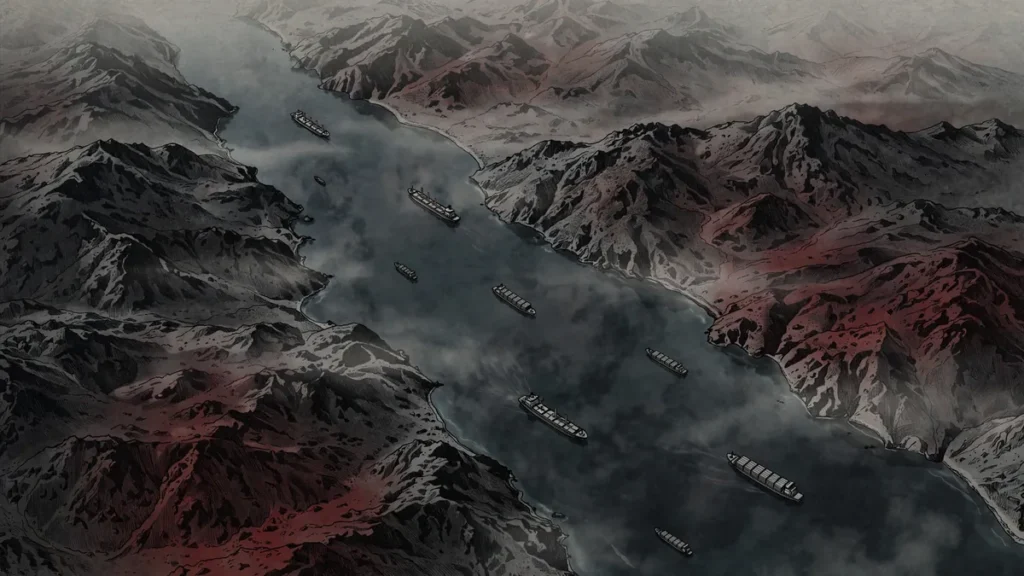
Separately on November 10, the navy of Iran’s Islamic Revolutionary Guard Corps (IRGC) said two oil tankers had caught fire after explosions while attempting to cross what it called an “unauthorised route” through the Strait of Hormuz. In a statement carried by the semi-official Tasnim news agency, the IRGC Navy said one of the vessels, described as a supertanker, struck a naval mine and exploded, while a second tanker, which it claimed was operating under the protection of US military aircraft, suffered an unspecified incident and caught fire. Both vessels had switched off their navigation and identification systems before the incidents, the statement said. The IRGC warned that vessels cooperating with the US military would face the same consequences if they attempted the route.
Later on November 10, the IRGC Navy said a third tanker had exploded after striking a naval mine on Tuesday afternoon in the eastern part of the strait, according to state broadcaster IRIB. That claim, too, named no vessel, flag or crew figure and gave no casualty information.
What investigators have confirmed and what remains unverified must be kept apart. The IRGC statements themselves are confirmed — they were carried by Iranian state and semi-official media and widely reported — but the events they describe are not. No independent source has confirmed the mine strikes, the fires, the identities of the vessels or the claim of US fighter-jet escort, and the US military has not confirmed any involvement, the Turkish outlet ANews reported. Maritime trade publication Safety4Sea noted that the reported incidents “have not been independently verified.” Until a vessel is named, a crew is accounted for or wreckage is documented, the IRGC’s two — and then three — tankers should be treated as claims, not confirmed casualties.
By the numbers: the November 10 tanker incidents
| Metric | Figure | Source |
|---|---|---|
| Confirmed shipping incidents, November 10 | 2 (ADNOC vessel; UKMTO tanker strike) | WAM; UKMTO Warning 201-26 (CONFIRMED) |
| UKMTO strike time and location | 13:38 UTC; 19 nautical miles north-east of Lima, Oman | UKMTO via gCaptain and Arab News (CONFIRMED) |
| Crew casualties in confirmed incidents | None reported; UKMTO crew safe, no environmental impact | UKMTO; ADNOC gave no casualty figure (CONFIRMED) |
| Tankers the IRGC says caught fire | Two, then a third claimed later on November 10 | IRGC Navy via Tasnim and IRIB (REPORTED — unverified) |
| Pre-war Hormuz war-risk premium | 0.15% to 0.25% of hull value | Lloyd’s List, March 11, 2026 (CONFIRMED) |
| Early-October Hormuz war-risk premium | 6% to 10% of hull value per voyage | Brokers via the Financial Times, reported October 7 (REPORTED) |
| Cost on a $100 million tanker | About $250,000 before the war; $6 million to $10 million at early-October quotes | WarBrief Live analysis of broker quotes (REPORTED) |
| Brent crude move, November 10 | Down 5.8% as Trump signalled a shift from military action to diplomacy | Reuters (REPORTED) |
Caveat: broker premium quotes are ranges from different brokers, dates and vessel types, not an official index, and no single figure describes the whole market on any given day. IRGC figures are claims from a party to the conflict and have not been independently verified.
How the November 10 attacks fit a weekend of escalation
The attacks did not come out of nowhere. They cap four days of mounting incidents around the strait, and they sit inside a war that began on February 28, 2026, when the United States and Israel launched strikes on Iran, after which Tehran restricted transit through the strait to routes it authorises.
- October 30: Qatar Gas Transport Company (Nakilat) reported that its vessel Al Maayeda was attacked by unidentified objects while sailing in the Arabian Gulf. No crew members were injured, there was no environmental impact, and the vessel remained safe and operational, the company said in a statement to the Qatar Stock Exchange.
- November 8: The Joint Maritime Information Center (JMIC) maintained its threat level for the Strait of Hormuz at SEVERE, warning that further deliberate attacks were highly likely, gCaptain reported.
- November 9 (Saturday): A US military aircraft fired precision-guided munitions at the stern of the St Kitts and Nevis-flagged bulk carrier Huda in the Gulf of Oman, and two tankers were hit within an hour of each other on Saturday evening, according to UKMTO incident reports cited by Splash247. Iran’s Revolutionary Guard Corps Navy subsequently claimed two tankers had struck naval mines after attempting to use unauthorised routes.
- November 9 (late): Maritime security firm Ambrey reported that an unidentified merchant vessel was struck on its port side by a projectile about 17 nautical miles north-east of Khasab, Oman, while outbound through the waterway, TradeWinds reported.
- November 10: The ADNOC vessel damage and the UKMTO projectile strike, followed by the IRGC’s claims of two and then three tankers on fire.
The pattern matters because it shows the shipping war is no longer confined to a single chokepoint or a single weapon. Mines, projectiles, drones and direct military strikes have all been reported within a few days, and the victims have included state-linked tankers, independent merchant vessels and a bulk carrier. That breadth is what underwriters price, and it is why the insurance market, not only the military picture, has become a front line of the conflict. Our explainer on how war-risk insurance works sets out the mechanics in full.
Why the attacks matter for shipping and war-risk insurance
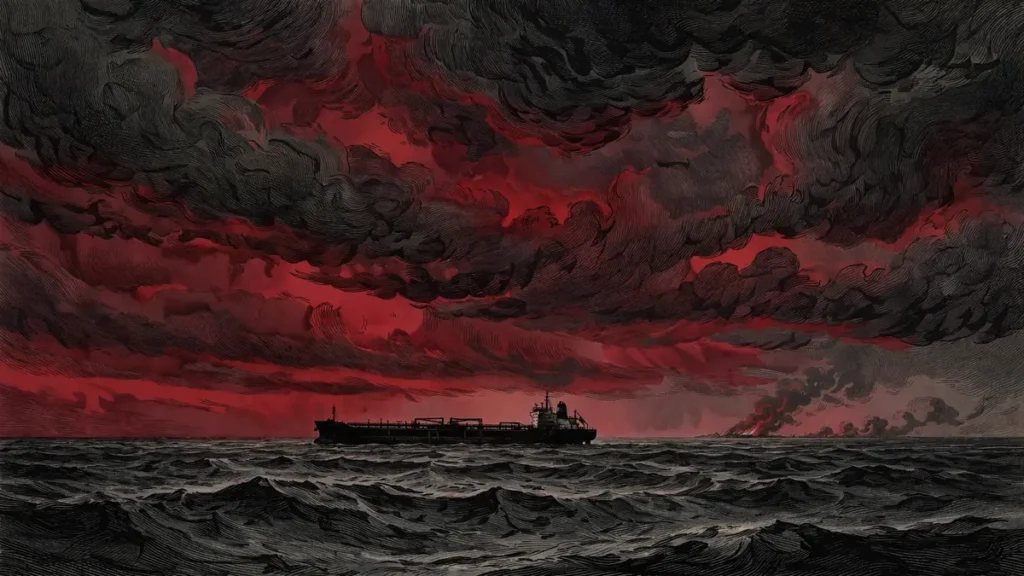
Every transit through a Joint War Committee listed area triggers an additional premium, charged as a percentage of the ship’s insured hull value and usually priced for a seven-day entry. Before the war, Hormuz war-risk cover typically cost 0.15% to 0.25% of hull value, according to Lloyd’s List. By early October 2026, brokers were quoting 6% to 10% per voyage, the Financial Times reported. On a $100 million tanker, that swing turns a roughly $250,000 premium into $6 million to $10 million for one transit, before cargo cover, which is bought separately.
Fresh attacks push in the same direction as the October quotes: up. Underwriters can reprice or withdraw cover at short notice, and some voyages become effectively uninsurable when no underwriter will take the risk at any price. One recent study of the crisis found vessel traffic through the strait had collapsed by more than 80%, with hundreds of ships idling or rerouting, even without a universally enforced physical blockade. Insurance, in that analysis, has become a gatekeeper of maritime access: a ship that cannot be insured at a viable price does not sail, whatever the military situation.
The November 10 incidents add two new data points to that calculation. An attack inside UAE territorial waters — not only in the strait itself — widens the geography underwriters must price, and a projectile strike in the Gulf of Oman, on the strait’s eastern approaches, does the same. If the IRGC’s mine claims were confirmed, the effect would be larger still: mines are the peril that most directly threatens hull war cover, because a single minefield can close a route for every ship, not just one. For now, though, the confirmed picture is two damaged vessels and no confirmed mine strike on November 10.
What the November 10 tanker attacks mean for US/UK/EU readers
The most immediate effect for readers in the United States, Britain and Europe runs through fuel prices — but not in the direction the headlines might suggest. Brent crude fell 5.8% on November 10, Reuters reported, because President Donald Trump signalled a shift away from military action and toward diplomacy with Iran. Markets, in other words, priced the diplomacy higher than the attacks on the day. That can reverse quickly: a confirmed mine strike, a closure of the strait or a casualty event would push the same market sharply the other way, and the war-risk premium is the channel through which shipping costs reach the pump. Our analysis of why Brent fell while oil still costs more explains the gap between the crude price and what drivers actually pay.
For travellers, the disruption is already visible. Etihad cancelled Abu Dhabi flights to Riyadh and Dammam through November 19, Gulf News reported, and Saudi Arabia moved Riyadh schools online after its air defences intercepted a ballistic missile and a cruise missile launched toward the capital by Yemen’s Houthi movement on November 10. Anyone flying to or through the Gulf should check flight status before travelling and expect short-notice changes.
For security, the day’s other development matters as much as the attacks. The Gulf Cooperation Council approved an advanced headquarters for its unified military command in Kuwait and agreed to deploy “appropriate” forces there, its secretary-general said, according to Saudi state television. The Gulf states, most of which host US military bases, are building a standing military structure while the war continues — a signal that regional governments expect the confrontation to last, whatever the diplomacy of the moment. South Korea, meanwhile, approved an expansion of its Cheonghae naval mission toward the Strait of Hormuz on November 10, adding another navy to the crowded waterway.
Different perspectives
Tehran’s framing is that the strait is under its control and that only authorised routes are safe. The IRGC Navy’s statement warned that vessels cooperating with US forces would face the same consequences as the two tankers it says caught fire, and Iran has maintained since February 28 that it bars safe passage for vessels belonging to or affiliated with Israel and the United States. Iranian Foreign Minister Abbas Araghchi said on November 10 that the war would end only through diplomacy that meets Iran’s demands, and Tehran’s seven conditions — including lifting the naval blockade and unilateral sanctions, ensuring safe passage and releasing frozen Iranian assets — remain on the table, according to Iranian officials cited by the Express Tribune.
Washington’s framing is that pressure is working and further strikes are unnecessary for now. President Trump said there was positive momentum toward ending the war after talks with Qatar’s prime minister, and told CNN that further American strikes were highly unlikely as long as negotiations over Tehran’s nuclear programme and efforts to reopen the strait continued to make progress. Secretary of State Marco Rubio told G7 allies in Paris that US sanctions and the naval blockade were working so well that major combat operations were not needed. That is the position our analysis of Trump’s “effectively over” remark examined this morning: a claim about the war’s direction, not a signed deal, and the blockade continues.
The Gulf states’ framing is defensive and practical. The UAE condemned the attack on the ADNOC vessel, Saudi Arabia’s air defences intercepted missiles aimed at Riyadh, and the GCC moved to stand up a unified command headquarters. Qatar, meanwhile, said it had received “positive responses” from both Washington and Tehran on its mediation efforts. The region’s governments are simultaneously hardening their defences and pushing for a negotiated end — and their shipping, their oil exports and their airspace sit in the middle.
What to watch next in the Strait of Hormuz
The first test comes at first light on November 11, when the master of the UKMTO tanker is due to conduct a damage assessment. Whether ADNOC names the vessel and the nature of the damage will determine whether the two incidents can be separated or are, as some analysts suspect, the same event reported twice. The second test is whether the IRGC’s mine claims gain any independent corroboration — a named vessel, a crew account, satellite imagery or a matching UKMTO warning. Without that, they remain claims from a party to the conflict.
Beyond the incidents themselves, watch the diplomacy. Qatar said mediation continues and that both sides have responded positively; Iran’s national security chief, Mohsen Rezaei, said on November 10 that Washington had not given an “acceptable response” to Tehran’s conditions and that the strait remains closed. Watch, too, whether underwriters move Hormuz premiums after November 10, whether JMIC updates its SEVERE threat rating, and whether the US naval blockade of Iranian ports — the pressure instrument Rubio cited in Paris — produces any new enforcement action. For the wider picture, our conflict-zones hub tracks the war’s theatres, and our explainer on how naval blockades work sets out the legal and practical framework behind the US blockade.
Frequently asked questions
What happened to the ADNOC vessel on November 10, 2026?
ADNOC Logistics & Services confirmed that one of its vessels sustained damage following an attack in the UAE’s territorial waters in the Arabian Gulf on the afternoon of November 10, 2026. The company did not name the vessel, describe the weapon, identify an attacker or give a casualty figure, and said response efforts were ongoing.
What did UKMTO report near Lima, Oman?
UKMTO Warning 201-26 reported that a tanker was struck by an unidentified projectile about 19 nautical miles north-east of Lima, Oman, at 13:38 UTC on November 10. The crew was safe, there was no environmental impact, and a damage assessment was planned for first light. UKMTO did not identify the tanker or the origin of the projectile.
Did Iran claim responsibility for the tanker attacks?
Iran’s Revolutionary Guard Corps Navy claimed that two tankers — later a third — caught fire after explosions on an “unauthorised route” through the strait, one after striking a naval mine. It did not name the vessels, and the claims have not been independently verified. It is not clear whether those claims overlap with the ADNOC and UKMTO incidents.
Were any crew members hurt in the November 10 attacks?
No injuries were reported in either confirmed incident. The UKMTO tanker’s crew was reported safe, and ADNOC gave no casualty figure for its vessel. The IRGC’s claims gave no information about casualties or the condition of any crew.
How do the attacks affect war-risk insurance and fuel prices?
War-risk premiums for Hormuz transits were already quoted at 6% to 10% of hull value in early October, against 0.15% to 0.25% before the war. Fresh attacks can push premiums higher or make some voyages uninsurable, and those costs feed through freight rates into fuel prices. Brent crude fell 5.8% on November 10, however, because markets priced diplomacy ahead of the attacks that day.
Sources
- Emirates News Agency (WAM): ADNOC Logistics & Services vessel sustained damage following attack
- gCaptain: ADNOC Vessel Damaged in Gulf Attack as UKMTO Reports Fresh Tanker Strike Near Hormuz
- Arab News: Tanker struck by unknown projectile off Oman, UKMTO says
- TradeWinds: Adnoc ship hit as Iran claims tanker strikes and denies peace talk progress
- Khaleej Times: Adnoc says vessel damaged after attack in UAE waters on November 10
- Safety4Sea: Iran reports two tankers on fire in Strait of Hormuz
- Dawn: Live updates — war returns to Iran with Israel, US strikes
- Gulf News: Middle East war — 9 things UAE residents need to know tonight, November 10
- RSDI: Insurability as Power — Reframing Control in the Strait of Hormuz

Discussion 0
Share analysis, corrections, or context. Be civil — comments are moderated.