
WarBrief Live | November 10, 2026 | Breaking Analysis
2 days — talks scheduled in Abu Dhabi, November 10–11 | February 18, 2026 — last face-to-face meeting, in Geneva | ~20% — of Ukraine occupied by Russia | 4 — regions Putin wants Kyiv to vacate
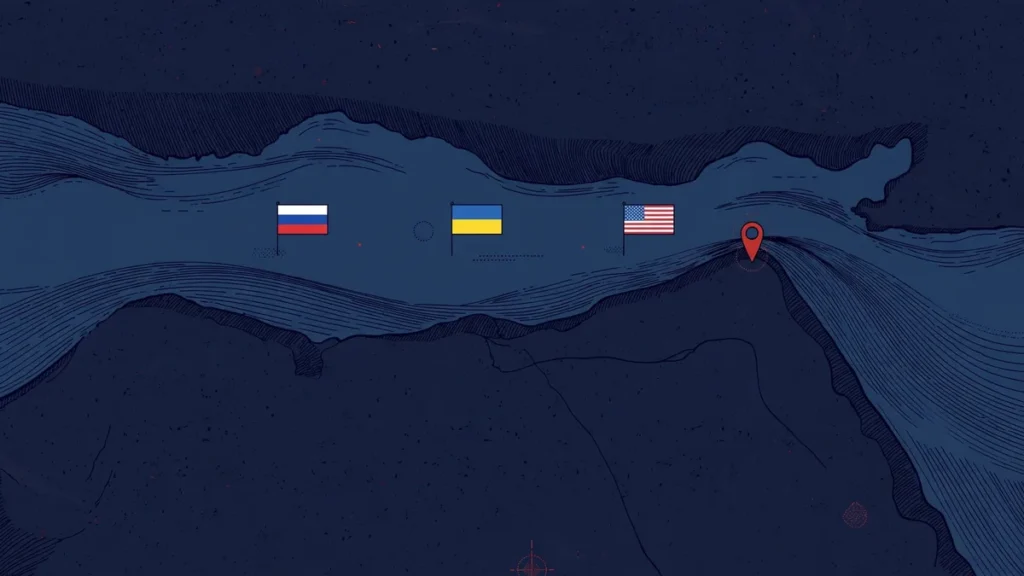
Russia, Ukraine and the US opened two days of US-brokered talks in Abu Dhabi on November 10, 2026 — their first face-to-face meeting since February — with security guarantees on the agenda and Europe kept out of the room.
Key Takeaways
- Negotiators from Russia, Ukraine and the United States sat down in Abu Dhabi on November 10 for a two-day session — the first time the three sides have met face to face since Geneva on February 18, 2026.
- Security guarantees for Ukraine are the central agenda item, with a possible Article 5-style defence commitment reported to be under discussion — though that remains unconfirmed.
- Europe is not at the negotiating table. Russia insisted on a strictly trilateral format, while European officials hold separate consultations with Kyiv in Abu Dhabi.
- The two sides remain far apart on territory: President Vladimir Putin wants Ukraine to vacate four regions, and President Volodymyr Zelenskyy refuses to cede land his forces have died defending.
What happened on day one of the Abu Dhabi talks?
Delegations from all three sides arrived in Abu Dhabi on November 9, and the first session began on Tuesday morning. Officials in Kyiv put the start at about 06:30 GMT, according to Reuters, while Russian state media reported an 11:50 local start. Ukrainian state media and the Russian news agency RIA Novosti both reported that the talks were under way, and Al Jazeera confirmed the meeting had begun.
The session is the third round of talks held in Abu Dhabi this year, following security consultations in January and February. It is also the first meeting of the three delegations since they last sat together in Geneva on February 18, 2026 — a gap of almost nine months in which Washington’s attention was consumed by the war in Iran.
Before the trilateral session, US envoys Steve Witkoff and Jared Kushner met separately with envoys from Ukraine, the European Union, NATO, Germany, France, the United Kingdom and Italy to continue consultations on European security and Ukraine’s post-war future, according to the Associated Press.
President Donald Trump told reporters in Washington that he saw a “very strong inclination” towards ending the war and that both sides were “tired of fighting”. “We’re having a very good conversation about that in Abu Dhabi,” he said. Trump has said a broad deal is possible, adding that it could involve more than Ukraine — “it might involve all of Europe”.
The talks run for two days, November 10–11. The agenda, as set out by Witkoff, covers post-war security arrangements, de-escalation, humanitarian efforts and next steps towards peace. A US official told reporters that Washington believed there was now “a shot at trying to make serious progress to end the war”.
- March 2022: first direct Russia–Ukraine peace talks in Istanbul, Turkey.
- January–February 2026: two rounds of US-mediated security consultations in Abu Dhabi.
- February 18, 2026: last face-to-face meeting of the three delegations, in Geneva.
- November 9, 2026: delegations arrive in Abu Dhabi; Witkoff and Kushner hold separate consultations with European envoys.
- November 10, 2026: trilateral talks open in Abu Dhabi; a second day follows on November 11.
Who is sitting at the negotiating table?
The delegations are led by experienced negotiators who have attended previous rounds. The United States is represented by special envoy Steve Witkoff and Jared Kushner, President Trump’s son-in-law and Ukraine envoy, who have spearheaded Washington’s mediation.
Russia’s delegation is headed by presidential aide Vladimir Medinsky, who has led Moscow’s team since the first direct peace talks in Istanbul in March 2022. He is joined by Deputy Foreign Ministers Sergei Ryabkov — attending for the first time — and Mikhail Galuzin, military intelligence chief Igor Kostyukov, and Lieutenant General Yuri Zhigarlovsky, deputy chief of the General Staff’s operational department.
Ukraine’s delegation is led by Rustem Umerov, head of the country’s Foreign Intelligence Service, who also attended earlier talks. It also includes Zelenskyy’s chief of staff Kyrylo Budanov, his deputy Sergiy Kyslytsya, and Davyd Arakhamia, parliamentary faction leader of Zelenskyy’s Servant of the People party.
Why is Europe not at the table in Abu Dhabi?
Europe’s absence is the most contested feature of the format — and it was decided before anyone arrived. Russia made it clear it did not want Europeans taking part in the negotiations, and Kremlin spokesperson Dmitry Peskov said the talks had been agreed as a three-way format. “What will take place in Abu Dhabi in the coming days is trilateral negotiations between Russia and Ukraine with US mediation,” Peskov said. “As for the presence of Europeans, you know that the Americans have their own channels of communication with Europeans, and Ukrainians with Europeans.”
European powers sent officials anyway. France, Germany and the European Commission dispatched representatives to Abu Dhabi, and officials from the United Kingdom, France, Germany and Italy, along with NATO and EU officials, are holding separate consultations with Kyiv’s representatives in the city. Umerov said Ukraine was “doing everything to ensure that Europe is a participant in the diplomatic process”.
Washington’s plan is to bring the Europeans in after this round. A US official said the proposal was “to bring the Europeans into the discussion after this trilateral and to try to run on parallel tracks so that they can both help solve the other”. Kushner said a comprehensive settlement would also require “direct engagement between Russia and our European partners on the broader security arrangements that affect them”, adding that the Abu Dhabi discussions would set the stage for “that engagement to begin in the near future, as part of a broader multilateral process”. Moscow has said EU representatives could join at a later stage.
The arrangement has drawn criticism in European capitals. Trump’s suggestion that a deal could settle Europe’s security prompted a backlash from officials who said negotiations on European security needed the direct involvement of the governments concerned, and that Russia should not be involved in setting European security policy. Some in the EU see Washington’s proposals as too accommodating to Moscow, the Associated Press reported.
The same day the talks opened, G7 foreign ministers were meeting in Paris, with Ukraine’s Foreign Minister Andrii Sybiha joining the discussions. US Secretary of State Marco Rubio, who met French President Emmanuel Macron on November 9, struck a cautious note, saying the process to end the war still had “a ways to go”, while adding there had been “advances” in what Europe’s post-conflict security architecture could look like.
By the numbers: the Abu Dhabi talks
| Metric | Figure | Status | Source |
|---|---|---|---|
| Length of the Abu Dhabi session | 2 days, November 10–11, 2026 | CONFIRMED | Reuters; Al Jazeera |
| Last face-to-face meeting of the three sides | February 18, 2026, Geneva | CONFIRMED | Al Jazeera |
| Abu Dhabi rounds held this year | 3 (January, February, November) | CONFIRMED | Al Jazeera |
| Ukrainian territory occupied by Russia | Roughly 20%, including Crimea and parts of Donbas | CONFIRMED | Al Jazeera |
| Regions Putin wants Kyiv to vacate | 4 (Donetsk, Luhansk, Zaporizhzhia, Kherson) | CONFIRMED | Associated Press |
| Length of the front line | About 1,200 km (750 miles) | CONFIRMED | Associated Press |
| Prisoners exchanged with UAE mediation | Hundreds since the war began | CONFIRMED | The National |
| Both sides privately flexible on territory | Claimed by a US official speaking anonymously | REPORTED | Al Jazeera |
| Russia suffering “record losses” | Claimed by Zelenskyy; disputed by Moscow | REPORTED | Reuters |
Figures marked CONFIRMED are corroborated by two or more outlets. Figures marked REPORTED rest on a single or anonymous source and should be treated as claims, not established fact.

What are the security guarantees on the table?
Security guarantees are expected to be central to the two-day discussions, alongside de-escalation, humanitarian measures and prospects for a wider settlement. A US official briefing reporters said security guarantees for Ukraine would be a central topic, including the possibility of a defence commitment modelled on Article 5 of NATO’s founding treaty — a claim that remains reported, not confirmed.
For Kyiv, guarantees are the point of the exercise. Zelenskyy has rejected any limits on Ukraine’s military or its arrangements with Western partners, which Kyiv sees as essential to stop Moscow invading again. Ukraine argues that an immediate ceasefire is the necessary first step towards a wider settlement, and that only a direct meeting between Putin and Zelenskyy can settle territorial issues.
The American framing goes further than Ukraine alone. The US official said the talks would also cover “long-term security architecture between Russia and Europe, how to reduce future conflicts”. Russian Foreign Minister Sergey Lavrov welcomed the approach, saying: “We can only welcome the (US) negotiators on President Donald Trump’s request proposing to put the issue of collective security on top of the agenda of the talks on a Ukrainian settlement.”
That wider framing is precisely what worries European governments: a negotiation about Europe’s security in which Europe is not in the room. Before launching its full-scale invasion in February 2022, Russia demanded the withdrawal of NATO forces from countries that joined the alliance after 1997 — a demand the alliance rejected, and one that is likely to resurface in any comprehensive deal Moscow proposes.
Where Moscow and Kyiv still stand apart
The gap between the two sides has barely moved. Putin wants Ukraine to pull its troops back from Donetsk, Luhansk, Zaporizhzhia and Kherson — the four regions Moscow illegally annexed in September 2022 but never fully captured. He also demands that Ukraine abandon its bid to join NATO, accept strict limits on its military, and drop restrictions on the Russian language and the Moscow-affiliated Orthodox Church in Ukraine. Putin wants a comprehensive peace deal on those conditions and will not agree to a general halt in hostilities, arguing that would only allow Ukrainian troops to rest and replenish. He has warned that Russia will achieve its goals by force if Kyiv refuses.
Zelenskyy rejects Putin’s demands to voluntarily cede territory that Russia has not been able to take on the battlefield. On the eve of the negotiations he said Ukraine’s leverage was increasing as a result of its recent battlefield performance, which has included retaking some territory in Donetsk. “Ukrainian forces are currently genuinely strengthening Ukraine’s negotiating position,” he said in his nightly video address on November 9, adding that Russia was suffering “record losses” — a claim Moscow disputes.
The war, meanwhile, has not paused for the talks. While ground battles have become a war of attrition along the roughly 1,200 km front, Russia has intensified its air campaign against Ukraine’s power grid as winter sets in, relying on ballistic missiles and jet-powered drones and taking advantage of Ukraine’s shortage of US-made Patriot interceptors. Ukraine has escalated its drone strikes on Russian oil refineries. A truce on striking energy targets announced by Trump last month quickly fell apart. Reuters noted that Russian front-line advances have slowed to a virtual halt this year.
Analysts caution against expecting a breakthrough. The New Voice of Ukraine’s analysis, citing the Institute for the Study of War, expects no substantive peace agreement to emerge from this week’s talks, though technical discussions on prisoner repatriations and localised de-confliction could yield modest progress. Kyiv’s concrete agenda, according to the same analysis, focuses on targeted ceasefires — a verifiable halt to Russian strikes on energy infrastructure and commercial maritime transit.
What the Abu Dhabi talks mean for US/UK/EU readers
For readers in the US, the UK and Europe, the talks matter in three concrete ways: energy, security planning and money.
First, energy. The war’s energy dimension is now central to the fighting itself: Russia is striking Ukraine’s power grid as winter approaches, while Ukraine is hitting Russian refineries. Any ceasefire covering energy infrastructure — which Kyiv is pushing for — would ease pressure on European energy markets heading into winter. If the talks collapse and the strikes escalate, expect renewed volatility in oil and gas prices and higher heating costs.
Second, security. The talks are not only about Ukraine: the US is explicitly tying a settlement to a broader European security bargain, and European governments are simultaneously rehearsing their own defence plans — as our coverage of Exercise Koalicja shows. Whatever is agreed — or not agreed — in Abu Dhabi will shape NATO and EU defence spending, air-defence procurement and force posture for years.
Third, money. Since Trump took office, the US has slashed direct aid to Kyiv, while Europe has become the main foreign funder of Ukraine’s budget and military purchases. Zelenskyy has voiced hope that the Democrats’ gains in last week’s US midterm elections could increase American support. For European taxpayers, the question is whether Abu Dhabi produces a settlement that reduces that bill — or a stalemate that keeps it growing.
What to watch next in Abu Dhabi
The second day of talks on November 11 is the first test: watch for any joint statement, and for whether the delegations agree to keep meeting or to hand the process to a leaders’ level. Three specific signals matter most.
First, prisoner exchanges. The UAE has mediated the exchange of hundreds of prisoners since the war began, and a new exchange announcement would be the clearest early deliverable. Second, energy and maritime ceasefire language: Kyiv is pushing for a verifiable halt to strikes on energy infrastructure and commercial shipping, and any agreed wording there would be a genuine step. Third, Europe’s entry: watch whether the US announces a date for direct engagement between Russia and its European partners, and whether the separate consultations in Abu Dhabi produce a European position paper or a joint statement from the UK, France, Germany and Italy.
If none of those appear, the talks will most likely be recorded as another round of positioning — useful for keeping channels open, but not the breakthrough Trump has predicted. The next scheduled milestone after Abu Dhabi is the G7’s follow-up in Paris and, later in the month, the APEC summit in Shenzhen, where Trump, Xi Jinping and Putin may meet on the sidelines.
Read next: our preview of the Abu Dhabi talks and our report on how Europe joined the process — plus the full background in our conflict zones hub.
Frequently asked questions
What are the Abu Dhabi Ukraine talks?
Two days of US-brokered trilateral talks between Russia, Ukraine and the United States, held in Abu Dhabi on November 10–11, 2026. They are the first face-to-face meeting of the three delegations since Geneva on February 18, 2026, and focus on security guarantees, de-escalation and humanitarian steps.
Who is at the negotiating table?
Russia is led by presidential aide Vladimir Medinsky, with deputy foreign ministers Sergei Ryabkov and Mikhail Galuzin, military intelligence chief Igor Kostyukov and General Yuri Zhigarlovsky. Ukraine is led by Foreign Intelligence Service chief Rustem Umerov, with chief of staff Kyrylo Budanov, Sergiy Kyslytsya and Davyd Arakhamia. The US is represented by special envoy Steve Witkoff and Jared Kushner.
Why is Europe not taking part in the talks?
Russia insisted on a strictly trilateral format and objected to European participation in the negotiations. European officials from the UK, France, Germany and Italy, plus NATO and EU officials, are instead holding separate consultations with Kyiv in Abu Dhabi, and the US plans to bring them into parallel discussions after this round.
What security guarantees are being discussed?
Security guarantees for Ukraine are the central topic, including — according to a US official speaking anonymously — the possibility of a defence commitment modelled on NATO’s Article 5. Kyiv wants guarantees against a future Russian invasion and rejects limits on its military or its Western partnerships. The talks also cover a broader European security architecture.
What happens after the Abu Dhabi talks?
The second day of talks takes place on November 11. Watch for announcements on prisoner exchanges, energy or maritime ceasefire language, and any date for direct engagement between Russia and its European partners. Analysts do not expect a substantive peace agreement to emerge from this round.
Sources
- Reuters: Russia, Ukraine to meet for US-backed talks after Trump says broad deal possible
- Al Jazeera: Russia, Ukraine and US officials hold talks in Abu Dhabi
- Associated Press via The Hindu: U.S.-brokered talks are set to start in Abu Dhabi to discuss Ukraine-Russia peace deal
- The National: Russia and Ukraine security-focused talks start in Abu Dhabi
- The New Voice of Ukraine: What Ukraine demands and why diplomats expect zero fast breakthroughs at Abu Dhabi talks


Discussion 0
Share analysis, corrections, or context. Be civil — comments are moderated.