
WarBrief Live | November 9, 2026 | International Security
600+
submarine cables in service and planned
1.5M km
of cable on the ocean floor
99%
of intercontinental internet traffic
$10T
in financial transactions every day
Undersea cable sabotage is the deliberate cutting of the fibre-optic cables on the ocean floor that carry almost all intercontinental internet traffic – usually by a ship dragging its anchor across the seabed until it snags and snaps a cable. It is the cheapest form of hybrid warfare available to a hostile state: a single anchor drag can sever a country’s data links and power supply, yet proving intent is so difficult that, until this month, no saboteur had ever been convicted.
That changed on November 5, 2026, when a Finnish court jailed two crew members of the cargo ship Fitburg for dragging an anchor through two telecommunications cables between Finland and Estonia. The case is the first successful prosecution of its kind – and it arrives just as the UK-led Joint Expeditionary Force prepares to formalise expanded anti-submarine operations in the Baltic on November 10. This explainer sets out how undersea cable sabotage works, who is suspected of doing it, how damage is found and fixed, and why justice has been so rare.
Key Takeaways
- Around 600 submarine cables carry about 99% of intercontinental internet traffic and an estimated $10 trillion in financial transactions every day, according to TeleGeography and the Open Geospatial Consortium.
- The cheapest sabotage method is also the most deniable: dragging a ship’s anchor across a shallow seabed, the pattern behind the Baltic incidents of 2023 to 2025.
- On November 5, 2026, a Finnish court jailed two crew members of the cargo ship Fitburg for cable sabotage – the first convictions of their kind. The ruling can still be appealed.
- NATO’s Baltic Sentry patrols have sharply reduced incidents since January 2025, and on November 10 the UK-led Joint Expeditionary Force formalises expanded anti-submarine operations in the Baltic and the Atlantic.
What are undersea cables, and why do they matter?
Submarine cables are the physical backbone of the internet. TeleGeography, which maintains the authoritative global registry, tracks more than 600 active and planned submarine cables, with over 1.5 million kilometres in service. The cables carry nearly all intercontinental data – around 99% by the Open Geospatial Consortium’s count – and an estimated $10 trillion in financial transactions every day. Satellites, for all their visibility, carry only a small fraction of international traffic.
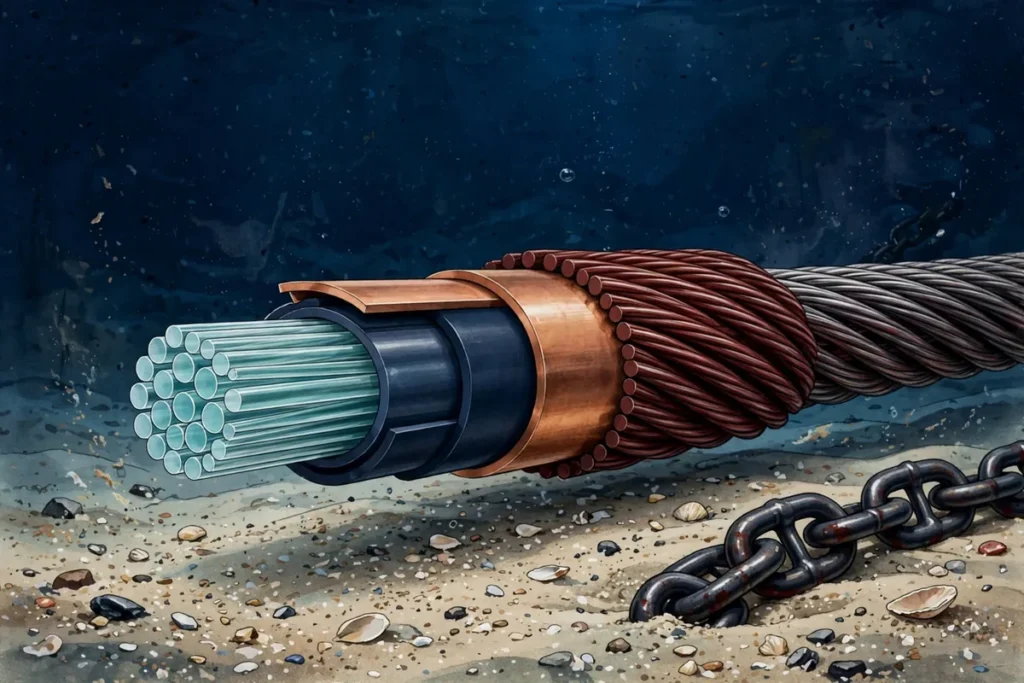
Each cable is a bundle of glass fibres about the diameter of a garden hose, wrapped in steel-wire armour, copper sheathing and polymer layers. They lie unprotected across most of the seabed, marked on nautical charts, and are owned by private telecoms consortiums rather than governments. No navy guards them. That combination – essential, exposed and privately owned – is what makes them an ideal grey-zone target: damage can be inflicted without firing a shot, and the attacker can claim it was an accident.
Undersea cable sabotage explained: how is a cable actually cut?
There are three practical methods, and they map neatly onto depth. The first, and by far the most common in the Baltic, is anchor dragging. A large cargo ship or tanker drops a heavy anchor to the seabed and keeps moving, using the vessel’s momentum – thousands of tons of inertia – to tear through anything in its path. As a Ukrainian cable expert, Professor Viktor Katko, explained to dev.ua, every captain has charts showing exactly where cables lie, so a ship that drags an anchor for kilometres across a charted cable route is very hard to explain as a navigational error. The Balticconnector gas pipeline and its data cables were damaged this way in October 2023, and the Chinese-flagged Yi Peng 3 is suspected of dragging its anchor for around 180 nautical miles across the Baltic seabed in November 2024.
The second method is for deeper water, where anchors cannot reach: divers or submersibles place explosives on the cable, or use cutting tools at depth. A diver cannot slice a cable with hand tools – the armour is too strong – so this route needs specialist equipment and a state-level operator. The third method is the newest: in March 2025, the South China Morning Post reported that Chinese scientists had unveiled a purpose-built deep-sea cable cutter, developed by the China Ship Scientific Research Centre, capable of severing armoured cables at depths of up to 4,000 metres using a 150mm diamond-coated grinding wheel. The device was described in a peer-reviewed paper in the journal Mechanical Engineer and is designed to mount on crewed or uncrewed submersibles. Analysts at the Lowy Institute cautioned that the announcement was as much theatre as weapon – cables at 4,000 metres are neither armoured nor fortified – but the capability itself is now a matter of public record.
Cutting is not the only option. During the Cold War, the US Navy’s Operation Ivy Bells tapped a Soviet cable in the Sea of Okhotsk, clamping a recording pod onto it without cutting it, and the specially modified submarine USS Jimmy Carter is widely reported to carry the same capability today. Tapping steals information; cutting denies it. The Baltic campaign has been a cutting campaign.
It is worth keeping the scale in proportion. The International Cable Protection Committee records roughly 200 cable faults a year worldwide, and about two-thirds are caused by fishing vessels and ships dragging anchors by accident. Sabotage is a small, deliberate slice of a much larger background of routine damage – which is precisely what makes it deniable.
Why is the Baltic Sea the world’s most exposed cable corridor?
The Baltic is shallow, crowded and dense with cables. Its average depth is only about 54 metres, according to an IEEE research paper published by Spain’s defence ministry, and some sections of the C-Lion1 cable between Finland and Germany run through water as shallow as 20 metres. At that depth, any large ship’s anchor can reach the seabed. More than 35 cables connect the nine countries around the sea, according to the University of Washington’s Jackson School, and around 2,000 ships are on its waters at any given time.
Since 2022, about ten subsea cables have been cut in the region, seven of them in a single 60-day window between November 2024 and January 2025. The Nord Stream pipeline sabotage of September 2022 served as proof of concept that deep-seabed infrastructure is reachable, and the pattern since has been consistent: a vessel with a flag of convenience, an anchor drag of tens of kilometres, and a trail of damaged cables behind it. On November 10, 2026, ten nations of the UK-led Joint Expeditionary Force formalise expanded anti-submarine operations aboard HMS Prince of Wales, directly in response to this campaign – a sign of how seriously the threat is now taken in London, Stockholm and Helsinki.
The Baltic incident file: a timeline of suspected sabotage
The incidents below are the cases investigators have linked to deliberate anchor dragging. Attribution remains contested in most of them: suspicion is not proof, and only one case has ended in a conviction.
- October 2023: the Chinese-flagged Newnew Polar Bear damages the Balticconnector gas pipeline and associated data cables between Finland and Estonia. China later acknowledged the damage but attributed it to a storm.
- November 17-18, 2024: the Chinese bulk carrier Yi Peng 3 is suspected of dragging its anchor for around 180 nautical miles, severing the Arelion cable between Sweden and Lithuania and the C-Lion1 cable between Finland and Germany. China denied European investigators access to the vessel; the Swedish Accident Investigation Authority found no definitive proof of intent, while noting facts that partly contradict the accidental-damage explanation.
- December 25, 2024: the Cook Islands-flagged tanker Eagle S, suspected of belonging to Russia’s sanctions-evading shadow fleet, is suspected of dragging its anchor for about 90 kilometres, cutting the 658 MW Estlink 2 power cable and four telecom cables between Finland and Estonia. Finnish police recovered the vessel’s anchor from the seabed. In October 2026, a Finnish court dismissed the case after prosecutors failed to prove intent.
- December 31, 2025: the cargo ship Fitburg drags its anchor for several hours along the seabed, damaging two telecommunications cables between Finland and Estonia. The vessel, which had left St Petersburg, was detained on New Year’s Eve.
- January 2025: the Chinese-owned Shunxin-39 damages a cable near Yehliu, off Taiwan – part of a wider pattern of cable damage around the island that Taipei has linked to suspicious shipping.
| Metric | Figure | Source |
|---|---|---|
| Active and planned submarine cables | 600+ (CONFIRMED) | TeleGeography |
| Total cable length in service | Over 1.5 million km (CONFIRMED) | TeleGeography |
| Share of intercontinental internet traffic | About 99% (CONFIRMED) | Open Geospatial Consortium |
| Daily financial transactions over cables | $10 trillion (CONFIRMED) | Open Geospatial Consortium; NATO |
| Cable faults per year worldwide | About 200 (CONFIRMED) | International Cable Protection Committee |
| Baltic cables cut since 2022 | About 10 (CONFIRMED) | University of Washington |
| Estlink 2 capacity cut on December 25, 2024 | 658 MW (CONFIRMED) | Datacenter Dynamics |
| Eagle S anchor drag length | About 90 km (CONFIRMED) | Finnish police, via AP |
| Eagle S repair cost | About $70 million (REPORTED) | StrategyPage |
| Fitburg sentences, November 5, 2026 | 3.5 years and 2 years 10 months (CONFIRMED) | Helsinki District Court |
| China deep-sea cutter operating depth | 4,000 metres (REPORTED) | South China Morning Post |
Figures marked CONFIRMED come from two or more independent sources or official statements; figures marked REPORTED rest on a single source and should be treated as provisional.
How do crews find and fix a cut cable?
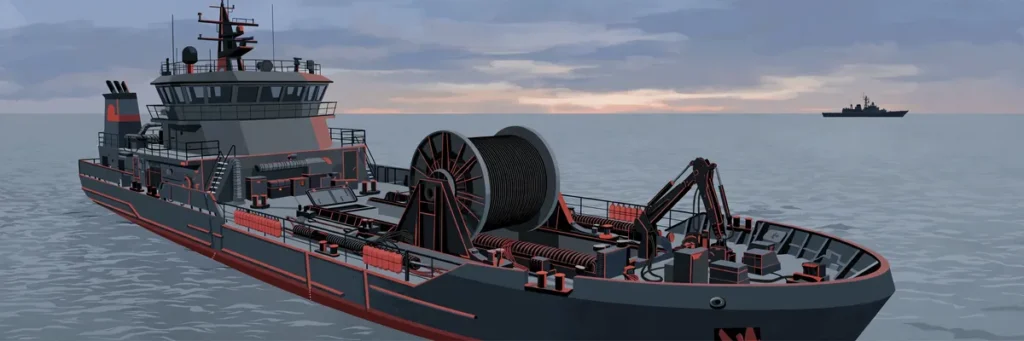
Detection is fast; repair is slow. Operators use optical time-domain reflectometry – sending light pulses down the fibre and timing the reflections – to locate a break to within metres, and repair ships then sail to the site. There are only around 60 specialised cable ships worldwide, and a repair can take weeks: the damaged section is grappled from the seabed, hauled to the surface, and spliced with new fibre. The Eagle S repairs cost about $70 million, according to StrategyPage – a reported figure, but an indication of the scale.
Most users never notice a single cut, because networks spread capacity across several cables and traffic reroutes automatically. The danger is concentration: where many cables share one narrow corridor – the Red Sea, the Strait of Malacca, the Strait of Hormuz – several cuts at once can degrade service across a region. That is why war-risk insurance surcharges and shipping costs rise after cable incidents, even when the internet itself keeps working.
Why do saboteurs almost never face justice?
The legal architecture is the saboteur’s best friend. Under Articles 113 to 115 of the UN Convention on the Law of the Sea, enforcement responsibility for cable damage falls to the flag state of the offending vessel. The ships involved in the Baltic incidents flew flags of convenience – the Cook Islands, St Vincent and the Grenadines – registries with neither the capacity nor the incentive to prosecute. A coastal state can board a suspect vessel in its own territorial waters, as Finland did with the Eagle S, but proving intent is another matter: an anchor drag looks identical whether it is deliberate or negligent, and the Eagle S case collapsed in October 2026 precisely because prosecutors could not prove intent.
Attribution is further complicated by the patchwork of jurisdictions. A cable may cross territorial seas, exclusive economic zones and international waters in a single run, with different rules in each. China denied Swedish prosecutors access to the Yi Peng 3, and the Swedish investigation ended without a finding of intent. Until the Fitburg case, no crew had been convicted anywhere for cutting a cable – and even that ruling, handed down on November 5, 2026, is not final and can be appealed.
What the Fitburg convictions change
The Helsinki District Court sentenced the Fitburg’s Russian captain to three years and six months in prison and the Azerbaijani boatswain to two years and ten months, after finding they dragged the ship’s anchor along the seabed for several hours on December 31, 2025, damaging two telecommunications cables. The vessel had left St Petersburg bound for Haifa, and the cable belonged to the Finnish telecoms group Elisa. It is the first time a court has jailed anyone for undersea cable sabotage.
The deterrent effect is already visible. Finland’s navy chief, Rear Admiral Tuomas Tiilikainen, said on November 9, 2026, that Finland has recorded no additional attacks against its underwater infrastructure since the Fitburg incident. But the limits are equally visible: the Eagle S dismissal a month earlier shows that intent remains extremely hard to prove, and the Fitburg convictions rest on unusually strong evidence – a detained vessel, a recovered anchor trail and a cooperative prosecution. The next case may not be so clean.
How NATO and the Joint Expeditionary Force are fighting back
The military response began in January 2025, when NATO launched Baltic Sentry after the Eagle S incident: frigates, maritime patrol aircraft and naval drones, coordinated through a maritime awareness tool called Mainsail that fuses public, space-based, commercial and International Maritime Organisation data. On November 3, 2026, NATO’s Assistant Secretary General for Operations, Christian Buck, told the European Parliament’s defence committee that attacks on undersea cables in Europe’s north had “largely stopped” since the operation began, with the last incident in January 2026 and limited in scope.
The numbers support the claim. Finland’s navy chief said on November 9 that NATO generally keeps at least three warships deployed for every Russian military vessel in the Baltic – currently about four to one – and that at least 13 operations to intercept and inspect suspected shadow-fleet vessels have been conducted across Europe this year. The European Union has responded with sanctions on the shadow fleet and a cable-security action plan. The next step is the Joint Expeditionary Force pact on November 10, which formalises expanded anti-submarine operations across the Baltic and the Atlantic, building on the Royal Navy’s tracking of Russian submarines near cables and pipelines. The UK’s own military posture is set out in our United Kingdom country profile.
What undersea cable sabotage means for US, UK and EU readers
For most readers, a single cable cut changes nothing you can see: redundancy means your broadband, banking apps and video calls keep working. The risk is cumulative and concentrated. A coordinated attack on several cables at a chokepoint – the Red Sea, where Houthi-linked damage was reported in 2024, or the Strait of Hormuz – could slow international services, push up insurance and shipping costs, and disrupt the $10 trillion a day in financial transactions that flow through these cables. Energy is the sharper edge for Europeans: Estlink 2 is a power cable, and cutting it removed 658 MW of Finland-Estonia interconnection capacity at the height of winter.
The practical consequences are already in your bills and your news: higher war-risk insurance on shipping, naval patrols that cost taxpayers money, and a new category of geopolitical risk that businesses must price in. The honest assessment is that the system is resilient but not invulnerable – and that the defence now depends less on the cables themselves than on patrols, prosecutions and the political will to treat an anchor drag as what it usually is.
What to watch next on the seabed
Five things will show whether the Fitburg convictions and the JEF pact mark a turning point. First, whether the JEF’s November 10 commitments translate into sustained patrols rather than a one-day ceremony. Second, whether the Fitburg ruling survives appeal – a reversal would restore the impunity that has defined this campaign. Third, the European Union’s cable-security action plan and whether it produces binding protection standards rather than statements. Fourth, Taiwan, where Taipei is tightening protection of its cables after repeated damage. And fifth, China’s deep-sea cutter: it has been unveiled, not yet observed in use, and its first deployment would signal a move from anchor-drag deniability to purpose-built sabotage. WarBrief will track all five from our conflict zones hub.
Frequently asked questions
What is undersea cable sabotage?
It is the deliberate cutting or damaging of the fibre-optic cables on the ocean floor that carry almost all intercontinental internet traffic. The most common method is dragging a ship’s anchor across the seabed; deeper cables can be cut with explosives or purpose-built cutting devices carried by submersibles.
How many undersea cables have been cut in the Baltic Sea?
About ten subsea cables have been cut in the Baltic since 2022, according to the University of Washington, with seven of those cuts occurring in a 60-day window between November 2024 and January 2025. Most are suspected anchor-drag incidents involving Chinese-flagged or Russian shadow-fleet vessels, though intent has only been proven in court in one case.
Can a cut undersea cable shut down the internet?
No, not on its own. Networks spread capacity across several cables, so traffic reroutes automatically when one fails. The risk comes from several cables being cut at once in a narrow corridor such as the Red Sea or the Strait of Hormuz, which can degrade service and raise costs across a region.
Who is suspected of cutting undersea cables?
Russia and China are the states most often suspected: Russia through its shadow fleet of sanctions-evading tankers in the Baltic, and China through Chinese-flagged vessels in the Baltic and around Taiwan. Attribution is difficult, and most cases have not been proven in court. The Fitburg convictions of November 2026 are the exception.
What is NATO doing to protect undersea cables?
NATO launched the Baltic Sentry mission in January 2025, deploying frigates, maritime patrol aircraft and naval drones to monitor the Baltic Sea. NATO says incidents have largely stopped since then. On November 10, 2026, the UK-led Joint Expeditionary Force formalises expanded anti-submarine operations, and the EU has sanctioned shadow-fleet vessels and drawn up a cable-security action plan.
Sources
- TeleGeography: Submarine Cable FAQs
- University of Navarra: Sabotage of undersea cables – Russia’s and China’s hybrid warfare strategy
- University of Washington: Baltic Sea Undersea Cable Security
- Military.com: NATO Announces a New Mission to Protect Undersea Cables in the Baltic Sea Region
- The New Voice of Ukraine: Finnish court jails Fitburg captain and boatswain over undersea cable damage
- Saudi Gazette: Finnish court jails Russian captain over Baltic Sea cable sabotage
- Lowy Institute: Cutting through the narrative – What China’s deep-sea cable-cutter really signals
- EU Perspectives: Baltic Sentry makes sabotage too costly for Russia, NATO man tells lawmakers
- MENAFN: Finland Navy Chief – NATO Patrols Deter Russian Activity in Baltic Sea


Discussion 0
Share analysis, corrections, or context. Be civil — comments are moderated.