
WarBrief Live | October 16, 2026 | Explainer
Last updated: October 16, 2026. We update this guide when major AI-military developments break.
AI battlefield intelligence is the use of artificial intelligence to gather, process, and act on information at the tactical edge — the drones, sensors, and computers that help frontline forces find targets and strike them faster than ever before. Where strategic military intelligence works at the level of spy agencies and satellites (see our companion piece on AI Military Intelligence), battlefield AI works in the mud: reconnaissance drones with computer vision, sensors fused together near the front, and software that compresses the time from spotting a target to hitting it from minutes to seconds.
Key Takeaways
- AI battlefield intelligence works at the tactical edge — helping frontline forces detect, identify, and target threats — distinct from the strategic spy-agency intelligence in our companion article.
- In Ukraine, the time from spotting a target to firing on it has reportedly fallen from about 20 minutes to under two minutes in some sectors, driven by AI-assisted imagery analysis, drone coordination software, and sensor fusion.
- The U.S. Army is fielding TITAN ground stations that fuse satellite, aerial, and terrestrial sensor data with AI at the frontline, moving sensor fusion into a production program.
- Electronic warfare is the central battleground: jamming has pushed both sides toward fiber-optic drones and onboard AI that works even when radio links die.
- AI targeting has real limits: hallucinations, false positives, data overload, and adversarial tricks that fool military computer vision remain unsolved.
What is AI battlefield intelligence?
AI battlefield intelligence refers to artificial-intelligence systems that support ISR — intelligence, surveillance, and reconnaissance — and targeting at the tactical and operational level. In plain terms: machine-learning software that watches drone video feeds, fuses data from radars and satellites, flags objects that look like tanks or launchers, and gets that information to someone who can act on it — all faster than human analysts alone could.
It is important to separate two levels of AI in war. Strategic intelligence is the domain of agencies and headquarters: satellite imagery at scale, signals intelligence, long-term analysis. That world is covered in our companion explainer, AI Military Intelligence: How Algorithms Serve the Spy World. Tactical AI, by contrast, lives close to the fighting: an algorithm running on a drone that picks out vehicles in a live feed, or a mobile ground station that merges several sensor sources into one target list. Tactical AI deals in seconds, not days — and its mistakes can kill people in minutes.
How does AI speed up battlefield targeting?
The core military concept here is the kill chain: detect, identify, locate, decide, assign a weapon, attack, and assess. Historically, each stage involved different people, units, and communications systems, and every handoff burned time — time a mobile launcher used to relocate. AI battlefield intelligence attacks that delay at almost every stage.
The most vivid evidence comes from Ukraine. The Financial Times reported in September 2026 that identifying a target and launching a strike took about 20 minutes at the start of the war; under some current battlefield conditions, the same process can take less than two minutes — and sometimes just seconds. Reporting from the eastern front describes Ukrainian forces sharing live drone video and coordinates across nearby units almost instantly, with the gap between spotting an enemy position and firing artillery down to roughly three to five minutes. These figures are not a universal average across the front — that caveat matters — but the direction of travel is unmistakable.
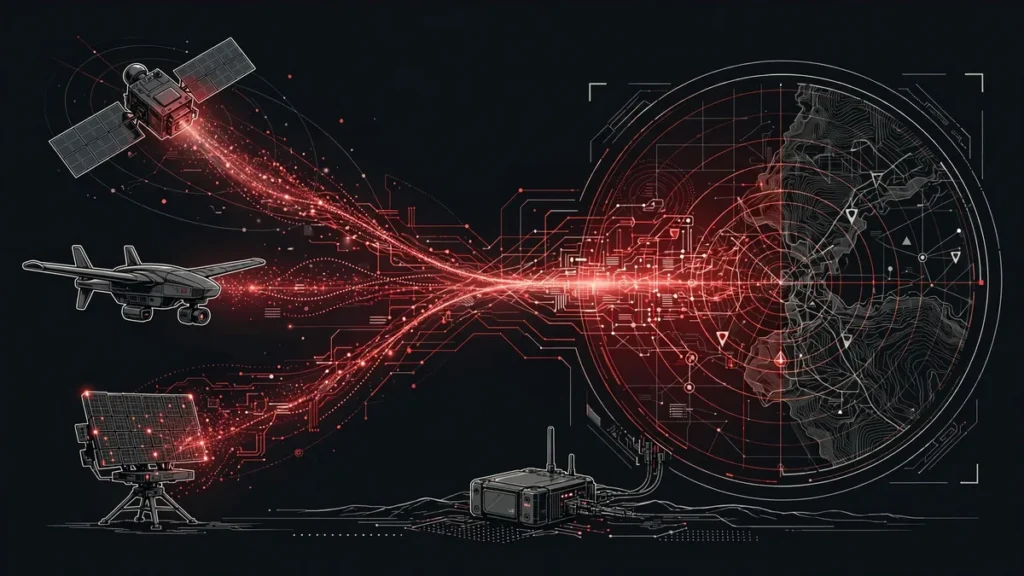
Three building blocks drive this. First, computer-vision target recognition: software scans drone and satellite video for military objects in seconds. Ukraine’s defense ministry said in August 2026 that AI has cut by up to 90 percent the time its analysts need to detect enemy activity in imagery — while insisting humans retain strike authority. Second, battlefield coordination software: Ukraine’s Delta system has grown from a digital map into a command layer linking drone feeds, radios, satellite imagery, and unit reports. Third, automated battle planning: Ukraine has tested “Marichka,” a closed neural network designed to compress brigade-level planning from six to twelve hours down to minutes — still in testing, with the commander keeping the final decision.
Which battlefield systems use AI for intelligence and targeting?
The clearest sign that AI battlefield intelligence has moved from experiment to program of record is TITAN, the U.S. Army’s Tactical Intelligence Targeting Access Node. On September 1, 2026, the Army moved TITAN into production with $192 million in initial delivery orders to Palantir Technologies and Anduril Industries for eight systems — four Advanced and four Basic variants, delivered over 18 months. These are crewed mobile ground stations with access to space, high-altitude, aerial, and terrestrial sensors, designed to fuse that data with AI and hand actionable targeting information to commanders and long-range precision fires: multi-domain sensing condensed into a sensor-to-shooter node at the edge.
The Army’s experimentation pipeline runs parallel. The XVIII Airborne Corps’ Maven-assisted targeting experiments, described in Defense News via a nonprofit security-research center’s report, compressed a target pass to under one minute and matched the targeting workload of the 2003 Iraq invasion’s time-critical cell — which needed more than 2,000 staff — with about 20 soldiers. Those are experimental benchmarks, not Army-wide deployment, but they show what the technology can do when the data pipeline is in place.
On the Ukrainian side, the human-in-the-loop principle is officially retained: software can detect a possible target and shorten assessment time, but a human operator decides whether to strike. The AI layer is framed as a speed advantage, not a delegation of authority.
How is electronic warfare changing AI battlefield intelligence?
On today’s battlefields, sensors and signals are weapons, and electronic warfare (EW) — jamming, spoofing, and signal interception — shapes everything AI can see. The drone war in Ukraine has become an adaptation cycle: every successful countermeasure provokes a technical answer. Many inexpensive drones depend on radio links and satellite navigation. Jam the command frequency and a remotely piloted drone goes blind; spoof navigation and it loses its way.
One response has been the fiber-optic FPV drone, which unreels a hair-thin optical cable as it flies — a physical control link no radio jammer can sever. Both sides now field them at scale. The trade-off: cables snap, snag, add weight, and limit range, so fiber-optic drones are EW-resistant, not invincible.
As explored in our AI drone warfare explainer, AI terminal-guidance modules let an FPV drone lock onto a target designated by its operator and finish the final approach even after the radio link is jammed or lost. The broader lesson: EW is pushing AI down to the edge, where sensors must think for themselves because the connection home cannot be trusted.
What are the limits of AI on the battlefield?
The failures of AI battlefield intelligence are less cinematic than its successes, but they are real — and in targeting, they are dangerous.
Hallucinations and false positives. The same models that spot real vehicles also misclassify them. Computer-vision systems trained on limited battlefield data can flag civilian vehicles as threats or miss camouflaged equipment. A false positive passed to a firing unit can kill civilians — which is why militaries that deploy these tools, including Ukraine’s, publicly retain human authorization for strikes.
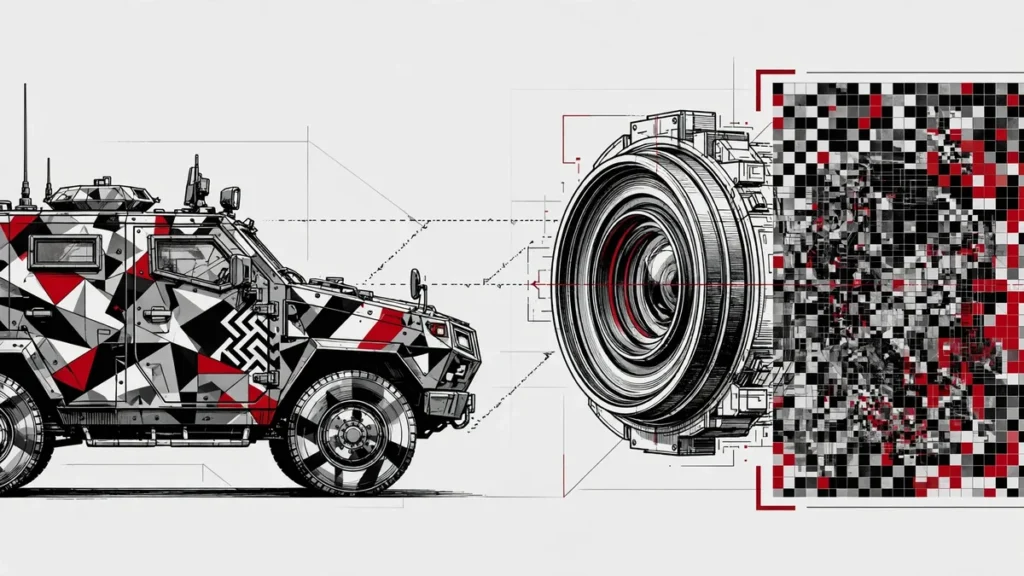
Adversarial manipulation. Military computer vision can be deliberately fooled. Researchers at MIT demonstrated a 3D-printed turtle that a deep-learning vision system confidently identified as a rifle — from every angle. Since then, research has produced adversarial patches that can camouflage aircraft from detection algorithms, and a 2025 study for the Dutch defense establishment designed anti-AI camouflage for naval vessels using patterns calculated to make AI object detectors miss or misclassify ships. A 2026 paper described patches that deceive both optical and infrared detectors at once, with claimed attack success rates above 90 percent in physical tests. Camouflage is no longer just about hiding from eyes — it is about hiding from algorithms.
Data overload. Sensors collect far more than staffs can absorb, and AI only partly solves that. A sensor-fusion system is only as good as the data feeding it; bad inputs, mislabeled training data, and conflicting sensor reports produce confident-sounding errors.
Over-reliance and speed pressure. When the kill chain runs in seconds, there is less time for human verification — and a psychological pull to trust the machine. Military ethicists call this automation bias. The faster the loop, the harder it is for a human on the loop to intervene meaningfully, a concern that carries over into the broader debate over AI in warfare.
Why this matters beyond the battlefield
For readers, the practical stakes are concrete. Defense budgets are being reshaped around AI — the TITAN production award alone commits $192 million in initial orders — and export controls on semiconductors are increasingly framed as battlefield-relevant policy. The deeper significance is a shift in the meaning of military speed: for centuries it meant moving soldiers and shells faster; increasingly it means moving information faster. The side that understands the battlefield first, even by minutes, can act while the other is still orienting.
By the numbers: AI battlefield intelligence
| Metric | Figure | Source |
|---|---|---|
| Target spotting-to-strike time in Ukraine, 2022 | ~20 minutes (REPORTED) | Financial Times, Sept 2026 (via ai-talks.org) |
| Spotting-to-strike in some sectors, 2026 | Under 2 minutes, sometimes seconds (REPORTED) | Financial Times, Sept 2026 (via ai-talks.org) |
| Spotting-to-artillery fire, eastern front | ~3–5 minutes; movement engaged within seconds (REPORTED) | New York Times (via Noah Intelligence) |
| Imagery-analysis time reduction claimed | Up to 90% (REPORTED — Ukrainian MoD claim) | Defence Industry Europe, Aug 2026 |
| TITAN initial production award | $192M for 8 systems (CONFIRMED) | U.S. Army/Palantir announcement, Sept 1, 2026 |
| XVIII Airborne Corps target pass with Maven assist | Under 1 minute (REPORTED — experiment, 2024) | Defense News via CSET report, Aug 2024 |
Caveat: these figures come from different militaries, contexts, and years. Treat them as directional evidence of a trend, not a universal average.
Further reading: The Evolution of OSINT: How Open Source Intelligence Is Changing Warfare
Frequently asked questions
What is AI battlefield intelligence?
The use of AI — mainly computer vision, data fusion, and decision-support software — for intelligence and targeting at the tactical level, close to the fighting. It is distinct from strategic military intelligence, which operates at the level of agencies and satellites.
How does AI speed up battlefield targeting?
AI compresses the “kill chain” — detect, identify, locate, decide, strike — by scanning drone and satellite video automatically, fusing sensor feeds into one picture, and sharing coordinates across units instantly. In Ukraine, spotting-to-strike has reportedly fallen from about 20 minutes to under two minutes in some sectors.
Does AI decide who to strike?
In current declared practice, no — at least not for the militaries that describe their procedures publicly. Ukraine’s defense ministry says it follows a human-in-the-loop principle: software can detect and assess targets, but a human operator authorizes the strike.
How is electronic warfare changing AI battlefield intelligence?
Jamming of radio links and satellite navigation has forced adaptation: fiber-optic drones that cannot be jammed by radio interference, and AI terminal-guidance systems that finish the final approach after the control link is lost. It has also driven adversarial camouflage designed to fool AI vision systems.
What are the limits of AI targeting?
Hallucinations and false positives, adversarial manipulation (patterns that trick computer vision), data overload, and automation bias — the human tendency to over-trust algorithmic output, especially under time pressure. None of these problems is solved, which is why human authorization remains the declared norm.
Sources
- ai-talks.org: Algorithmic Battlefield — How AI Is Rewriting Modern Warfare
- Defence Industry Europe: Ukraine’s defence ministry says AI cuts battlefield imagery analysis time by up to 90%
- Army Recognition: U.S. Army Moves TITAN AI Targeting Into Production With $192M Awards
- Defense News: This system may allow small Army teams to probe 1,000 targets per hour
- Noah Intelligence: Ukraine’s Delta software transforms battlefield operations
- TechRadar: Ukraine reveals in-house AI system to slash battle planning time
- ai-talks.org: Autonomous UAVs — How Drones Are Rewriting Modern Warfare
- MIT Technology Review: Military artificial intelligence can be easily and dangerously fooled


Discussion 0
Share analysis, corrections, or context. Be civil — comments are moderated.