
WarBrief Live | October 31, 2026 | Shipping and Energy
| Brent, October 30 $117.64 a barrel, up 2.4% | Sinokor’s September Hormuz share About 37% of crude volume (Bloomberg) | PGSA non-compliance list About 123 vessels (Seatrade Maritime) | War-risk premiums, early October 6% to 10% of hull value (brokers via FT) |
Iran’s November 1 warning to Sinokor, its designated-route demand and rising war-risk costs are squeezing Hormuz shipping — without closing the strait outright.
Oil is still moving, and United States Central Command says the internationally recognised primary transit routes have been cleared of mines. At the same time, Iran is telling a named shipowner that its whole fleet faces “legal action” from November 1, and insurers are pricing a Hormuz transit as a high-risk voyage. The result is a contested waterway in which two route systems, two legal claims and two very different cost curves operate side by side. This article explains what is confirmed, what is only reported, and what the November 1 deadline actually changes. It is reporting and analysis, not navigation or shipping advice: vessel operators should follow their flag state, insurer and official maritime advisories.
Key Takeaways
- Iran’s Persian Gulf Strait Authority (PGSA) has warned that “legal action” will be taken against all Sinokor vessels from November 1, 2026, after alleging the highest number of transit violations over the past three months.
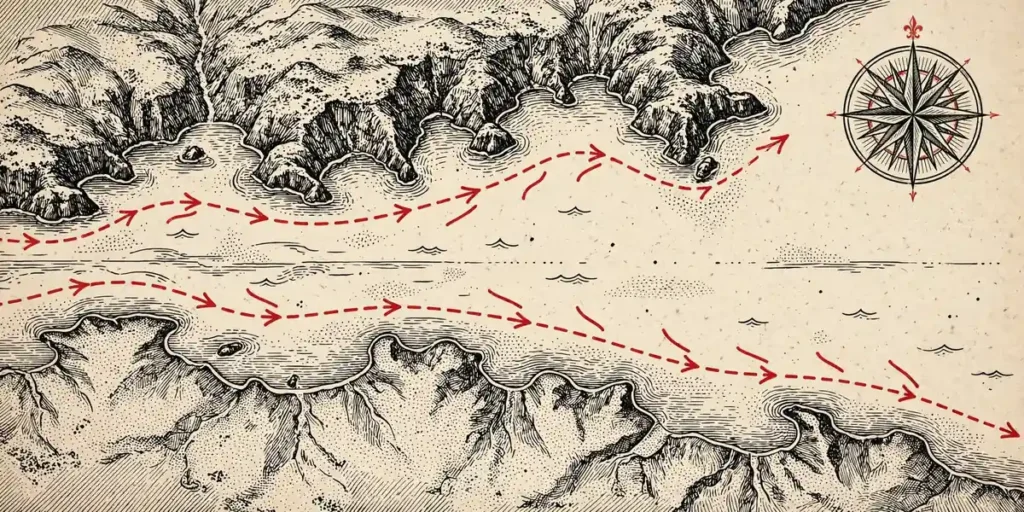
- Iran demands vessels use a designated route and coordinate passage with its armed forces, and treats a southern corridor closer to Oman’s shores as unauthorised; the United States coordinates transits through a southern corridor and says primary routes are clear of mines.
- Brent crude settled at $117.64 a barrel on October 30, 2026, after touching $118, as tanker incidents in the strait highlighted supply risk.
- War-risk premium figures vary by basis and date: brokers quoted 6% to 10% of hull value in early October, while a separate cargo-value measure reached 10% in a Reuters analysis on October 22 — they are not one blended rate.
- The Korea Shipowners’ Association disputes Iran’s account, saying the vessels in question were sub-chartered and carried no South Korean crew, and Sinokor is seeking clarification from Tehran.
What is Iran’s designated Hormuz route, and who recognises it?
Iran’s position, as stated by its Islamic Revolutionary Guard Corps (IRGC) and the PGSA, is that vessels must use a designated route through the Strait of Hormuz and coordinate passage with Iran’s armed forces. The IRGC has said tankers that used routes it describes as unauthorised, switched off navigation systems and ignored radio warnings encountered incidents or struck mines. Those mine claims have not been independently verified, and Reuters has reported that they could not be independently verified. What is confirmed is the demand itself, and the competing claim from Washington.
Admiral Brad Cooper, commander of US Central Command, said in a video released on October 30 that US forces had “successfully cleared the strait’s internationally recognised primary transit routes of Iranian sea mines” and remain present to keep those routes free and clear. The United Kingdom Maritime Trade Operations (UKMTO) agency continues to log incidents independently of either side’s route claim. That three-way picture — an Iranian designated route, a US-coordinated corridor and UKMTO incident reports — is the essential context for every Hormuz shipping story this week.
The PGSA, established in May 2026, presents itself as the authority managing vessel movement through the strait and requires detailed vessel information before passage, covering ownership, charterers, crew nationalities and cargo, according to trade reporting. It publishes a “non-compliant vessels” list: Seatrade Maritime puts that list at 123 entries, while other reports describe it as more than 120 vessels. Vessels on the list face, in the PGSA’s words, restrictions on future passages, including fines, detention or confiscation. No Western government, the International Maritime Organization or any party to the UN Convention on the Law of the Sea has recognised the PGSA’s permit requirement, and transit passage through international straits cannot be suspended or conditioned under that convention.
Why is Sinokor being singled out?
Sinokor Merchant Marine, the South Korean tanker group, is being singled out for scale and visibility. According to Bloomberg vessel-tracking analysis cited by trade outlets, Sinokor-controlled tankers transported about 105.6 million barrels of crude through the Strait of Hormuz in September 2026, about 37% of the 286.3 million barrels that passed through the strait that month. Seatrade Maritime, citing Lloyd’s List Intelligence data, reports a different measure — 47% of Hormuz very large crude carrier (VLCC) transits in September, and more than 50% in the first 10 days of October. The two figures are not contradictory: one measures crude volume, the other the share of VLCC transits. By either measure, Sinokor is the largest single carrier still moving Gulf crude at scale while other owners have cut back.
The PGSA’s statement, posted on social media on October 27, said Sinokor vessels “have committed the highest number of crossing violations over the past 3 months” and that “appropriate enforcement actions have been taken against at least 7 of them”. It then warned cargo owners, stakeholders and insurers that “as of November 1, legal action will be taken against all vessels of this company”. The statement did not specify what form that legal action would take. Trade reporting notes this is the first time the PGSA has issued a blanket warning covering an entire owner’s fleet, rather than naming individual vessels. Lloyd’s List has separately reported that seven Sinokor vessels were attacked in the waters concerned, but the PGSA statement itself refers only to legal action — a distinction worth keeping, because “attacked” and “subject to legal action” are not the same claim.
Sinokor’s side is also on the record. The Korea Shipowners’ Association has said the vessels identified in the dispute were sub-chartered to an overseas oil company and carried no South Korean crew, and that Sinokor was unaware of the PGSA’s separate warning and was checking the circumstances. That dispute does not settle whether any vessel broke a rule, but it means the November 1 warning cannot be read as an agreed fact between the parties. It is an Iranian claim and a deadline, contested by the industry body that speaks for the owner.
By the numbers: Hormuz shipping on October 31, 2026
| Metric | Figure | Source |
|---|---|---|
| Brent crude, October 30 settlement | $117.64 a barrel, up 2.4%, after touching $118 (CONFIRMED) | Reuters via Business Times / The Tribune |
| Sinokor crude through Hormuz, September | About 105.6 million barrels, about 37% of strait volume (CONFIRMED as Bloomberg analysis) | Bloomberg via Seatrade Maritime / Newspim |
| Sinokor share of Hormuz VLCC transits, September | 47% (CONFIRMED as Lloyd’s List Intelligence data) | Lloyd’s List Intelligence via Seatrade Maritime |
| PGSA non-compliance list | About 123 vessels (CONFIRMED as Seatrade Maritime count) | Seatrade Maritime |
| Sinokor vessels with claimed enforcement action | At least 7 (CONFIRMED as PGSA statement) | PGSA via Seatrade Maritime / Newspim |
| Oman rescue, October 30 | 25 crew evacuated from Panama-flagged merchant ship RITI (CONFIRMED) | Oman’s Maritime Security Centre via AFP |
| UKMTO Lavan incident, October 30 | Vessel 40 nautical miles south of Lavan Island struck by unknown projectile; fire onboard; crew safe (CONFIRMED) | UKMTO via AFP |
| IRGC claim: tankers halted after mine strikes | Three to four tankers (REPORTED, not independently verified) | IRGC via AFP / Reuters |
| VLCC daily freight, Gulf to China | Near $1.4 million a day (REPORTED, Reuters analysis, October 22) | Reuters via SeaNews |
Caveat: figures marked CONFIRMED are confirmed as the stated source’s report or statement, not as independently verified facts about every underlying event; figures marked REPORTED rest on a single or secondary source and should be treated as claims until corroborated.
How much has war-risk insurance risen, and why do the figures differ?
War-risk insurance is where the Hormuz squeeze becomes a number shipowners cannot ignore — and where careless reporting most often goes wrong, because different sources measure different things. Before the US-Israeli war with Iran began on February 28, 2026, brokers typically charged 0.15% to 0.25% of a vessel’s hull value for Gulf cover. By early October 2026, brokers quoted 6% to 10% of hull value for a tanker transit, according to Financial Times reporting summarised by trade outlets. On a $100 million tanker, that is $6 million to $10 million for a single voyage, before cargo insurance.
A separate Reuters analysis dated October 22, 2026, measured insurance on a different basis: the value of the cargo being transported. It found insurance costs had risen from about 3% of cargo value before the war to 10% now, with VLCC daily freight rates nearing $1.4 million. A further update from marine insurance sources on October 31 put additional war-risk premiums for Hormuz transits at 1% to 5% of vessel values, against a previous market benchmark of about 2%. Those ranges overlap but are not identical, because they reflect different dates, vessels, bases (hull versus cargo) and underwriters’ risk appetites. The honest summary is a range with dates attached, not a single rate.
That pricing has a direct operational consequence. When insurance for a single transit costs millions of dollars, some voyages stop being commercially viable even when the waterway is physically passable. That is why CENTCOM’s statement that routes are “free and clear” and insurers’ pricing can both be true at once: one describes mine clearance on recognised routes, the other describes the price of risk after a week of tanker fires, limpet-mine reports and a named-fleet warning. Shippers, charterers and cargo owners are caught between the two — which is exactly why the PGSA addressed its November 1 warning to cargo owners, stakeholders and insurers, not only to shipowners.
What the Hormuz squeeze means for US, UK and EU readers
For readers in the United States, the United Kingdom and the European Union, the Hormuz squeeze reaches household budgets through fuel and freight before it reaches headlines about tankers. Brent at $117.64 a barrel, up about 13% to 14% over October, is already feeding into diesel and petrol prices, and the war-risk and freight surcharges above are added to delivered crude costs before a litre reaches a forecourt. None of this predicts a specific price at a specific pump — refining margins, taxes and exchange rates all sit between Brent and the forecourt — but the direction of pressure is upward while the strait remains contested.
There is a second, quieter effect: schedule risk. When owners wait for insurance quotes, reroute, switch off tracking systems or hold vessels outside the strait, delivery dates slip even for cargoes that eventually arrive. The WarBrief conflict zones hub tracks the wider Iran war context, while our mines explainer covers why tankers have been catching fire, and our shadow-fleet explainer explains the ghost tankers operating outside normal insurance and tracking. Readers who want the overnight incident detail should start with our October 31 overnight roundup; this article is the compliance and costs layer on top of it, not a repeat of it.
What to watch next in Hormuz shipping
First, watch what actually happens on and after November 1: whether any Sinokor-linked vessel is detained, fined, seized or attacked, and whether Sinokor or the Korea Shipowners’ Association publishes a response beyond seeking clarification. Second, watch UKMTO incident reports and Oman’s maritime statements, the most reliable independent check on both sides’ claims this week, including the October 30 rescue of 25 crew from the RITI and the Lavan projectile strike. Third, watch Brent and war-risk quotes together: a falling Brent with still-rising premiums would signal fear of a shipping disruption more than an oil supply cut, while both rising together would signal broader escalation fear. Finally, watch the diplomacy. On October 31, Iran’s supreme leader Mojtaba Khamenei ordered the armed forces to respond immediately and without geographic limits to any new threat, according to a statement on his official Telegram account reported by Arab News and AFP, and Iran’s army warned that any new US attack would spread the war wider. Qatari mediators were in Tehran on October 30, and any progress there would be the first thing that could genuinely lower the insurance curve.
Frequently asked questions
What is Iran’s designated Hormuz route?
It is the route Iran’s Persian Gulf Strait Authority says vessels must use, with passage coordinated with Iran’s armed forces. Iran treats a southern corridor closer to Oman’s shores as unauthorised; the United States coordinates transits through a southern corridor in Omani waters and says primary routes are cleared of mines.
Why is Sinokor facing legal action from November 1, 2026?
The PGSA says Sinokor vessels committed the highest number of transit violations over the past three months and that enforcement action has already been taken against at least seven of them. It has warned that legal action will be taken against all Sinokor vessels from November 1, without specifying the form that action will take. The Korea Shipowners’ Association disputes the account, saying the vessels were sub-chartered and carried no South Korean crew.
How much has war-risk insurance for Hormuz actually risen?
It depends on the basis and date. Brokers quoted 6% to 10% of hull value in early October 2026, against 0.15% to 0.25% before the war. A Reuters analysis on October 22 put cargo-value insurance at 10%, up from about 3% before the war. Late-October additional-premium quotes were reported at 1% to 5% of vessel value. Do not blend these into a single rate.
Is the Strait of Hormuz closed?
No single answer fits all vessels. Iran has said the strait remains closed to passage it has not coordinated, while US Central Command says primary transit routes are free and clear and vessels are transiting. Oil is still moving, but at higher cost and higher risk, and many vessels transit with tracking switched off or under naval coordination.
What should readers watch on November 1?
Whether any Sinokor-linked vessel is detained, fined, seized or attacked, what Sinokor and its industry association say next, what UKMTO reports, and whether Brent and war-risk quotes move together or apart. Those observable facts will matter more than further warnings.
Sources
- Seatrade Maritime: Iran’s Hormuz authority to take “legal action” against Sinokor
- Newspim: Iran Warns Sinokor Merchant Marine of Legal Action Over Hormuz Rule Violations
- Malay Mail (AFP): Strait of Hormuz conflict: Oman rescues sailors as Iran claims tankers hit mines
- Business Times (Reuters): Oil jumps 2%, settles at 6-month highs on fears of escalation in Iran
- Assafina: Iran Threatens Action Against Sinokor Vessels in the Strait of Hormuz
- Assafina: Ship Insurance Costs Rise in Strait of Hormuz Amid Security Risks
- SeaNews (Reuters analysis): Middle East Oil Exports Surge, Yet Tanker Operations Face Ongoing Risks


Discussion 0
Share analysis, corrections, or context. Be civil — comments are moderated.