
WarBrief Live | October 29, 2026 | Breaking Analysis
A Russian drone struck a crowded platform at Dnipro’s main railway station on October 29, 2026, killing at least 13 people and wounding 10 more, Ukrainian officials said, even as a localised ceasefire held in the southern city of Oleshky.
Key Takeaways
- At least 13 people were killed and 10 wounded when a drone hit a platform at Dnipro’s main railway station, President Volodymyr Zelenskyy said, a toll corroborated by Reuters reporting from officials on the ground.
- Ukraine’s air force said it intercepted three jet-powered drones in the daytime attack, but a fourth evaded its defences and hit the station, according to AFP reporting.
- The same day brought further deadly strikes: two 15-year-old girls were killed in Chernigiv, and two people were killed when a drone hit a residential building in Kremenchuk.
- The strike underlines the limits of the Oleshky truce: the ceasefire covers one occupied city, not the wider war, and envoys are still working toward proposed talks in Abu Dhabi between November 6 and 10.
What happened at Dnipro railway station?
A Russian drone slammed into a busy platform at the railway station in Dnipro on Thursday, October 29, 2026, killing at least 13 people, Reuters reported, citing Ukrainian officials. The strike hit a platform where a regular commuter train and a scheduled passenger train were standing, Zelenskyy said, and images released by Ukraine’s emergency services showed bodies on the platform, rescuers helping victims to safety, and two burnt-out passenger trains with their windows shattered.
The state rail company, Ukrzaliznytsia, said a jet-powered drone had hit a platform where a commuter train was preparing to depart for the nearby southern city of Zaporizhzhia. Regional governor Oleksandr Hanzha said in a post on Telegram that at least five more people were wounded in the early count; Zelenskyy later confirmed 13 people killed and 10 injured. Dnipro mayor Borys Filatov wrote on Telegram: “Many people were killed. Lots were injured.” The head of Ukraine Railways, Oleksandr Pertsovsky, said an elevated threat level had been announced, adding on Facebook: “But unfortunately there were still a large number of people on the platform.”
What investigators have confirmed so far is the location, the death toll and the weapon type as described by Ukrainian authorities. What remains unverified is any Russian account of the strike: no Russian statement on the Dnipro station attack appeared in the sources reviewed for this article, and the interception claim rests on Ukraine’s air force. Readers should treat the casualty figures as the latest official Ukrainian count, which may be revised as rescue work continues.
What kind of drone hit the station?
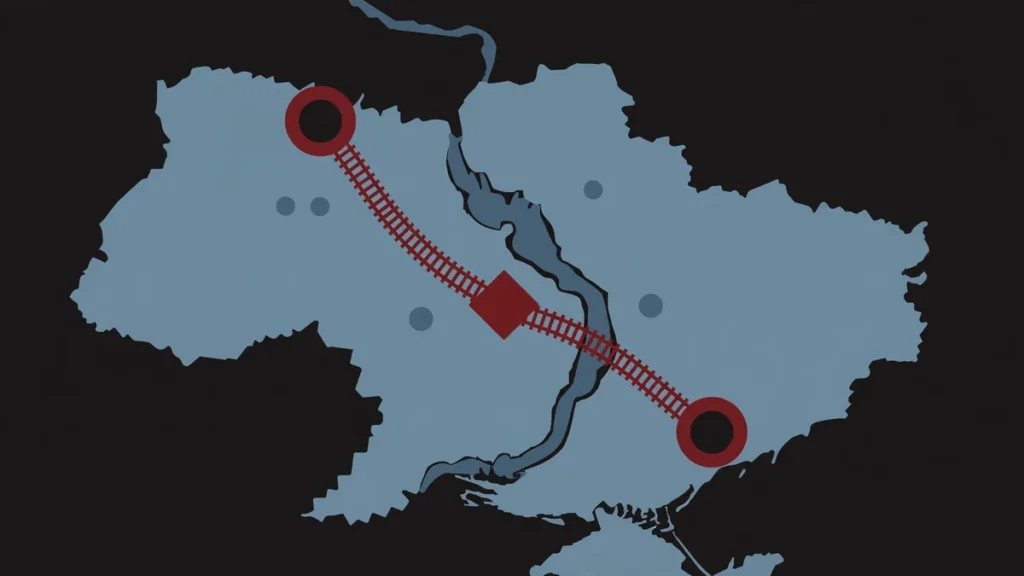
Ukrainian authorities described the weapon as a jet-powered drone. According to AFP’s reporting, Ukraine’s air force said it intercepted three jet-powered drones in the daytime attack, but a fourth evaded its defences and struck the station. Ukrzaliznytsia used the same description, saying a jet-powered drone hit the platform.
The detail matters because jet-powered drones are a newer, faster class of weapon in Russia’s strike arsenal, and the air force’s account suggests an attack pressed in daylight against a civilian transport hub rather than a night-time barrage. That account is, however, a Ukrainian military claim: it has not been independently corroborated in the reporting reviewed, and it should be read as such. What is independently corroborated is the outcome on the platform itself, documented by emergency-service photographs and confirmed by both the regional governor and the president.
By the numbers: the Dnipro strike and a day of attacks across Ukraine
Dnipro was the deadliest single strike of the day, but it was not the only one. AFP’s same-day reporting records further deaths in Chernigiv and Kremenchuk, and at least five more people killed in separate Russian attacks elsewhere in Ukraine, according to local officials.
| Metric | Figure | Source | Status |
|---|---|---|---|
| People killed at Dnipro station | 13 | Zelenskyy; Reuters | CONFIRMED |
| People wounded at Dnipro station | 10 (Zelenskyy); at least 5 (governor, early count) | Zelenskyy statement; Governor Hanzha | REPORTED |
| Jet-powered drones intercepted in the attack | 3 | Ukrainian air force via AFP | REPORTED |
| Drones that hit the station | 1 | Ukrainian air force via AFP | REPORTED |
| Girls aged 15 killed in Chernigiv strike | 2 | City military administration via AFP | REPORTED |
| People killed in Kremenchuk residential strike | 2 | Local governor via AFP | REPORTED |
| Train services evacuated in September 2026 over drone threats | More than 5,800 | Ukrzaliznytsia via AFP | REPORTED |
| Drones that headed toward Moscow overnight | 613 | Moscow mayor via Reuters | REPORTED |
Caveat: figures marked CONFIRMED are corroborated by two or more sources; figures marked REPORTED rest on a single source or an official claim and may be revised.
Why Ukraine’s railways are a target
Russia has fired drones on trains across Ukraine since the first days of its 2022 invasion, destroying hundreds of locomotives and killing several railway workers, according to AFP. The pattern is not incidental. Ukraine’s vast train network is a vital form of transport in a country where journeys between east and west can take 24 hours, and it carries civilians, freight and military logistics alike.
The scale of the disruption is visible in the railway operator’s own numbers: in September alone, passengers were evacuated from more than 5,800 Ukrainian train services due to the threat of Russian drone strikes, Ukrzaliznytsia told AFP. A strike on a station platform at departure time therefore hits both a transport node and public confidence in the network, at the start of a winter in which Russia has intensified drone and missile attacks on energy sites around major cities, in what Kyiv says is a bid to plunge the country into cold and darkness.
A truce in Oleshky, war everywhere else
The Dnipro strike landed on the third day of a fragile local ceasefire in Oleshky, a Russian-occupied city in the southern Kherson region where residents have faced months of food, water and medicine shortages. The truce was holding, both countries said, with the Ukrainian human rights ombudsman Dmytro Lubinets announcing that he had set out with the Ukrainian delegation towards Oleshky through Belarus and Russia. Zelenskyy said on October 28 that it would be a “huge success” if the local ceasefire, brokered with the involvement of US First Lady Melania Trump, allowed for the evacuation of stranded citizens.
But the truce covers one city, not the war. The same week brought the overnight drone operation toward Moscow, in which Russia said it downed most of 613 drones heading toward the capital, as covered in our earlier analysis, 613 Drones Toward Moscow Overnight as Russia Strikes Kharkiv, and a Russian strike on Kharkiv that damaged an educational institution. The Kremlin earlier in the week vowed not to let up in the overall pace of the war even as the sides prepare to restart stalled talks under US mediation. Our explainer on the local truce, Oleshky Ceasefire: What the Localised Ukraine-Russia Truce Covers, sets out exactly what the Oleshky arrangement does and does not cover, and why a local humanitarian pause is not a national ceasefire.
What the Dnipro strike means for US/UK/EU readers
For readers in the United States, Britain and Europe, the strike lands directly in the sanctions debate. In the aftermath of the attack, Zelenskyy refreshed his criticism of a deal struck this month between US President Donald Trump and Russian President Vladimir Putin to ease some sanctions on Russia, allowing Moscow to release diesel onto global markets. He asked:
“How many such terrorist strikes has Russia carried out against our people since sanctions were lifted on some Russian oligarchs and energy sector, instead of de-escalating?”
Zelenskyy urged the European Union, the United States and the G7 to act firmly, saying sanctions against Moscow and its war machine must not be eased for as long as the war continues, and calling for new, stronger sanctions steps. For European readers, the timing compounds an already difficult energy picture: with winter approaching and European gas prices above 100 euros per megawatt-hour, as covered in European Gas Over 100 Euros: What the Winter Price Shock Means, any easing of pressure on Russian energy revenues is now politically harder to defend after a civilian mass-casualty strike.
There is also a practical travel dimension. Ukrainian rail remains operating, but under an elevated threat level, and station platforms are now demonstrated targets. Readers with travel involving Ukraine should expect disruption, evacuation alerts and schedule changes, and should follow the guidance of Ukrainian authorities and their own foreign ministries rather than assuming any route is routine. For the wider public, the strike is a reminder that the war’s civilian toll is not confined to the front line or to energy infrastructure: it reaches the places where ordinary people board trains.
What to watch next in the Ukraine war
Three things will show whether October 29 marks an escalation or a grim continuation. First, the Oleshky test: whether aid reaches the city’s roughly 2,000 remaining residents and whether civilians are evacuated safely, without a ceasefire violation, will signal whether even narrow humanitarian deals can hold. Second, the casualty count from Dnipro and the other October 29 strikes may still be revised as rescue operations conclude. Third, the diplomatic calendar: Zelenskyy has proposed that Ukrainian, Russian and US negotiators meet in Abu Dhabi between November 6 and 10, with a firm US date expected around November 4, after the November 3 US midterms, although the Kremlin has cast doubt on that timetable. Whether the Dnipro strike hardens Western positions on sanctions before those talks is the question to watch.
Read next: 613 Drones Toward Moscow Overnight as Russia Strikes Kharkiv and Kyiv’s Southern Bridge Hit as the Oleshky Truce Holds. For the full picture of the war’s theatres, see our Conflict Zones hub.
Frequently asked questions
What happened at Dnipro train station on October 29, 2026?
A Russian drone hit a busy platform at Dnipro’s main railway station, killing at least 13 people and wounding 10 more, according to President Volodymyr Zelenskyy and Reuters reporting. The platform held a regular commuter train preparing to depart for Zaporizhzhia and a scheduled passenger train.
How many people were killed in the Dnipro station strike?
At least 13 people were killed, a figure confirmed by Zelenskyy and corroborated by Reuters. Zelenskyy said 10 more people were injured; the regional governor’s early count reported at least five wounded.
What kind of drone was used in the Dnipro strike?
Ukrainian authorities described it as a jet-powered drone. Ukraine’s air force said it intercepted three jet-powered drones in the daytime attack, but a fourth evaded its defences and hit the station. That interception account is a Ukrainian military claim and has not been independently corroborated.
Why did the strike happen during a ceasefire?
The ceasefire in force is localised to the city of Oleshky only; it is not a nationwide truce. Fighting has continued elsewhere throughout the Oleshky pause, including the overnight drone operation toward Moscow and strikes on Kharkiv, Chernigiv and Kremenchuk.
What happens next after the Dnipro strike?
Attention turns to the Oleshky aid and evacuation operation, to any revision of the casualty figures, and to the proposed Ukraine-Russia-US talks in Abu Dhabi between November 6 and 10, with a firm date expected around November 4. Zelenskyy has also pressed the EU, the US and the G7 for stronger sanctions on Moscow.
Sources
- Reuters: Russian drone attack on train station kills 13 in Ukraine’s Dnipro
- Channel NewsAsia (AFP): Russian drone strike on Ukraine train station kills 13
- Arab News (AFP): ‘Horrific’ Russian drone strike kills 13 at Ukraine train station: Kyiv
- The Tribune: Zelenskyy says 13 killed in Russian strike on Dnipro; urges tougher western sanctions on Moscow


Discussion 0
Share analysis, corrections, or context. Be civil — comments are moderated.