
WarBrief Live | October 20, 2026 | Explainer
Last updated: October 20, 2026. We update this guide when major AI-military developments break.
AI drone warfare is the use of artificial intelligence to make military drones smarter — able to navigate, recognize targets, coordinate with each other, and keep fighting even when their operators lose contact. Drones have become the defining weapon of the Ukraine war, and AI is being woven into them at every level: from $400 first-person-view strike drones with AI terminal guidance to interceptor drones that hunt other drones, to ground robots running the war’s last-mile logistics. Two distinctions matter throughout: remotely piloted versus autonomous, and today’s deployed technology versus what is still experimental.
Key Takeaways
- Most “AI drones” on today’s battlefields are remotely piloted with AI assistance — AI terminal guidance that locks onto a designated target and finishes the final approach after the control link is lost is the biggest real-world shift of 2026.
- Electronic warfare has driven an adaptation cycle: heavy jamming pushed both sides toward fiber-optic FPV drones (immune to radio jamming) and onboard AI that works without any link.
- Ukraine is becoming a drone-first military: a target of 25,000 unmanned ground vehicles in the first half of 2026, more than 9,000 robotic missions in March 2026 alone, and a goal of shifting 100% of frontline logistics to robots.
- Counter-drone warfare is maturing alongside: AI-guided interceptor drones, electronic warfare, and dedicated testing programs like the U.S. Falcon Peak exercises.
- True swarms remain largely experimental, but the building blocks — navigation, computer vision, coordination — are being proven in combat piece by piece.
What is AI drone warfare?
AI drone warfare means military drone operations in which artificial intelligence performs functions that previously required a human operator in real time: recognizing objects in a camera feed, navigating without GPS, maintaining a lock on a moving target, selecting a flight route, or coordinating multiple aircraft. It spans the air — reconnaissance and strike drones — and increasingly the ground and sea, where unmanned vehicles do logistics, demining, and resupply.
What is the difference between a remote-controlled and an autonomous drone?
This is the distinction the entire subject turns on, and it is worth getting right because headlines routinely blur it. A remotely controlled (remotely piloted) drone is steered moment to moment by a human operator over a radio or fiber-optic link. Most first-person-view (FPV) strike drones — the small quadcopters that have become the workhorses of the Ukraine war, costing as little as $400 to $500 — fall here. The human flies the drone into the target.
AI-assisted drone keeps the human in charge but hands specific functions to software. The clearest example is automated terminal tracking: the operator designates the target through the camera image, and transfers the tracking task to onboard software. If the radio link degrades or dies in the final seconds, the drone can keep tracking the selected object and finish the approach. The human selected the target; the software finished the flight. This model is being scaled in 2026: Germany is financing 50,000 Shrike FPV strike drones for Ukraine running Auterion terminal-guidance software — roughly €90 million — where computer vision locks a moving target in the final phase even after the control link is jammed.
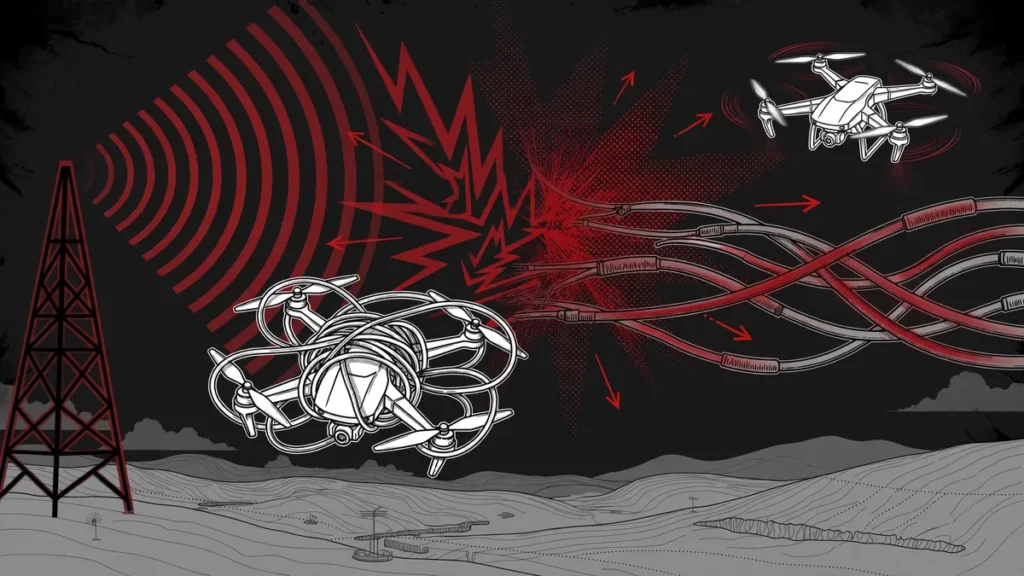
A fully autonomous drone — one that selects its own targets and engagements without human designation — is the third category, and the one with the least real-world evidence in offensive use. Loitering munitions with autonomous engagement against pre-approved target types are reported in some arsenals, but the claims are contested. When someone says “AI drones,” ask which parts of the mission are autonomous. The answer is usually “the final seconds,” not “the whole war.”
How did electronic warfare change drone warfare?
The drone war and the electronic-warfare war are the same war. Inexpensive drones depend on communications and navigation; break those and they fail. Both sides built dense webs of jammers — analysts estimate that at times the majority of conventional FPV flights have been disrupted. That pressure created the conflict’s most striking adaptation.
Fiber-optic FPV drones emerged at scale in 2024–2025 and are now standard on many frontline sectors. Instead of radio, the drone unreels a hair-thin optical cable as it flies; commands and video travel through glass, which no radio jammer can touch. Russia pioneered the approach; Ukraine’s defense ministry authorized its own long-range fiber-optic strike systems in 2026, including the Baton Optik with a strike range exceeding 30 kilometers. The limitations are physical: cables snap and snag, add weight, and cap range. Russia has reportedly answered fiber-optic drones with physical interception — including anti-drone FPV interceptors — since electronic methods do not work.
The second answer is onboard AI: drones that do not need a link at all. AI guidance modules — some reportedly costing under $100 — provide terminal guidance for the final few hundred meters of flight, holding lock through heavy jamming. In September 2026, Ukraine’s Brave1 defense cluster ran standardized trials of AI terminal-guidance modules from seven companies against moving ground targets: six passed, with pilots taking their hands off the controls after lock-on. The number of successful strikes using AI guidance has reportedly risen tenfold since the start of the year.
What has Ukraine taught the world about AI drones?
Ukraine is running the world’s most intense laboratory for drone warfare, and the lessons extend beyond the air. The country created a dedicated Unmanned Systems Forces branch — described in reporting as the world’s first drone air force — with FPV attack drones as its backbone. Beyond strikes, drones are systematically dismantling Russian air defenses: Ukrainian officials reported 194 elements of Russia’s air-defense network hit by drone strikes in the first half of 2026 alone, though that figure is a Ukrainian claim and cannot be independently verified.
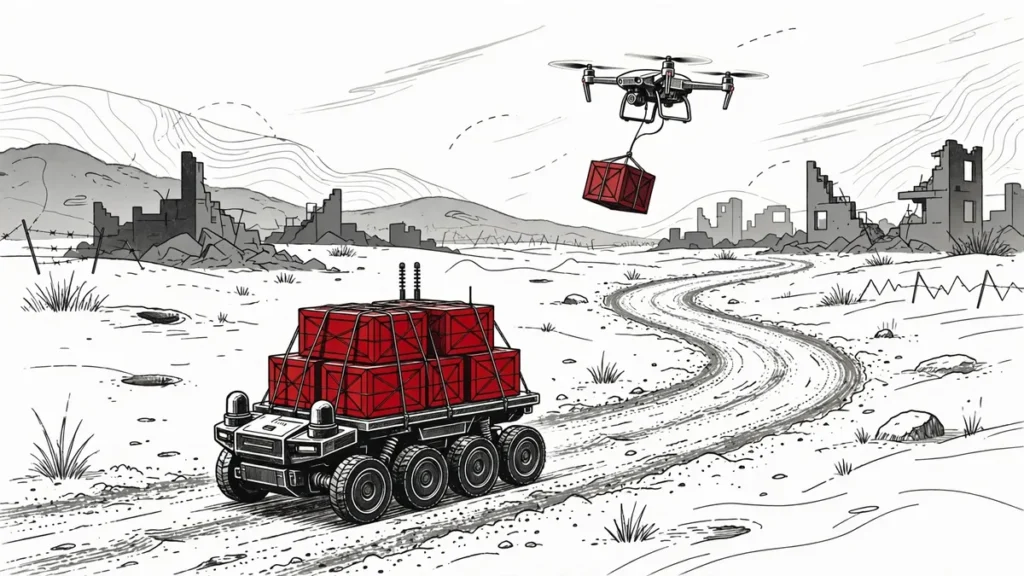
The quieter revolution is on the ground. FPV drones now patrol a kill zone 10 to 20 kilometers deep, making conventional vehicle logistics on the last stretch of the supply chain lethal. The answer has been unmanned ground vehicles (UGVs): Ukraine aimed to contract 25,000 in the first half of 2026, with the defense minister setting the goal that robotic systems handle 100 percent of frontline logistics. In March 2026 alone, troops ran more than 9,000 missions with these systems. Logistics is where battlefield automation is scaling fastest — covered in full in our Ukraine AI warfare lessons piece.
Ukraine is also where drone-on-drone warfare is maturing. Interceptor drones like Perennial Autonomy’s Bumblebee — semi-autonomous quadcopters that destroy small drones by direct collision — are credited with downing Russian FPV and reconnaissance drones, with the company claiming direct-hit rates above 70 percent. The U.S. is adapting the lessons at home: its Northern Command has been testing Ukraine-vetted interceptor drones in “Falcon Peak” counter-drone exercises.
Are drone swarms real yet?
Swarms — dozens or hundreds of drones coordinating autonomously — are the most hyped and least deployed part of AI drone warfare. The demonstrated state of the art is instructive: DARPA’s OFFSET program coordinated swarms of more than 250 drones in urban scenarios — in controlled experiments, not combat. Reports describe “wolf-pack” swarm development in China, but public evidence of combat-deployed autonomous swarms remains thin.
What is combat-proven is coordination one level down: networked drone operations sharing a common tactical picture (see our AI battlefield intelligence explainer), drone-ground teaming — Ukraine claimed a September 2026 “world-first” of bomber drones airdropping explosive ground robots behind Russian lines — and massed one-way-attack campaigns like Russia’s Shahed strikes, which are pre-programmed and remotely launched, not AI-autonomous. The swarm future is being assembled piece by piece, but a truly autonomous combat swarm remains an experiment, not a battlefield fact.
How do you defend against AI drones?
Counter-drone — or C-UAS (counter-uncrewed aircraft systems) — is now a full discipline, from electronic warfare (jamming and spoofing) through physical interception (interceptor drones, nets, guns) to radar-guided systems. The hard problem is economics: defending against cheap drones has historically required missiles costing hundreds of thousands or millions of dollars, an exchange ratio no defender can sustain — which is why AI-guided interceptors costing a fraction of a missile are scaling.
AI is entering both sides of that equation. Attackers use AI terminal guidance to defeat jamming; defenders use AI for detection, tracking, and autonomous interception. The cat-and-mouse cycle shows no sign of slowing: every successful countermeasure — jamming, fiber optics, interceptors — has produced a technical answer within months.
Why this matters beyond the battlefield
The Ukraine war has collapsed the timeline between laboratory and battlefield for drone AI, and the lessons are being absorbed by every major military. The U.S. Army’s AI-defined targeting programs, covered in our AI warfare overview, build on the same sensor-to-shooter logic Ukraine is proving daily. Initiatives like the Pentagon’s Project Meridian are accelerating the integration of AI into defense planning.
For readers outside the military, three implications stand out. First, the democratization of precision strike: capabilities that once required a guided missile now come in a $500 quadcopter with a $100 AI module — a proliferation reality with consequences for terrorism, critical-infrastructure protection, and export controls. Second, civilian airspace and infrastructure are already in the blast radius of the drone age: airports, power grids, and shipping are all adapting to threats that look nothing like conventional attack. Third, the autonomy question remains unresolved: today’s drones are overwhelmingly human-controlled, but each generation delegates more — and the international rules for where that stops, detailed in our autonomous weapons explainer, are still being written.
By the numbers: AI drone warfare
| Metric | Figure | Source |
|---|---|---|
| Cost of an FPV strike drone | As little as $400–500 (REPORTED) | Afterburner/Ukraine reporting, Sept 2026 |
| AI terminal-guidance module cost | Under $100 (REPORTED — manufacturer claim) | UAS Vision on The Fourth Law’s TFL-1 |
| Shrike FPVs financed by Germany | 50,000, ~€90M, with Auterion AI guidance (REPORTED) | July 2026 reporting |
| Growth in successful AI-guided strikes | Tenfold since start of 2026 (REPORTED — Brave1/MoD) | The Defender, Sept 8, 2026 |
| Ukraine UGV procurement target, H1 2026 | 25,000 units (CONFIRMED — ministerial announcement) | Defense News, Apr 24, 2026 |
| Robotic missions by Ukrainian troops, March 2026 | More than 9,000 (REPORTED — MoD) | Defense Minister Fedorov, Apr 2026 |
| Amphibious UGV resupply mission | 40+ km over land and water, Sept 29, 2026 (REPORTED) | Ukraine MoD via defence media |
| DARPA OFFSET swarm size | 250+ drones coordinated (REPORTED — experiment) | DARPA program reporting |
Caveat: cost figures and operational claims come from manufacturers, officials, and media reporting; battlefield claims are not independently verifiable. Experimental results (OFFSET) should not be read as deployed capability.
Frequently asked questions
What is AI drone warfare?
Military drone operations where artificial intelligence performs functions once done by human operators — recognizing targets in video feeds, navigating without GPS, locking onto moving targets, or coordinating aircraft. It covers strike drones, reconnaissance drones, interceptor drones, and increasingly unmanned ground and sea vehicles.
What is the difference between a remote-controlled and an autonomous drone?
A remote-controlled drone is steered moment to moment by a human over a radio or fiber-optic link. An AI-assisted drone keeps the human in charge but hands specific tasks — like terminal guidance after target lock — to software. A fully autonomous drone would select and engage targets without human designation, a category with little publicly confirmed offensive deployment today.
Are drone swarms real?
Mostly not yet in combat. DARPA has demonstrated coordination of 250+ drones in experiments, and China is reported to be developing “wolf-pack” swarms, but publicly confirmed autonomous combat swarms remain rare.
How do you defend against drones?
Counter-drone combines electronic warfare (jamming, spoofing), physical interception (interceptor drones, guns, nets), and radar-guided systems. The central challenge is cost — cheap drones against expensive defenses.
Sources
- The Defender: The number of successful strikes using AI guidance has increased tenfold (Sept 2026)
- Grosswald: Germany funds 50,000 Shrike FPV drones with Auterion terminal guidance (July 2026)
- ai-talks.org: Autonomous UAVs — How Drones Are Rewriting Modern Warfare
- Defense News: Ukraine to field 25,000 ground robots in push to replace soldiers for frontline logistics
- Defence Blog: U.S. puts Ukraine-tested interceptor drones through border tests
- Ukraine Ministry of Defence: Baton Optik fiber-optic strike drones authorized (via GlobalSecurity)
- UAS Vision: $100 AI upgrade gives Ukrainian FPV drones accuracy in heavy jamming
- Defence Redefined: Amphibious UGV completes first resupply mission (Sept 29, 2026)



Discussion 0
Share analysis, corrections, or context. Be civil — comments are moderated.