
WarBrief Live | October 30, 2026 | Analysis
Last updated: October 30, 2026. We update this guide when major AI-military developments break.
No war in history has been shaped by artificial intelligence the way Russia’s war on Ukraine is being shaped right now. From AI-guided turrets shooting down jet-powered drones over Kyiv to British firms training drone-swarm algorithms on millions of real battlefield detections, ukraine ai warfare has become the world’s live laboratory for what AI does to combat. This is not another news roundup — our companion piece “AI in the Russia-Ukraine War: The AI Laboratory” covers the developments themselves. This article asks the harder question: what do those developments teach the world’s militaries about the wars of the next decade?
Key Takeaways
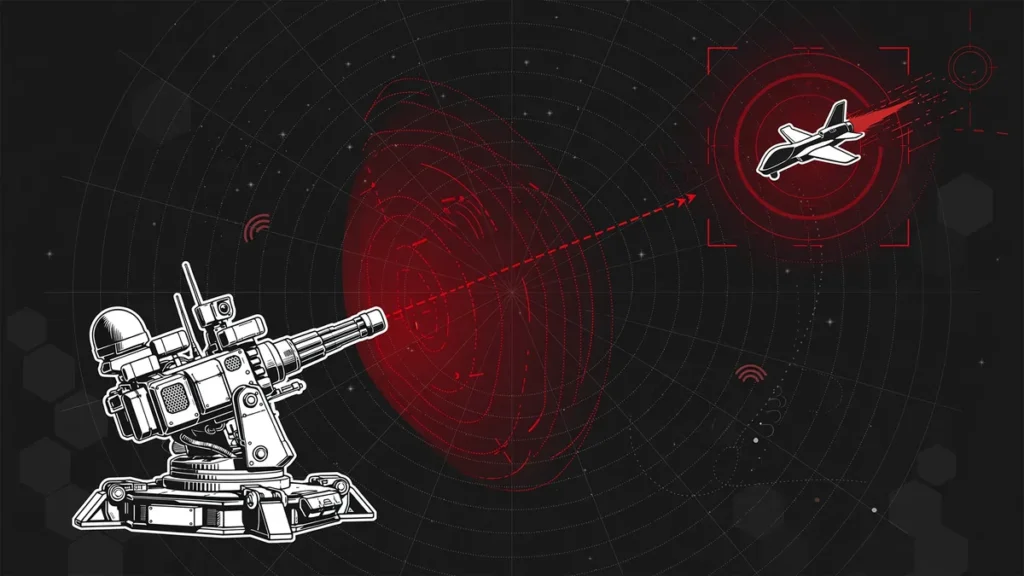
- Ukraine is now fielding AI-guided automated turrets that engage Russian jet-powered drones with computer vision — 12 were installed around Kyiv in early October 2026, with more on the way.
- Russia fired more than 3,000 jet-powered drones at Ukraine in September 2026 alone, and is reported to be producing about 3,000 a month — a scale that makes AI-assisted defense unavoidable.
- The central lesson is the adaptation cycle: whoever learns fastest from battlefield data — drones, counter-drones, electronic warfare, counter-countermeasures — wins the month. AI accelerates that loop on both sides.
- Ukraine’s deal giving British firms access to 6+ million battlefield object detections is turning combat footage into the training data of future Western drone swarms.
- Neither side has demonstrated fully autonomous lethal targeting; claims of “autonomy” remain claims. Human involvement is still the norm, and that restraint is itself a lesson.
What makes Ukraine the world’s first AI-shaped war?
Wars have always been laboratories; Ukraine is the first where the laboratory runs on data. Every drone sortie produces video; every interception produces telemetry; every electronic-warfare duel teaches both sides’ algorithms something new. The result is a conflict where machine-learning systems are embedded in the daily rhythm of fighting — not as a futuristic overlay, but as the plumbing: computer vision that helps turrets track targets too fast for human gunners, AI that funnels incoming drones into narrower flight paths, and planning tools that digest battlefield data for operational decisions.
The scale is what forces the issue. In September 2026, Russia fired more than 3,000 jet-powered drones at Ukraine, according to the Ukrainian Air Force — and Ukrainian military intelligence estimates Russian factories are now producing roughly 3,000 Geran-4 and Geran-5 jet-powered drones every month, alongside some 2,800 conventional Geran-2s. An Associated Press report from October 1 described the new reality: the drones fly at hundreds of kilometers per hour, leaving crews seconds to react, while Ukraine’s fastest interceptors manage only 300–400 kph. At that speed and volume, unaided human defenders cannot keep up. AI is not a luxury upgrade — it is the only way the defense math closes.
What are the newest AI developments on the battlefield?
The first days of October 2026 produced a milestone. Ukraine confirmed the operational deployment of autonomous computer-vision-guided machine-gun turrets capable of detecting, tracking, and engaging incoming Geran-5 drones without direct human trigger activation. On October 4, President Volodymyr Zelenskyy said Ukraine had already installed 12 such automated turrets around Kyiv, with more on the way — and on October 5, Ukrainian officials reported the turrets had been used to shoot down Russian jet-powered drones, including the Geran-5.
Two caveats matter. First, “without direct human trigger activation” describes the engagement loop for fast-moving air threats — it does not mean Ukraine has fielded fully autonomous weapons making their own targeting decisions in general combat, and no verified evidence of that exists on either side. Second, the systems have short effective range and are one layer in a layered defense. Still, the direction is unmistakable: when threats move at jet speed, the engagement decision migrates toward the machine.
Elsewhere the AI footprint keeps widening. Ukraine is developing SPECTR, an AI-powered system for analyzing battlefield data and supporting operational planning, built by the A1 Artificial Intelligence Center under the Ministry of Defence, with several combat units already testing it. Ukraine’s P1-SUN JetKiller interceptor drone destroyed a Geran-5-type small cruise missile for the second time. And on the industrial front, Shield AI and Australia’s Innovaero announced the integration of the Hivemind autonomy platform into next-generation OWL loitering munitions. For the drone-domain primer, see our AI drone warfare explainer and the taxonomy of AI autonomous weapons.
What are the five lessons future militaries should take from Ukraine?
1. The adaptation cycle is the weapon. Ukraine’s war is a duel of learning loops: drones improve, electronic warfare degrades them, countermeasures restore them, and the cycle repeats in weeks. AI accelerates every turn. The side that completes the loop fastest wins the month. Future militaries should invest less in the perfect platform and more in the speed of redesign.
2. Cheap mass beats exquisite scarcity. A jet-powered drone costs a fraction of the interceptor fired at it, and Russia’s reported output of ~3,000 a month exploits that asymmetry ruthlessly. The US Army’s move to advance 30 finalists in a competition for cheaper Patriot-class interceptor alternatives — reported in October 2026 — shows even the richest military on earth has absorbed the lesson. AI is what makes cheap mass usable.
3. Data is now ammunition. The September 2026 deal between the British government and Ukraine gives up to 12 British firms access to a database of imagery and video from Ukrainian drones containing over 6 million detections of tanks, artillery, air defenses, infantry, and aerial targets — explicitly to train AI models for drone swarms. Combat footage has become training data. Every future war will generate the dataset that trains the next war’s algorithms, and militaries that cannot collect, label, and exploit their own data will fight blind.
4. Electronic warfare is the silent front. Ukraine uses EW and AI to funnel Russian drones into narrower corridors where interceptors have a chance. Russia constantly adapts frequencies and flight profiles. The lesson: in a drone-saturated battlespace, the spectrum is terrain. AI that can sense, jam, and spoof at machine speed is as important as the drones themselves.
5. Human control is a choice — and a competitive question. The British government stressed that in the drone swarms its firms are developing, “there is always human involvement.” Neither side has shown fully autonomous lethal targeting. But the pressure to delegate more to machines grows with every speed increase — and the side that keeps meaningful human judgment while moving fastest will have solved the hardest problem of all.
How do drones, EW and cyber fit together?
Ukraine teaches that these are not separate domains but one kill web. Drones find targets; EW blinds and misdirects; cyber operations (kept brief here — see our dedicated Russia-Ukraine cyber warfare analysis) disrupt command networks; AI stitches the three together by fusing sensor data and recommending actions. The commander of Ukraine’s Unmanned Systems Forces, Robert “Madyar” Brovdi, put the cultural shift bluntly: “Drones are the plague of the third millennium.” In the drone-saturated kill zone, some estimates cited by CSIS suggest more than 90% of Russian casualties are now caused by drones — a figure CSIS attributes to “some estimates,” not a comprehensive count, and which should be read as an indicator of scale, not a verified statistic.
The industrial lesson is equally stark. Germany and Ukraine signed fourteen defense-industry agreements worth approximately €6.6 billion in October 2026, centered on drones, radars, and interceptors — plus €1 billion in military assistance. Innovation without industrialization is a demo; Ukraine’s war punishes anyone who cannot manufacture at scale.

Ukraine AI warfare: by the numbers
| Metric | Figure | Source |
|---|---|---|
| Russian jet-powered drones fired at Ukraine, Sept 2026 | 3,000+ | Ukrainian Air Force (CONFIRMED) |
| Estimated Russian monthly production: jet-powered drones (Geran-4/5) | ~3,000/month | Ukrainian military intelligence (REPORTED — estimate) |
| Automated AI turrets installed around Kyiv (Oct 4, 2026) | 12, more on the way | President Zelenskyy (CONFIRMED statement) |
| Battlefield object detections shared with UK firms for swarm-AI training | 6,000,000+ | UK government, Sept 2026 (CONFIRMED) |
| Zelenskyy: overall drone neutralization / jet-powered interception rate | ~70% / 57% | Zelenskyy (REPORTED — official claim) |
| Estimated Russian casualties since Feb 2022 | ~1.4M, incl. up to 450,000 dead | CSIS, Jul 2026 (REPORTED — analysis estimate) |
| H1 2026 casualty ratio (Russian:Ukrainian) | ~8:1, partly attributed to drones incl. AI-enabled | CSIS, Jul 2026 (REPORTED — analysis estimate) |
| Germany–Ukraine defense-industry agreements, Oct 2026 | 14 deals, ~€6.6B + €1B aid | Foreign Affairs Forum (REPORTED) |
Caveat: casualty and production figures are estimates from the cited analyses and official claims, not independently verified counts. Ukrainian and Russian official statements are claims, not confirmed facts.
Why this matters beyond the battlefield
Ukraine’s lessons are already migrating. British firms are turning Ukrainian combat data into drone-swarm AI for Western arsenals. Gulf states are buying Ukrainian counter-drone know-how. The US Army is redesigning its interceptor economics. What is proven in Ukraine becomes procurement doctrine in Washington, London, Warsaw, and Taipei within a few years — which is why the war’s AI experiments matter far beyond its borders.
For readers, the practical takeaway is about the character of future wars: they will be faster, more automated, and fought at a scale of machines that makes human heroism less decisive and industrial-data capacity more so. The air war’s escalation — Russia’s strikes on Ukrainian cities — is tracked in our Putin air-war analysis. Our 2030–2040 battlefield forecast projects where these lessons lead next.
Frequently asked questions
Is Ukraine using fully autonomous weapons?
No verified evidence exists of fully autonomous lethal targeting by either side as of October 2026. Ukraine’s automated turrets engage fast-moving air threats with computer vision, and drone swarms in development keep human involvement by design (per the UK government). “AI-enabled” — computer vision, navigation, data fusion — is accurate; “fully autonomous” is not.
What is the single biggest AI lesson from the Ukraine war?
The adaptation cycle: drones, counter-drones, electronic warfare, and counter-countermeasures evolve in weeks, and AI accelerates each turn. Militaries that can learn from battlefield data fastest — redesigning, retraining, and manufacturing at speed — outperform those with better individual platforms.
How is Ukraine’s battlefield data being used?
Under a September 2026 deal, British firms can access a Ukrainian database of drone imagery containing over 6 million object detections to train AI models for drone swarms. Up to 12 companies may participate, with proposals required to show applicability to both Ukrainian and British defense needs.
Are drones really causing most casualties now?
Some estimates cited by CSIS suggest over 90% of Russian casualties in the drone-saturated kill zone come from drone attacks — but CSIS attributes this to “some estimates,” not a comprehensive count. What is confirmed is that drones, increasingly AI-enabled, dominate the tactical battle in a way no prior war has seen.
Sources
- National Security Journal: Russia fired more than 3,000 jet-powered drones at Ukraine in September
- Reuters: UK firms to use Ukraine battlefield data for AI drone swarm development
- AP via TBS News: Jet-powered Russian drones challenge Ukraine’s air defences
- Foreign Affairs Forum: The Arithmetic of War — Autonomy, Interceptors and the Race to Industrialize Innovation
- The Military Report: Geoffrey Hinton warned us about robot armies. Then came Ukraine


Discussion 0
Share analysis, corrections, or context. Be civil — comments are moderated.