WarBrief Live | October 2, 2026 | Breaking Analysis
Yemen’s internationally recognized government said its warplanes carried out 20 airstrikes on Houthi targets in Taiz province on October 2, 2026, as fighting between Saudi-backed forces and the Iran-aligned Houthi movement reached its most dangerous level since a United Nations-brokered truce largely halted cross-border attacks in 2022. The strikes, announced by the government’s military spokesperson and aimed at Houthi movements, personnel, vehicles and military equipment, came as ground combat around Taiz killed dozens of fighters on both sides over the previous day and authorities sealed off every road leading into the province.
Key Takeaways
- Yemen’s government military spokesperson said warplanes carried out 20 strikes in three hours against Houthi targets in Taiz province on October 2, 2026 (Reuters).
- Reuters describes the moment as the most serious escalation between Saudi Arabia and the Houthis since the UN-brokered truce of 2022; Agence France-Presse reported 80 combatants killed in Taiz fighting over the previous day, citing sources on both sides.
- The escalation follows an alleged Houthi drone strike on a power station in Medina on September 29 — claimed by the Saudi-led coalition, denied by the Houthis — and two weeks after Riyadh said it intercepted a Houthi drone near Mecca.
- Taiz is the strategic key to southwestern Yemen: if the Houthis take it, Reuters notes, they would gain full control of the country’s north, a tighter grip on the Red Sea coast and easier access to the government-held south.
- With Houthi forces controlling much of Yemen’s Red Sea coastline, the fighting carries direct risks for Red Sea shipping lanes and the Bab el-Mandeb Strait.
What happened on October 2
Colonel Abdul-Basit al-Bahr, the military spokesperson for Yemen’s internationally recognized government, said on Friday that warplanes had carried out 20 strikes over the preceding three hours, targeting what he described as Houthi movements, personnel, vehicles and military equipment in Taiz province. The announcement was reported by Reuters, which quoted the spokesperson directly.
The air operation landed against the backdrop of intense ground fighting. Six military sources told Reuters that combat was widespread across Taiz and that authorities had ordered the closure of all roads leading into the province, designating them military operational areas. Around 19 roads were affected, including the main route running from southern Sanaa to Taiz.
Separate reporting by Agence France-Presse, carried by the Malay Mail, put the human cost of the ground fighting at 80 combatants killed over the past day. According to AFP’s sources on both sides, Houthi military sources said at least 55 anti-government fighters were killed over the previous 24 hours, while government sources told AFP that 26 troops on their side had been killed. On Thursday, government sources told AFP that the Houthis destroyed a bridge linking government-held areas to Aden, the city where the government is based.
Background and timeline
The current escalation has built up through a series of moves and counter-moves this year, after years of relative calm along the Saudi-Yemeni border:
- 2014–2015: The Houthi movement seized Yemen’s capital, Sanaa, in 2014; Saudi Arabia intervened in 2015, leading a military coalition backing the internationally recognized government against the Houthis.
- 2022: A UN-brokered truce largely halted attacks across the Saudi-Yemeni border, ushering in several years of reduced fighting.
- July 2026: The Houthis declared a naval blockade on Saudi Arabia and began attacking Saudi territory and shipping, while making major territorial gains along Yemen’s Red Sea coast. Saudi Arabia responded with airstrikes in Yemen and backing for government forces.
- September 2026: The Houthis launched what AFP described as a lightning offensive in Taiz governorate and seized much of Yemen’s Red Sea coastline, including the area around the Bab al-Mandeb strait.
- September 29, 2026: The Saudi-led coalition said a Houthi drone struck the Taibah electricity distribution station in Medina at 5:11 a.m. local time, knocking one transformer out of service without disrupting the wider electricity network. The coalition said investigators linked the attack to the Houthis after examining drone wreckage. The Houthis denied involvement.
- October 1, 2026: The Institute for the Study of War assessed that Houthi forces had temporarily disrupted the primary ground supply route linking Taiz and Aden. The UN’s special envoy for Yemen, Hans Grunberg, said he was alarmed by developments in the Taiz governorate, warning the Houthi operations posed “grave risks to the civilian population.”
- October 2, 2026: Yemen’s government announced 20 airstrikes on Houthi targets in Taiz; AFP reported 80 combatants killed in the previous day’s fighting.

Why Taiz matters
Taiz, Yemen’s third-largest city after Sanaa and Aden, sits in the country’s southwest near the Red Sea coast. Reuters’ reporting spells out the stakes: unchallenged occupation of Taiz would give the Houthis full control over Yemen’s north, a tighter grip on the Red Sea coast and easier access to the south, including the southern port city of Aden, which serves as the government’s seat.
The Houthis have yet to wrest control of Taiz city itself, according to AFP, but fighting is raging on several fronts around it — including in highlands overlooking the coastal areas the Houthis seized in recent weeks. The destruction of the bridge linking government-held areas to Aden, reported by AFP on October 1, points to a deliberate Houthi effort to isolate the forces defending the city: the Institute for the Study of War assessed that Houthi forces had temporarily disrupted the primary ground supply route between Taiz and Aden as part of efforts to cut off government-aligned troops.
The government’s answer has been airpower. The 20 strikes announced on October 2, together with the earlier Saudi-led airstrikes and missile attacks — which Houthi military spokesperson Yahya Saree put at 1,256 since the latest escalation began — show both sides are escalating in the air as well as on the ground.
Why it matters: Red Sea shipping and energy
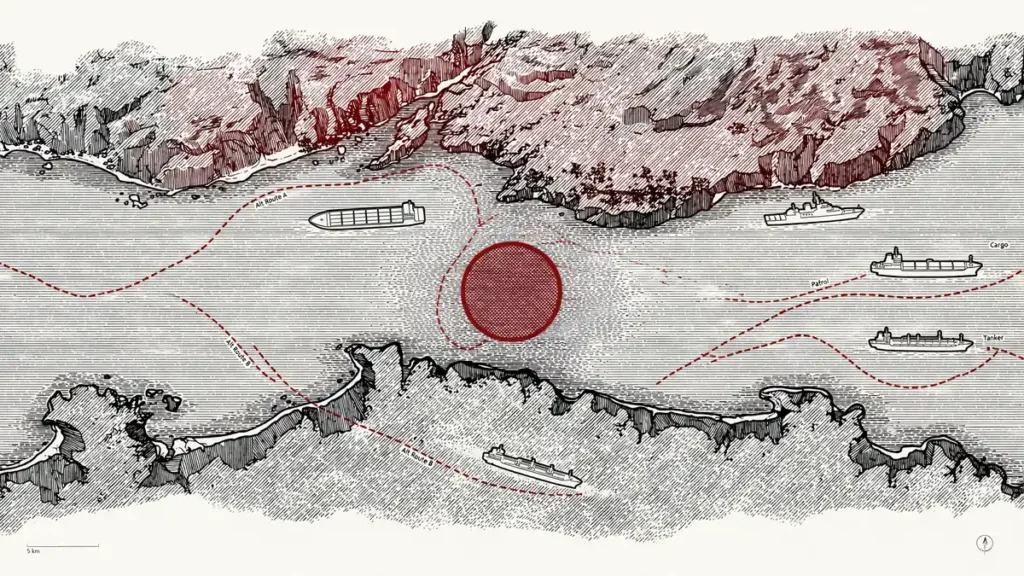
What makes this escalation a global story, not just a Yemeni one, is geography. The fighting is unfolding along one of the world’s most critical maritime corridors. About 15 percent of global maritime trade has historically passed through the Bab el-Mandeb Strait, the narrow waterway between Yemen and the Horn of Africa that connects the Red Sea to the Gulf of Aden and onward to the Suez Canal. The Houthis now control much of Yemen’s Red Sea coastline, including the area around that strait, according to AFP.
Reuters’ reporting explicitly flags the implications for Red Sea shipping lanes and the Bab el-Mandeb Strait, and the renewed conflict has already displaced tens of thousands of people. The Houthi naval blockade on Saudi Arabia declared in July, combined with attacks on Saudi territory and shipping, has turned Yemen’s coast into a pressure point for energy exports and container traffic alike — a dynamic with clear echoes of the energy geopolitics reshaped by this year’s wider Iran conflict, which we have tracked in our coverage of the Iran war’s impact on global energy markets.
For readers tracking how Middle East conflicts move markets and supply chains, our conflict zones hub maintains ongoing coverage of the region’s flashpoints, and our intelligence briefing page tracks developments as they break.
Different perspectives
The two sides tell sharply different stories about how this escalation began. The Saudi-led coalition says its investigation — including examination of drone wreckage — confirmed Houthi planning and execution of the September 29 attack on Medina’s Taibah power station, which supplies electricity to the Prophet’s Mosque. Coalition spokesperson Major General Turki al-Maliki described it as a deliberate provocation against Muslims and a continuation of Houthi attempts to target Islam’s two holiest sites, following an alleged attempt against Mecca that the coalition says it foiled two weeks earlier. The coalition says it will continue strengthening the defense of the holy cities against drone attacks.
The Houthis reject that account entirely. A Houthi military source, quoted by the Houthi-run Saba news agency, denied the Medina accusation, calling it a lie intended to cover up what he described as Saudi Arabia’s failure to substantiate its earlier accusation about Mecca. The Houthis have likewise denied targeting Mecca or any other Islamic holy site, and have accused the coalition of its own strikes on Sanaa and other parts of Yemen.
Regional governments have begun taking sides publicly. Turkey’s foreign ministry condemned the Medina attack on October 1 and reaffirmed support for Saudi Arabia, warning that attacks threatening Saudi sovereignty “must cease immediately and unconditionally.” The United Nations, through envoy Hans Grunberg, has focused on the civilian toll, calling for civilians and civilian infrastructure to be protected and for unhindered humanitarian access. The contrast between Washington’s earlier approach to Houthi strikes and the current regional war is explored in our analysis of how the Iran war differed from US strikes on the Houthis.
What to watch next
The immediate question is whether the 20 airstrikes mark a one-day operation or the start of a sustained air campaign against Houthi positions around Taiz — and whether Saudi aircraft, not just Yemeni government warplanes, take a more direct role. The second question is Taiz city itself: the Houthis have seized the surrounding highlands and cut supply routes, but the city still holds. Its fall would redraw the map of the war.
Beyond Yemen, watch the water. The Houthis’ grip on the Red Sea coast and the strait gives them leverage over shipping that insurers, energy traders and navies will price in quickly. Any widening of the naval blockade or attacks on commercial vessels would echo the shipping crises of earlier years and force rerouting decisions with real costs for European and Asian supply chains.
Finally, watch diplomacy. The UN envoy’s alarm signals that international mediation is being tested; whether backchannel Saudi–Houthi contacts can be revived — and whether regional actors like Turkey, Pakistan and Egypt, whose governments have all weighed in this week — will be the measure of whether this escalation stays contained to Taiz or becomes something larger.
Frequently asked questions
Why is Saudi Arabia fighting the Houthis again in 2026?
A UN-brokered truce in 2022 largely halted cross-border attacks, but hostilities resumed this year after the Houthis declared a naval blockade on Saudi Arabia in July and began attacking Saudi territory and shipping, according to Reuters. The Houthis also made major territorial gains along Yemen’s Red Sea coast. Saudi Arabia responded with airstrikes in Yemen and support for government forces, and the fighting around Taiz is now the most serious escalation since the truce.
Where is Taiz, and why is it strategically important?
Taiz is Yemen’s third-largest city, in the country’s southwest near the Red Sea coast. Reuters reports that unchallenged Houthi control of Taiz would give the movement full control of Yemen’s north, a tighter grip on the Red Sea coast and easier access to the south, including Aden, the government’s seat. The city anchors the front line between Houthi-held territory and the Saudi-backed government.
What happened in the alleged drone attack on Medina?
The Saudi-led coalition said that on September 29, 2026, at 5:11 a.m. local time, a drone struck the Taibah electricity distribution station in Medina, which supplies power to the Prophet’s Mosque, knocking one transformer out of service. The coalition says investigators linked the attack to the Houthis after examining drone wreckage. The Houthis deny responsibility, calling the accusation a lie.
Could the fighting in Yemen disrupt Red Sea shipping?
Possibly. About 15 percent of global maritime trade has historically transited the Bab el-Mandeb Strait, and the Houthis now control much of Yemen’s Red Sea coastline. The Houthis declared a naval blockade on Saudi Arabia in July 2026, and Reuters notes the current fighting carries direct implications for Red Sea shipping lanes — though the full impact will depend on whether commercial vessels are targeted or rerouted.
What is the Bab el-Mandeb Strait?
The Bab el-Mandeb is the narrow strait between Yemen and the Horn of Africa that connects the Red Sea to the Gulf of Aden. It is one of the world’s most important maritime chokepoints, linking Mediterranean and Asian trade routes via the Suez Canal. Control of its Yemeni shore is a major reason the fighting around Taiz and the Red Sea coast matters far beyond Yemen.
Sources
- Reuters: Yemen carried out 20 strikes on Houthi targets in Taiz province, spokesperson says
- Reuters: Saudi-led coalition says Houthis attacked power station in Medina
- AFP (via Malay Mail): Yemen fighting in Taiz kills 80 combatants, sources tell AFP
- Turkish Minute: Turkey condemns attack on power station serving Prophet’s Mosque, blames Houthis
- USNN: Yemeni Government Airstrikes Hit Houthis in Taiz Amid Red Sea Crisis