
WarBrief Live | November 19, 2026 | Explainer
1,550
deployed warheads allowed per side under New START
700
deployed missiles and bombers allowed per side
18
on-site inspections a year — verification now gone
0
binding limits on US or Russian arsenals since February 5, 2026
New START, the last treaty limiting American and Russian strategic nuclear weapons, expired on February 5, 2026, and nothing has replaced it. The three leaders who met in Shenzhen on November 19 promised only to talk about reducing nuclear risks — no caps, no inspections, no date.
Key Takeaways
- New START capped each side at 1,550 deployed strategic warheads, 700 deployed delivery vehicles and 800 launchers, with up to 18 on-site inspections a year. All of it lapsed on February 5, 2026.
- Verification had already broken down years earlier: inspections stopped in 2020 and never resumed, and Russia suspended participation in February 2023. What expired was the legal framework, not a working inspection regime.
- Russia has said it will keep observing the central limits as long as the United States does; Washington says there is no formal understanding.
- China, with about 620 warheads, refuses to join a treaty while its arsenal is far smaller than the more than 5,000 warheads each held by the United States and Russia — and it is the fastest-growing arsenal in the world.
- The November 19 trilateral in Shenzhen produced a joint declaration promising dialogue on nuclear risks, but no treaty, no limits and no timetable.
What was New START?
New START — the New Strategic Arms Reduction Treaty — was signed in Prague on April 8, 2010, by then US President Barack Obama and then Russian President Dmitry Medvedev, and entered into force on February 5, 2011. It was the last in a line of US-Russian arms control agreements stretching back to START I in 1991, and it was built to do two things at once: cap the arsenals and let each side check the other. Al Jazeera’s explainer sets out the same framework, and the Straits Times explainer explains why its expiry matters.
The treaty’s central limits were simple numbers. Each side could deploy no more than 1,550 strategic nuclear warheads, no more than 700 deployed intercontinental ballistic missiles, submarine-launched ballistic missiles and nuclear-capable heavy bombers, and no more than 800 deployed and non-deployed launchers and bombers combined. The US State Department said both sides had met those limits by February 2018.
Just as important as the numbers was the machinery around them. Each side could carry out up to 18 on-site inspections a year at the other’s strategic nuclear sites, and the two governments exchanged data and notifications about their forces through a Bilateral Consultative Commission. By February 2023 the parties had carried out 328 on-site inspections and exchanged 25,449 notifications. Arms control, in this design, did not require trust — it required counting.
The treaty was written for ten years, with a single five-year extension. That extension was exercised in February 2021, taking it to February 5, 2026. No further extension was legally available, so when that date passed, the treaty expired by its own terms.
What happened when New START expired?
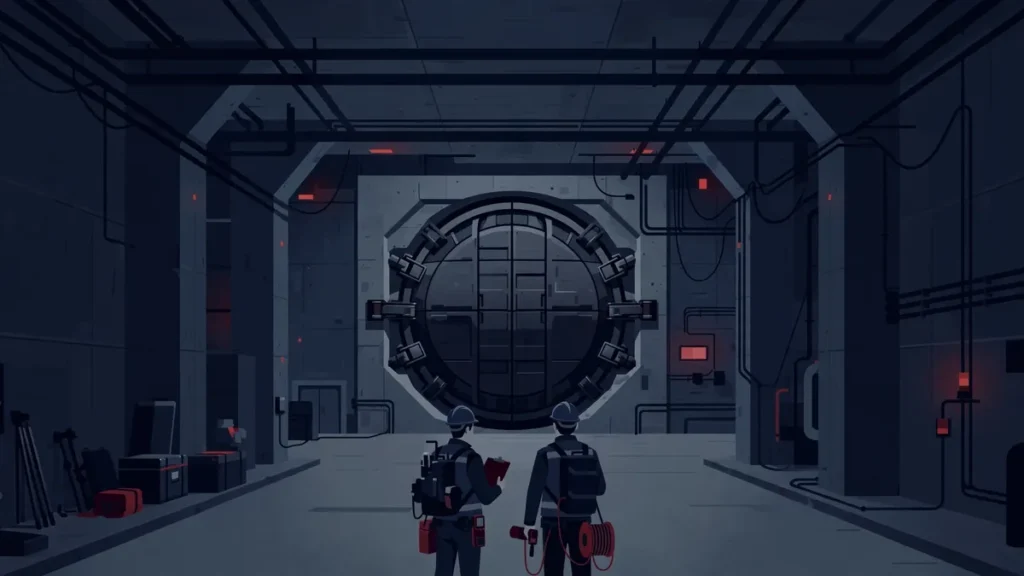
On February 5, 2026, the last legally binding limit on the two largest nuclear arsenals in the world disappeared. For the first time in more than half a century — since the SALT I agreement of 1972 — no treaty caps American and Russian strategic forces, and no bilateral inspection or data regime operates between them. UN Secretary-General Antonio Guterres called the expiry a grave moment.
But the treaty had been dying for years before its legal death. On-site inspections were paused in 2020 because of the COVID-19 pandemic and never resumed. On February 21, 2023, President Vladimir Putin announced that Russia was suspending its participation in the treaty — expressly not withdrawing from it, since the treaty contains no suspension clause. The United States holds the suspension legally invalid; Russia describes it as a response to American, British and French actions.
The United States answered with countermeasures on June 1, 2023, withholding American data and notifications and denying inspector visas and facilities, while continuing to observe the central limits. The last agreed data exchange, in September 2022, recorded Russia at 1,549 warheads on 540 delivery vehicles. After that, each side was left to judge the other’s compliance from its own intelligence. Washington assessed that Moscow was probably not exceeding the treaty’s deployed-warhead limit, but it could no longer certify Russian compliance.
Background and timeline
- April 8, 2010: New START signed in Prague by Obama and Medvedev.
- February 5, 2011: The treaty enters into force, with limits of 1,550 deployed warheads, 700 deployed delivery vehicles and 800 launchers.
- February 2018: The US State Department says both sides have met the central limits.
- 2020: On-site inspections pause for the COVID-19 pandemic and never resume.
- February 2021: The treaty’s single five-year extension is exercised, taking it to February 2026.
- February 21, 2023: Putin announces Russia is suspending participation in the treaty.
- June 1, 2023: The United States imposes countermeasures, withholding data and notifications while still observing the limits.
- February 5, 2026: New START expires. No binding limits remain on US or Russian strategic arsenals.
- February 11, 2026: Russian Foreign Minister Sergey Lavrov tells lawmakers Russia will observe the limits as long as the United States does.
- November 19, 2026: Trump, Putin and Xi meet in Shenzhen and promise dialogue on reducing nuclear risks — but agree no treaty, no caps and no date.
What did the Shenzhen trilateral actually agree on nuclear arms?
The first-ever meeting of the three leaders — US President Donald Trump, Chinese President Xi Jinping and Russian President Vladimir Putin — took place on November 19, 2026, at Kylin Villa in Shenzhen, on the sidelines of the APEC summit. It ran for about 90 minutes, starting nearly two hours behind schedule. Our full account of the meeting is in The First Trump-Putin-Xi Trilateral: What Is on the Table.
Afterwards the three leaders issued a joint declaration on peace with four commitments, according to Chinese and Russian officials: reform of the United Nations, increased supplies of refined petroleum products, upholding the immunity of state officials in international courts, and dialogue on reducing nuclear risks and preventing proliferation. The declaration says that “nuclear war cannot be won and must never be fought”, the BBC reported. The text was released by China’s Xinhua news agency and by the Kremlin; Washington has not published it.
What matters is what the declaration does not contain. It sets no caps on warheads, no inspection regime, no deadline and no date for the promised nuclear-risk dialogue. The summary of the meeting did not mention the wars in Ukraine or Iran. As Daryl Kimball of the Arms Control Association put it, one meeting was unlikely to produce dramatic breakthroughs — at best it could start a process that might eventually lead to sustained talks.
President Xi told his counterparts that nuclear weapons should be prohibited and destroyed, and called for a nuclear-weapon-free world, according to state broadcaster CCTV. President Trump has said he wants a “new, improved and modernised” deal that includes China. He previously rejected Russia’s proposal to simply extend New START, demanding a three-way agreement instead. That demand is the central obstacle, because Beijing has repeatedly said it will not join.
Why does China refuse to join a nuclear arms treaty?
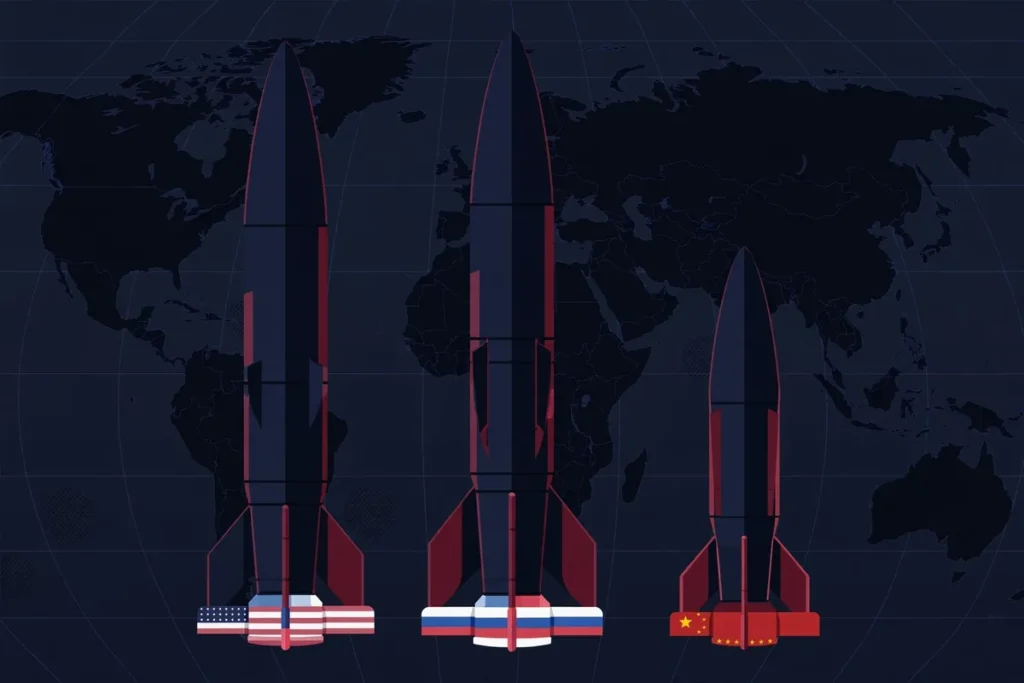
China’s objection is arithmetic, and it is also about trust. The Stockholm International Peace Research Institute (SIPRI) estimates that China held about 620 nuclear warheads in January 2026 — well below the 800 cap each for Russia and the United States under New START, and far below the more than 5,000 warheads each in the American and Russian stockpiles. As China’s foreign ministry spokesman Lin Jian said in February, when New START expired: “China’s nuclear forces are not on the same level as those of the United States and Russia, and China will not participate in disarmament negotiations at this stage.”
Washington’s case for including Beijing is that a treaty covering only two of the three nuclear powers no longer reflects the balance of power. US Undersecretary of State for Arms Control Thomas DiNanno said in February that “a bilateral treaty with only one nuclear power is simply inappropriate in 2026 and going forward”, and Secretary of State Marco Rubio said it was impossible to have true arms control in the 21st century without China, because of its “vast and rapidly growing stockpile”. The United States also wants a successor treaty to cover weapons New START never touched — Russia’s novel systems and the growth of China’s stockpile.
Beijing’s answer, in the words of Zhao Minghao, a professor at Fudan University’s Institute of International Studies, is that China maintains a declared no-first-use policy and a “minimum deterrence” posture: nuclear weapons as political instruments for assured retaliation, not warfighting. From Beijing’s perspective, a treaty would cap its insurance while imposing intrusive verification on a comparatively small force. Zhao also pointed to a credibility problem, given Washington’s earlier withdrawals from the Anti-Ballistic Missile Treaty and the Intermediate-Range Nuclear Forces Treaty.
Other analysts add that China weighs American missile defences, precision-strike capabilities and emerging technologies that could weaken its retaliatory capability. Sun Chenghao, a fellow at Tsinghua University’s Center for International Security and Strategy, told Al Jazeera that an agreement limiting China’s forces while leaving those concerns untouched “would have limited appeal”. William Yang of the International Crisis Group said Beijing would view any treaty as “a mechanism designed to limit its nuclear modernisation”.
The result is a deadlock with a clear shape. Analysts say China would engage in a trilateral framework only when the United States and Russia first reduce their arsenals towards genuine parity — and, as Alejandro Reyes of the University of Hong Kong put it, “the fundamental obstacle is political trust”. Each side regards its own capabilities as defensive while viewing the others’ modernisation as potentially threatening.
By the numbers: the arsenals after New START
| Metric | Figure | Source |
|---|---|---|
| Deployed strategic warhead limit under New START | 1,550 per side | Treaty text, via Al Jazeera |
| Deployed delivery vehicle limit under New START | 700 per side | Treaty text, via Al Jazeera |
| Launcher limit under New START | 800 per side | Treaty text, via Al Jazeera |
| On-site inspections allowed per year | 18 per side | Treaty text, via Al Jazeera |
| On-site inspections carried out by February 2023 | 328 | US State Department data |
| Russia total warheads, January 2026 (SIPRI estimate) | 5,420 | SIPRI Yearbook 2026 |
| United States total warheads, January 2026 (SIPRI estimate) | 5,042 | SIPRI Yearbook 2026 |
| China total warheads, January 2026 (SIPRI estimate) | 620 | SIPRI Yearbook 2026 |
| World total warheads, January 2026 (SIPRI estimate) | 12,187 | SIPRI Yearbook 2026 |
| Deployed warheads, January 2026 (SIPRI estimate) | 4,012 worldwide | SIPRI Yearbook 2026 |
Caveat: treaty limits are historical caps, not current holdings — the treaty has expired. SIPRI figures are expert estimates as of January 2026, not live counts; no nuclear-armed state publishes a full, current inventory. China’s arsenal is the fastest-growing in the world, adding about 100 warheads a year since 2023, though its increase in the year to January 2026 was about 20, from 600 to 620.
The scale of the imbalance is the story of the table. Russia and the United States together hold about 86 percent of all nuclear warheads. China’s 620 warheads are more than France and the United Kingdom hold combined, yet still roughly an eighth of either superpower’s stockpile. That gap is precisely why Beijing sees no advantage in a treaty built on equal ceilings — and why Washington sees no point in a treaty that leaves the fastest-growing arsenal outside it.
Three capitals, three different answers
Washington wants a bigger treaty. The Trump administration’s position is that any successor to New START must include China and must cover all Russian nuclear weapons, including novel systems the old treaty never touched. The administration has also kept pressure on in a different way: in October 2025, the President ordered preparations to resume nuclear testing on an equal basis with other countries. No US nuclear explosive test had taken place as of November 2026, although a non-nuclear high-explosive experiment was conducted at the Nevada test site in September 2026.
Moscow wants restraint without a treaty, on its own terms. Lavrov’s February statement — Russia will observe the limits as long as the United States does — is a conditional, voluntary pledge, not a verified commitment. It preserves the status quo without inspections, data exchanges or any mechanism to detect a breach. Russia has also said it will keep to the treaty’s central limits only as long as the United States does, which makes restraint conditional on reciprocity.
Beijing wants time. Its arsenal is growing faster than any other country’s, and every year of delay narrows the gap with Washington and Moscow. Analysts say the likeliest near-term outcome is not a treaty but informal restraints — test moratoria, data exchanges, notification of major exercises — while formal arms control waits for a geopolitical thaw that, in the words of one analyst, this decade is unlikely to deliver.
What the end of New START means for US, UK and EU readers
There is no immediate household effect: no price rises, no travel disruption, no change to daily life follows directly from the treaty’s expiry. The consequences are slower and strategic, and they land first on governments and defence budgets — which is where readers in the US, the UK and Europe will eventually feel them.
For the United States, the end of verification means less certainty about Russian forces, at the same time as the US is modernising its own triad. That uncertainty is an argument, in Washington, both for more defence spending and for a new treaty — the two camps draw opposite conclusions from the same darkness.
For the United Kingdom and Europe, the stakes are direct. Britain and France are the only other nuclear-armed NATO states, and European security planning has relied for decades on US-Russian limits holding the strategic balance in place. With no limits and no inspections, NATO planners must assume the worst about Russian deployments, which pushes European defence budgets upward and sharpens the debate over missile defence and nuclear sharing. The Shenzhen declaration’s promise of dialogue is, for European capitals, better than silence — but a promise to talk is not a cap on warheads.
For energy and markets, the link is indirect but real. The same Shenzhen meeting promised more refined petroleum supplies, and nuclear tensions feed the risk premium that already runs through oil prices during the Iran war. A world without arms control is a world where a miscalculation is harder to catch early — and markets price that risk, however quietly.
What to watch next in nuclear arms control
First, whether the promised nuclear-risk dialogue gets a date. The Shenzhen declaration sets no timetable, and no follow-up meeting has been announced. Trump and Xi are due to meet again at the G20 summit in Florida in December, which is the next natural moment for the conversation to resume.
Second, whether voluntary restraint holds. The current stability rests on two informal pledges — Russia’s conditional promise to observe the old limits, and the absence of any US decision to exceed them. Neither is verified, and neither would survive a crisis intact. Watch for any announcement of new deployments, or any US move towards a nuclear explosive test, as the first sign that restraint is fraying.
Third, China’s build-up. SIPRI’s January 2026 estimate of 620 warheads is already out of date in the only direction that matters: up. The pace of Chinese silo construction and warhead production will determine how long Beijing can plausibly refuse a seat at the table — and how long Washington can plausibly insist on one.
Finally, watch the other treaties. The Non-Proliferation Treaty remains in force, and it is now the only binding agreement constraining the spread of nuclear weapons. New START’s expiry leaves it carrying a weight it was never designed to bear alone. The limits of security assurances without enforcement are a familiar story — see our explainer on the Budapest Memorandum: what Ukraine gave up and was promised.
Read next: more in our Intelligence Reports hub and our Conflict Zones hub.
Frequently asked questions
What was New START?
New START was the last US-Russian treaty limiting strategic nuclear weapons. Signed in 2010 and in force from 2011, it capped each side at 1,550 deployed strategic warheads, 700 deployed delivery vehicles and 800 launchers, with up to 18 on-site inspections a year. It expired on February 5, 2026.
Why did New START expire?
The treaty was written for ten years with a single five-year extension, which was used in 2021. No further extension was legally available. Russia suspended participation in February 2023 and inspections had stopped in 2020, so the treaty expired as a legal framework that had already stopped working in practice.
What happens now that New START has expired?
Nothing limits US or Russian strategic arsenals, and no inspection or data-exchange regime operates between them — the first time in more than half a century. Russia says it will observe the old limits as long as the United States does, but Washington says there is no formal understanding. The three leaders promised dialogue on nuclear risks at Shenzhen on November 19, 2026, with no date set.
Why won’t China join a nuclear arms treaty?
China holds about 620 warheads, far fewer than the more than 5,000 each held by the United States and Russia, and says its forces are “not on the same level”. It maintains a no-first-use policy and a minimum-deterrence posture, and argues a treaty would cap its arsenal while imposing intrusive verification on a much smaller force.
How many nuclear weapons do the US, Russia and China have?
SIPRI’s January 2026 estimates put the world total at 12,187 warheads: Russia 5,420, the United States 5,042 and China 620. Russia and the United States together hold about 86 percent of the total. These are expert estimates, not official counts.
Could a new treaty replace New START?
Possibly, but not soon. The United States wants a deal that includes China and covers weapons New START never touched; China will only engage once the United States and Russia reduce towards genuine parity; and Russia prefers voluntary restraint to verified limits. Analysts expect informal restraints, not a treaty, in the near term.
Sources
- Al Jazeera: Why is China resisting a nuclear treaty with the US and Russia?
- Straits Times: Explainer — What is the New START nuclear treaty and why does its expiry matter?
- The Hindu: US-China-Russia trilateral meeting explained
- Indian Express: APEC Summit live updates — Trump, Xi and Putin agree on UN reforms, oil supplies, nuclear talks
- Business Times: Trump, Xi and Putin hold first ever three-way talks, discussing nuclear arms and the war in Ukraine
- Outlook India: Can Trump bring China and Russia together for a new nuclear arms treaty?
Discussion 0
Share analysis, corrections, or context. Be civil — comments are moderated.