
WarBrief Live | November 13, 2026 | Explainer
| 20.9m b/d oil through the Strait of Hormuz, first half of 2025 (EIA) | 4.2m b/d oil through Bab el-Mandeb, first half of 2025 (EIA) | 21 nm Strait of Hormuz at its narrowest | 18 miles Bab el-Mandeb at its narrowest |
Bab el-Mandeb and the Strait of Hormuz bracket the same oil route out of the Gulf. Hormuz is the sharper energy shock, carrying about five times as much oil, while Bab el-Mandeb is the costlier detour, forcing ships around Africa.
That distinction matters more in 2026 than at any point in decades, because both passages are disrupted at the same time. The Strait of Hormuz has been contested since the US-Israeli strikes on Iran began on February 28, 2026, with tanker traffic collapsing to a fraction of normal levels. Bab el-Mandeb, meanwhile, has been squeezed since November 2023 by the Houthi campaign against Red Sea shipping, and the pressure tightened further in 2026 when Houthi forces seized the Yemeni shore of the strait and the island that divides its shipping lanes. This explainer sets out what each chokepoint is, what passes through it, who controls its shores, and what happens when one closes — or both.
Key Takeaways
- The Strait of Hormuz carried about 20.9 million barrels of oil a day in the first half of 2025 — roughly a fifth of global petroleum liquids consumption — against about 4.2 million a day through Bab el-Mandeb, according to the US Energy Information Administration (EIA).
- Hormuz is a supply shock: Gulf crude has almost no way out except limited pipelines. Bab el-Mandeb is a rerouting shock: ships can go around Africa, but the detour adds 10 to 14 days and sharply higher fuel and insurance costs.
- In 2026 both failed at once. EIA estimates put Hormuz oil flow at 4.9 million barrels a day in the second quarter of 2026, down from 21.6 million in the last quarter of 2025, while flows through Bab el-Mandeb rose as Gulf crude was rerouted toward the Red Sea.
- The two straits are linked: the main pipeline bypass for Hormuz delivers crude to Saudi Arabia’s Red Sea coast, and a tanker loading there must still leave through Bab el-Mandeb. Closing both at once removes the workaround as well as the route.
What is the Strait of Hormuz?
The Strait of Hormuz is the narrow waterway between Iran to the north and Oman and the United Arab Emirates to the south, connecting the Persian Gulf with the Gulf of Oman and the Arabian Sea. It is the only sea route out of the Gulf, which makes it the exit for most oil and gas exports from Saudi Arabia’s Gulf coast, Iraq, Kuwait, Qatar, Bahrain, the UAE and Iran. At its narrowest the strait is 21 nautical miles (39 kilometres) wide, and it runs about 167 kilometres (90 nautical miles) long. Shipping moves through two traffic lanes, each roughly two miles wide, in a separation scheme that keeps inbound and outbound tankers apart.
The volumes are what make it the world’s most important oil chokepoint. The EIA estimated that about 20.7 million barrels a day of crude oil and petroleum products crossed the strait in 2024, rising to 20.9 million a day in the first half of 2025 — roughly 20 per cent of global petroleum liquids consumption and about a quarter of all seaborne oil trade. Of that flow, about 14.7 million barrels a day was crude oil and condensate and about 6.1 million was refined products such as diesel and jet fuel. Around a fifth of global liquefied natural gas (LNG) trade also passed through the strait, about 11.4 billion cubic feet a day in the first half of 2025, most of it from Qatar. About 84 per cent of the crude oil leaving the strait in 2024 went to Asian markets, with China, India, Japan and South Korea taking the largest shares.
That normal picture no longer holds. Iran said the strait was closed after the US-Israeli strikes began on February 28, 2026, and the EIA’s estimates show oil flow falling to 4.9 million barrels a day in the second quarter of 2026, against 21.6 million in the last quarter of 2025. The multinational Joint Maritime Information Center recorded just 101 transits through the strait over October 22–24, about a quarter of the roughly 138 a day seen before the war. Reuters reported on October 30 that Iran’s Revolutionary Guards navy said two oil tankers had been involved in incidents and stopped in waters south of the strait after ignoring radio warnings. The disruption continued into November: four tankers were reportedly hit by explosions in the strait over Wednesday and Thursday, November 11–12, and on November 13 Iran’s Revolutionary Guards said a ship had been hit by an explosion after striking a mine — claims that have not been independently confirmed. The US Navy, for its part, says it has opened a southern route for commercial vessels. What is confirmed is that traffic has collapsed; what is still disputed is who controls the waterway and how much is getting through.
What is Bab el-Mandeb?
Bab el-Mandeb — Arabic for the “Gate of Tears” or “Gate of Grief” — is the strait at the southern end of the Red Sea, between Yemen on the Arabian Peninsula and Djibouti and Eritrea in the Horn of Africa. It connects the Red Sea with the Gulf of Aden and the Indian Ocean, and it is the southern gateway to the Suez Canal. At its narrowest it is about 18 miles (29 kilometres) wide, and tanker traffic is funnelled into two channels, each about two miles wide, separated by Perim Island, also called Mayyun, at the strait’s tightest point.
Under normal conditions the strait carried about 9.3 million barrels a day of crude oil and petroleum products in 2023, roughly 12 per cent of global seaborne oil trade, alongside about 30 per cent of global container traffic. But normal conditions ended in November 2023, when Houthi forces in Yemen began attacking and seizing merchant ships in the Red Sea. Flows fell sharply: the EIA put Bab el-Mandeb oil transit at about 4.0 million barrels a day on average in 2024 and 4.2 million in the first half of 2025. Shipping through the Red Sea is now running roughly 60 per cent below its level before the late-2023 attacks, according to Reuters and AP reporting, and Suez Canal revenue has fallen from about $10.25 billion in 2023 to $4.67 billion in the 2025/26 financial year, according to figures cited from Egypt.
The pressure tightened again in 2026. On July 20 the Houthis announced a naval blockade aimed at Saudi-linked shipping, and tanker transits dropped during the summer. On September 11–12, Houthi forces took the port of Mokha and the rest of Yemen’s Red Sea coast, including the Hanish islands and Mayyun Island in the strait’s narrowest section, according to Al Jazeera. Cargo transits through the strait stood at 1,215 vessels in September 2026, 47 per cent below pre-crisis levels, according to Lloyd’s List Intelligence. The strait has not been formally closed — no notice from the UK Maritime Trade Operations, the International Maritime Organization or the US Maritime Administration has declared it shut — but Houthi forces now hold the Yemeni shore and the islands inside the passage, and carriers are split on whether to route through it at all.
Bab el-Mandeb vs the Strait of Hormuz: how do they compare?
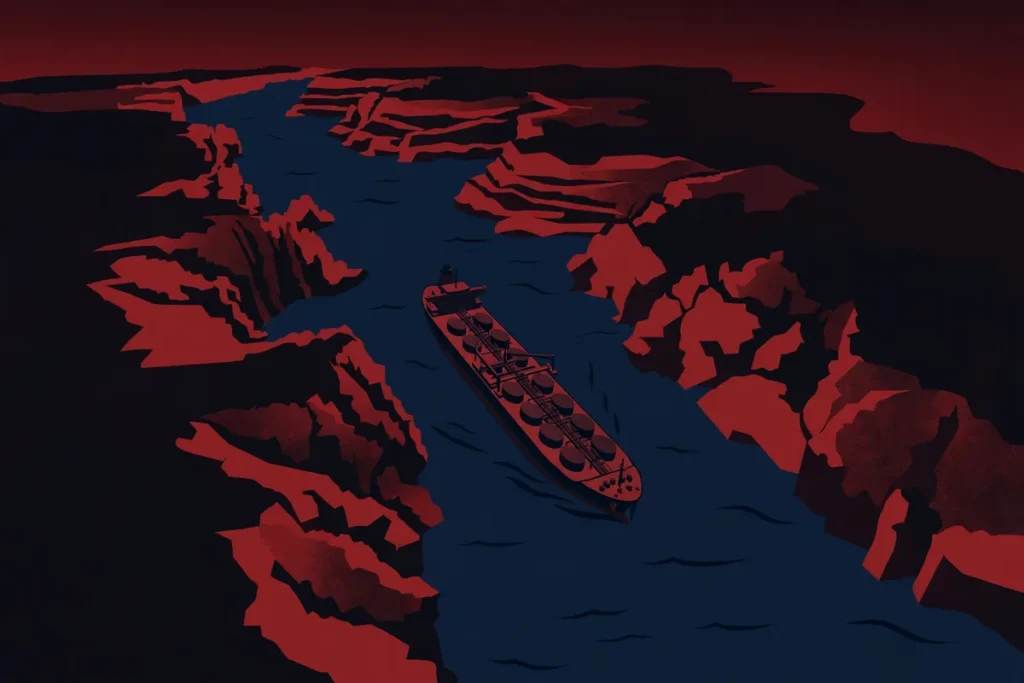
The two straits fail in different ways, and that is the key to understanding them. Hormuz creates the sharper immediate energy shock, because the oil that passes through it has nowhere else to go: pipeline bypasses cover only a fraction of normal flows, and LNG has few substitutes. Bab el-Mandeb creates the larger rerouting penalty: ships can sail around the Cape of Good Hope, but the detour ties up vessels for longer, raises fuel and insurance costs, and disrupts delivery schedules across the whole Asia–Europe container trade.
Who controls the shores also differs. Hormuz is flanked by states — Iran on one side, Oman and the UAE on the other — and its disruption in 2026 is a state-level confrontation involving the US Navy, Iran’s Revolutionary Guards and the Gulf Arab states. Bab el-Mandeb is flanked on the Yemeni side by a non-state actor: the Houthis, designated a Foreign Terrorist Organization by the United States, now hold the shore and the islands that split the shipping lanes. That makes Bab el-Mandeb harder to reopen by diplomacy alone, because the actor controlling the passage is not a government that sits at the negotiating table in the usual way.
| Metric | Strait of Hormuz | Bab el-Mandeb | Source |
|---|---|---|---|
| Oil flow, first half of 2025 | 20.9 million b/d | 4.2 million b/d | EIA, World Oil Transit Chokepoints |
| Oil flow, 2023 | 21.8 million b/d | 9.3 million b/d | EIA |
| Share of global petroleum liquids use | ~20% | ~5% | EIA |
| LNG flow, first half of 2025 | 11.4 billion cubic feet a day (~20% of global LNG trade) | ~8% of global LNG trade | EIA; Al Jazeera |
| Narrowest width | 21 nautical miles (39 km) | 18 miles (29 km) | EIA |
| Main destinations | Asia (~84% of crude in 2024) | Europe and Asia via Suez | EIA |
| 2026 flow (REPORTED) | 4.9 million b/d, Q2 2026 (EIA estimate) | 5.4 to 8.1 million b/d as Hormuz crude rerouted (EIA estimate) | EIA via shipping trackers |
| 2026 traffic (REPORTED) | ~12 tankers a day vs 50 before the war (Kpler, early November) | 1,215 cargo transits in September, 47% below pre-crisis (Lloyd’s List) | Kpler; Lloyd’s List Intelligence |
Figures are EIA estimates for the periods stated and should not be blended into a single trend line. Rows marked REPORTED rely on tracker estimates or single-source claims and are presented as reported, not confirmed.
Can oil bypass either strait?
For Hormuz, the answer is only partly. Saudi Arabia’s East-West Pipeline, known as Petroline, carries crude across the kingdom to the Red Sea port of Yanbu, and the UAE has a pipeline from its Habshan fields to Fujairah on the Gulf of Oman. The EIA estimated in June 2025 that about 2.6 million barrels a day of additional capacity was potentially available across the Saudi and UAE pipelines in a disruption, and the International Energy Agency’s 2026 assessment put the range at 3.5 to 5.5 million barrels a day. That is real mitigation, but it covers roughly a fifth to a quarter of normal Hormuz flows — and it is not guaranteed throughput. The limits showed in September 2026, when the East-West Pipeline was shut down as a precaution on September 11 after a drone attack, according to shipping monitors.
For Bab el-Mandeb there is no pipeline bypass at all: the only alternative is the sea route around the Cape of Good Hope, which adds about 10 to 14 days to a voyage between Asia and Europe and more than $2 million per voyage in extra fuel and operating costs, according to shipping industry reporting. The longer route also ties up vessels, which tightens the global fleet and pushes freight rates up for everyone, even on routes nowhere near the Red Sea.
The two bypasses are also connected, which is the part most often missed. The main workaround for a Hormuz disruption is to send Saudi crude through Petroline to Yanbu on the Red Sea — but a tanker loading at Yanbu and heading for Europe must then leave the Red Sea through Bab el-Mandeb. When both straits are disrupted at once, the bypass itself runs through the second chokepoint. That interlock is why the double disruption of 2026 has proved so hard to route around, and why war-risk insurance has become a decisive cost: Red Sea war-risk premiums rose from about 0.2 per cent of a ship’s value in calm conditions to between 0.7 and 1.0 per cent after incidents, and premiums for Saudi-linked shipping reached 3 to 7 per cent of hull value after the July 20 blockade, according to shipping monitors. Our full breakdown of what the tanker war costs in shipping and insurance explains how those premiums are set.
What happens if both chokepoints close at once?
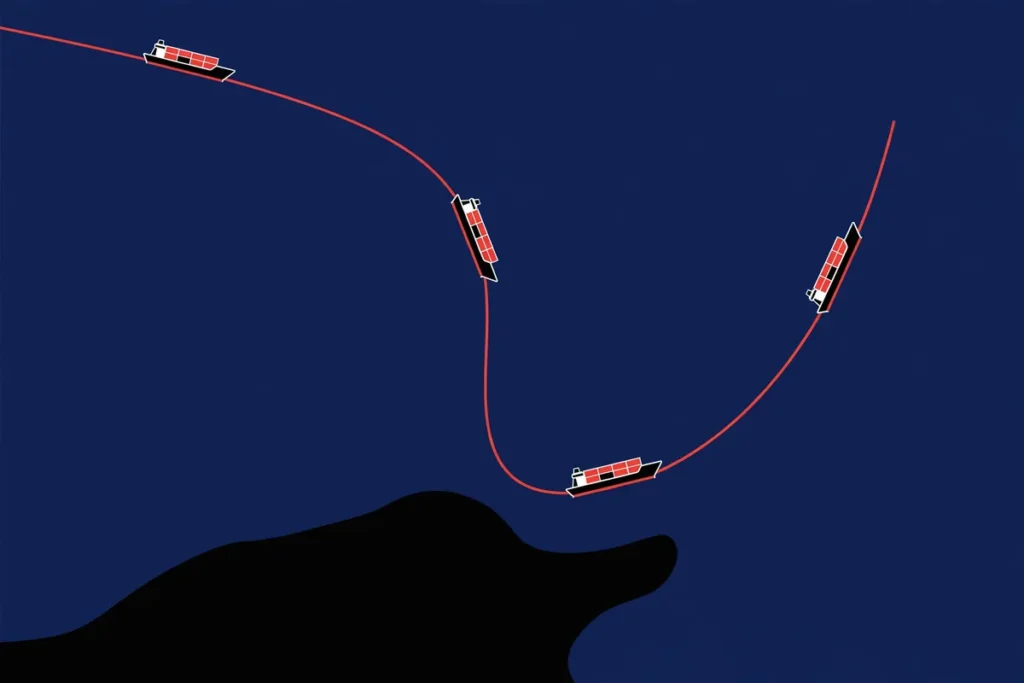
2026 is the live test of that question. As Hormuz flows fell from 21.6 million barrels a day in the last quarter of 2025 to 4.9 million in the second quarter of 2026, EIA estimates show Bab el-Mandeb flows rising from 5.4 to 8.1 million barrels a day, as Gulf crude that could not leave through Hormuz was rerouted toward the Red Sea — and then had to run the Houthi-held strait to reach the Suez Canal. The result is not a clean substitution but a squeeze at both ends: less oil moving overall, and what does move costs more to insure and takes longer to arrive.
The knock-on effects are already visible. Suez Canal revenue has more than halved. Container traffic through the canal fell from 5.9 million TEU in September 2023 to 2.19 million TEU in September 2026, according to Lloyd’s List Intelligence. Tanker traffic through Hormuz averaged about 12 vessels a day in early November, against about 50 before the war, according to Kpler’s November 5 briefing. And the pattern of attacks has widened beyond the straits themselves: Houthi forces have claimed strikes on Saudi oil infrastructure, airlines have extended suspensions of flights to Saudi Arabia, and the UN Security Council has renewed sanctions on Yemen’s Houthis as the campaign continues. The two straits are no longer separate problems. As one shipping analysis put it, disruption in one raises prices; disruption in both threatens systemic breakdown. For a fuller picture of how these passages are fought over, see our explainer on how naval blockades work and our assessment of the Hormuz tanker campaign.
What the double chokepoint means for US/UK/EU readers
For readers in the US, the direct exposure is smaller than the headlines suggest. The EIA estimated American imports from Persian Gulf countries through Hormuz at around 0.5 million barrels a day in 2024, about 7 per cent of total US crude imports and about 2 per cent of US petroleum liquids consumption. But oil is a global market, and a fifth of world supply passing through a contested strait moves the price everywhere: Brent crude has swung sharply on Hormuz risk alone throughout 2026, and those moves feed through to petrol and diesel prices at pumps in the US, the UK and the EU within weeks.
For readers in the UK and Europe, the exposure runs through Bab el-Mandeb and the Suez Canal rather than Hormuz. Middle East crude, diesel and jet fuel bound for Europe travel via Suez, and the longer Cape route raises delivered costs and delays shipments of everything from refined fuels to containerised goods, grains and industrial inputs. Egypt, which depends on canal revenue, has lost more than $6 billion a year by its own figures. And the disruption reaches beyond energy: airlines have extended flight suspensions to Saudi Arabia as Houthi missile and drone attacks continue, and travel advisories across the region remain in flux. The practical takeaway is that a distant strait neither the US nor Europe controls now sets a floor under fuel prices and a delay on goods — and there is no quick alternative route while both passages are contested.
Frequently asked questions
What is the difference between Bab el-Mandeb and the Strait of Hormuz?
The Strait of Hormuz is the only sea exit from the Persian Gulf, between Iran and Oman, and it carries about five times as much oil as Bab el-Mandeb — roughly 20.9 million barrels a day in the first half of 2025, against 4.2 million. Bab el-Mandeb is the southern gateway to the Red Sea and the Suez Canal, between Yemen and Djibouti, and it matters more for container trade and for oil and refined products heading to Europe.
Which strait matters more for oil prices?
For oil prices, Hormuz matters more: most Gulf crude has no way around it except limited pipelines, so a disruption there removes supply from the market. For the cost of goods, Bab el-Mandeb matters more, because Asia–Europe cargo must choose between the Suez route and a detour of 10 to 14 days around Africa. The largest risk is both closing together, because that also cuts off the pipeline bypass to the Red Sea.
Can oil bypass the Strait of Hormuz?
Only partly. Saudi Arabia’s East-West Pipeline and the UAE’s Habshan–Fujairah pipeline can move an estimated 2.6 to 5.5 million barrels a day around the strait, against normal flows of about 21 million. There is no pipeline bypass for LNG, and the Saudi pipeline was itself shut as a precaution in September 2026 after a drone attack.
Is Bab el-Mandeb closed in 2026?
Not formally. No maritime authority has declared it closed, and ships are still transiting. But Houthi forces have held Yemen’s Red Sea coast and Mayyun Island since September 2026, cargo transits were 47 per cent below pre-crisis levels that month, and many owners are routing around the Cape of Good Hope instead. It is open but disrupted, and for many shippers that amounts to the same thing.
What happens if both straits close at the same time?
The main workaround disappears: Gulf crude rerouted by pipeline to the Red Sea still has to leave through Bab el-Mandeb. In 2026, with both disrupted, Hormuz flows fell by more than three-quarters while Bab el-Mandeb absorbed rerouted crude at higher cost and risk, Suez revenue more than halved, and war-risk insurance premiums rose sharply. The result is higher fuel prices, longer delivery times and tighter shipping capacity worldwide.
Read next: What the Tanker War Costs: Hormuz Shipping, Insurance, Rerouting and War Risk Insurance Explained: The Hormuz Surcharge. For the wider picture, see the Conflict Zones hub.
Sources
- Reuters: Iran’s IRGC navy says two tankers stopped south of Hormuz after incidents
- Al Jazeera: Iran war live — IAEA ‘increasingly concerned’ over Isfahan enrichment plant (November 13, 2026)
- Gulf News: US-Israel-Iran Conflict — Key Updates UAE Residents Must Know Today (November 13, 2026)
- The Hindu: Iran says it struck U.S. military radar in Bahrain (November 13, 2026)
- Clear Mariner: Bab el-Mandeb Strait — Tanker Traffic, Risk & Compliance
- Strategic Energy Map: Bab el-Mandeb — Is It Open? Status, Ship Traffic and Oil Flows
- Mansfield Energy: What’s That — Bab el-Mandeb Strait
- PetroEyes: Strait of Hormuz Oil Flows — Volumes and Bypasses (EIA data)
- The Eastern Strategist: Bab el-Mandeb Strait — War Risk Cost
- Core Insights Consulting: A Strait Held Hostage — Policy Note, October 2026
- EveeStatistic: Hormuz vs Bab el-Mandeb — 2026 Energy Benchmark


Discussion 0
Share analysis, corrections, or context. Be civil — comments are moderated.