
WarBrief Live | November 11, 2026 | Markets & Economy
| $89.15 Brent’s intraday low, November 10 – first sub-$90 trade since August 31 | $92.77 Brent at 09:34 GMT, November 11 – the morning rebound | 37 Ships attacked in the Strait of Hormuz in October – a monthly record | -22% Brent’s fall from its late-October high near $118 |
Brent crude fell below $90 on November 10, 2026 – its first sub-$90 trade since August – even as tankers burned in the Strait of Hormuz, because traders are pricing in de-escalation and rising OPEC output, not the shipping war.
It is the strangest split in the oil market this year. On the water, the war is getting worse: October saw 37 vessels attacked in and around the Strait of Hormuz, the highest monthly total since the conflict began, and November has already added 10 more. On the trading screen, the war is fading: Brent crude, the global benchmark, slid from near $118 in late October to below $90 on November 10, 2026, before steadying at about $92.77 on the morning of November 11. This article explains the paradox – what pushed the price down, what is still burning in the Strait, and why the market believes diplomacy, not the tanker war, will set the price from here.
Key Takeaways
- Brent crude fell below $90 a barrel intraday on November 10, 2026, its first sub-$90 trade since August 31, then rebounded to about $92.77 by 09:34 GMT on November 11.
- The fall came even as attacks on shipping intensified: 37 vessels were attacked in October, the highest monthly total since the war began, with 10 more attacks recorded so far in November.
- Traders are betting that diplomacy, not the tanker war, sets the price: United States officials have played down further strikes, OPEC output rose sharply in October, and a supply glut is building.
- For readers, cheaper crude should ease petrol, diesel and heating costs over the coming weeks – but a single escalation in the Strait could reverse the move within hours.
Why did Brent crude fall below $90 on November 10?
The slide began on Monday, November 9, when Brent fell 5.85% to $92.57, and accelerated on Tuesday. Brent touched $89.15 during November 10 trading – its first trade below $90 since August 31 – before settling at $91.49, down 1.17% on the day. By Wednesday morning the price had steadied, with Brent futures up 1.4% at $92.77 by 09:34 GMT, according to Reuters, and United States West Texas Intermediate crude up 0.9% at $86.80.
Four forces drove the fall. First, the diplomacy signal: United States President Donald Trump said the war in Iran could end “fairly soon”, and United States officials played down the need for further military strikes, which we covered in our analysis of Trump’s “effectively over” remarks. Second, the talks track: Russian and Ukrainian officials met in Abu Dhabi on November 10 for their first peace talks since February, and the Abu Dhabi talks entered their second day on November 11. Third, supply is recovering: OPEC output rose by 1.38 million barrels a day in October to 22.87 million barrels a day, according to a Reuters survey, with Saudi Arabia, Kuwait and Iraq leading the gains. Fourth, the glut: United States crude stocks rose by 9 million barrels in the week ended November 6, according to market sources citing American Petroleum Institute data, and OPEC+ has paused output increases beyond December amid fears of oversupply.
Put together, the market read November 9 and 10 as a de-escalation trade. Traders sold the war premium they had built into the price in October, when Brent averaged $124 a barrel, and started pricing a settlement instead. We explained the first leg of that fall on November 5 in our earlier analysis of why oil prices fell in November 2026; the sub-$90 break on November 10 was the second leg.
What happened in the Strait of Hormuz?
While the price fell, the shipping war did not pause. New data from the Washington Institute for Near East Policy, reported by Reuters, showed that 37 ships were attacked in the Strait of Hormuz and surrounding waterways in October, the highest monthly total since the war began, and that 10 attacks have been recorded so far in November. The International Maritime Organization has confirmed 130 incidents in the region since the conflict began on February 28, 2026, with at least 25 seafarers killed.
The latest incidents are documented in detail. Videos posted on social media on Sunday, November 8, and verified by Reuters showed a tanker operated by Navig8 on fire near the coast of Oman; Iranian state media said it was one of three tankers hit that day for using what Tehran described as unauthorised routes through the strait. On Tuesday, November 10, the United Kingdom Maritime Trade Operations agency said a tanker had been struck northeast of Lima in Oman. In a separate statement the same day, Iran’s Revolutionary Guards Navy said two tankers had caught fire after hitting naval mines while travelling along an unauthorised route. That account is the Iranian military’s claim and has not been independently confirmed. The full incident record is in our report on the November 10 tanker strikes and on our conflict zones hub.
The damage to shipping is structural, not just episodic. The United States Energy Information Administration estimates that oil flows through the Strait fell to 4.9 million barrels a day in the second quarter of 2026, against 21.6 million barrels a day in the fourth quarter of 2025 – roughly a fifth of the pre-war level. And even a diplomatic deal would not restore traffic quickly: LSEG Oil Research said in a note on November 10 that an increase in flows through the waterway would still depend on mine clearance, insurance costs and whether shipowners would be willing to take the risk at all.
Background and timeline: from the October peak to the November slide
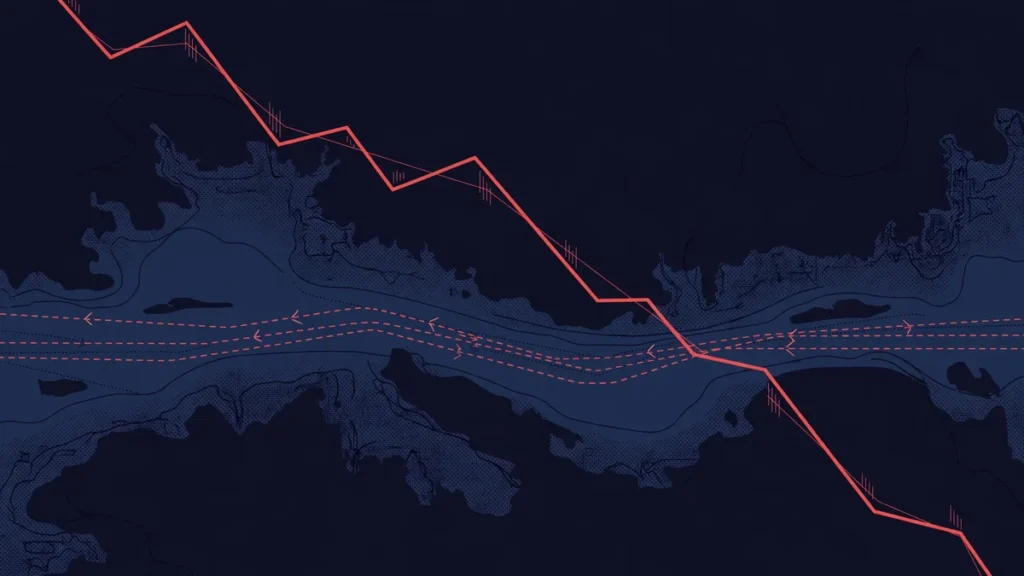
The paradox of November 10 was built over six weeks. The timeline below sets out how the price and the shipping war moved in opposite directions.
- February 28, 2026: the conflict begins. The International Maritime Organization has since confirmed 130 shipping incidents in the region.
- Late October 2026: Brent crude peaks near $118 a barrel as the war premium reaches its height.
- October 2026: 37 ships are attacked in the Strait of Hormuz and surrounding waterways, the highest monthly total of the war, and Brent averages $124 a barrel – its highest monthly average since July 2022 in inflation-adjusted terms, according to the United States Energy Information Administration.
- November 2, 2026: eight OPEC+ members agree to raise December output targets by 137,000 barrels a day and to pause further increases in January, February and March amid glut fears.
- November 7, 2026: a Bloomberg survey finds OPEC output rose by 930,000 barrels a day in October to 22.8 million barrels a day, about 88% of the volume the same members pumped in February, with Saudi Arabia raising output by 970,000 barrels a day to 9.2 million.
- November 8, 2026: a Navig8 tanker is filmed on fire near the coast of Oman; Iranian state media says it was one of three tankers hit for using unauthorised routes.
- November 9, 2026: Brent falls 5.85% to $92.57.
- November 10, 2026: Brent trades below $90 intraday, touching $89.15, and settles at $91.49. The United Kingdom Maritime Trade Operations agency reports a tanker struck northeast of Lima, Oman. Iran’s Revolutionary Guards Navy says two tankers hit naval mines. The Energy Information Administration publishes its November Short-Term Energy Outlook.
- November 11, 2026: Brent rebounds to $92.77 by 09:34 GMT. Iran’s security chief says Tehran will not allow even a single particle of enriched nuclear material to leave the country. The Abu Dhabi talks enter day two.
By the numbers: the oil market on November 11, 2026
The figures below are the hard numbers behind the paradox, with each one tied to its source and its status. Confirmed figures come from two or more independent sources or from the named primary source; reported figures rest on a single party’s claim.
| Metric | Figure | Source | Status |
|---|---|---|---|
| Brent intraday low, November 10 | $89.15 | Yahoo Finance / CNBC | Confirmed |
| Brent close, November 10 | $91.49, down 1.17% | Yahoo Finance / CNBC | Confirmed |
| Brent, 09:34 GMT November 11 | $92.77, up 1.4% | Reuters | Confirmed |
| WTI, 09:34 GMT November 11 | $86.80, up 0.9% | Reuters | Confirmed |
| Brent, late-October high | About $118 | Oilprice | Confirmed |
| Brent average, October 2026 | $124 | United States Energy Information Administration | Confirmed |
| Ships attacked, October 2026 | 37 | Washington Institute for Near East Policy | Confirmed |
| Shipping incidents since February 28, 2026 | 130 | International Maritime Organization | Confirmed |
| OPEC output, October 2026 | 22.87 million barrels a day, up 1.38 million | Reuters survey | Confirmed |
| United States crude stocks, week to November 6 | Up 9 million barrels | American Petroleum Institute, via Reuters | Confirmed |
| Tankers reported hit by mines, November 10 | 2 | Iran’s Revolutionary Guards Navy | Reported – not independently confirmed |
One caveat: prices are snapshots taken during the trading day and move constantly; the November 10 low and the November 11 rebound are both real, and both matter.

Why traders are betting on de-escalation over escalation
The market’s logic is cold but consistent: traders price what they expect to happen next, not what happened yesterday. Three expectations are doing the work.
First, the diplomacy track is moving. United States officials have played down the need for further military strikes, President Trump has said the war could end “fairly soon”, and the Abu Dhabi talks are under way, with the same delegations returning for day two on November 11. Iran’s security chief pushed back on Wednesday, saying no enriched nuclear material would leave the country, and Washington has said nuclear matters must be part of any initial negotiations – but the market reads even a stalled negotiation as better than an escalating war. As UBS analyst Giovanni Staunovo put it, oil prices on Wednesday were “being supported by fading hopes of an imminent de-escalation” – the rebound itself shows how finely balanced the mood is.
Second, supply is recovering faster than the shipping war can choke it. OPEC’s crude output rose by 1.38 million barrels a day in October to 22.87 million barrels a day, according to the Reuters survey, reaching 90% of the output produced in February, the last month before the conflict. The Bloomberg survey tells the same story with slightly different numbers – a rise of 930,000 barrels a day to 22.8 million, or about 88% of February’s level. Saudi Arabia led the recovery, raising output by 970,000 barrels a day to 9.2 million. The barrels are getting out, even if the route is dangerous, and OPEC+ ministers meet on November 29 to set output targets for 2027.
Third, the October shock has already been priced and spent. Brent averaged $124 in October and peaked near $118 late in the month; by November 10 it had fallen about 22% from that peak. The war premium that traders built in October is being unwound because the feared outcome – a closed Strait and a supply shock – has not materialised in the form the market feared. As June Goh, senior analyst at Sparta Commodities, told Reuters, the key driver now is whether Iran engages with United States demands to reach a diplomatic agreement. Until that question is answered, the price will swing on headlines, as Wednesday’s rebound shows.
What does Brent below $90 mean for US, UK and EU readers?
For households, the most direct effect is at the pump. Crude oil is the largest single input cost in petrol and diesel, so a Brent price below $90, down from about $118 in late October, should feed through to lower fuel prices over the coming weeks. The pass-through is not instant: refiners, distributors and retailers adjust with a lag, and in the United Kingdom and much of the European Union, fuel duty and tax make up the majority of the pump price, so the saving at the till will be smaller than the fall in crude suggests. Heating oil costs should also ease as winter begins, which matters most for households in the United Kingdom and northern Europe that still rely on oil-fired heating.
For the wider economy, cheaper energy helps on inflation. Central banks in the United States, the United Kingdom and the eurozone have been watching energy costs closely, and a sustained period of sub-$90 Brent would take pressure off consumer prices. But the relief is fragile. Goldman Sachs has raised its December Brent forecast to $105 a barrel, from $90 previously, and warned that Brent could climb to $140 a barrel in 2027 if oil production across the Gulf region remains significantly below its 2025 average. For travellers, cheaper jet fuel should help fares at the margin, but airspace and shipping risks around the Gulf remain, and war-risk insurance continues to push freight costs higher. The practical message for readers is simple: enjoy the lower prices, but do not plan on them lasting. This article is educational only and is not financial advice.
Different perspectives: bulls, bears and the shipping industry
Not everyone agrees the price has further to fall. The bulls, led by Goldman Sachs, argue that the supply picture is worse than the headline OPEC numbers suggest: Gulf production is still well below its 2025 average, and if it stays there, Brent could reach $140 in 2027. Their December forecast of $105 already sits above the current price, which implies they expect the de-escalation bet to be tested soon.
The bears point to the glut. OPEC+ has paused output increases beyond December precisely because it fears oversupply, United States crude stocks are rising, and October’s $124 average now looks like the peak of the war premium rather than a new normal. On this view, the sub-$90 break was the market catching up with fundamentals that the shipping war had obscured.
The shipping industry takes a third view, and it is the most sobering. LSEG Oil Research warned that even if a diplomatic agreement were reached, restoring flows through the Strait would still depend on mine clearance, insurance costs and whether shipowners would be willing to take the risk. The tankers are still being hit, the mines are still in the water, and the insurance market is still pricing the route as a war zone. The oil price and the shipping war can diverge for weeks – but the industry’s warning is that the divergence ends the moment a tanker sinks.
Russia’s refining sector adds a further complication. Russian oil refining capacity has been reduced by about 30% since late October following renewed Ukrainian drone attacks, according to industry sources cited by Reuters, and on November 11 a regional governor said a drone attack caused a fire in the port area of Ust-Luga on Russia’s Baltic coast, injuring three workers. If Russian product exports tighten, diesel markets in Europe could feel it even while crude falls.
What to watch next in the oil market
Five things will decide whether Brent holds below $90 or climbs back above $100. First, official United States inventory data due later on Wednesday, November 11, which will confirm or contradict the American Petroleum Institute’s reported 9-million-barrel stock build. Second, the outcome of the Abu Dhabi talks and any signal from Washington on whether its envoys travel to Moscow and Kyiv next. Third, the next Hormuz incident – or the absence of one: ten attacks have already been recorded in November, and a quiet week would strengthen the de-escalation bet. Fourth, the OPEC+ ministerial meeting on November 29 and 30, which will set output targets for 2027 and show whether the group still fears a glut. Fifth, whether Brent retests $89.15 or holds above $92: the market’s next move will tell us whether November 10 was the bottom of the panic or the start of a new range. WarBrief will update this story as those signals land.
Frequently asked questions
Why did oil prices fall in November 2026?
Brent crude fell from about $118 in late October to below $90 on November 10 as traders priced in de-escalation signals from Washington, rising OPEC output and a building supply glut, even while attacks on tankers in the Strait of Hormuz continued.
Is the Strait of Hormuz closed?
No. Shipping continues, but at sharply reduced volumes: the United States Energy Information Administration estimates oil flows through the Strait at 4.9 million barrels a day in the second quarter of 2026, against 21.6 million barrels a day in the fourth quarter of 2025. Attacks continue, with 10 recorded so far in November.
How much oil passes through the Strait of Hormuz?
Before the war, about 21.6 million barrels a day of oil flowed through the Strait in the fourth quarter of 2025, according to the United States Energy Information Administration. Flows have since fallen to roughly a fifth of that level.
Will oil prices rise again in 2027?
Goldman Sachs has raised its December Brent forecast to $105 a barrel and warned Brent could reach $140 in 2027 if Gulf production stays significantly below its 2025 average. That is a forecast, not a certainty, and it depends on diplomacy failing and supply staying constrained.
What does Brent below $90 mean for petrol prices?
Crude is the main input cost for petrol and diesel, so lower Brent should ease pump prices over the coming weeks. But taxes, refining margins and exchange rates also matter, and a fresh escalation in the Strait of Hormuz could reverse the move quickly.
Sources
- Reuters, via Channel News Asia: Oil up 1% after Iran says no nuclear material will leave the country
- Reuters, via The Economic Times: Oil Price Today (November 11): Brent crude rises to $92 as attacks on ships offset Iran war resolution hopes
- Reuters survey, via Stocktwits: Midweek Oil Wrap – Brent Tops $90 A Barrel After Pulling Back Briefly, OPEC October Oil Output
- Bloomberg survey, via Rigzone: Survey Shows OPEC Output Neared Pre-War Levels
- FinanceFeeds: Brent Crude Oil Price $92.53 Wednesday After the Lowest Settle Since August



Discussion 0
Share analysis, corrections, or context. Be civil — comments are moderated.