
WarBrief Live | November 8, 2026 | Explainer
| 1950 year Seoul handed wartime command to the US | 1994 peacetime control returned to Seoul | 3 conditions for wartime transfer | 28,500 US troops in South Korea (NDAA level) |
Wartime operational control — OPCON — is the authority to direct combined American and South Korean forces in war. It still sits with a US general, 76 years after Seoul first handed it over in 1950.
On November 8, 2026, the chairman of South Korea’s National Assembly defence committee said Washington had confirmed that the conditions for transferring that authority remain unchanged, after a parliamentary delegation visited US Indo-Pacific Command in Hawaii. The allies’ annual Security Consultative Meeting, where Seoul had hoped to fix a target year for the handover, has slipped to early 2027. This is wartime operational control, explained: what it is, why it has lasted so long, and what would actually change when it moves.
Key Takeaways
- Wartime OPCON of South Korean forces is held by the US four-star general commanding the Combined Forces Command. Seoul has held peacetime control since December 1994.
- Transfer has been conditions-based, not date-based, since 2014. Three conditions must be met: South Korean command capability, an allied answer to North Korea’s nuclear and missile threat, and a suitable security environment.
- The handover has slipped twice — from 2012 to 2015, then to an open-ended conditions framework — and the 58th Security Consultative Meeting, where Seoul hoped to agree a target year, is now postponed to early 2027.
- When transfer happens, a Korean four-star general will command the Future Combined Forces Command, with a US deputy. US troops, the alliance and extended deterrence stay in place.
What is wartime OPCON?
Operational control is the authority to direct military forces in operations — to organise them, assign missions and employ them in the field. It is narrower than full command: as the Institute for Security and Development Policy explains in its backgrounder on the issue, OPCON covers “authoritative direction over all aspects of military operations, joint training, and logistics necessary to accomplish the missions assigned to the command”, but does not in itself include direction over administration, discipline, internal organisation or unit training.
In South Korea’s case, the arrangement works like this. Under armistice conditions, South Korea’s Joint Chiefs of Staff command the country’s own armed forces. If war breaks out, operational control of designated South Korean units passes to the Combined Forces Command (CFC), the allies’ war-fighting headquarters — and the CFC is commanded by a US four-star general who simultaneously commands US Forces Korea and United Nations Command. The transfer requires the approval of both presidents. As the Carnegie Endowment for International Peace notes, South Korea is the only place where a long-standing arrangement puts a US-led command in operational control of the majority of a sovereign state’s forces in the event of an attack.
That is why OPCON is debated so fiercely in Seoul. Supporters of transfer call it a matter of sovereignty: a country should command its own military in war. Opponents call the current arrangement a security guarantee: a US general in command means American forces are committed from the opening moments of any conflict, with no political decision left to take. Both arguments have shaped the last two decades of alliance diplomacy, and both are still live.
How did a US general end up commanding South Korea’s military?
The arrangement was born in the first weeks of the Korean War. On July 14, 1950, President Syngman Rhee assigned command authority over South Korea’s land, sea and air forces to General Douglas MacArthur, commander of the United Nations Command. The 1954 Agreed Minutes to the bilateral Mutual Defense Treaty then confirmed that, for as long as the UN Command was responsible for South Korea’s defence, it would keep operational control of the country’s military.
The command changed hands once, in 1978, when the Combined Forces Command was created and took operational control from the UN Command — but the commander stayed American. The first real step back came in December 1994, when South Korea’s Joint Chiefs of Staff regained peacetime operational control. Wartime control stayed with the CFC commander, and talks on handing that over were shelved as North Korea’s nuclear programme advanced.
- July 14, 1950: President Rhee assigns command authority to General MacArthur and the UN Command.
- November 1954: The Mutual Defense Treaty Agreed Minutes confirm UN Command control while it is responsible for South Korea’s defence.
- November 7, 1978: The Combined Forces Command is created; operational control moves from the UN Command to the CFC, still under a US commander.
- December 1, 1994: South Korea regains peacetime operational control. Wartime OPCON stays with the CFC commander.
- February 2007: Seoul and Washington agree the wartime transfer will take place on April 17, 2012 — a date chosen by reversing July 14, the day control was handed over.
- June 2010: After the sinking of the corvette ROKS Cheonan in March and the shelling of Yeonpyeong Island in November, the transfer is delayed to December 1, 2015.
- October 2014: At the 46th Security Consultative Meeting, the allies abandon fixed dates entirely and adopt the Conditions-based OPCON Transition Plan.
- October 2018: At the 50th SCM, the allies sign Alliance Guiding Principles for a Future Combined Forces Command led by a Korean four-star general.
- August 2019: The first-stage initial operational capability assessment of the future command is completed.
What are the three conditions for OPCON transfer?
The Conditions-based OPCON Transition Plan, drawn up in 2015, sets three broad conditions for the handover. Defence Minister Kang Shin-chul told a National Assembly audit on October 26, 2026, that the three conditions “remain the basic framework” — a point The Korea Times reported after the hearing.
First, South Korea must have the military capabilities to lead combined defence. In practice this means the future Korean-led command must be able to run a peninsula-wide war: its own intelligence, surveillance and reconnaissance assets, early missile warning, and command, control, communications, computers and intelligence (C4I) systems. Seoul has been building these for years — its Kill Chain pre-emptive strike system and the Korea Air and Missile Defense network are the centrepieces — but the test is whether they work together under wartime conditions, not whether each system exists on its own.
Second, the alliance must be able to counter North Korea’s nuclear and missile threats. This is the condition that has moved the most. North Korea’s arsenal has grown steadily since the conditions were written, and its newer systems — including the Hwasong-11Na cluster warhead test examined in WarBrief’s coverage — keep raising the bar. The condition is assessed against North Korea’s military capabilities as they stand, not as they stood in 2015.
Third, the security environment on the Korean Peninsula and in the region must be conducive to a stable transfer. This is the most political of the three: it covers not only the military situation at the Korean DMZ but the wider regional picture, including US–China competition and the state of the alliance itself.
Readiness is measured through a three-stage verification of the future command. Initial operational capability — the basic ability to perform the mission — was assessed in August 2019. Full operational capability, the second stage, tests whether the Korean-led command can run integrated operations; Seoul says it is working with Washington to complete that verification by the end of 2026. Full mission capability, the final stage, requires the Korean-led command to lead combined operations under full-scale wartime conditions, tested through large joint exercises. Only after all three stages are verified do the two defence ministers recommend a transfer date to their presidents.
Why does the transfer keep slipping?
Two forces pull in opposite directions: a political timetable in Seoul and a conditions-first stance in Washington. President Lee Jae Myung’s administration wants the transfer completed before its term ends in 2030, and 2028 is widely discussed as a likely target year — a South Korean government source told Yonhap in February 2026 that the year was under consideration, and Korean press reporting in November put 2028 under review as the target year. The gap between that timetable and the military conditions is the story of the last month.
On October 14, 2026, General Xavier Brunson, commander of US Forces Korea and the Combined Forces Command, told a seminar in Washington that North Korea’s evolving capabilities meant the old yardsticks no longer applied. “Conditions have changed and we have changed our plans, so there are new standards to be met,” he said, according to Korean press accounts of the event. It was not his first warning: in April 2026 he said that “political expediency should not precede the conditions”. The message in both cases was the same — the calendar does not decide; the capabilities do.
Seoul’s answer came on October 26, when Defence Minister Kang told lawmakers that the three conditions remain the framework and that the allies were consulting on completing full operational capability verification and agreeing a target year by the end of 2026. Two days later, the allies postponed the 58th Security Consultative Meeting — the forum where that target year was to be agreed — to early 2027. It is the first time since 1998 that the meeting has slipped into the following year. Defence Minister Kang and US Defense Secretary Pete Hegseth met on the sidelines of a regional defence gathering in Cebu on October 28, where Hegseth reaffirmed Washington’s commitment to the transfer, and the two agreed to hold a bilateral defence meeting in Washington in December before the rescheduled SCM. Yonhap reported the postponement as a mutual decision driven by scheduling.
The latest word came on November 8, when Jin Sung-joon, chairman of the National Assembly’s National Defense Committee, briefed reporters after leading a bipartisan delegation to US Indo-Pacific Command in Hawaii from November 1 to 5. Herald Business reported that Jin said the US side had confirmed the existing agreement on a conditions-based transfer remains intact and that the conditions have not changed. Jin also relayed the US explanation that the SCM delay was a scheduling matter, unrelated to any disagreement over OPCON. Yonhap’s account of the same briefing records the same message: the agreement stands, and the conditions have not changed as of now.
Read together, the two accounts are less contradictory than they first look. The framework — a conditions-based transfer under the 2015 plan — is unchanged, as Jin reported. But the standards applied under that framework have moved, as Brunson said, because North Korea’s capabilities have moved. That is the honest reading of where the transfer stands: the principle is settled, the timetable is not, and the December defence ministers’ meeting is the next place the two sides will try to close the gap.
What changes when OPCON transfers — and what does not?
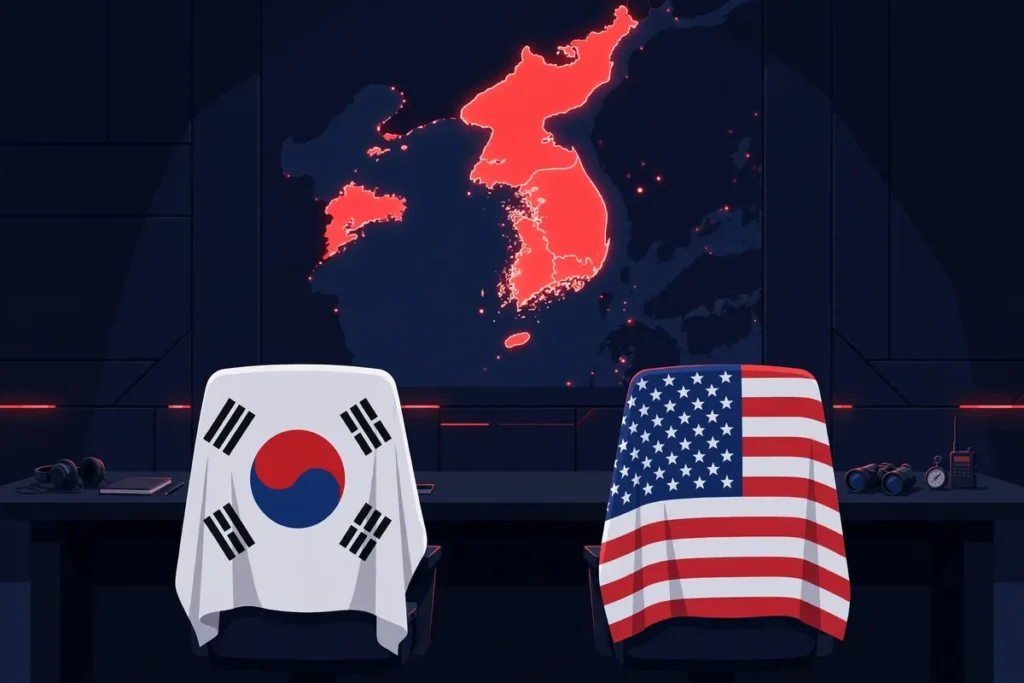
What changes is who gives the orders. Under the Future Combined Forces Command structure agreed in 2018, a Korean four-star general will command the combined force, with a US four-star general as deputy commander. Korean commanders will command Korean troops and US commanders will command US troops, within a single combined headquarters. Seoul will lead combined defence planning for the peninsula for the first time since 1950, and the alliance’s day-to-day war-fighting decisions will be made by a Korean commander.
What does not change is nearly everything else. US troops stay: the fiscal year 2026 National Defense Authorization Act, passed by the US Senate 77–20, bars the use of defence funds to cut US Forces Korea below 28,500 troops unless the administration certifies that a reduction serves US national security interests and follows consultation with allies including South Korea. The Mutual Defense Treaty stands, extended deterrence continues, and United Nations Command keeps its separate armistice role. The transfer itself requires the joint approval of both presidents — it is a decision the two governments take together, not one Seoul can take alone.
That is the point most often lost in the debate. OPCON transfer is a change of command, not a change of alliance. South Korea already commands its own forces in peacetime, and it already provides the bulk of the manpower that would fight on the peninsula. What it does not yet command is the combined force in war — and the allies’ own tests, not a date on a calendar, will decide when it does.
| Metric | Figure | Source |
|---|---|---|
| Wartime command first handed to the US | July 14, 1950 | Carnegie Endowment; Yonhap chronology (CONFIRMED) |
| Peacetime OPCON returned to Seoul | December 1, 1994 | The Korea Times; Carnegie Endowment (CONFIRMED) |
| Transfer conditions | 3 | The Korea Times, October 26, 2026 (CONFIRMED) |
| First verification stage (IOC) completed | August 2019 | Sejong Institute brief (CONFIRMED) |
| US troops in South Korea (NDAA level) | 28,500 | Korea JoongAng Daily, FY2026 NDAA (CONFIRMED) |
| Security Consultative Meeting | 58th — postponed to early 2027 | Yonhap, October 28, 2026 (CONFIRMED) |
| Target year under discussion | 2028 | Yonhap, February 2026 (REPORTED) |
Figures marked REPORTED rest on press reporting rather than an official announcement. The 28,500 troop figure is the level written into US law; US defence personnel data has shown actual active-duty strength fluctuating below it in recent years.
What the OPCON question means for US/UK/EU readers
For American readers, OPCON is the clearest test of how the US manages its oldest Asian alliance. About 28,500 US troops are stationed in South Korea, and Congress has now written that level into law — a signal that, whatever the debate over command, the troop presence is not up for unilateral change. The December defence ministers’ meeting and the early-2027 SCM will show whether Washington and Seoul can agree a target year, or whether the conditions-first camp keeps the date open.
For British and European readers, the stakes are indirect but real. South Korea is one of the world’s largest producers of semiconductors, and the peninsula sits astride shipping lanes that carry a large share of Europe’s trade with East Asia. A stable OPCON transition signals an alliance that can manage change without friction; a stalled one signals the opposite, at a moment when European governments are watching closely how the United States handles its allies. The Gwangju air base relocation, discussed during the parliamentary delegation’s Hawaii visit, is a reminder of the overlap: the base move is tied to a semiconductor cluster project, and US commanders described it as South Korea’s sovereign decision.
For anyone following the region, the practical point is simple. The OPCON question will not be settled by a single announcement. It will be settled in stages — FOC verification, a target year, then the final full mission capability test — and each stage is a data point on the health of the alliance. The December meeting is the next one to watch.
What to watch next in the OPCON transfer
December 2026 brings the bilateral defence ministers’ meeting in Washington, agreed in Cebu as the preparatory step before the rescheduled SCM. Seoul’s stated aim is to complete full operational capability verification and agree a target year by the end of 2026 — whether the December meeting delivers either will be the first real test of that timetable.
Early 2027 brings the 58th Security Consultative Meeting itself, the forum where the two defence ministers would formally endorse the FOC result and, if the conditions allow, set the transfer year. Watch for the communique’s language: an agreed year would be a breakthrough; a restatement of the conditions framework would mean the timetable has slipped again.
Beyond the meetings, watch the exercises. Full mission capability is tested through large-scale joint field exercises and command post simulations. South Korean commanders led the combined exercise for the first time in the alliance’s history in 2019, and Seoul has led more of them since — each one is a rehearsal for the transfer itself. And watch Pyongyang: every new missile or nuclear development resets the second condition, and with it the argument over whether the bar has moved again. For the wider picture, see WarBrief’s South Korea country profile and our country profiles hub.
Frequently asked questions
What is wartime OPCON?
Wartime operational control is the authority to direct combined US and South Korean forces during a war on the Korean Peninsula. It is currently held by the US four-star general commanding the Combined Forces Command. South Korea has held peacetime operational control of its own forces since December 1994.
Who commands South Korean forces in wartime today?
The commander of the Combined Forces Command — a US four-star general who also commands US Forces Korea and United Nations Command. The transfer of wartime control to that command requires the approval of both the South Korean and US presidents.
What are the three conditions for OPCON transfer?
First, South Korea must have the military capabilities to lead combined defence. Second, the alliance must be able to counter North Korea’s nuclear and missile threats. Third, the security environment on the peninsula and in the region must be conducive to a stable transfer. The conditions were agreed under the 2015 Conditions-based OPCON Transition Plan.
When will South Korea take over wartime OPCON?
There is no fixed date. Transfer is conditions-based, verified through three stages — initial, full and full mission capability. Seoul aims to complete the second stage and agree a target year by the end of 2026, 2028 is reported as a likely target year, and the Lee Jae Myung administration wants the transfer done before its term ends in 2030.
Will US troops leave South Korea when OPCON transfers?
No. Transfer changes who commands the combined force, not whether US forces are present. The fiscal year 2026 US National Defense Authorization Act sets the US Forces Korea level at 28,500 troops, and the Mutual Defense Treaty, extended deterrence and United Nations Command’s armistice role all continue unchanged.
Read next: Tinian North Field Revival: 6,000 Air Force Flights a Year — the Air Force’s plan for 6,000+ annual operations from four Northern Mariana airfields, and the November 29 deadline to comment.
Sources
- Yonhap: US reaffirms commitment to conditions-based OPCON transition to South Korea (November 8, 2026)
- The Korea Times: Defense committee chair says OPCON agreement stands despite US midterm outcome (November 8, 2026)
- Herald Business: US confirms no change in conditions for wartime OPCON transfer, Assembly defense chief says (November 8, 2026)
- Yonhap: South Korea, US agree to postpone key bilateral security dialogue to early next year (October 28, 2026)
- The Korea Times: Korea seeks to complete key OPCON verification, set transfer year by Dec (October 26, 2026)
- The Korea Times: Korea-US annual security meeting pushed to early 2027 (October 28, 2026)
- Carnegie Endowment for International Peace: Why Doesn’t South Korea Have Full Control Over Its Military? (2019)
- Institute for Security and Development Policy: Not a Sovereignty Issue — Understanding the Transition of Military Operational Control (backgrounder)
- Korea JoongAng Daily: US Senate passes defense bill to maintain USFK troop levels at 28,500 minimum
- Newsis (Newspim): Kind words in Hawaii, scrutiny in Congress — US puts brakes on wartime OPCON ‘timetable politics’ (November 8, 2026)

Discussion 0
Share analysis, corrections, or context. Be civil — comments are moderated.