
WarBrief Live | November 4, 2026 | Event Preview
Exercise Koalicja at a glance
- Dates: November 9-22, 2026
- Place: Nowa Deba training area, south-east Poland, about 100 km from Ukraine
- Scale: About 2,800 troops from 11 nations, led jointly by the United Kingdom and France
- Purpose: Rehearse moving, protecting and supplying a force that could deploy to Ukraine only after fighting ends
Exercise Koalicja is the first major rehearsal of the Multinational Force-Ukraine, running November 9-22, 2026, in south-east Poland, to test how a European-led force could deploy to Ukraine after fighting ends. It is a rehearsal for a peace that does not yet exist, staged while the war is still being fought, and that tension is the point of the exercise: to show, before any ceasefire, that a force exists that could move quickly once one is agreed.
The exercise was announced on November 3, 2026, by the British and French governments, and it is the first major test of a force that has so far existed mostly on paper and in headquarters. The United Kingdom government statement describes Koalicja, the Polish word for “coalition”, as the first major exercise run by the Multinational Force-Ukraine (MNF-U), the military arm of the Coalition of the Willing. What is confirmed is the scale, the location and the limits. What remains unverified is everything that would matter most in a real deployment: the rules for using force, the exact composition of a deployed force, and whether the political agreement behind it would hold under fire.
Key Takeaways
- About 2,800 troops from 11 nations will train in Poland from November 9 to 22, 2026, in the first major exercise of the Multinational Force-Ukraine.
- The United Kingdom and France jointly lead the exercise; France provides the largest contingent, about 1,100 troops, and the United Kingdom about 300.
- The force would deploy to Ukraine only after hostilities end and only at Ukraine’s request. It is not a peacekeeping force, not a ceasefire-monitoring mission, and not a NATO operation.
- The exercise tests movement, protection, sustainment and multinational command, plus a Turkish-led maritime element in Istanbul for Black Sea mine clearance.
- No new, specific Kremlin statement on Koalicja itself had appeared in the coverage reviewed for this article as of November 4, 2026; Moscow’s longstanding opposition to foreign troops in Ukraine stands.
What is Exercise Koalicja?
Exercise Koalicja is a two-week land, air and maritime rehearsal built around a single question: if a ceasefire were agreed tomorrow, could a multinational European force actually get itself to Ukraine, organise itself there, and keep itself supplied? The British government statement says the exercise will test how to move, protect and supply a force that would help rebuild Ukraine’s armed forces once the fighting ends, and will test command-and-control arrangements and how different national components integrate and operate as one force.
The Multinational Force-Ukraine was set up in 2025 as the military arm of the Coalition of the Willing, the group of nations that have pledged strengthened military, economic and diplomatic support to Ukraine. It already has an operational headquarters in Paris, commanded by British Lieutenant General Tom Bateman, and the headquarters is set to move from Paris to London during 2026, according to the United Kingdom statement. The exercise is co-led by Bateman and French General Armel Dirou. Dirou described it as a key milestone and a concrete demonstration that the force could deploy as soon as hostilities have ended, in remarks reported by Agence France-Presse.
Koalicja is deliberately not a display of heavy combat power. Agence France-Presse reported that only light equipment, such as drones for anti-drone and self-defence drills, is expected in Poland, with no tanks. That restraint is itself a message. A force that arrived with armour and missile systems would look like an army preparing to fight; a force practising logistics, communications and counter-drone work looks like one preparing to arrive after the fighting stops. Whether Moscow reads it that way is a separate question, and one the organisers cannot control.
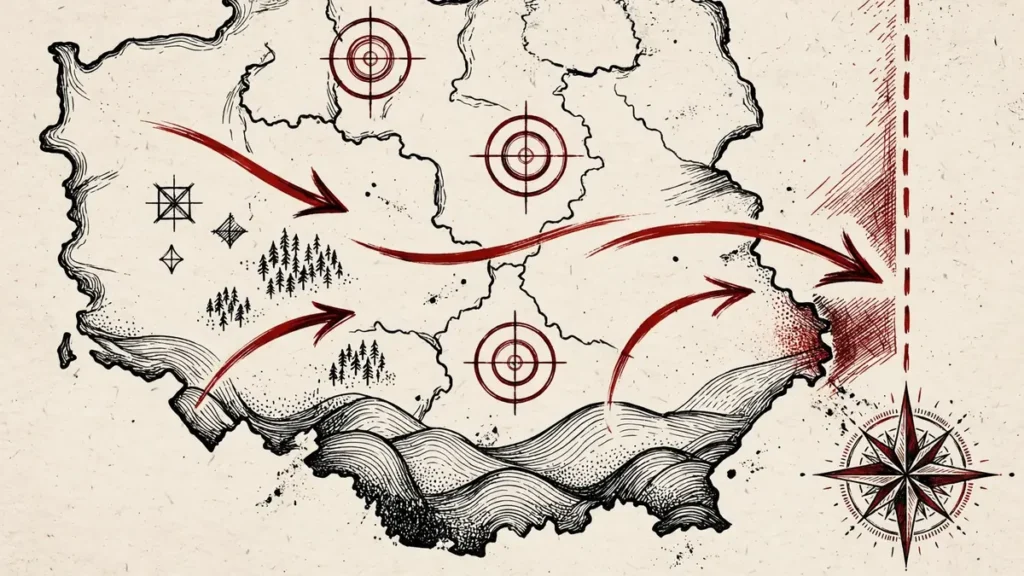
Who is taking part in Exercise Koalicja, and with what?
The eleven participating nations are Belgium, Estonia, France, Germany, Lithuania, the Netherlands, Poland, Spain, Sweden, Turkiye and the United Kingdom, according to the United Kingdom government statement. Ten of them take part in the land and air activity around Nowa Deba, about 100 km west of the Ukrainian border; Turkiye’s role is separate, standing up the maritime element from Istanbul.
France contributes the largest contingent, about 1,100 troops, while the United Kingdom contributes 300 personnel, including soldiers from the British Army’s 7 Brigade, known as the Desert Rats, who will rehearse logistical movements. Royal Air Force Typhoon fighter jets and a Voyager refuelling aircraft will fly sorties overhead, simulating how air power would reassure commercial air travel once Ukraine’s skies reopen, according to the United Kingdom statement. Le Monde reported that air activity will also involve bases in Romania, and that counter-drone operations will be a major component, including a French drone unit using autonomous aerial and ground systems. Those two details are reported, not confirmed in the United Kingdom statement, and are marked as such in the table below.
The maritime element matters more than its size suggests. Turkish forces will test arrangements for maritime mine clearance so that commercial shipping can safely return to Ukraine’s ports, according to the United Kingdom statement. A post-war Ukraine that cannot export through the Black Sea is a Ukraine that cannot pay for its own reconstruction, so reopening sea routes is not a side task. It is one of the three things the force is meant to enable, alongside safer skies and the regeneration of Ukraine’s armed forces.
By the numbers: Exercise Koalicja
| Metric | Figure | Source |
|---|---|---|
| Duration | November 9-22, 2026 (14 days) | United Kingdom government statement |
| Total troops | About 2,800 | United Kingdom government statement |
| Participating nations | 11 | United Kingdom government statement |
| Largest contingent | France, about 1,100 troops | Agence France-Presse |
| United Kingdom contingent | 300 personnel, including 7 Brigade | United Kingdom government statement |
| Distance from the Ukrainian border | About 100 km | Joint statement via Agence France-Presse |
| Heavy equipment in Poland | REPORTED: light equipment only, no tanks | Agence France-Presse |
| Counter-drone focus | REPORTED: a major component | Le Monde |
Figures marked CONFIRMED in the text are carried by the United Kingdom government statement and corroborated by Agence France-Presse or Interfax reporting. Figures marked REPORTED rest on a single outlet and should be treated as provisional until the exercise begins.
What will the exercise actually test?
Four practical problems dominate the programme, and each one has defeated multinational operations before. The first is movement: getting personnel, vehicles and supplies across several national borders, on roads and railways that were not built for a sudden surge, without the delays that border formalities and incompatible paperwork create. The second is protection, including counter-drone work, in a theatre where cheap drones have become one of the main threats to any force on the move. The third is sustainment: fuel, food, spare parts and medical support for thousands of troops far from their home bases, for weeks rather than days. The fourth is command: making eleven national contingents, speaking different languages and using different radios and procedures, act as one force under a single headquarters.
That last problem is why the headquarters move matters. A force whose headquarters is still finding its feet cannot command a deployment, and Koalicja is the first chance for the Paris headquarters, soon to move to London, to run a force of this size in the field. The exercise will also test the compatibility of communication systems between contingents, according to Le Monde, which is the unglamorous work on which every more dramatic capability depends. An army that cannot talk to itself cannot manoeuvre, however good its vehicles are.
There is also a political test embedded in the military one. Participation in Koalicja is not a commitment by every participating nation to deploy troops inside Ukraine later. Governments will decide that separately, if and when a ceasefire exists. The exercise therefore tests readiness without settling the political question, and readers should not mistake a training roster for a deployment pledge.
What Koalicja is not, and why that distinction matters
The United Kingdom statement is unusually explicit about what the force will not do, and the negatives are worth stating plainly because they are the most commonly misunderstood part of the story. The force would not carry out peacekeeping duties. It would not monitor a ceasefire. It is not designed for offensive operations. It is not a NATO operation, although NATO has been informed about the exercise. And it would not enter Ukraine while fighting continues: deployment requires both an end to hostilities and a request from Ukraine’s government.
Lieutenant General Bateman put the intended role in these terms: “It is not designed for offensive operations. Its purpose is to provide reassurance and support the regeneration of Ukraine’s armed forces, strengthening their ability to deter and, if necessary, defend against future Russian aggression.” That is a defensive, post-war mission: help Ukraine rebuild an army that can deter another attack, help make its skies and seas safer, and stand at a distance from any residual front line rather than on it. The force that is eventually deployed, if one ever is, could number up to 20,000 troops, according to Le Monde, but Koalicja itself involves only about 2,800, and no deployment date has been set.
The distinction also explains the American absence. The United States is not part of the Multinational Force-Ukraine and has little involvement in it, according to Agence France-Presse, and its role in future security guarantees for Ukraine remains uncertain. Koalicja is therefore a European-led answer to a European problem, built in part because the scale of any American backstop is no longer something European capitals can assume. That is a strategic shift in itself, and the exercise is its first visible field test.

Different perspectives: reassurance, deterrence, and Russian opposition
From London and Paris, Koalicja is presented as reassurance: proof that the Coalition of the Willing is a real force rather than a diplomatic slogan. Defence Secretary Wes Streeting said: “This isn’t a hypothetical plan, it’s a real force, ready to help Ukraine once the fighting stops.” The emphasis on readiness rather than combat is deliberate. It is aimed at Kyiv, which needs to believe that a ceasefire would be followed by real support, and at European publics, who need to believe that support would not mean their own soldiers fighting a war.
From Kyiv’s perspective, the exercise is useful but incomplete. A rehearsal in Poland does not answer the hardest question, which is what happens if a deployed force is attacked after a ceasefire. Western officials have said the force would be able to defend itself, but the detailed rules for using force, and what response an attack would trigger from the contributing governments, have not been published. A force that can shoot back is not the same as a force whose governments have agreed what shooting back would mean.
From Moscow’s perspective, the force has been opposed from the start. Russia has repeatedly said it would not accept a foreign military presence in Ukraine, and Russian officials have previously described such contingents as legitimate targets. Agence France-Presse noted that the exercise risks antagonising Moscow, which has shown little appetite for a settlement. As of November 4, 2026, no new, specific Kremlin statement on Koalicja itself had appeared in the coverage reviewed for this article, so readers should treat any claim about a fresh Russian reaction to this exercise as unverified unless a named official statement appears. The older, general opposition is confirmed; a new reaction is not.
What does Exercise Koalicja mean for US/UK/EU readers?
For readers in the United Kingdom, Koalicja is the clearest public sign yet of what post-war British involvement in Ukraine could look like: a few hundred troops in a multinational force, led from London after the headquarters move, with air support rather than a large ground deployment. It does not mean British troops are about to deploy to Ukraine, and it does not change the position that no deployment happens while fighting continues. What it does mean is that the planning, the command structure and the logistics for such a deployment are being built now, not improvised later.
For readers in the European Union, the exercise tests whether European states can run a complex multinational operation without relying on American communications, transport and command systems. If Koalicja exposes gaps in cross-border movement or in communications compatibility, those gaps will shape defence spending and procurement debates in the year ahead, because they are the same gaps that would matter in any future European-led operation. If it runs smoothly, it strengthens the argument that Europe can provide its own reassurance force.
For readers in the United States, the direct impact is smaller but the signal is not. A European force that can operate without American troops is a force that changes the burden-sharing argument in Washington, in both directions: it shows allies stepping up, and it also shows them building structures that do not depend on Washington. The exercise also sits in a crowded diplomatic calendar. Officials from the United States, Germany, France, Britain, NATO and the European Union were meeting in Brussels on November 4, 2026, and United States envoy Steve Witkoff has said Ukrainian and Russian delegations will meet in Abu Dhabi on November 10-11, 2026, overlapping with the second week of Koalicja. The rehearsal and the negotiations will therefore unfold at the same time, each watched for what it says about the other.
What to watch next in Poland, Abu Dhabi and Brussels
The first thing to watch, when the exercise opens on November 9, 2026, is what actually appears on the ground at Nowa Deba: whether the light-equipment picture reported by Agence France-Presse holds, and how visible the counter-drone work is. The second is the maritime element in Istanbul, where the mine-clearance rehearsal will show whether the Black Sea part of the plan is more than a line in a statement. The third is any Russian reaction once troops are visibly in the field, as opposed to the general opposition already on record.
The fourth is the headquarters move from Paris to London, which is expected to follow the exercise. A smooth handover would suggest the force is maturing into a standing structure; a delayed or messy one would suggest the opposite. The fifth, and most important, is whether the Abu Dhabi talks on November 10-11, 2026, produce anything that makes a post-war force more than a rehearsal. WarBrief Live has previewed those talks separately, and readers following both stories should watch for any mention of security guarantees, because a guarantee without a force to back it is a promise, and a force without a guarantee is a rehearsal. Koalicja tests the second half of that equation. The talks test the first.
Until a ceasefire exists, Koalicja remains what its organisers say it is: a rehearsal. Its value lies not in the troops on a Polish training ground, but in the problems it finds and fixes before anyone has to solve them under fire.
Frequently asked questions
What is Exercise Koalicja?
Exercise Koalicja is the first major exercise of the Multinational Force-Ukraine, running November 9-22, 2026, in south-east Poland. About 2,800 troops from 11 nations, led jointly by the United Kingdom and France, rehearse how a force could move, protect and supply itself in support of Ukraine after fighting ends.
Will troops from Exercise Koalicja deploy to Ukraine?
No, not as part of the exercise. The force would only enter Ukraine once hostilities have ceased and at the request of Ukraine’s government. Koalicja takes place in Poland, with a separate maritime element in Istanbul, and participation in the exercise is not a commitment to deploy later.
Is Exercise Koalicja a NATO operation?
No. The Multinational Force-Ukraine is the military arm of the Coalition of the Willing, not a NATO force, although NATO has been informed about the exercise. The United States is not part of the force and has little involvement in it.
Why is Turkiye’s role separate from the Poland exercise?
Turkish forces stand up the maritime element of the force in Istanbul, testing arrangements for maritime mine clearance so commercial shipping can safely return to Ukraine’s ports. The land and air activity in Poland involves the other ten participating nations.
What should readers watch for when Koalicja begins?
Watch what equipment actually appears at Nowa Deba, how visible the counter-drone work is, how the Istanbul mine-clearance rehearsal goes, any new Russian reaction once troops are in the field, and whether the Abu Dhabi talks on November 10-11, 2026, produce security-guarantee language that would give a future force a political framework.
Sources
- Joint Forces: France and UK to Lead MNF-U Exercise Koalicja
- Interfax-Ukraine: Multinational military drills to be held in Poland in preparation for establishing peace in Ukraine
- Free Malaysia Today (Agence France-Presse): Multinational Ukraine force to hold first exercise in Poland
- Le Monde: In Poland, ‘coalition of the willing’ holds first large-scale military exercise
- Kyiv Post: European Troops Prepare for Post-Ceasefire Ukraine Deployment
- The Week (Associated Press): Russian strikes disrupt water and power in Kyiv as rescuers still search for survivors in south
Read next: United Kingdom Military Capabilities: Koalicja and the Post-War Force, France Military Capabilities: Leading Europe’s Ukraine Support Force, Abu Dhabi Ukraine-Russia Talks, November 10-11: What to Expect, and the Conflict Zones hub.



Discussion 0
Share analysis, corrections, or context. Be civil — comments are moderated.